
ワークアウトに打ち込み、筋肉が回復を始めるために手っ取り早くプロテインを飲みたがっている。あなたはジムバッグに向かうが、その選択は以前ほど単純ではない。信頼できるシェイカーボトルとプロテインパウダーに手を伸ばすか、プロテインカプセルのスマートで便利なシンプルさに手を伸ばすか。
これは単なる好みの問題ではなく、あなたのライフスタイルやフィットネスの目標に合ったツールを見つけることです。このガイドでは、プロテインカプセルとパウダーを、利便性、コスト、摂取量、吸収率といった最も重要な要素について比較し、あなたが知るべきことをすべて説明します。このガイドブックを読めば、あなたにはどちらのプロテイン・カプセルが合っているのかがよくわかるだろう。.
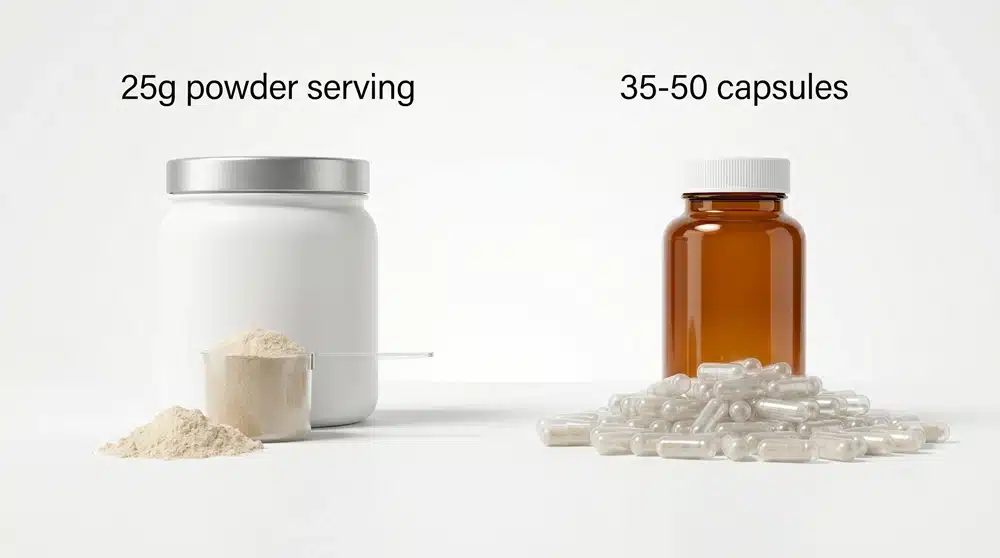
簡単な答え: Protein powder is the better choice when you need a full 20-30 g serving for recovery, muscle maintenance, or the lowest cost per gram. Protein capsules are best for travel, taste avoidance, or low-dose niche formulas, but capsule volume is the limiting factor: one 25 g protein scoop can require dozens of capsules.
プロテイン・カプセルとは?
プロテインカプセルは、持ち運びに便利な究極のソリューションだ。ホエイ、コラーゲン、または植物由来のプロテインパウダーをあらかじめ計量して、消化のよいゼラチンやベジタリアンの容器に入れたものだ。最大の魅力は、その利便性にある。.
Are Protein Pills Real? Yes—But Dosage Is the Limitation
Yes, protein pills and protein capsules do exist. They usually contain whey, collagen, pea protein, amino acids, or a blended protein powder inside a gelatin or vegetarian shell. The important question is not whether they work, but whether the capsule can hold enough protein for your goal.
A common size 00 capsule can hold roughly 0.5-0.7 g of powder depending on bulk density and particle size. That means a 25 g protein target may require about 35-50 capsules before considering excipients or capsule shell weight. This is why capsules are practical for low-dose formulas, collagen add-ons, amino acid blends, or travel packs, but they rarely replace a full post-workout protein shake.
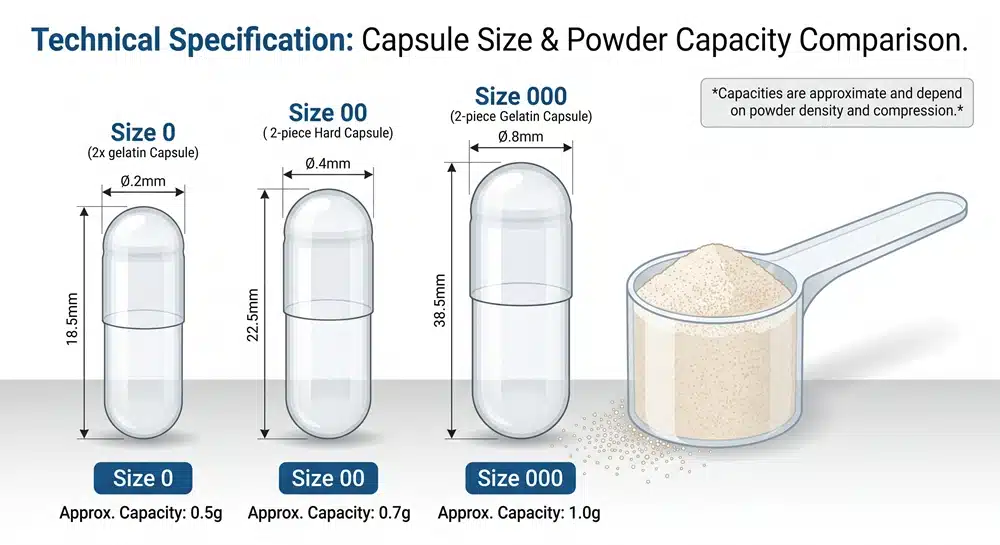
| カプセルサイズ | Typical fill estimate* | How many for 25 g protein? | Practical takeaway |
|---|---|---|---|
| サイズ0 | About 0.5 g powder | ~50 capsules | Useful for compact formulas, not full protein servings. |
| サイズ00 | About 0.5-0.7 g powder | ~35-50 capsules | Common supplement size, but still inefficient for 20-30 g protein servings. |
| サイズ000 | Up to about 1 g powder depending on density | ~25+ capsules | Higher capacity but often too large for comfortable daily use. |
*Actual fill weight depends on powder density, particle size, moisture, flowability, and whether the formula requires excipients. Brands should run pilot fills before finalizing label claims.
長所だ:
- 究極の利便性: 混ぜる手間もない。水で飲むだけ。.
- 味気ない: プロテインシェイクの味や食感が嫌いな人に最適。.
- 正確な投与量: 各カプセルには、特定の測定された量のタンパク質が含まれており、補給の手間を省くことができます。.
- 旅行にも適している: バッグや車、ポケットに入れてもこぼれる心配がない。.
毎週のように出張するあるコンサルタントは、かさばるプロテインパウダーの桶は荷物にならない。代わりに、彼女はプロテインカプセルの小瓶を機内持ち込み手荷物に入れている。機内でもホテルの部屋でも、コップ1杯の水と一緒に飲めば、プロテイン摂取の目標を達成できる。彼女にとって、絶対的な利便性は他のすべてに勝る。.
短所だ:
- 一食あたりのタンパク質を低くする: The main limitation is physical volume. A capsule can only hold a small amount of protein powder, so reaching a 20-30 g serving may require dozens of capsules. For most athletes, this makes capsules inconvenient as a primary protein source.Protein capsules are not automatically “weaker” than powder. If the ingredient quality and total grams of protein are equal, the body still digests protein into amino acids. The problem is serving practicality: capsules are excellent for portability and taste avoidance, but inefficient for high-dose protein delivery.
- コストが高くなる可能性がある: グラム単位で見ると、カプセルはバルクパウダーよりも高価であることが多い。.
- 吸収が遅い: タンパク質が吸収される前にケーシングが溶ける必要があるため、プレミックスシェイクよりも若干時間がかかる。.
激しいリフティングの直後に30グラムのプロテインを摂取しようとするボディビルダーにとって、カプセルは非現実的だ。目標を達成するためには、30粒以上のカプセルを飲み込まなければならないかもしれないが、吸収の速いプロテインシェイクを1回飲むのに比べると、不便で時間がかかる。.
プロテインパウダーとは何か?
プロテインパウダーは、筋肉の成長と回復のための定番サプリメントです。ホエイ、カゼイン、大豆、エンドウ豆などのタンパク源を脱水し、粉末状にしたものである。水や牛乳などの液体と混ぜてプロテインシェイクを作るように設計されています。.
長所だ:
- 一食あたりの高タンパク質: 1スクープで20~30グラムのタンパク質を簡単に摂取できる。.
- 費用対効果: グラム当たりで見ると、バルクパウダーの方がカプセルより安いことがほとんどだ。.
- 吸収が早い: 特にホエイプロテインは消化が非常に早く、運動後の回復に理想的だ。.
- 万能だ: シェイクやスムージーを作ったり、オートミールや焼き菓子などの食品に加えることもできる。.
Why One Scoop Fits Sports Nutrition Better
For active consumers, the biggest advantage of powder is that one scoop can realistically deliver a complete protein serving. The International Society of Sports Nutrition position stand notes that an overall protein intake of about 1.4-2.0 g/kg/day is sufficient for most exercising individuals, while the NIH Office of Dietary Supplements notes that high-quality protein is often consumed in repeated doses around training windows. A powder serving of 20-30 g fits this pattern far more naturally than a bottle full of capsules.
ヘビーレッグデイを終えたウェイトリフティング選手は、筋肉を素早く補給する必要がある。ホエイパウダー1スクープを水に混ぜることで、彼は即座に25グラムの吸収の早いプロテインを摂取し、回復を最大化することができる。.
短所だ:
- 準備が必要: きちんと混ぜるにはシェーカーボトルかブレンダーが必要だ。.
- 面倒なこともある: 粉をすくったり混ぜたりすると、粉がこぼれたり、埃っぽい後片付けになったりすることがある。.
- フレーバー/テクスチャーの問題: ある種のプロテインパウダーの味やテクスチャーが苦手な人もいるかもしれない。.
急いで外に出ようとする通勤客が、シェイクを手早く混ぜようとする。粉が溶けきれずに塊が残り、粉が容器から漏れて黒っぽい作業服につく。準備の必要性と散らかる可能性が、彼らの朝にストレスを加える。.
頭から頭までの比較:5つの主な違い
| 特徴 | プロテインカプセル | プロテイン・パウダー | 勝者 |
|---|---|---|---|
| Protein per unit | Usually about 0.5-0.7 g per size 00 capsule, depending on powder density. | Commonly 20-30 g per scoop. | プロテインパウダー |
| Serving practicality | A 25 g target may require roughly 35-50 capsules. | One scoop usually covers the full serving. | プロテインパウダー |
| 利便性 | No shaker, no flavor, easy to carry. | Needs water/milk and a shaker or blender. | Protein capsules |
| Cost per gram | Often higher because of capsule shells, filling, packaging, and lower protein per container. | Usually lower when sold in tubs or pouches. | プロテインパウダー |
| Absorption timing | The shell must disintegrate before contents disperse; gelatin and HPMC can behave differently. | Already dispersed in liquid when mixed, making it practical around workouts. | Protein powder for post-workout use |
| 味と食感 | Tasteless and odorless for most users. | May have sweetness, flavor, or texture issues. | Protein capsules |
| Best B2B use case | Travel products, collagen capsules, amino acid add-ons, niche formulas, or low-dose protein blends. | Sports nutrition, meal support, high-protein servings, family-size products, and value positioning. | Depends on product strategy |
Manufacturer’s View: Why Protein Capsules and Powders Behave Differently
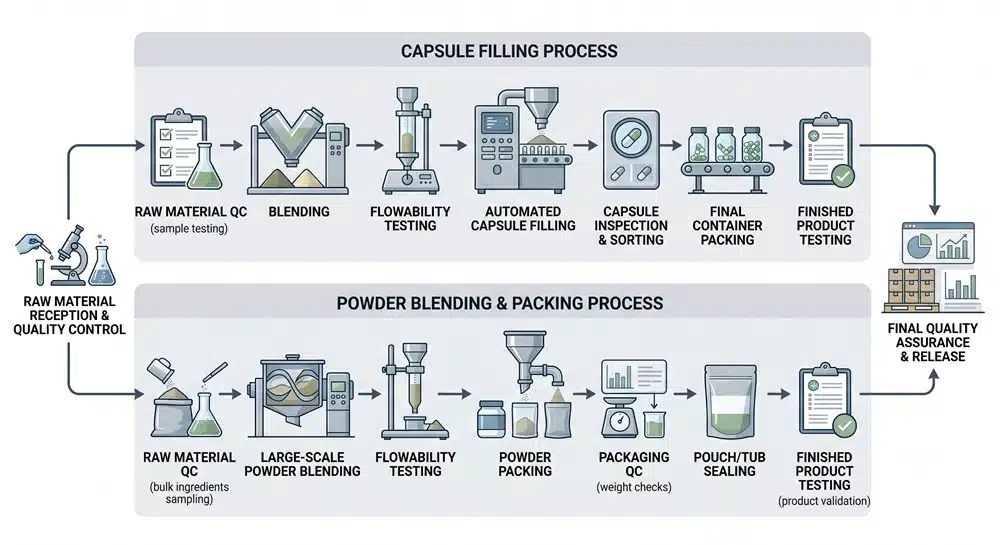
From a supplement manufacturing perspective, the capsule-vs-powder decision is also a process-control decision. Capsules require the powder blend to flow consistently into small capsule bodies. If a protein powder has low bulk density, poor flowability, high dusting, or moisture sensitivity, fill weight variation becomes harder to control and the number of capsules per serving increases quickly.
Powder supplements solve the high-dose problem more efficiently, but they create different challenges: flavor masking, instant dispersion, blend uniformity, scoop accuracy, clumping control, and moisture-resistant packaging. In other words, capsules are not simply “premium powder in a shell”; they are best used when the target dose is small enough for the capsule format.
For brands, the practical decision is: use capsules when convenience and precision matter more than gram-level dose; use powder when the product promise depends on delivering 20-30 g of protein per serving. A qualified プロテインサプリメントメーカー can test bulk density, flowability, moisture behavior, and label-claim feasibility before launch.
Regulatory note: U.S. dietary supplement manufacturing is subject to 21 CFR Part 111 current good manufacturing practice requirements, including production controls, specifications, and master manufacturing records.
どのような人がプロテインカプセルを選ぶべきか?
いくつかのカテゴリーではパウダーが勝つかもしれないが、プロテインカプセルは、利便性が文句なしのチャンピオンである特定のライフスタイルにとって理想的なソリューションである。ここでは、誰が最も恩恵を受けるかを紹介しよう:
- ブランド・ビルダー 市場への参入を目指す起業家にとって、カプセルはまたとないチャンスを提供してくれる。プライベートブランドのサプリメントや、サプリメントの製造・販売などのサービスを提供する会社と協力することで、カプセルの製造・販売に参入することができる。 カスタムサプリメント処方 を使えば、正確さと使いやすさを重視するニッチなユーザーに向けて、ターゲットを絞った製品を作ることができる。.
- 多忙なプロフェッショナルや頻繁に旅行する人: 常に移動している人にとって、便利な剤形の価値はいくら強調してもしすぎることはありません。カプセル化されたサプリメントは、ブリーフケースや機内持ち込み手荷物に放り込むことができ、粉末のように散らかったり手間がかかったりすることもない。.
- シェイクが嫌いな人 プロテインパウダーの味や食感、甘味料に敏感な人は多い。カプセルは、完全に無味無臭の代替品を提供する。製品を選ぶときは、一流メーカーと提携しているブランドを探すのが賢明だ。 サプリメント OEM 高品質の原料を使用していることを確認するためだ。.
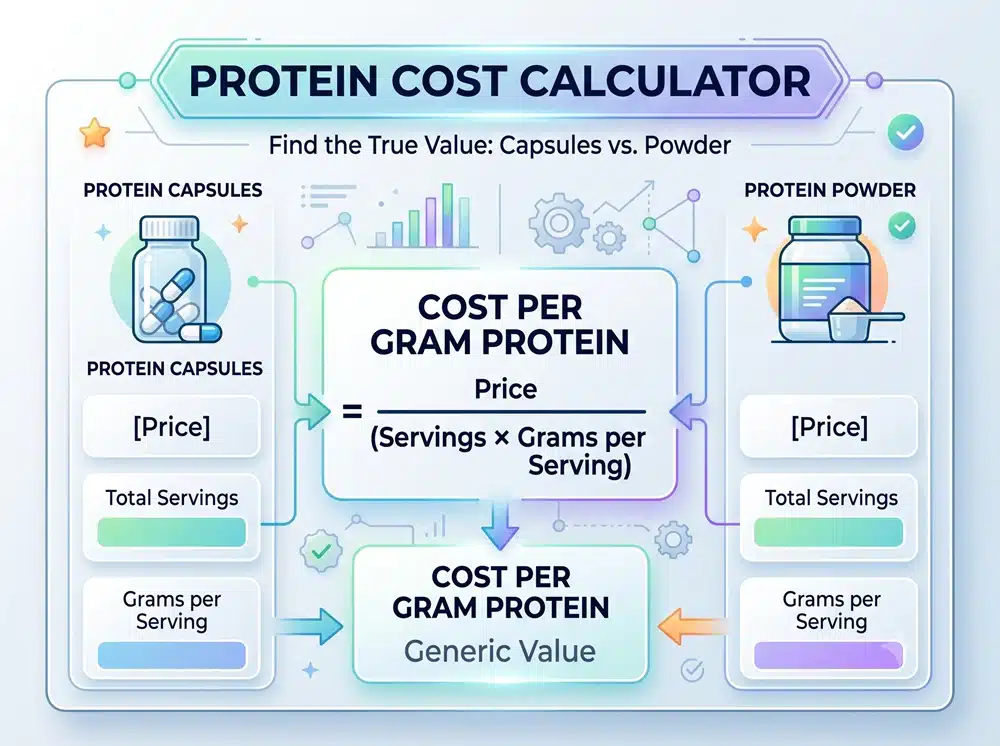
Cost per Gram: The Simple Formula
To compare protein capsules and powder fairly, do not compare bottle price to tub price. Compare cost per gram of actual protein:
Cost per gram of protein = Product price ÷ (servings per container × protein grams per serving)
Example: if a protein powder costs $40 and provides 30 servings at 25 g protein each, the cost is $40 ÷ 750 g = about $0.053 per gram of protein. If a capsule bottle costs $25 and contains 180 capsules with 0.6 g powder each, it provides about 108 g total powder, or $0.23 per gram before adjusting for actual protein purity. In that scenario, a 25 g protein target would require about 42 capsules and cost much more than powder.
Use this formula with your own product price, protein assay, serving size, and capsule fill weight before making final claims.
誰がプロテインパウダーを選ぶべきか?
プロテインパウダーが業界のスタンダードであり続けるのには理由がある。プロテインパウダーは、価値、柔軟性、パフォーマンスにおいて、他の追随を許さない強力な組み合わせを提供します。プロテインパウダーは次のような用途に最適です:
- クリエイティブ・クック プロテインパウダーはシェイクのためだけのものではない。フルーツスムージーに混ぜたり、オートミールに混ぜて食べ応えのある朝食にしたり、小麦粉の代わりにヘルシーなパンケーキやマフィンのレシピに使ったりと、その多用途性はキッチンでも発揮される。.
- アスリートまたはボディビルダー: 激しい運動の後、筋肉は修復と成長のために、吸収の早いタンパク質を大量に必要とします。ホエイプロテインパウダーは、1スクープで20~30グラムのタンパク質を摂取できるため、カプセルを何十粒も飲み込むよりもはるかに効率的であり、本格的な疲労回復の王者として議論の余地はない。.
- 予算重視の消費者: プロテイン1グラムあたりのコストで言えば、パウダーが明らかに勝っている。学生から食料品代を管理しようとする家族まで、誰にとっても、プロテインを大量に購入することは、食生活を補う最も経済的な方法である。.
Safety, Label, and Compliance Checklist
Whether you choose protein capsules or powder, the product should be selected based on ingredient quality, dosage transparency, allergen control, and third-party or batch testing where possible. Dietary supplements are regulated differently from conventional foods and drugs, and the FDA does not approve most dietary supplements before they are sold.
- For capsules: check the capsule shell material. Gelatin capsules may not fit vegan, vegetarian, halal, or kosher positioning, while HPMC vegetarian capsules can better support plant-based claims.
- 粉末の場合: check allergens such as milk, soy, egg, and gluten; added sugars; sweeteners; and whether the product has heavy metal, microbial, and identity testing.
- For high-protein diets: consumers with kidney disease, pregnancy, medication use, or medical conditions should speak with a qualified healthcare professional before changing protein intake.
結論正しい選択は個人的なもの
結局のところ、プロテインカプセルとパウダーの論争は、一つの「ベスト」な選択肢を見つけることではなく、自分にとってベストな選択肢を見つけることなのだ。.
多忙なスケジュール、絶え間ない出張、究極の利便性を求める生活なら、シンプルなプロテイン・カプセルがぴったりだ。しかし、タンパク質の摂取量を最大化し、コストを抑え、キッチンで創意工夫できる柔軟性を持つことを優先するなら、従来のプロテインパウダーが最善の策であることに変わりはない。.
利便性、コスト、投与量、汎用性といった要素と、ご自身のライフスタイルやフィットネスの目標とを比較検討することで、ご自身の旅を最もサポートする選択肢を自信を持って選ぶことができます。.
よくある質問
Do protein pills exist?
Yes. Protein pills and capsules exist, usually as whey, collagen, pea protein, amino acid, or blended protein powders inside gelatin or vegetarian capsule shells. Their main limitation is dose, not existence.
Are protein capsules as effective as protein powder?
They can be effective if the total protein amount and protein quality are the same. In practice, powder is usually more effective for high-dose goals because it can deliver 20-30 g in one serving.
How many protein capsules equal one scoop of protein powder?
If a scoop provides 25 g protein and one capsule contains about 0.5-0.7 g powder, you may need roughly 35-50 capsules to match one scoop, depending on the formula.
Do protein capsules absorb slower than powder?
Capsules must first disintegrate before the contents disperse. This can make them slightly less practical for immediate post-workout use than a pre-mixed protein shake, although total daily protein intake remains the key factor.
Who should choose protein capsules?
Capsules are best for frequent travelers, flavor-sensitive users, low-dose protein add-ons, collagen capsules, amino acid blends, or brands building niche convenience products.
Who should choose protein powder?
Protein powder is better for athletes, bodybuilders, budget-conscious consumers, and anyone who needs a full protein serving of 20-30 g at a lower cost per gram.
参照
- ISSN Position Stand: Protein and Exercise:https://pubmed.ncbi.nlm.nih.gov/28642676/
- NIH ODS: Dietary Supplements for Exercise and Athletic Performance:https://ods.od.nih.gov/factsheets/ExerciseAndAthleticPerformance-Consumer/
- NIH ODS Health Professional Fact Sheet:https://ods.od.nih.gov/factsheets/ExerciseAndAthleticPerformance-HealthProfessional/
- FDA Q&A on Dietary Supplements:https://www.fda.gov/food/dietary-supplements/questions-and-answers-dietary-supplements
- FDA Dietary Supplements:https://www.fda.gov/food/dietary-supplements
- 21 CFR Part 111:https://www.ecfr.gov/current/title-21/chapter-I/subchapter-B/part-111
- USP <2040> Disintegration and Dissolution of Dietary Supplements:https://www.uspnf.com/sites/default/files/usp_pdf/EN/USPNF/revisions/2040disintegrationanddissolution.pdf
- Capsule shell material impacts dissolution:https://pmc.ncbi.nlm.nih.gov/articles/PMC3940125/
- LFA Capsule Size Chart:https://www.lfacapsulefillers.com/capsule-size-chart/
- Capsule Connection sizing information:https://capsuleconnection.com/capsule-sizing-info

ウォーレン・ワン氏は、栄養補助食品のサプライチェーンにおいて豊富な経験を持つベテランの専門家であり、コラーゲンペプチド、骨スープ由来タンパク質、ケラチンといった主要成分の研究、開発、工程管理、およびグローバルな調達において、豊富な実務経験を有しています。 本コラムの執筆者として、彼はマーケティング的な装いを剥ぎ取り、難解な成分科学や製造品質管理基準を、分かりやすい本格的な科学普及記事へと変換することに尽力しています。これにより、読者がラベルの裏にある真実を理解し、より合理的な健康に関する選択を行えるよう支援しています。.


