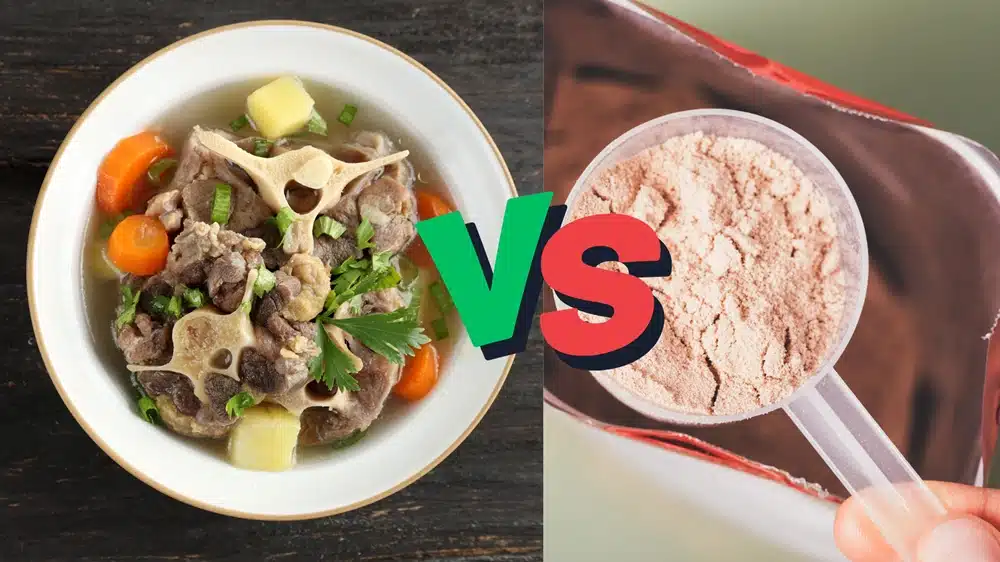
For consumers, the label term alone should not be the main decision factor. For supplement brands, the better question is whether the ingredient source, molecular weight range, solubility, taste, testing, documentation, and claim language match the finished product you want to launch.
If you are comparing collagen raw materials for a formula, Gensei supplies เปปไทด์คอลลาเจนแบบปริมาณมาก and supports collagen powder, capsule, tablet, gummy, and private label supplement projects.
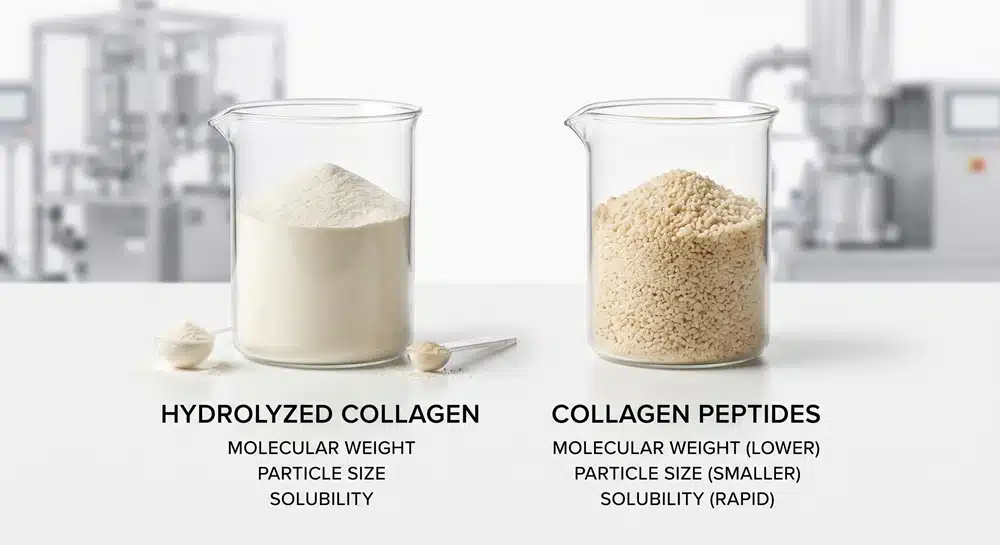
Quick Answer: Hydrolyzed Collagen vs Collagen Peptides
What Does Hydrolyzed Collagen Mean?
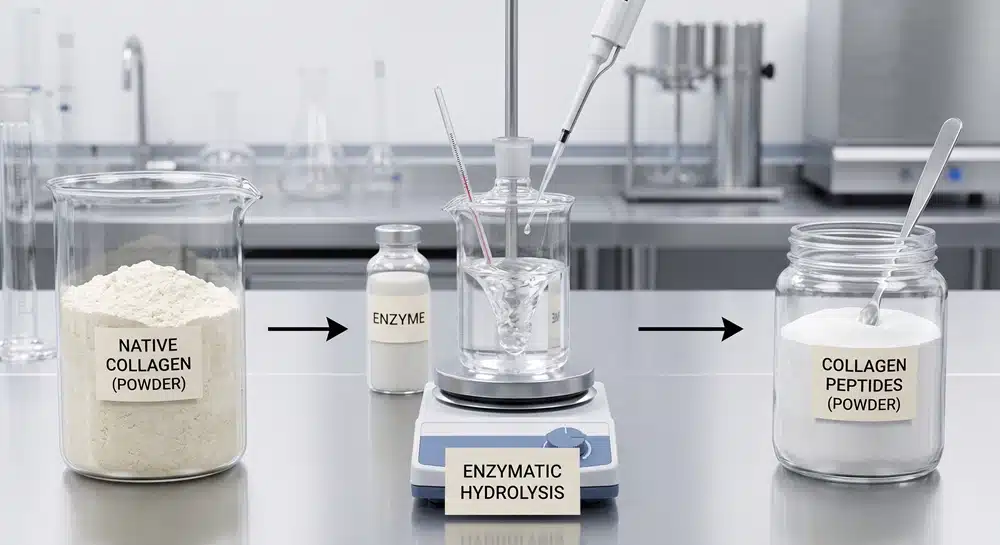
Hydrolyzed collagen is collagen that has been processed through hydrolysis. In supplement manufacturing, enzymes are commonly used to break long native collagen proteins into smaller peptides. This makes the ingredient easier to use in drink powders, capsules, tablets, gummies, ready-to-mix sachets, and functional foods.
The term “hydrolyzed” focuses on the manufacturing process. It tells the buyer that the original collagen protein has been broken down. It does not, by itself, tell you the source, molecular weight distribution, taste, odor, solubility, or testing standard.
เปปไทด์คอลลาเจนคืออะไร?
Collagen peptides are the smaller peptide chains produced after collagen is hydrolyzed. In other words, hydrolysis is the process, and collagen peptides are the result. This is why “hydrolyzed collagen,” “collagen hydrolysate,” and “collagen peptides” are often used interchangeably on supplement labels.
For finished product positioning, “collagen peptides” often feels more consumer-friendly, especially for beauty-from-within, healthy aging, joint support, and sports nutrition products. For technical specifications, “hydrolyzed collagen” or “collagen hydrolysate” may appear on COAs, ingredient lists, and supplier documentation.
Hydrolyzed Collagen vs Collagen Peptides: Main Differences
Collagen, Gelatin, Collagen Hydrolysate, and Collagen Peptides
Searchers often compare more than two terms, so it is important to separate native collagen, gelatin, collagen hydrolysate, and collagen peptides.
If your product depends on gelling, compare this topic with คอลลาเจนเปปไทด์ vs เจลาติน. If your product uses a food-style positioning, compare collagen peptides with คอลลาเจนจากน้ำซุปกระดูก before choosing the final ingredient story.
Does the Name Change the Benefits?
No. If the product source, peptide profile, dosage, and quality specifications are the same, the label wording does not create a different benefit. A product labeled “hydrolyzed collagen” is not automatically stronger than one labeled “collagen peptides,” and a product labeled “collagen peptides” is not automatically cleaner or more effective.
For compliant supplement content, avoid saying that collagen “treats,” “cures,” or “prevents” diseases. Safer wording includes “supports skin hydration,” “supports connective tissue,” “supports joint comfort in active adults,” or “helps provide collagen-derived amino acids,” when those claims are supported by evidence and reviewed for the target market.
How to Choose a Collagen Ingredient for Supplement Formulation
For supplement brands, the best choice is not about choosing between two names. It is about choosing the right ingredient specification for the product format and target user.
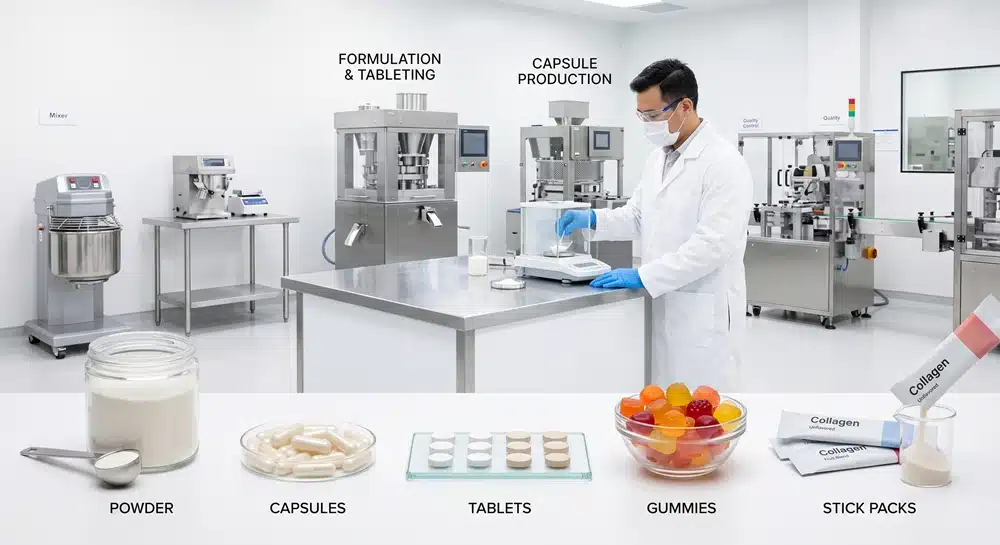
For production planning, collagen peptides are commonly used in การผลิตอาหารเสริมแบบผง, capsules, tablets, stick packs, sachets, functional beverages, gummies, and ผลิตภัณฑ์เสริมอาหารสูตรเฉพาะแบรนด์ส่วนตัว.
Quality Specifications to Request Before Buying
Before choosing a supplier, ask for batch-level documentation instead of relying only on marketing claims.
- แหล่งที่มา: bovine, marine, porcine, chicken, เยื่อหุ้มเปลือกไข่, or specialty source.
- Collagen type: type I, II, III, or a blended positioning, where applicable.
- การกระจายน้ำหนักโมเลกุล: helps evaluate peptide size and formula suitability.
- Protein or peptide content: needed for dose and label planning.
- โลหะหนัก: lead, arsenic, cadmium, and mercury testing.
- จุลชีววิทยา: total plate count, yeast and mold, E. coli, Salmonella, and other relevant tests.
- Solubility and sensory data: especially important for powders and beverages.
- Allergen and origin statements: necessary for marine, bovine, chicken, or other animal-derived claims.
- COA and specification sheet: the foundation for procurement and QA review.
For capsules, also check bulk density and flowability. For high-dose powders, also check taste, odor, color, foam, and mixing behavior. For capsule projects, see การผลิตอาหารเสริมแบบแคปซูล.
Label Claim and Compliance Considerations
Collagen products are dietary supplements, not drugs. Content should not imply that hydrolyzed collagen or collagen peptides diagnose, treat, cure, or prevent disease. Claims should be truthful, specific, and supported by appropriate substantiation.
Brands planning a collagen product should review ingredient claims, structure/function wording, dosage, target audience, and required disclaimers before final artwork approval. If you are building a collagen concept for skin, joint, tendon, sports, or healthy aging positioning, Gensei can support custom formulation review and finished product manufacturing.
คำถามที่พบบ่อย
คอลลาเจนไฮโดรไลซ์กับคอลลาเจนเปปไทด์เป็นสิ่งเดียวกันหรือไม่?
Yes, in most supplement contexts they refer to the same ingredient category. Hydrolyzed collagen describes the process, while collagen peptides describes the peptide ingredient produced by that process.
Is collagen hydrolysate the same as collagen peptides?
Usually yes. Collagen hydrolysate is another common technical term for hydrolyzed collagen peptides.
Which is better, hydrolyzed collagen or collagen peptides?
Neither term is automatically better. Compare the source, molecular weight, protein content, solubility, sensory quality, testing, and supplier documentation.
Are collagen peptides a complete protein?
No. Collagen peptides provide collagen-derived amino acids, especially glycine, proline, and hydroxyproline, but they are not typically positioned as a complete protein replacement.
Can brands use both terms on the same product?
Yes, many brands use “collagen peptides” on the front panel and “hydrolyzed collagen” or “collagen hydrolysate” in the supplement facts, ingredient list, or technical documentation. The wording should be consistent with the ingredient specification and local labeling rules.
What is the most important specification for B2B sourcing?
There is no single specification that covers every formula. For procurement, start with source, molecular weight distribution, protein or peptide content, COA, heavy metals, microbiology, solubility, sensory data, allergen statement, MOQ, and lead time.
เอกสารอ้างอิง
- Hydrolyzed Collagen – Sources and Applications, Molecules, 2019
- Enzymatic Hydrolysis of a Collagen Hydrolysate Enhances Postprandial Absorption Rate, Nutrients, 2019
- Oral supplementation of specific collagen peptides and human skin physiology, Skin Pharmacology and Physiology, 2014
- FDA: ข้อมูลสำหรับผู้บริโภคเกี่ยวกับการใช้อาหารเสริม
- FTC: แนวทางปฏิบัติตามข้อกำหนดสำหรับผลิตภัณฑ์สุขภาพ

Warren Wan เป็นผู้เชี่ยวชาญที่มีประสบการณ์ยาวนานในห่วงโซ่อุปทานของผลิตภัณฑ์เสริมอาหาร โดยมีความรู้และประสบการณ์ทางปฏิบัติอย่างลึกซึ้งด้านการวิจัย พัฒนา การควบคุมกระบวนการผลิต และการจัดหาวัตถุดิบหลักจากทั่วโลก เช่น เปปไทด์คอลลาเจน โปรตีนจากน้ำซุปกระดูก และเคราติน ในฐานะผู้เขียนคอลัมน์นี้ เขามุ่งมั่นที่จะลอกเปลือกการตลาดออก และแปลงความรู้ทางวิทยาศาสตร์เกี่ยวกับส่วนผสมที่เข้าใจยาก รวมถึงมาตรฐานการควบคุมคุณภาพการผลิต ให้กลายเป็นเนื้อหาวิทยาศาสตร์ที่เข้าใจง่ายและเข้าถึงได้สำหรับทุกคน เพื่อช่วยให้ผู้อ่านเข้าใจความจริงที่ซ่อนอยู่เบื้องหลังฉลากผลิตภัณฑ์ และตัดสินใจเลือกผลิตภัณฑ์เพื่อสุขภาพได้อย่างมีเหตุผลมากขึ้น.