
Câu trả lời nhanh
“Natural” vitamin A is not automatically safer, better absorbed or more effective than “synthetic” vitamin A. The more useful comparison is the actual form—preformed vitamin A such as retinol or retinyl esters versus provitamin A carotenoids such as beta-carotene—together with the dose, source documentation, delivery system, stability and intended user.For consumers, whole foods are generally the preferred starting point, while supplements should be selected according to a real nutritional need and the Supplement Facts panel. For supplement brands, “natural” is not a substitute for identity, potency, carrier, stability, contaminant and label-claim specifications.
This guide explains how to compare vitamin A forms, interpret RAE and older IU labels, avoid misleading source claims, and evaluate ingredient and finished-product quality.
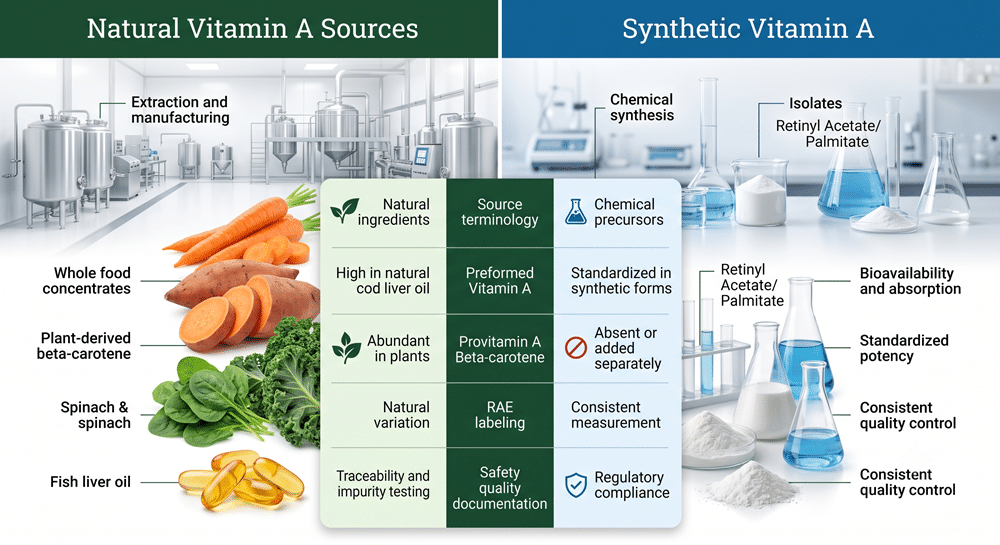
Natural vs Synthetic Vitamin A at a Glance
| Yếu tố quyết định | What Actually Matters | Common Misunderstanding |
|---|---|---|
| Nguồn | Food, animal-derived material, plant carotenoid, fermentation or industrial manufacture | “Natural” always means safer or more bioavailable |
| Vitamin A form | Retinol, retinyl acetate, retinyl palmitate, beta-carotene or another provitamin A carotenoid | All forms have the same conversion and safety profile |
| Physiological use | Preformed vitamin A is directly available after digestion; carotenoids require conversion | Plant source automatically delivers more usable vitamin A |
| An toàn | Total dose, preformed versus carotenoid form, pregnancy, smoking history, medicines and health status | Synthetic vitamin A causes toxicity while natural vitamin A cannot |
| Công thức | Potency, carrier, beadlet or oil system, antioxidants, light and oxygen protection, overage and stability | The ingredient name alone predicts shelf-life performance |
| Quality evidence | Specification, identity method, assay, COA, source declaration, contaminant controls and finished-product data | A “natural” front-label claim proves quality |
What Does “Natural Vitamin A” Mean?
In everyday supplement marketing, “natural vitamin A” may refer to vitamin A supplied by foods, fish liver oil, animal-derived retinol or retinyl esters, plant-derived beta-carotene, or an ingredient produced from a biological source. These categories are not interchangeable.
Food provides vitamin A within a broader nutrient matrix. Animal foods can provide preformed vitamin A, while orange, yellow and dark-green plant foods provide provitamin A carotenoids. The body must convert provitamin A carotenoids into retinol, and conversion efficiency varies among people.
For a supplement ingredient, the term “natural” should be supported by a clear source and manufacturing declaration. It should not be used as shorthand for higher potency, superior absorption, lower toxicity or clinically better outcomes.
What Is Synthetic Vitamin A?
“Synthetic vitamin A” usually describes a vitamin A ingredient manufactured through controlled industrial processes. Common supplement and food-fortification forms include retinyl acetate and retinyl palmitate. These are preformed vitamin A forms that the body can convert to retinol after digestion.
Retinyl palmitate is also a normal vitamin A storage form in animal tissues. Therefore, the molecule name alone does not reliably tell a consumer whether the commercial ingredient was extracted from a biological source or produced industrially. Brands should use supplier documentation rather than assumptions based on the ingredient name.
Formulators comparing material options can review available retinyl acetate, retinyl palmitate, powder, beadlet and oil-dispersion specifications in the Hướng dẫn về nguyên liệu vitamin A.
Preformed Vitamin A vs Provitamin A Carotenoids
The scientifically useful distinction is usually preformed vitamin A versus provitamin A carotenoids.
| Danh mục | Ví dụ | How the Body Uses It | Key Formulation or Safety Point |
|---|---|---|---|
| Vitamin A dạng sẵn | Retinol, retinyl acetate, retinyl palmitate | Converted to retinol and active metabolites after digestion | Counts toward the upper limit for preformed vitamin A |
| Các carotenoid tiền vitamin A | Beta-carotene, alpha-carotene, beta-cryptoxanthin | Must be converted into vitamin A; conversion varies | Needs form-specific RAE calculation and source documentation |
| Non-provitamin carotenoids | Lutein, zeaxanthin, lycopene | Not converted into vitamin A | Should not be counted as vitamin A activity |
A product should not describe every carotenoid as vitamin A. The label amount must be based on the ingredient’s recognized vitamin A activity and the applicable conversion rules.
Is Natural Vitamin A Better Absorbed?
There is no valid rule that every natural-source vitamin A ingredient is better absorbed than every manufactured ingredient. Absorption and use depend on the chemical form, food or supplement matrix, dietary fat, digestive function, dose and individual carotenoid conversion.
Preformed vitamin A is more directly available than provitamin A carotenoids because carotenoids require conversion. However, this does not make a high-dose preformed vitamin A supplement automatically better. It also does not prove that a “natural” fish-liver or animal-source ingredient is safer than an appropriately formulated manufactured retinyl ester.
Comparisons between beta-carotene in whole foods and a concentrated supplement also involve differences in dose, food matrix and study design. Brands should avoid turning one bioavailability study into a universal “natural beats synthetic” claim.
Is Retinyl Palmitate Natural or Synthetic?
Retinyl palmitate is a defined vitamin A ester. It occurs naturally as a storage form of vitamin A in the body, but commercial retinyl palmitate used in supplements and fortified foods is commonly manufactured. A finished-product label may also use a carrier, antioxidant or encapsulation system that affects dietary, allergen and source positioning.
The correct procurement question is not only “Is it natural?” Ask:
- What is the manufacturing source and process?
- Is the material retinyl palmitate, retinyl acetate, retinol or beta-carotene?
- What is the assay and potency basis?
- Which carriers, antioxidants and processing aids are present?
- Is the vegan, non-GMO, allergen or source statement supported by documentation?
Vitamin A Amounts: RAE, IU and Label Interpretation
Current U.S. nutrition labeling expresses vitamin A in micrograms of retinol activity equivalents (mcg RAE). RAE accounts for the different vitamin A activity of preformed retinol and provitamin A carotenoids.
- 1 mcg RAE equals 1 mcg of preformed retinol.
- 1 mcg RAE equals 2 mcg of supplemental beta-carotene.
- 1 mcg RAE equals 12 mcg of dietary beta-carotene.
- 1 mcg RAE equals 24 mcg of dietary alpha-carotene or beta-cryptoxanthin.
Older products and technical documents may still use International Units. IU conversion depends on the form, so formulators should not convert an IU specification without confirming whether the activity comes from retinol, a retinyl ester or beta-carotene.
Adult vitamin A needs are commonly expressed as 900 mcg RAE per day for men and 700 mcg RAE per day for women. These are intake targets from all food and supplement sources, not automatic stand-alone supplement doses.
Safety: Form and Dose Matter More Than the Marketing Term
Preformed Vitamin A and the Upper Limit
The adult tolerable upper intake level is 3,000 mcg RAE per day for preformed vitamin A from food and supplements. This upper limit does not mean that everyone should take an amount close to it. Consumers should account for multivitamins, cod liver oil, beauty products, eye formulas, fortified foods and stand-alone vitamin A supplements.
Pregnancy and Preformed Vitamin A
High intake of preformed vitamin A during pregnancy can cause birth defects. People who are pregnant, may become pregnant or are breastfeeding should not independently use a high-dose preformed vitamin A supplement. Prenatal formulas require a complete professional review of form, amount and all sources.
Beta-Carotene and Smoking History
Beta-carotene does not produce the same classic vitamin A toxicity as excessive preformed vitamin A. However, high-dose beta-carotene supplements have been associated with increased lung-cancer risk in current smokers, former smokers and people exposed to asbestos. A “plant-based” or “natural” source claim does not remove this concern.
Medicines and Medical Conditions
People using prescription retinoids, or managing liver disease, fat-malabsorption conditions or other medical issues, should obtain professional guidance before supplementing. An educational article should not provide a definitive interaction list without a qualified medical review.
Which Form Is Better for a Supplement?
| Mục tiêu sản phẩm | Possible Starting Form | Decision Boundary |
|---|---|---|
| Reliable preformed vitamin A declaration | Retinyl acetate or retinyl palmitate | Control total preformed vitamin A, source, potency and stability |
| Plant-based provitamin A positioning | Beta-carotene | Confirm source, activity calculation, carotenoid profile and target-user safety |
| Mixed-source multivitamin | Combination of preformed vitamin A and beta-carotene | State each contribution and validate total RAE |
| Oil-based softgel or drops | Oil dispersion of retinyl ester or carotenoid | Verify carrier oil, oxidation, fill compatibility and dose delivery |
| Tablet, capsule, gummy or powder | Stabilized beadlet or microencapsulated powder | Verify carrier, particle distribution, process loss, uniformity and shelf life |
The most appropriate choice depends on the target market, serving size, dosage form, consumer positioning and risk review. A qualified Sản xuất gia công vitamin partner should evaluate form, potency, process exposure, packaging and finished-product testing together.
Các tiêu chuẩn chất lượng mà các thương hiệu thực phẩm bổ sung cần kiểm tra
| Thông số kỹ thuật | Những điều cần kiểm tra | Tại sao điều này lại quan trọng |
|---|---|---|
| Bản sắc | Declared retinoid or carotenoid form and validated identification method | Prevents form and labeling errors |
| Hiệu lực | Assay, IU/g or mcg RAE basis, minimum specification and lot result | Supports formula calculations and label accuracy |
| Nguồn | Animal, plant, fermentation or manufactured source; country and process | Supports truthful natural, vegan and traceability statements |
| Hệ thống vận chuyển | Oil, starch, gelatin, gum, modified starch, silica, antioxidants and other carriers | Affects dietary claims, processing and stability |
| Các chất gây ô nhiễm | Heavy metals, microbiology, solvents and other risk-based tests | Supports raw-material and finished-product safety |
| Sự ổn định | Light, oxygen, heat and moisture sensitivity in the final dosage form and package | Vitamin A can lose potency during processing and storage |
| Tài liệu | Specification, COA, TDS, SDS, allergen, non-GMO, vegan and origin statements | Supports supplier qualification and claim review |
These controls should be connected to a documented kiểm soát chất lượng thực phẩm bổ sung program rather than treated as optional marketing documents.
Các yếu tố cần lưu ý trong quá trình bào chế và sản xuất
- Potency basis: Calculate the formula from the guaranteed minimum assay and the correct RAE conversion.
- Micro-dosing and uniformity: Vitamin A is used at low inclusion levels, so diluted premixes and validated blend-uniformity controls may be necessary.
- Overage: Do not add an arbitrary overage. Justify it using processing loss and real-time or scientifically relevant stability data.
- Light and oxygen: Review manufacturing exposure, antioxidants, nitrogen protection where appropriate and light-protective packaging.
- Dạng bào chế: Oil dispersions may suit softgels or drops; stabilized beadlets may suit tablets, capsules, gummies and powders.
- Finished-product assay: Verify potency using a suitable method for the final matrix, not only the raw-material COA.
- Xem xét yêu cầu bồi thường: Ensure “natural,” “plant-based,” “vegan,” “better absorbed” and safety statements match the complete ingredient and evidence package.
Danh sách kiểm tra dành cho người mua
- Identify whether the formula uses preformed vitamin A, provitamin A carotenoids or both.
- Confirm the exact ingredient name, source and manufacturing process.
- Request the potency specification and lot-specific COA.
- Verify the RAE calculation and any IU conversion.
- Review carriers, antioxidants and processing aids.
- Confirm vegan, allergen, non-GMO and source claims with documentation.
- Define microbiological, heavy-metal and other risk-based limits.
- Review light, oxygen, heat and moisture controls.
- Require finished-product assay and unit-uniformity data where applicable.
- Justify overage through process and stability evidence.
- Review pregnancy, smoking-history and medication-related claim boundaries.
- Confirm packaging, shelf life, MOQ, lead time and change-control requirements.
RFP Questions for a Vitamin A Supplier or Manufacturer
- Which retinyl acetate, retinyl palmitate and beta-carotene grades are qualified?
- What is the source and manufacturing process for each grade?
- How is potency expressed and verified: IU/g, mcg RAE/g or another basis?
- Which carrier, antioxidant and encapsulation materials are present?
- How do you calculate and verify vitamin A in a diluted beadlet or premix?
- Which controls are used for low-dose blend and dosage-unit uniformity?
- What process-loss and stability data support the proposed overage?
- Which packaging provides suitable light and oxygen protection?
- Which tests are performed on the finished product, and by which laboratory?
- Can you provide COA, specification, TDS, SDS, allergen, vegan, non-GMO and origin documents?
- What are the MOQ, sample quantity, lead time and change-control process?
- How are “natural,” “plant-based,” absorption and health claims reviewed?
Common Marketing Mistakes
- Calling natural vitamin A universally safer or better absorbed.
- Describing manufactured retinyl palmitate as inherently toxic because it is synthetic.
- Presenting beta-carotene as risk-free for all users.
- Using food-source research to prove a concentrated supplement is superior.
- Using “natural” without a source and process definition.
- Comparing IU amounts without identifying the vitamin A form.
- Promising glowing skin, stronger immunity, disease prevention or rapid results.
- Ignoring total preformed vitamin A from other supplements and fortified foods.
Câu hỏi thường gặp
Is natural vitamin A better than synthetic vitamin A?
Not automatically. The form, amount, conversion, source documentation, formulation and user matter more than the marketing category. Whole foods are generally a practical starting point, but a properly specified manufactured ingredient can provide accurate and stable vitamin A in a supplement.
Is retinyl palmitate natural or synthetic?
Retinyl palmitate occurs naturally as a vitamin A storage form, while commercial supplement-grade retinyl palmitate is commonly manufactured. Ask the supplier for a source and process declaration rather than inferring origin from the molecule name.
Is retinol natural or synthetic?
Retinol is a vitamin A molecule found in foods and the body, and it can also be produced for commercial use. “Retinol” identifies the chemical form, not necessarily the commercial source.
Is beta-carotene the same as vitamin A?
Beta-carotene is a provitamin A carotenoid. The body can convert it into vitamin A, but it is not preformed retinol and the conversion rate varies.
Which vitamin A form is best for supplements?
No single form is best for every product. Retinyl esters can support a reliable preformed vitamin A declaration, while beta-carotene can support plant-based positioning. The choice should account for total RAE, target users, dosage form, stability and claim strategy.
Can natural vitamin A cause toxicity?
Yes. Excessive preformed vitamin A can cause toxicity regardless of whether the source is described as natural or synthetic. Source language does not override dose-related risk.
Should pregnant people avoid vitamin A?
Vitamin A is essential during pregnancy, but high intake of preformed vitamin A can cause birth defects. Pregnant people should not independently add a high-dose vitamin A supplement and should review the complete prenatal formula with a qualified professional.
Is beta-carotene safer for smokers?
High-dose beta-carotene supplements are not considered appropriate for current or former smokers or people exposed to asbestos because clinical studies found increased lung-cancer risk in these groups.
Điểm chính cần ghi nhớ
The natural-versus-synthetic label is too simple to guide a responsible vitamin A decision. Consumers and brands should compare the actual form, RAE contribution, dose, source documentation, carrier system, target-user safety, stability and finished-product evidence.
For a commercial project, send the proposed form, target RAE, dosage format, destination market and documentation requirements when you liên hệ với GENSEI for a specification, sample or manufacturing review.
Tài liệu tham khảo
- NIH Office of Dietary Supplements: Vitamin A and Carotenoids — Health Professional Fact Sheet
- NIH Office of Dietary Supplements: Vitamin A and Carotenoids — Consumer Fact Sheet
- NIH Office of Dietary Supplements: Frequently Asked Questions
- Comparative Bioavailability of Vitamins in Human Foods Versus Supplements: A Review
- Retinol and Retinyl Esters: Biochemistry and Physiology
- FDA: Các tuyên bố về cấu trúc/chức năng
- FTC: Hướng dẫn tuân thủ đối với các sản phẩm chăm sóc sức khỏe
- 21 CFR Phần 111: Thực hành sản xuất tốt hiện hành đối với thực phẩm bổ sung

Warren Wan là một chuyên gia dày dạn với kinh nghiệm phong phú trong chuỗi cung ứng thực phẩm bổ sung, sở hữu kinh nghiệm thực tiễn sâu rộng trong nghiên cứu, phát triển, kiểm soát quy trình và tìm nguồn cung ứng toàn cầu các thành phần cốt lõi như peptit collagen, protein từ nước hầm xương và keratin. Với tư cách là tác giả của chuyên mục này, ông cam kết loại bỏ những lớp bao bọc tiếp thị, biến những kiến thức khoa học phức tạp về thành phần và các tiêu chuẩn kiểm soát chất lượng sản xuất thành những nội dung phổ biến khoa học dễ hiểu nhưng sâu sắc, giúp độc giả hiểu rõ sự thật đằng sau các nhãn mác và đưa ra những lựa chọn sức khỏe hợp lý hơn.


