Bei Suchanfragen nach “Haipulver” ist oft Haifischknorpelpulver gemeint, doch der Begriff ist mehrdeutig. In einer professionellen Spezifikation sollte das Material stets als Haifischknorpelpulver bezeichnet und die Art, die anatomische Herkunft, das Verarbeitungsverfahren sowie die vorgesehene Verwendung angegeben werden.
Was ist Haifischknorpelpulver?
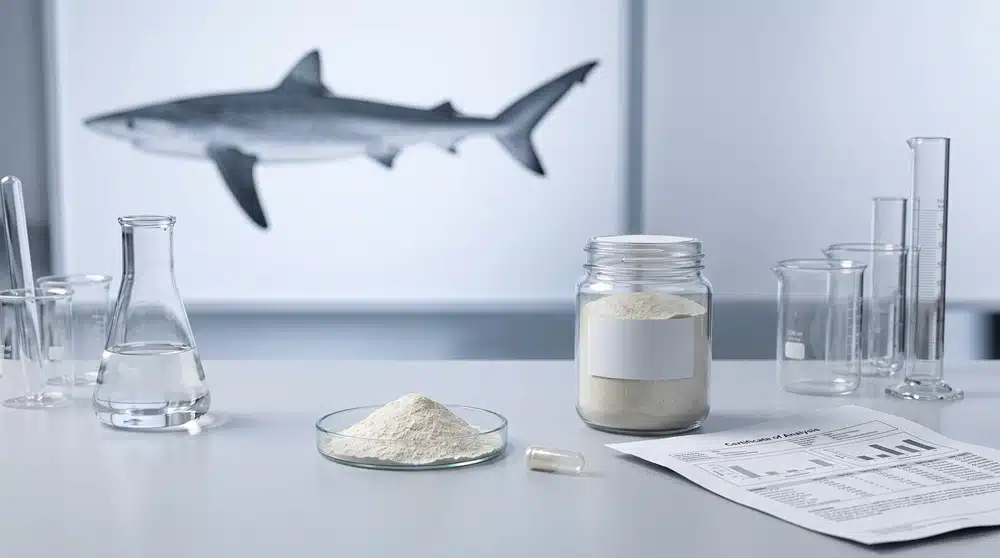
Haifischknorpelpulver wird aus gereinigtem, getrocknetem und gemahlenem Knorpelgewebe von Haien hergestellt. Im Gegensatz zu Knochenfischen besteht das Skelett von Haien hauptsächlich aus Knorpel. Das daraus gewonnene Pulver ist ein komplexes Material tierischen Ursprungs und kein einzelner, standardisierter Wirkstoff.
Zu den typischen Bestandteilen zählen unter anderem Kollagenproteine, Glykosaminoglykane (GAGs), Chondroitinsulfat, Kalzium, Phosphor sowie geringere Mengen anderer Bestandteile. Die genaue Zusammensetzung variiert je nach Haiart, anatomischer Herkunft, Verarbeitung, Reinigung und Charge.
For buyers evaluating shark cartilage powder, the commercial name alone is not enough. Request a batch specification that defines source species, cartilage source, chondroitin/GAG content, protein, calcium, phosphorus, moisture, particle size, microbiology, heavy metals, and traceability documentation.
Haifischknorpel vs. Haifischkollagen vs. Chondroitinsulfat
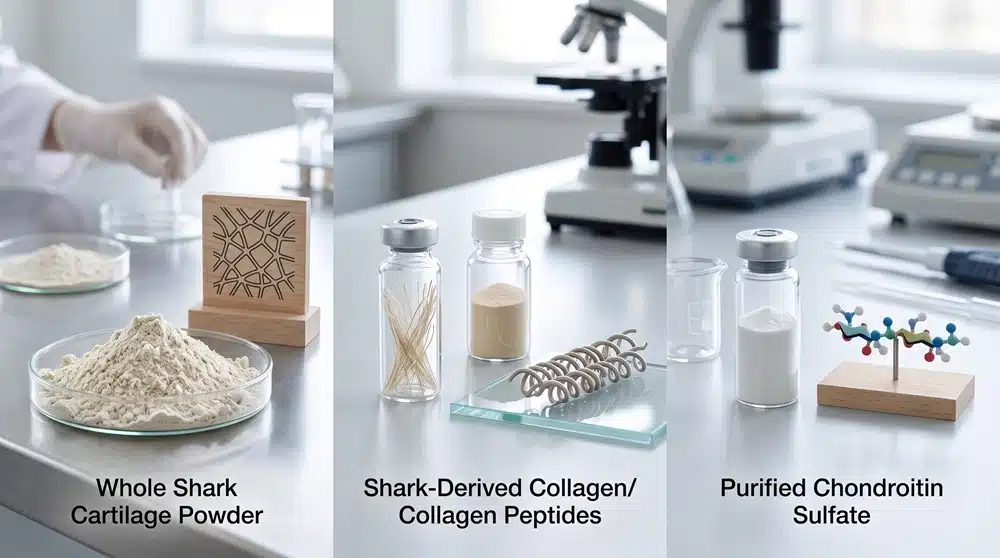
Diese Begriffe tauchen in Suchergebnissen oft durcheinander auf, bezeichnen jedoch unterschiedliche Materialien.
| Material | Was es ist | Typische Zusammensetzung / Schwerpunkt | Wichtige Frage des Käufers |
|---|---|---|---|
| Haifischknorpelpulver | Ganzes oder minimal fraktioniertes getrocknetes Knorpelmaterial | Proteinmischung, GAGs, Mineralstoffe, Chondroitinsulfat und weitere Bestandteile | Um welche Analysen und Kontrollen der Ausgangsarten handelt es sich konkret? |
| Haikollagen | Aus Haifischgewebe isoliertes oder hydrolysiertes Kollagen | Kollagenproteine oder -peptide | Welcher Kollagentyp, welches Peptidprofil und welches Ausgangsgewebe werden geliefert? |
| Chondroitin-Sulfat | Gereinigter, sulfatierter Glykosaminoglykan-Wirkstoff | Definierter Chondroitinsulfat-Assay und quellabhängiges Sulfatierungsmuster | Welche Herkunft, welche Analysemethode, welche Reinheit und welches Molekulargewichtsprofil sind angegeben? |
Pulver aus ganzem Haifischknorpel sollte daher nicht als gleichwertig mit einem gereinigten Spezifikation für Chondroitinsulfat. Eine Analyse von handelsüblichen Haifischknorpelpulvern aus dem Jahr 2007 ergab erhebliche Schwankungen beim Chondroitinsulfatgehalt, darunter auch Proben, in denen mit der in der Studie verwendeten Methode kaum oder gar kein Chondroitinsulfat nachweisbar war. Diese Schwankungen sind für die Rezeptur, die Kennzeichnung und die Qualifizierung von Lieferanten von großer Bedeutung.
Welche positiven Wirkungen werden dem Haifischknorpelpulver zugeschrieben?
Haifischknorpelpulver wurde in der Vergangenheit für eine Vielzahl von Anwendungsbereichen angepriesen. Die entscheidende Frage ist nicht, ob eine bestimmte Wirksbehauptung vorliegt, sondern inwieweit sie durch wissenschaftliche Erkenntnisse gestützt wird.
| Anspruchsbereich | Warum der Vorschlag gemacht wurde | Evidenz aus klinischen Studien zum Einsatz von Haifischknorpel in seiner Gesamtheit | Praktische Schlussfolgerung |
|---|---|---|---|
| Krebs / Anti-Angiogenese | Einige Knorpelextrakte zeigten in Labor- oder Tiermodellen eine antiangiogene Wirkung | In klinischen Studien konnte nicht nachgewiesen werden, dass Haifischknorpel eine wirksame Krebsbehandlung darstellt. | Haifischknorpel darf nicht als Mittel zur Vorbeugung, Behandlung oder Heilung von Krebs vermarktet werden |
| Gelenkgesundheit / Knieschmerzen | Knorpel enthält Chondroitinsulfat und Strukturproteine | Die spezifischen Erkenntnisse zu Pulver aus ganzem Haifischknorpel sind begrenzt und belegen keine Wirksamkeit bei der Behandlung von Arthritis oder Knieschmerzen. | Übertragen Sie die Erkenntnisse aus gereinigtem Chondroitin nicht automatisch auf Vollknorpelpulver. |
| Entzündung | GAGs und experimentelle Knorpelfraktionen wurden auf ihre biologische Aktivität untersucht | Die Erkenntnisse aus Studien am Menschen reichen für pauschale entzündungshemmende Wirksamkeitsangaben nicht aus | Verwenden Sie ausschließlich fundierte Struktur-/Funktionsangaben, sofern diese für das jeweilige Produkt unterstützt werden. |
| Unterstützung des Immunsystems | In präklinischen Studien wurden unterschiedliche Auswirkungen auf das Immunsystem festgestellt | Kein nachgewiesener klinischer Nutzen für die Immunfunktion | Vermeiden Sie die Formulierung “stärkt das Immunsystem”, es sei denn, für das Endprodukt liegen entsprechende Belege vor. |
| Haut / Wundheilung | Knorpel enthält Kollagen und Bestandteile der extrazellulären Matrix | Die klinischen Belege für die Wirksamkeit von oral eingenommenem Haifischknorpelpulver sind unzureichend | Leiten Sie keine Rückschlüsse auf die Haut- oder Wundheilungsergebnisse allein aus dem Kollagengehalt ab |
Hilft Haifischknorpel bei Krebs?
Es gibt keine verlässlichen klinischen Belege dafür, dass Haifischknorpelpulver zur Krebsbehandlung geeignet ist. Das Interesse entstand aufgrund von Laboruntersuchungen zur Angiogenese und aufgrund der falschen landläufigen Annahme, dass Haie keinen Krebs entwickeln. Haie können sehr wohl an Krebs erkranken, und eine im Labor nachgewiesene antiangiogene Wirkung beweist nicht, dass ein oral eingenommenes Knorpelpulver Krebs beim Menschen heilt.
Das National Cancer Institute fasst mehrere Studien am Menschen zu Rinder- und Haifischknorpel zusammen. In einer randomisierten Studie mit Patientinnen mit fortgeschrittenem Brust- oder Darmkrebs verbesserte Haifischknorpel im Vergleich zu Placebo weder die Überlebensrate noch die Lebensqualität, wobei beide Gruppen zusätzlich eine Standardtherapie erhielten. In einer früheren Phase-I/II-Studie mit 60 Personen mit fortgeschrittenem Krebs, die oral Haifischknorpel erhielten, wurden keine vollständigen oder teilweisen Tumorreaktionen beobachtet, und die Forscher kamen zu dem Schluss, dass das Produkt unter den Studienbedingungen unwirksam war.
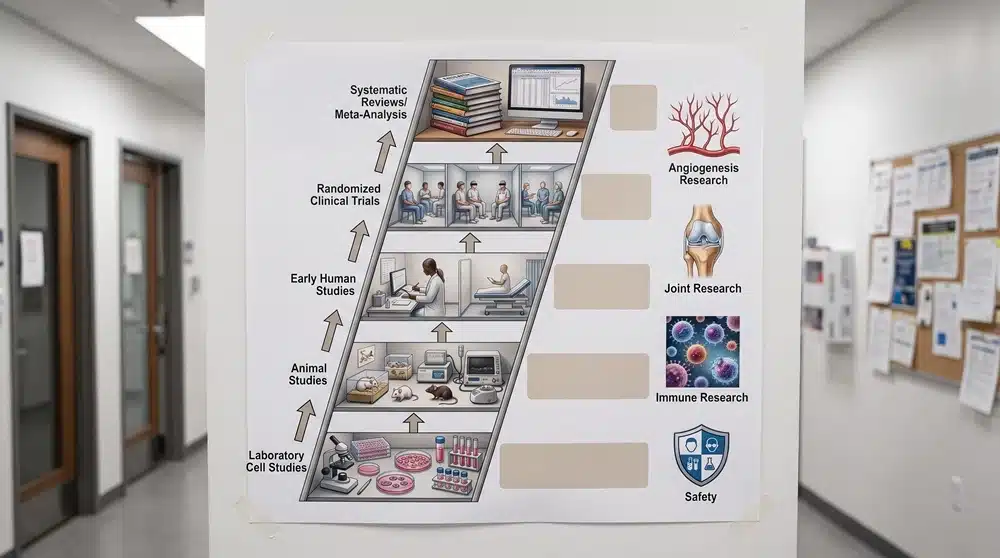
Die Unterscheidung zwischen präklinischer Wirkmechanismus und klinische Wirksamkeit ist von entscheidender Bedeutung. Eine Verbindung, die in einem Labormodell auf Endothelzellen oder die Angiogenese wirkt, ist nicht automatisch oral bioverfügbar, in einer klinisch relevanten Konzentration wirksam oder bei Menschen gegen Krebs wirksam.
Im US-amerikanischen Marketing für Nahrungsergänzungsmittel gelten Angaben zur Krebsbehandlung oder Krebsprävention als gesundheitsbezogene Angaben. Haifischknorpel sollte niemals als Alternative zur onkologischen Behandlung dargestellt werden.
Hilft Haifischknorpel bei Gelenk- oder Knieschmerzen?
Haifischknorpel enthält Bestandteile, die mit Knorpelgewebe in Verbindung stehen, insbesondere Chondroitinsulfat, was seine traditionelle Verwendung zur Förderung der Gelenkgesundheit erklärt. Allerdings gibt es Belege dafür, dass Pulver aus ganzem Haifischknorpel ist nicht gleichbedeutend mit einem Nachweis für einen gereinigten, standardisierten Chondroitin-Wirkstoff.
Bei einem Produkt in Pulverform kann der Chondroitin-Gehalt je nach Herkunft und Charge erheblich variieren. Eine Rezeptur, die auf einer chondroitinbezogenen Positionierung basiert, sollte daher den tatsächlichen Chondroitin-Gehalt genau angeben und prüfen, anstatt von einer festen Menge auszugehen, die sich aus der Bezeichnung des Inhaltsstoffs ergibt.
Suchanfragen wie “Haifischknorpel bei Knieschmerzen”, “Hilft Haifischknorpel bei Gelenkbeschwerden?” und “Wofür ist Haifischknorpel gut?” sollten unter Berücksichtigung folgender Evidenzgrenzen beantwortet werden: Das Pulver hat zwar eine plausible, auf seiner Zusammensetzung basierende Begründung, es gibt jedoch keine stichhaltigen klinischen Belege dafür, dass gewöhnliches Haifischknorpelpulver Arthritis behandelt oder Knieschmerzen zuverlässig lindert.
Wie sieht es mit Angaben zu entzündungshemmenden und immunstärkenden Wirkungen aus?
In einigen präklinischen Studien wurden biologische Wirkungen von Haifischknorpelextrakten oder -fraktionen beschrieben. Diese Experimente sind zwar nützlich für die Entwicklung von Hypothesen, belegen jedoch keinen Nutzen für den Verbraucher im Zusammenhang mit einem im Handel erhältlichen Pulver.
Auch die Ergebnisse zu den Immunreaktionen sind nicht durchweg “positiv”. Die NCI-Übersichtsarbeit beschreibt gemischte präklinische Immunbefunde, darunter je nach Modell sowohl verstärkte als auch abgeschwächte Immunreaktionen. Eine separate Laborstudie zu handelsüblichem Haifischknorpel berichtete von proinflammatorischen Zytokinreaktionen in menschlichen Leukozyten. Diese Befunde machen pauschale Aussagen wie “stärkt das Immunsystem” oder “reduziert Entzündungen im gesamten Körper” besonders schwer zu rechtfertigen.
Nebenwirkungen und Sicherheit von Haifischknorpelpulver
In der klinischen Literatur und in Fallberichten wurden gastrointestinale Nebenwirkungen wie Übelkeit, Erbrechen, Bauchbeschwerden, Blähungen, Verstopfung und Durchfall beschrieben. Außerdem wurde über Hyperkalzämie, Veränderungen des Blutzuckerspiegels, Schwäche sowie einen Fall von Hepatitis berichtet. Diese Berichte bedeuten nicht, dass jedes Produkt diese Nebenwirkungen hervorruft, sie sprechen jedoch für eine vorsichtige Anwendung und eine sorgfältige Produktcharakterisierung.
Da Haifischknorpel erhebliche Mengen an Kalzium enthalten kann, ist die Gesamtkalziumzufuhr von Bedeutung, insbesondere wenn ein Verbraucher zusätzlich Kalziumpräparate einnimmt oder Vitamin D Produkte einnimmt oder an einer Erkrankung leidet, die den Kalziumhaushalt beeinflusst. Die langfristige Sicherheit wurde nicht für alle im Handel erhältlichen Haifischknorpelprodukte systematisch nachgewiesen.
Schwangere oder stillende Personen, Kinder, Menschen mit schwerwiegenden Vorerkrankungen sowie Personen, die verschreibungspflichtige Medikamente einnehmen, sollten sich bei der Entscheidung, ob Haifischknorpel für sie geeignet ist, nicht auf einen allgemeinen Artikel über Nahrungsergänzungsmittel verlassen. Eine produktspezifische medizinische Beratung sollte von einer qualifizierten medizinischen Fachkraft erfolgen.
Verunreinigungen und Produktvariabilität
Haie sind langlebige Meeresräuber, weshalb der Kontrolle von Schadstoffen im Rohmaterial besondere Aufmerksamkeit zukommen muss. Eine Studie zu Kalziumpräparaten ergab, dass Produkte auf der Basis von Haifischknorpel höhere durchschnittliche Quecksilber- und Kadmiumkonzentrationen aufwiesen als die anderen getesteten Kategorien von Kalziumpräparaten, obwohl die in dieser Studie geschätzten Expositionen unter den von den Autoren zugrunde gelegten vorläufigen tolerierbaren Tagesdosen lagen.
Eine separate Analyse aus dem Jahr 2014 wies die Cyanobakterien-Aminosäure BMAA in 15 von 16 handelsüblichen Haifischknorpelprodukten nach und maß zudem Quecksilber. Die klinische Bedeutung einer BMAA-Exposition über die Nahrung ist nach wie vor unklar, daher sollte diese Studie nicht als Beweis dafür interpretiert werden, dass jedes Haifischknorpelprodukt unsicher ist. Sie untermauert jedoch einen wichtigen Grundsatz im B2B-Bereich: Pulver marinen Ursprungs sollten durch entsprechende Schadstofftests geprüft werden, anstatt allein aufgrund ihrer “Natürlichkeit” als unbedenklich anzusehen.”
Ein weiteres Problem ist die einheitliche Qualität der Produkte. Veröffentlichte Analysen von Produkten aus Haifischknorpel und Chondroitin haben Schwankungen beim Chondroitingehalt, bei der Herkunftsangabe und bei der Kennzeichnung festgestellt. Eine im Jahr 2021 durchgeführte Überprüfung von 29 Etiketten von Haifischknorpel-Nahrungsergänzungsmitteln in den USA ergab, dass bei 48,31 % der Produkte mindestens ein Verstoß gegen die gesetzlichen Vorschriften festgestellt wurde.

Nachhaltigkeit, Artenbestimmung und legale Beschaffung
Umweltkontroversen stehen in engem Zusammenhang mit der Qualität der Inhaltsstoffe. Haie wachsen oft langsam, werden erst spät geschlechtsreif und bringen relativ wenig Nachwuchs zur Welt, was einige Populationen anfällig für Überfischung macht. Die NOAA Fisheries weist darauf hin, dass Haie ökologisch wichtige Raubtiere sind und dass für viele Haiarten internationale Handelsbeschränkungen gelten.
Für den Handel in den USA sind Herkunftsnachweise besonders wichtig. Das Bundesgesetz verbietet den Besitz, den Transport, den Verkauf oder den Kauf von abgetrennten Haifischflossen oder Produkten, die Haifischflossen enthalten, vorbehaltlich eng gefasster gesetzlicher Ausnahmen. Viele Haiarten sind zudem im CITES-Übereinkommen aufgeführt, was bedeutet, dass für den internationalen Handel je nach Art, Herkunft und Transaktion Nachweise auf Artenebene sowie Genehmigungen erforderlich sein können.
Ein B2B-Einkäufer sollte sich daher folgende Frage stellen:
- Welche Haiart wird verwendet, einschließlich des wissenschaftlichen Namens?
- Welches anatomische Gewebe wird verwendet, und sind dabei auch abgelöste Teile der Flossen oder der Schwanzflosse enthalten?
- Stammt das Material aus der legalen Fischerei oder wurde es auf einem anderen, dokumentierten Weg beschafft?
- In welchem Land wurde das Material geerntet und verarbeitet?
- Welche CITES-, Einfuhr-, Ausfuhr- oder Fischereidokumente gelten für diese Art und diese Sendung?
- Kann der Lieferant eine Rückverfolgbarkeit auf Chargenebene von der Quelle bis zum fertigen Pulver gewährleisten?
Gesetzliche Vorschriften und CITES-Anforderungen sind artspezifisch und marktspezifisch und können sich ändern. Käufer sollten sich über die aktuellen Vorschriften für den Zielmarkt informieren, anstatt sich auf eine allgemeine Aussage wie “aus nachhaltiger Herkunft” zu verlassen.
Qualitätscheckliste für B2B-Haifischknorpelpulver
| Spezifikation | Was Sie beantragen sollten | Warum es wichtig ist |
|---|---|---|
| Artenidentität | Gebräuchlicher Name und wissenschaftlicher Name; Quellenangabe | Rückverfolgbarkeit, CITES-Überprüfung, Echtheit, Nachhaltigkeit |
| Anatomische Quelle | Genaue Herkunft des Knorpels; Bestätigung bezüglich des Materials der Flossen und der Schwanzflosse | Rechtkonforme Beschaffung und Konsistenz der Rohstoffe |
| Chondroitin-/GAG-Assay | Definierter Test, Verfahren, Ergebnis und Akzeptanzbereich | Der Gesamtpulveranteil kann erheblich variieren |
| Protein / Kollagen | Gesamtproteingehalt und, falls angegeben, eine validierte Spezifikation bezüglich des Kollagengehalts | Verhindert, dass ohne Tests die Behauptung “Haikollagen” abgeleitet wird |
| Mineralien | Kalzium, Phosphor, Asche | Erforderlich für die Zusammenstellung, die Gestaltung der Portionierung und die Sicherheitsprüfung |
| Schwermetalle | Blei, Cadmium, Quecksilber, Arsen mit methodischen Grenzwerten und Marktgrenzwerten | Bekämpfung von Schadstoffen aus marinen Quellen |
| Weitere Schadstoffe | Risikobasierter Prüfplan; BMAA oder andere marine Schadstoffe, sofern dies gerechtfertigt ist | Die Art und die Fangbedingungen können das Risiko beeinflussen |
| Mikrobiologie | TAMC/TYMC und marktgerechte Grenzwerte für Krankheitserreger | Grundlegende Sicherheit bei Nahrungsergänzungsmittel-Rohstoffen |
| Technische Daten | Feuchtigkeit, Maschenweite/Partikelgröße, Geruch, Farbe, Schüttdichte | Leistung von Kapseln, Tabletten, Beuteln und Pulvermischungen |
| Dokumentation | COA, Spezifikation, Sicherheitsdatenblatt (SDS)/Technisches Datenblatt (TDS), Herkunft, Rückverfolgbarkeit, Artangabe, behördliche Unterlagen | Käuferqualifizierung und Konformität des Endprodukts |
Marken, die nicht ausdrücklich ganzen Haifischknorpel benötigen, können Alternativen auch anhand eines breiteren Spektrums vergleichen Produktportfolio für die Gelenkgesundheit. Gereinigtes Chondroitinsulfat aus tierischen Quellen (außer Haifisch) oder nicht-tierische Alternativen können je nach Rezeptur eine besser kontrollierbare Spezifikation oder eine geeignetere Herkunftsgeschichte bieten.
Wie Hersteller von Nahrungsergänzungsmitteln Haifischknorpel positionieren sollten
Eine stichhaltige Produktgeschichte sollte sich auf die Identität und Zusammensetzung der Inhaltsstoffe konzentrieren und nicht auf unbegründete Aussagen zu Krankheitsverläufen. Zu den potenziell geeigneten Themen gehören Transparenz hinsichtlich der Herkunft, der quantifizierte Gehalt an Chondroitin und GAG, das Mineralstoffprofil, Qualitätsprüfungen, Rückverfolgbarkeit und verantwortungsbewusste Beschaffung.
Vermeiden Sie Marketingformulierungen wie:
- “Krebs heilt oder verhindert”;
- “beraubt Tumore der Nahrungszufuhr, indem es Blutgefäße blockiert”;
- “heilt Arthritis oder Knieschmerzen”;
- “regeneriert geschädigten Knorpel”;
- “stärkt das Immunsystem, um Krankheiten zu bekämpfen”;
- “klinisch nachgewiesen”, wenn in der zitierten klinischen Studie nicht dasselbe Produkt, dieselbe Dosis, dieselbe Verabreichungsart oder dieselbe Indikation untersucht wurde.
In den Vereinigten Staaten müssen Angaben zu Struktur und Funktion von Nahrungsergänzungsmitteln wahrheitsgemäß und nicht irreführend sein, durch Belege gestützt werden und gegebenenfalls mit dem erforderlichen Haftungsausschluss sowie dem FDA-Meldeverfahren einhergehen. Die Werberichtlinien der FTC verlangen darüber hinaus, dass objektive gesundheitsbezogene Angaben durch ausreichende wissenschaftliche Belege gestützt werden. Haifischknorpel weist eine spezifische Geschichte der Durchsetzung vor: Die FTC ging bereits gegen Vermarkter vor, die Haifischknorpelprodukte mit unbegründeten Angaben zur Krebsbehandlung bewarben.
FAQ
Was ist Haifischknorpelpulver?
Es handelt sich um getrockneten und gemahlenen Haifischknorpel, der eine Mischung aus Proteinen, Glykosaminoglykanen, Mineralstoffen und anderen Bestandteilen enthält. Es ist nicht dasselbe wie gereinigtes Chondroitinsulfat oder isoliertes Haifischkollagen.
Wofür ist Haifischknorpel gut?
Haifischknorpel wird für die Gelenkgesundheit und andere Anwendungszwecke vermarktet, doch fehlen stichhaltige klinische Belege für die Wirksamkeit des Vollpulvers. Er sollte nicht als bewährtes Mittel gegen Arthritis, Krebs, Immunerkrankungen oder Hautkrankheiten bezeichnet werden.
Hilft Haifischknorpel bei Krebs?
Es gibt keine zuverlässigen klinischen Belege dafür, dass Haifischknorpel zur Krebsbehandlung geeignet ist. In Studien am Menschen konnte weder ein Vorteil hinsichtlich der Überlebensrate noch der Lebensqualität nachgewiesen werden, und Haifischknorpel sollte keine evidenzbasierte onkologische Behandlung ersetzen.
Hilft Haifischknorpel bei Gelenk- oder Knieschmerzen?
Das Pulver enthält knorpelbezogene Stoffe wie Chondroitinsulfat, doch liegen keine ausreichenden Belege dafür vor, dass gewöhnliches Haifischknorpelpulver zur Behandlung von Arthritis oder Knieschmerzen geeignet ist. Daten zu gereinigtem Chondroitin sollten nicht automatisch auf Haifischknorpel im Ganzen übertragen werden.
Ist Haifischknorpel dasselbe wie Haifischkollagen?
Nein. Haifischknorpelpulver ist ein aus dem gesamten Gewebe bestehendes Mischmaterial. Haifischkollagen ist hingegen eine Kollagenfraktion oder ein Hydrolysat, das aus Haifischgewebe gewonnen wird. Ihre Spezifikationen, Zusammensetzung und Anwendungsbereiche unterscheiden sich.
Welche Nebenwirkungen hat Haifischknorpel?
Zu den berichteten Nebenwirkungen zählen Übelkeit, Erbrechen, Verdauungsbeschwerden, Verstopfung oder Durchfall. Außerdem wurde über Hyperkalzämie und seltene leberbezogene unerwünschte Ereignisse berichtet. Die Sicherheit hängt vom Produkt, der Dosis, der Anwendungsdauer und dem individuellen Gesundheitszustand ab.
Ist Haifischknorpel unbedenklich?
Es liegen nicht genügend standardisierte Langzeitdaten zur Sicherheit vor, um davon auszugehen, dass alle Produkte aus Haifischknorpel gleichwertig sind. Dabei sollten die Herkunft, der Kalziumgehalt, Verunreinigungen, Medikamente, gesundheitliche Umstände und die Produktqualität berücksichtigt werden.
Was sollten Hersteller von Nahrungsergänzungsmitteln in Haifischknorpelpulver testen?
Überprüfen Sie mindestens die Art und die Gewebeherstammquelle, den Chondroitin-/GAG-Gehalt, den Proteingehalt, den Kalzium-/Phosphorgehalt, Schwermetalle, die mikrobiologische Qualität, den Feuchtigkeitsgehalt, die Partikelgröße und die Rückverfolgbarkeit der Charge. Gegebenenfalls sollten die rechtlichen Unterlagen und die CITES-Unterlagen geprüft werden.
Referenzen
- National Cancer Institute: Knorpel (Rinder- und Haifischknorpel) PDQ – Patientenversion
- Phase-I/II-Studie zur Sicherheit und Wirksamkeit von Haifischknorpel bei der Behandlung von Krebs im fortgeschrittenen Stadium
- Kennzeichnungspraktiken bei Nahrungsergänzungsmitteln aus Haifischknorpel und die Einhaltung der US-amerikanischen Vorschriften
- Die Umweltneurotoxine BMAA und Quecksilber in Nahrungsergänzungsmitteln aus Haifischknorpel
- Quecksilber-, Cadmium- und Arsengehalt in Kalzium-Nahrungsergänzungsmitteln
- Bewertung von Chondroitinsulfat in Haifischknorpelpulver als Nahrungsergänzungsmittel
- NOAA Fisheries: Gesetze zur Haifischbewirtschaftung
- NOAA Fisheries: Hai-Schutz und CITES-Schutzmaßnahmen
- FDA: Angaben zu Struktur und Funktion
- FTC: Leitfaden zur Einhaltung der Vorschriften für Gesundheitsprodukte
- FTC: Operation „Cure.all“ – Durchsetzung der Vorschriften zu Krebsbehauptungen bezüglich Haifischknorpel

Warren Wan ist ein versierter Experte mit umfassender Erfahrung in der Lieferkette für Nahrungsergänzungsmittel und verfügt über fundierte praktische Kenntnisse in den Bereichen Forschung, Entwicklung, Prozesskontrolle und weltweite Beschaffung von Kerninhaltsstoffen wie Kollagenpeptiden, Knochenbrüheprotein und Keratin. Als Autor dieser Kolumne hat er es sich zur Aufgabe gemacht, den Marketing-Hype zu durchschauen und komplexe wissenschaftliche Erkenntnisse über Inhaltsstoffe sowie Standards der Produktionsqualitätskontrolle in leicht verständliche, fundierte Wissenschaftspopularisierung zu verwandeln, um den Lesern zu helfen, die Wahrheit hinter den Etiketten zu erkennen und rationalere Gesundheitsentscheidungen zu treffen.