
Respuesta rápida: CoQ10 frente al aceite de pescado

La coenzima Q10 y el aceite de pescado no son el mismo ingrediente. La CoQ10 es un antioxidante liposoluble que interviene en la producción de energía mitocondrial, mientras que el aceite de pescado aporta ácidos grasos omega-3, como el EPA y el DHA, que se utilizan habitualmente para favorecer el bienestar lipídico, antiinflamatorio y cardiovascular.
Para los consumidores, la mejor opción depende de sus objetivos de salud y de los medicamentos que tomen. La CoQ10 suele mencionarse en el contexto de la energía celular, el uso de estatinas y el aporte antioxidante. El aceite de pescado se asocia más estrechamente con la ingesta de omega-3, el control de los triglicéridos y la inflamación sistémica.
Para las marcas de complementos alimenticios, la pregunta más importante no es simplemente “¿cuál es mejor?”, sino: ¿qué ingrediente se adapta mejor a la forma farmacéutica, la estrategia de alegaciones, el sistema de aceites, los requisitos del certificado de análisis (COA), el objetivo de estabilidad y el posicionamiento en el mercado?
En muchos proyectos de desarrollo de productos, la CoQ10 y el aceite de pescado no son competidores. Pueden ser ingredientes complementarios, especialmente en productos en cápsulas blandas diseñados para la salud cardíaca, el envejecimiento saludable y el posicionamiento de omega-3 de alta calidad.
Temprano Fórmula personalizada de CoQ10 y omega-3 El asesoramiento puede ayudar a determinar la forma adecuada de CoQ10, los niveles recomendados de EPA/DHA, el aceite portador y el sistema antioxidante.¿Qué es la coenzima Q10?
La coenzima Q10, a menudo abreviada como CoQ10, es un compuesto natural presente en las células humanas. Desempeña un papel importante en la producción de energía mitocondrial y también actúa como antioxidante. Las concentraciones más elevadas se encuentran en órganos que consumen mucha energía, como el corazón, el hígado, los riñones y el páncreas.
En la formulación de complementos alimenticios, la CoQ10 se utiliza habitualmente en dos formas comerciales: la ubiquinona y el ubiquinol. La ubiquinona es la forma oxidada y se utiliza ampliamente porque es estable y rentable. El ubiquinol es la forma reducida y a menudo se presenta como más biodisponible, especialmente en fórmulas de gama alta o en productos dirigidos a personas mayores.
Dado que la CoQ10 es liposoluble, su sistema de administración es importante. Un ingrediente de CoQ10 mezclado en una cápsula blanda a base de aceite puede comportarse de forma muy diferente a un comprimido o cápsula de polvo seco. Para las marcas de complementos alimenticios, esto significa que a la hora de seleccionar la CoQ10 deben tener en cuenta no solo la dosis, sino también la solubilidad, el aceite portador, el sistema antioxidante, la compatibilidad con la cápsula blanda y las pruebas de estabilidad.
Beneficios de la coenzima Q10
¿Por qué debería considerar añadir CoQ10 a su rutina? Desglosémoslo:
- Salud del corazón: La CoQ10 es la mejor amiga del corazón, sobre todo para quienes padecen insuficiencia cardiaca. Las investigaciones, como un estudio Revista del Colegio Americano de CardiologíaEn un estudio realizado en el Reino Unido, se observó que la administración de suplementos de CoQ10 reducía en 39% los episodios cardiovasculares graves en pacientes con insuficiencia cardíaca. Es especialmente útil para quienes toman estatinas, que pueden reducir los niveles de CoQ10 y provocar dolores musculares o fatiga.
- Alivio de la migraña: Si las migrañas son un invitado inoportuno frecuente, la CoQ10 podría ayudarle. Un estudio publicado en Cefalalgia demostró que 150 mg diarios de CoQ10 reducían los días de migraña en 48% en comparación con un placebo. Esto cambia las reglas del juego para cualquiera que esté cansado de esos fuertes dolores de cabeza.
- Poder antioxidante: Al neutralizar los radicales libres, la CoQ10 ayuda a proteger las células del estrés oxidativo, que está relacionado con enfermedades crónicas como la diabetes y los trastornos neurodegenerativos. Algunos estudios sugieren que puede mejorar la sensibilidad a la insulina en personas con diabetes, aunque se necesitan más investigaciones.
- Otras ventajas potenciales: Se está investigando el papel de la CoQ10 en la mejora del rendimiento deportivo y en la ralentización del avance de enfermedades como el Parkinson o el Alzheimer, pero el jurado aún no se ha pronunciado al respecto.
La CoQ10 es como un compañero de confianza, que satisface las necesidades energéticas del organismo y mantiene a raya el daño celular. Pero, ¿cómo se compara con el aceite de pescado?
¿Qué es el aceite de pescado?
El aceite de pescado es un ingrediente de origen marino que aporta ácidos grasos omega-3 de cadena larga, principalmente EPA y DHA. Estos ácidos grasos se encuentran de forma natural en pescados grasos como la sardina, la anchoa, la caballa, el salmón y el arenque. En la fabricación de complementos alimenticios, el aceite de pescado se utiliza sobre todo en cápsulas blandas, aceites líquidos y productos combinados de omega-3.
La calidad del aceite de pescado no viene determinada únicamente por las palabras “aceite de pescado”. Las marcas deben comparar el contenido real de EPA y DHA, los marcadores de oxidación, los análisis de contaminantes, la trazabilidad del origen, el perfil olfativo y el comportamiento durante el plazo de conservación.
En el caso de los ingredientes del aceite de pescado, el control de la oxidación es un aspecto fundamental para garantizar la calidad. Un aceite de alta calidad debe ir acompañado de datos del certificado de análisis (COA), como el índice de peróxidos, el índice de p-anisidina y el TOTOX. Asimismo, antes de realizar compras a granel o iniciar la producción, deben revisarse los límites de metales pesados, PCB, dioxinas y microorganismos.
Beneficios del aceite de pescado
El aceite de pescado es famoso por sus múltiples beneficios, especialmente para el corazón y el cerebro. Esto es lo que dice la ciencia:
- Salud del corazón: El aceite de pescado es una superestrella para la salud cardiovascular. El Asociación Americana del Corazón recomienda los suplementos de omega-3 a las personas con triglicéridos altos, ya que pueden reducir los niveles en un 20-50% dependiendo de la dosis. El sitio REDUCE-IT publicado en la Revista de Medicina de Nueva InglaterraEn un estudio realizado en el Reino Unido, se observó que las dosis elevadas de EPA reducían los episodios cardiovasculares en 25% en pacientes con triglicéridos elevados.
- Salud cerebral: Los omega-3, especialmente el DHA, son cruciales para la función cerebral. Son un componente clave de las membranas de las células cerebrales y pueden reducir el riesgo de deterioro cognitivo y depresión. Un estudio publicado en la Revista de Psiquiatría Clínica descubrió que la suplementación con omega-3 puede ser un tratamiento complementario eficaz para el trastorno depresivo mayor.
- Efectos antiinflamatorios: Los omega-3 ayudan a controlar la inflamación, lo que puede aliviar los síntomas de enfermedades como la artritis reumatoide. La investigación en Salud.com señala que el aceite de pescado puede reducir el dolor y la rigidez articular en pacientes con artritis.
- Otras prestaciones: El aceite de pescado también puede contribuir a la salud ocular, mejorar el funcionamiento del hígado e incluso mejorar la salud de la piel al reducir afecciones relacionadas con la inflamación, como el acné.
El aceite de pescado es como un bálsamo relajante para el cuerpo, que calma la inflamación y ayuda a los órganos vitales. Pero, ¿cómo se compara con la CoQ10?
Coenzima Q10 vs Aceite de Pescado: ¿Cuál es la diferencia?
Aunque tanto la CoQ10 como el aceite de pescado son famosos por sus beneficios para la salud, actúan de formas distintas:
- CoQ10 se centra en la producción de energía y la protección antioxidante. Se concentra en órganos de alto valor energético como el corazón, el hígado y los riñones, garantizando que dispongan del combustible necesario para funcionar de forma óptima. Es especialmente útil para las afecciones que implican déficit de energía o estrés oxidativo.
- El aceite de pescado aporta omega-3 ácidos grasos que reducen la inflamación y favorecen la integridad estructural de las membranas celulares, especialmente en el corazón y el cerebro. Es ideal para controlar la inflamación sistémica y mejorar los perfiles lipídicos.
Imagine su cuerpo como una fábrica en plena actividad: La CoQ10 mantiene en funcionamiento los generadores de energía, mientras que el aceite de pescado garantiza que la maquinaria no se sobrecaliente. Se complementan mutuamente, pero sus aplicaciones difieren en función de sus necesidades de salud.
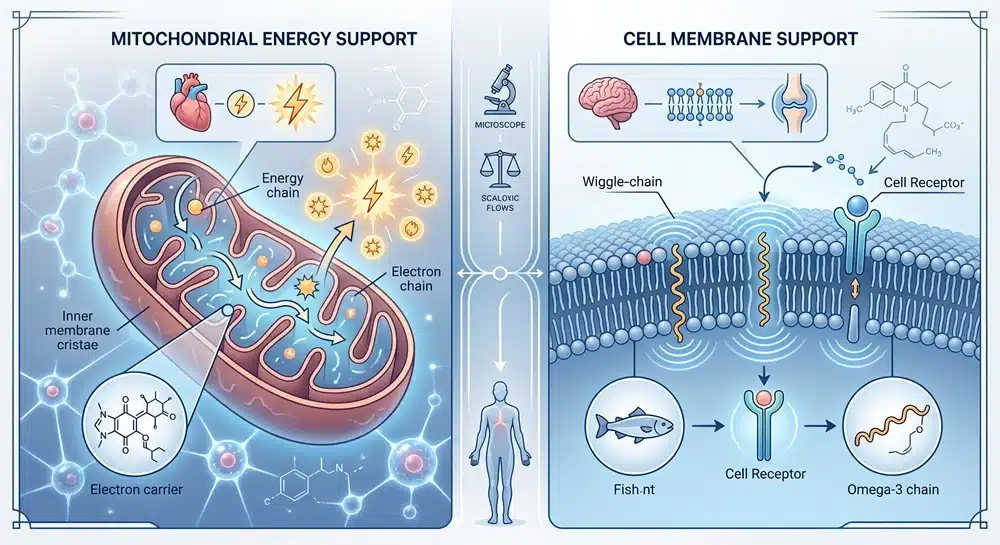
Tabla comparativa entre la coenzima Q10 y el aceite de pescado
Para que las diferencias queden más claras, he aquí una comparación en paralelo:
| Factor | CoQ10 | Aceite de pescado | Nota sobre la formulación |
| Función principal | Apoyo energético y antioxidante mitocondrial | Aporte de omega-3 (EPA/DHA) | Resuelven distintos problemas relacionados con el posicionamiento de los productos. |
| Forma común | Ubiquinona o ubiquinol | Aceite marino rico en EPA y DHA | Ambos son liposolubles y se adaptan a las formas farmacéuticas a base de aceite. |
| La mejor forma farmacéutica | Cápsula blanda, cápsula, comprimido, fórmula a base de aceite | Cápsulas blandas o aceite líquido | Las cápsulas blandas combinadas pueden resultar atractivas desde el punto de vista comercial. |
| Indicador clave de calidad | Ensayos, pureza, disolventes residuales, forma | Concentración de EPA/DHA, PV, p-AV, TOTOX, contaminantes | Es imprescindible realizar una revisión del COA antes de la producción. |
| Principal problema de fabricación | Escasa solubilidad en agua, dispersión y estabilidad del color | Oxidación, olores, riesgo de fugas | El aceite portador, el sistema antioxidante y la compatibilidad con la cápsula son factores importantes. |
| Mejor posicionamiento | Envejecimiento saludable, energía celular, bienestar cardíaco | Omega-3, apoyo a los triglicéridos, equilibrio de la inflamación | Los productos combinados pueden estar dirigidos a fórmulas de alta gama para la salud cardíaca. |
¿Qué es mejor para la salud del corazón? ¿CoQ10 o aceite de pescado?
Cuando se trata de la salud del corazón, ambos suplementos tienen puntos fuertes únicos, y la mejor elección depende de sus necesidades específicas:
- CoQ10 es especialmente eficaz para los pacientes con insuficiencia cardíaca y los que toman estatinas. Un estudio de Cedars-Sinai señala que la CoQ10 puede mejorar la producción de energía en las células cardiacas y reducir el estrés oxidativo, lo que podría disminuir el riesgo de sufrir enfermedades cardiacas. Es especialmente útil para contrarrestar el agotamiento de CoQ10 inducido por las estatinas, que puede causar dolor muscular.
- Aceite de pescado destaca en la reducción de los triglicéridos y la mejora de los perfiles de colesterol. El Asociación Americana del Corazón destaca que los omega-3 pueden reducir los triglicéridos en un 20-30% en personas con hipertrigliceridemia, y se ha demostrado que dosis elevadas de EPA reducen los eventos cardiovasculares. El aceite de pescado también ayuda a reducir la presión arterial y a estabilizar el ritmo cardiaco.
La investigación es mixta sobre su impacto general en la prevención de enfermedades del corazón. Por ejemplo, un estudio de 2018 en la Revista de Medicina de Nueva Inglaterra no halló una reducción significativa de los infartos de miocardio con los suplementos de aceite de pescado en personas sin factores de riesgo de cardiopatía. Por su parte, la CoQ10 resulta prometedora en afecciones cardiacas específicas, pero no está ampliamente aprobada para la prevención general de enfermedades cardiacas. Si la elección se basa en la salud cardiaca, el aceite de pescado puede tener una ligera ventaja en el control de los lípidos, mientras que la CoQ10 es mejor para la insuficiencia cardiaca o los problemas relacionados con las estatinas. La combinación de ambos puede ofrecer un apoyo completo, ya que se dirigen a diferentes aspectos de la salud cardiovascular.
Cuándo utilizar la coenzima Q10 frente al aceite de pescado
Elegir entre la CoQ10 y el aceite de pescado depende de sus objetivos de salud. Aquí tienes una guía para ayudarte a decidir:
- Elija CoQ10 si:
- Está tomando estatinas, que pueden reducir los niveles de CoQ10 y provocar fatiga o dolores musculares.
- Sufre insuficiencia cardíaca u otras afecciones cardíacas en las que la producción de energía es fundamental.
- Sufre migrañas frecuentes: los estudios demuestran que la CoQ10 puede reducir significativamente los días de migraña.
- Desea potenciar la energía celular y proteger contra el estrés oxidativo.
- Elija aceite de pescado si:
- Tiene niveles elevados de triglicéridos o colesterol, ya que está demostrado que los omega-3 mejoran los perfiles lipídicos.
- Se trata de reducir la inflamación, lo que puede ayudar en enfermedades como la artritis.
- Desea apoyar la salud cerebral, especialmente la función cognitiva o la estabilidad del estado de ánimo.
- No comes suficiente pescado azul (el Asociación Americana del Corazón recomienda al menos dos raciones semanales).
Sarah, una mujer de 45 años que toma estatinas, podría inclinarse por la CoQ10 para combatir la fatiga y ayudar a su corazón. Mientras tanto, su amigo John, que tiene los triglicéridos altos y rara vez come pescado, podría beneficiarse más del aceite de pescado. Su profesional sanitario puede ayudarle a adaptar la elección a sus necesidades.
¿Se puede tomar CoQ10 y aceite de pescado juntos?
La CoQ10 y el aceite de pescado suelen utilizarse juntos porque actúan mediante mecanismos diferentes. La CoQ10 interviene en la producción de energía mitocondrial y en la protección antioxidante, mientras que el aceite de pescado aporta los ácidos grasos omega-3 EPA y DHA. Desde el punto de vista de la nutrición general, no son el mismo ingrediente y no se sustituyen entre sí.
No obstante, los consumidores que tomen anticoagulantes, medicamentos para la tensión arterial, para la diabetes o hipolipemiantes con receta médica deben consultar a un profesional sanitario antes de combinar suplementos. El aceite de pescado, en dosis elevadas, puede influir en el riesgo de hemorragia, y la CoQ10 puede interactuar con determinados medicamentos, como la warfarina.
Desde el punto de vista de la fabricación de complementos alimenticios, puede tener sentido combinar la CoQ10 y el aceite de pescado en la misma cápsula blanda, ya que ambos son compatibles con los sistemas de administración a base de aceite. Un producto combinado podría promocionarse para la salud cardíaca, el envejecimiento saludable, la ingesta de omega-3 y el apoyo a la energía celular.
El principal reto no es si los ingredientes pueden figurar juntos en una etiqueta. El verdadero reto radica en la ejecución del proceso de fabricación: la dispersión de la CoQ10 en la fase oleosa, la uniformidad del llenado, el control de la oxidación, la compatibilidad con la cápsula, el control del olor a pescado y la estabilidad durante el plazo de conservación. Una fórmula bien diseñada debe definir el aceite portador, el sistema antioxidante, la forma de la CoQ10, la potencia de EPA/DHA y las especificaciones de calidad antes de la producción piloto.
Para las marcas que tengan previsto lanzar un producto mixto a base de aceite, Fabricación de cápsulas blandas de CoQ10 y aceite de pescado requiere un control minucioso de la uniformidad del relleno, la oxidación y la compatibilidad de la cubierta.Aspectos a tener en cuenta en la fabricación de cápsulas blandas de CoQ10 + aceite de pescado
Una cápsula blanda de CoQ10 + aceite de pescado puede resultar atractiva para las marcas de complementos alimenticios, pero requiere un mayor control de la formulación que una simple cápsula de un solo ingrediente.
En primer lugar, la CoQ10 es un ingrediente lipofílico, pero aun así requiere una dispersión adecuada en la fase oleosa. Si la dispersión es deficiente, el contenido activo de la cápsula blanda final puede variar de una cápsula a otra. Las marcas deben confirmar si la fórmula utiliza ubiquinona o ubiquinol y cómo se suspende o se disuelve el ingrediente en el sistema portador.
En segundo lugar, el aceite de pescado es sensible a la oxidación. La formulación debe diseñarse teniendo en cuenta el control de la oxidación, lo que incluye la calidad del aceite en bruto, la selección de antioxidantes, el lavado con nitrógeno (si procede), la protección del envase y los ensayos de estabilidad acelerados.
En tercer lugar, hay que comprobar la compatibilidad de la cápsula. Los aceites marinos, los aceites portadores y los principios activos en suspensión pueden afectar al sellado de las cápsulas blandas, al riesgo de fugas y a su aspecto. Es importante realizar un lote piloto antes de la producción a escala comercial.
Para los compradores B2B, la trayectoria de desarrollo ideal es:
1. Determinar la dosis recomendada de CoQ10.
2. Definir la cantidad recomendada de EPA y DHA por ración.
3. Revisar los certificados de análisis (COA) de las materias primas.
4. Comprueba el aceite base y el sistema antioxidante.
5. Realizar un llenado de prueba de cápsulas blandas.
6. Comprueba la uniformidad del llenado, la oxidación, las fugas y el aspecto.
7. Confirmar la estrategia de envasado y de vida útil.
Lista de comprobación de calidad antes de comprar CoQ10 o aceite de pescado

En el caso de las marcas de complementos alimenticios, el control de calidad debe comenzar antes de la producción. Solicita a los proveedores un certificado de análisis (COA) completo y confirma los métodos de ensayo utilizados.
En cuanto a los ingredientes de la CoQ10, consulta:
– Análisis y pureza de la CoQ10
– La forma de ubiquinona frente a la de ubiquinol
– Disolventes residuales
– Metales pesados
- Límites microbianos
– Tamaño de las partículas o propiedades de dispersión
- País de origen
– Información sobre alérgenos y OMG
– Datos sobre la estabilidad, si se dispone de ellos
En cuanto a los ingredientes del aceite de pescado, consulta:
– Contenido de la EPA
– Contenido de DHA
– Contenido total de omega-3
– Índice de peróxido (IP)
– valor de p-anisidina (p-AV)
– Valor TOTOX
– Metales pesados
– PCB
– Dioxinas
– Perfil sensorial y de olores
– Trazabilidad de la procedencia
– Pruebas o certificaciones realizadas por terceros
Un ingrediente de bajo coste no siempre supone el producto más económico a largo plazo. Una mala dispersión de la CoQ10, el aceite de pescado oxidado o una documentación insuficiente pueden provocar retrasos en la producción, resultados de estabilidad insatisfactorios, reclamaciones de los clientes o riesgos normativos.
Un enfoque estructurado control de calidad de los suplementos Esta revisión puede ayudar a verificar el ensayo de CoQ10, la potencia de EPA/DHA, los valores de oxidación, los metales pesados y la documentación del proveedor antes de la producción.¿Necesitas ayuda para desarrollar un producto con CoQ10 y aceite de pescado?
If you are developing a CoQ10 softgel, fish oil softgel, or combined CoQ10 + omega-3 formula, Gensei can help review ingredient form, carrier oil selection, EPA/DHA target, antioxidant system, pilot batch feasibility, packaging options, and quality testing requirements.
Envíanos la dosis prevista, la forma farmacéutica y el posicionamiento en el mercado, y nuestro equipo de formulación te ayudará a evaluar si la mejor estrategia comercial es optar por una cápsula blanda de un solo ingrediente, una cápsula blanda combinada o una línea de productos con varias referencias.
Si estás fabricando un producto comercial ya terminado, nuestro Suplementos de CoQ10 y aceite de pescado de marca propia Este servicio puede ofrecer apoyo en materia de formulación, envasado, controles de calidad y planificación del lanzamiento.Conclusión
En el enfrentamiento entre la coenzima Q10 y el aceite de pescado, no hay un único ganador. La CoQ10 es la mejor opción para aumentar la energía celular y proteger contra el estrés oxidativo, por lo que es ideal para la insuficiencia cardíaca, los consumidores de estatinas o los que sufren migrañas. El aceite de pescado, con sus ácidos grasos omega-3, es un campeón en la reducción de la inflamación, la disminución de los triglicéridos y el apoyo a la salud del corazón y el cerebro.
Para muchos, la combinación de ambos suplementos ofrece un potente dúo que aborda múltiples aspectos de la salud. Tanto si eres como Sarah, que quiere contrarrestar los efectos secundarios de las estatinas, como si eres como John, que quiere controlar los triglicéridos, estos suplementos pueden ser valiosos complementos para un estilo de vida saludable. Consulte siempre a su médico para asegurarse de que son adecuados para usted, y elija productos de alta calidad para maximizar sus beneficios.
Preguntas frecuentes
P: ¿La CoQ10 es lo mismo que el aceite de pescado?
R: No. La CoQ10 es un antioxidante liposoluble que interviene en la producción de energía mitocondrial. El aceite de pescado es un aceite marino que aporta ácidos grasos omega-3 EPA y DHA. Se trata de ingredientes distintos que responden a necesidades diferentes en cuanto al posicionamiento de los complementos alimenticios.
P: ¿Se pueden tomar juntos la CoQ10 y el aceite de pescado?
R: Muchos consumidores toman CoQ10 y aceite de pescado a la vez, y a menudo se considera que ambos ingredientes son complementarios. Sin embargo, las personas que toman anticoagulantes, medicamentos para la tensión arterial, para la diabetes o medicamentos recetados para el corazón deben consultar a un profesional sanitario antes de combinar estos suplementos.
P: ¿Qué es mejor para la salud del corazón, la CoQ10 o el aceite de pescado?
R: Ambos contribuyen a diferentes aspectos del bienestar cardíaco. El aceite de pescado se utiliza habitualmente para la ingesta de omega-3 y para controlar los triglicéridos, mientras que la CoQ10 suele mencionarse en relación con la energía celular y en contextos relacionados con las estatinas. Ninguno de los dos debe considerarse un tratamiento sin supervisión médica.
P: ¿La CoQ10 es lo mismo que el omega-3?
R: No. El término «omega-3» hace referencia a ácidos grasos como el EPA y el DHA. La CoQ10 no es un ácido graso omega-3. Pueden aparecer en la misma fórmula, pero son diferentes tanto desde el punto de vista químico como funcional.
P: ¿Qué es mejor, la CoQ10 o el aceite de krill?
R: El aceite de krill es otra fuente de omega-3, mientras que la CoQ10 es un ingrediente antioxidante. La mejor opción depende de si el objetivo del producto es el aporte de omega-3, su posicionamiento como antioxidante o una fórmula combinada para la salud cardíaca.
P: ¿Se pueden combinar la CoQ10 y el aceite de pescado en una sola cápsula blanda?
R: Sí, esto es posible desde el punto de vista de la forma farmacéutica, ya que ambos son compatibles con los sistemas a base de aceite. No obstante, es necesario someter la fórmula a pruebas para comprobar la dispersión de la CoQ10, la oxidación del aceite de pescado, la compatibilidad con la cápsula, la uniformidad del llenado y el riesgo de fugas.
P: ¿Qué deben comprobar las marcas antes de adquirir aceite de pescado?
R: Las marcas deben revisar los niveles de EPA, DHA, el contenido total de omega-3, el PV, el p-AV, el TOTOX, los metales pesados, los PCB, las dioxinas, el perfil de olor, la trazabilidad de la procedencia y los análisis realizados por terceros.
P: ¿Qué deben comprobar las marcas antes de adquirir CoQ10?
R: Las marcas deben revisar el método de análisis de la CoQ10, su forma, pureza, disolventes residuales, metales pesados, límites microbianos, tamaño de las partículas, país de origen, presencia de alérgenos e información sobre la estabilidad.
Referencias
- NCCIH. Coenzima Q10. https://www.nccih.nih.gov/health/coenzyme-q10
- Oficina de Suplementos Dietéticos de los NIH. Ácidos grasos omega-3: ficha informativa para profesionales de la salud. https://ods.od.nih.gov/factsheets/Omega3FattyAcids-HealthProfessional/
- Mortensen SA y otros. Ensayo aleatorizado Q-SYMBIO, PubMed. https://pubmed.ncbi.nlm.nih.gov/25282031/
- Sandor PS y otros. Eficacia de la coenzima Q10 en la profilaxis de la migraña, PubMed. https://pubmed.ncbi.nlm.nih.gov/15728298/
- Bhatt DL y otros. Ensayo REDUCE-IT, New England Journal of Medicine. https://www.nejm.org/doi/full/10.1056/NEJMoa1812792
- Recomendación científica de la AHA: Ácidos grasos omega-3 para el tratamiento de la hipertrigliceridemia. https://www.ahajournals.org/doi/10.1161/CIR.0000000000000709
- Monografía voluntaria de GOED sobre los aceites omega-3 con EPA y DHA. https://goedomega3.com/storage/app/media/Monograph/GOED%20Monograph%20-%202022%2001%2006%20-%20FINAL.pdf
- FDA. Declaraciones de estructura/función. https://www.fda.gov/food/nutrition-food-labeling-and-critical-foods/structurefunction-claims
- Niveles de oxidación de los suplementos de n-3 de venta libre en Norteamérica. https://pmc.ncbi.nlm.nih.gov/articles/PMC4678768/

Warren Wan es un experto con una amplia trayectoria en la cadena de suministro de complementos alimenticios, que cuenta con una gran experiencia práctica en la investigación, el desarrollo, el control de procesos y el abastecimiento global de ingredientes clave como los péptidos de colágeno, la proteína de caldo de huesos y la queratina. Como autor de esta columna, se dedica a desmontar los argumentos de marketing, transformando la compleja ciencia de los ingredientes y las normas de control de calidad de la producción en divulgación científica rigurosa y fácil de entender, ayudando a los lectores a comprender la verdad que se esconde tras las etiquetas y a tomar decisiones más racionales en materia de salud.


