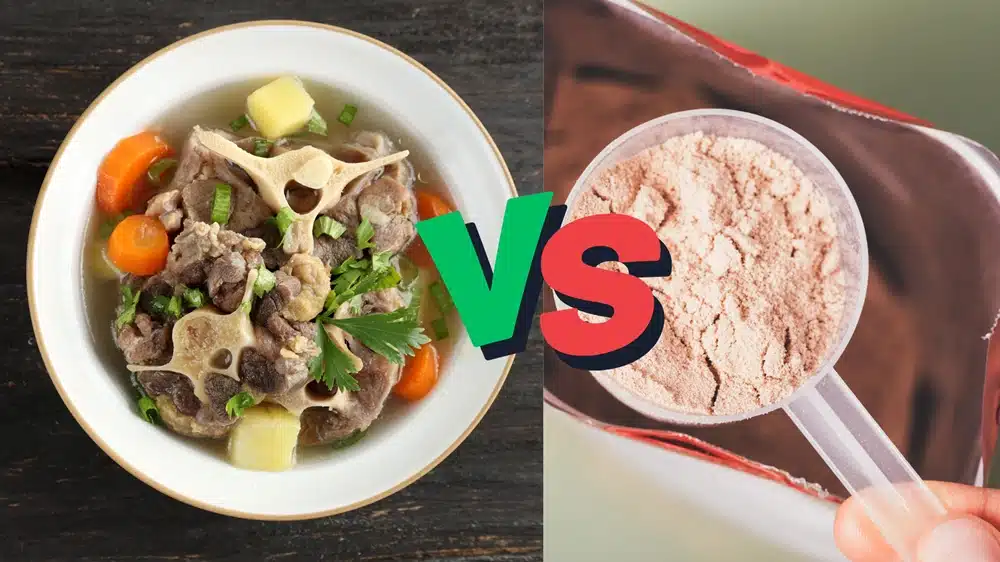
Elige la gelatina cuando la fórmula requiera resistencia del gel, elasticidad, formación de película o buenas propiedades para la cubierta de las cápsulas. Elige péptidos de colágeno cuando se requiera dispersabilidad, una ración de proteína del orden de un gramo y una gelificación mínima. En el caso de cualquiera de estos ingredientes, comprueba antes de la compra el origen del ganado, el tipo de tejido, los controles de EEB/ETE, las certificaciones, las especificaciones del lote y el rendimiento del producto final.
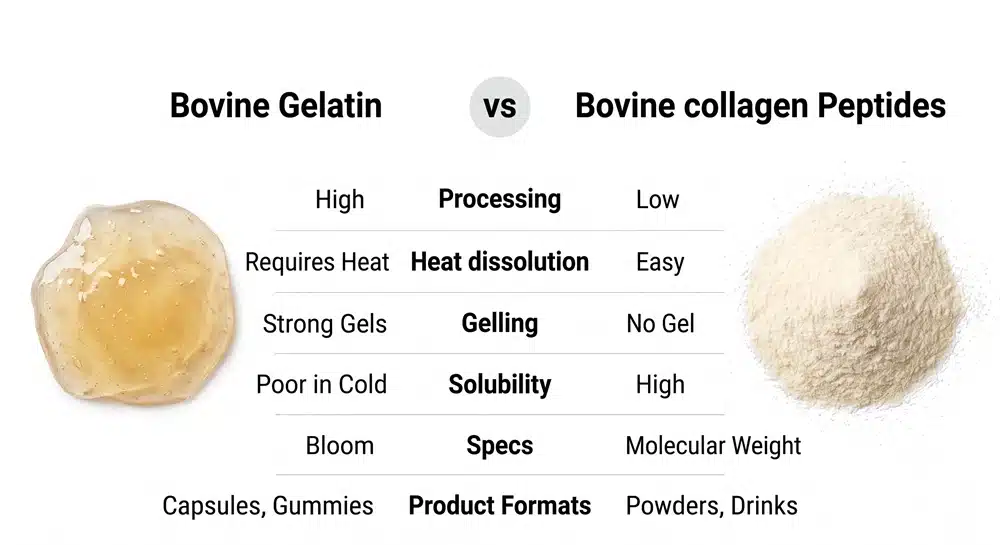
Comparativa rápida entre la gelatina bovina y los péptidos de colágeno
| Factor | Gelatina bovina | Péptidos de colágeno bovino |
|---|---|---|
| Tratamiento | Hidrólisis parcial y extracción de tejido bovino rico en colágeno | Hidrólisis enzimática adicional para obtener fracciones peptídicas más pequeñas |
| Comportamiento del agua | Se hidrata y se disuelve principalmente con el calor; se gelifica o se espesa al enfriarse | Normalmente se disuelve en líquidos calientes o fríos y no se gelifica |
| Función técnica principal | Gelificación, espesamiento, aglutinación, formación de películas y recubrimientos de cápsulas | Suministro de proteínas de colágeno solubles en polvos, bebidas y productos en forma de dosis sólidas |
| Especificaciones principales | Intensidad de la floración, viscosidad, pH, punto de gelificación, claridad, tamaño de las partículas y análisis microbiológico | Determinación del contenido proteico, distribución del peso molecular, solubilidad, perfil sensorial, tamaño de las partículas y análisis microbiológico |
| Aplicaciones habituales | Gominolas, alimentos en gel, cápsulas duras o blandas y sistemas de textura | Bebidas en polvo, sobres, mezclas proteicas, cápsulas, comprimidos y gominolas seleccionadas |
| Límite de las pruebas | No se deben extrapolar los resultados clínicos obtenidos con péptidos de colágeno hidrolizado a la gelatina común. | No se deben generalizar los resultados obtenidos con un péptido, una dosis o una fórmula concretos a todos los colágenos en polvo. |
¿Qué es la gelatina bovina?
La gelatina bovina es una proteína derivada del colágeno que se obtiene a partir de tejidos del ganado vacuno, como la piel o los huesos, mediante un proceso controlado de pretratamiento, extracción, concentración, secado y molienda. El procesamiento rompe la triple hélice nativa del colágeno y crea cadenas proteicas capaces de hidratarse, aumentar la viscosidad y formar un gel reversible.
“La ”gelatina bovina» no es una especificación completa. Los compradores deben definir, además, el tejido de origen, el país de origen, el tipo A o el tipo B cuando sea pertinente, la fuerza de Bloom, la viscosidad, el pH, la claridad, los límites microbiológicos y la aplicación prevista. Para el abastecimiento de ingredientes y la revisión de la documentación, compare las especificaciones con un experto cualificado proveedor de materia prima de gelatina.
¿Qué son los péptidos de colágeno bovino?
Bovine collagen peptides—also called hydrolyzed bovine collagen or collagen hydrolysate—are produced by further hydrolyzing collagen or gelatin into smaller peptide fractions. This additional processing reduces most gel-forming behavior and usually improves dispersibility in supplement powders and beverages.
Los grados comerciales pueden variar en cuanto al tejido bovino, el país de origen, la distribución del peso molecular, el contenido proteico, la solubilidad, el sabor, el olor, el color y la densidad aparente. Una expresión como “ultrahidrolizado” no sustituye a una especificación numérica ni a un certificado de análisis (COA) específico del lote. Las marcas que comparen ingredientes peptídicos pueden consultar venta al por mayor de péptidos de colágeno por origen, análisis, perfil molecular y documentación del lote.
¿La gelatina bovina es lo mismo que el colágeno?
No. La gelatina se obtiene del colágeno, y los péptidos de colágeno también se obtienen del colágeno, pero no son ingredientes comerciales intercambiables. Comparten un perfil de aminoácidos relacionado con el colágeno, que incluye glicina, prolina e hidroxiprolina, mientras que su estructura molecular y su comportamiento en la formulación difieren debido al proceso de elaboración.
En las especificaciones de un proveedor, en una orden de compra o en la etiqueta de un producto, debe aclararse el significado de la palabra “colágeno”. Puede referirse al colágeno nativo, a la gelatina, al colágeno hidrolizado, a los péptidos de colágeno o a un tipo concreto de colágeno. Una fórmula puede resultar fallida si estos términos se tratan como sinónimos sin comprobar la consistencia del gel, la solubilidad, el tamaño de la ración y las condiciones de procesamiento.
Elaboración, tipo A/tipo B y estructura molecular
Procesamiento de la gelatina
La gelatina puede producirse tras un pretratamiento ácido o alcalino. El material procesado con ácido se denomina habitualmente «tipo A», mientras que el procesado con álcali se denomina habitualmente «tipo B». La letra no indica un grado de calidad, sino que describe el método de pretratamiento y puede influir en el comportamiento del pH, el punto isoeléctrico y el rendimiento en la aplicación.
Procesamiento de péptidos de colágeno
Los péptidos de colágeno se someten a una hidrólisis controlada adicional. La información útil sobre su obtención no se limita simplemente al “bajo peso molecular”, sino que incluye la distribución completa del peso molecular, el método de obtención, el análisis proteico y la uniformidad entre lotes. Los péptidos más pequeños pueden mejorar la dispersabilidad, pero el tamaño molecular por sí solo no garantiza unos resultados clínicos superiores.
Firmeza, viscosidad, solubilidad y textura
La principal diferencia entre la gelatina y los péptidos de colágeno es de carácter funcional, más que promocional.
- Intensidad de la floración: una medida estandarizada de la resistencia del gel de gelatina. Un valor más alto suele indicar un gel más resistente en las condiciones de ensayo especificadas, aunque la textura también depende de la concentración, el pH, los azúcares, los ácidos, la temperatura de procesamiento y otros ingredientes.
- Viscosidad: afecta al bombeo, al vertido, al recubrimiento, a la formación de la película y a la sensación final en boca.
- Solubilidad: Los péptidos de colágeno suelen elegirse cuando es necesario que la fórmula se disperse sin cuajar en forma de gel.
- Gelificación termorreversible: La gelatina forma un gel al enfriarse y puede volver a derretirse con el calor; los péptidos de colágeno no suelen formar la misma red.
Sustituir la gelatina por péptidos de colágeno en una proporción de uno a uno puede reducir la estructura o impedir que una gominola se endurezca. Sustituir los péptidos de colágeno por gelatina puede hacer que una bebida en polvo forme grumos, se espese o se gelifique.
¿Qué ingrediente es mejor para cada producto?
| Objetivo del producto | Ingrediente inicial recomendado | Por qué |
|---|---|---|
| Gominola elástica tradicional | Gelatina bovina certificada | Aporta firmeza, elasticidad y textura masticable al gel |
| Cápsula de gelatina dura o blanda | Gelatina certificada para aplicaciones específicas | Proporciona la formación de una película y la estructura de la capa exterior |
| Bebida de colágeno transparente o de baja viscosidad | Péptidos de colágeno bovino | Aporta proteínas solubles sin gelificación intencionada |
| Sobre o barrita de proteína | Péptidos de colágeno bovino | Permite la dosificación y la dispersión con precisión de gramos |
| Postre en gel o alimento espesado | Gelatina bovina | Crea una red de gel que depende de la temperatura |
| Gominolas de colágeno con un contenido significativo de péptidos | Gelatina y péptidos de colágeno, tras las pruebas piloto | La gelatina aporta estructura; los péptidos aportan proteína de colágeno soluble, pero pueden alterar la textura y la actividad del agua. |
| Cápsula o comprimido que contiene colágeno | Péptidos de colágeno | El polvo que no se gelifica es más fácil de dosificar, pero hay que comprobar el número de cápsulas y la viabilidad del tamaño de la ración. |
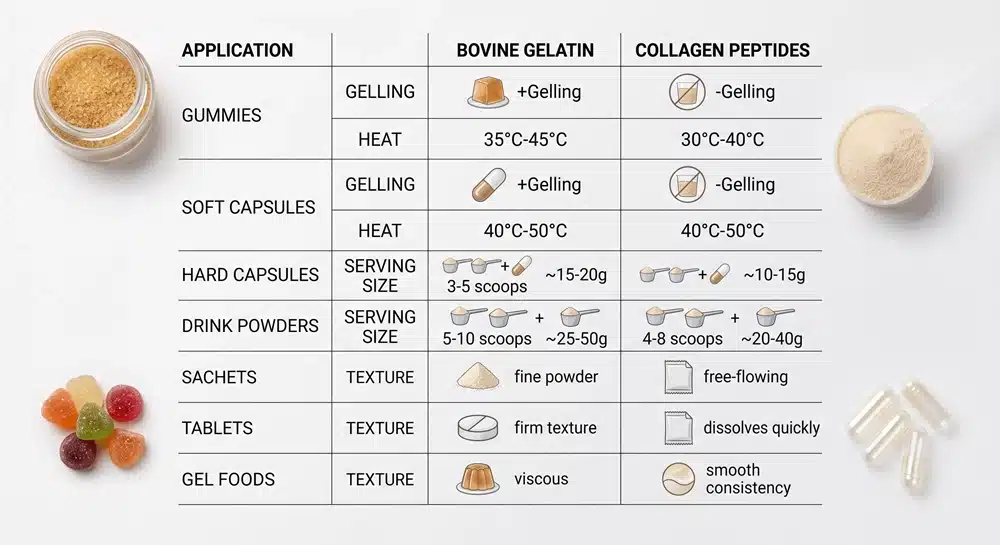
Notas sobre la formulación de gominolas y productos en gel
La fórmula de unas gominolas depende del grado Bloom de la gelatina, la viscosidad, la hidratación, el perfil de cocción, el pH, la adición de ácido, el sistema edulcorante, los sólidos, los ingredientes activos, la temperatura de moldeado, el curado y la actividad del agua. La adición de péptidos de colágeno puede debilitar, ablandar o alterar de algún modo la red de gel, por lo que una gominola con alto contenido en colágeno requiere ensayos de desarrollo, en lugar de una simple sustitución de ingredientes.
En las pruebas piloto, las marcas pueden evaluar la base de gel, la concentración de péptidos de colágeno, la exposición al calor, la textura, la uniformidad de la dosis y la estabilidad de conservación mediante un fabricante de suplementos de gominola.
¿Se absorben los péptidos de colágeno más rápido que la gelatina?
Los péptidos de colágeno contienen fracciones peptídicas más pequeñas y, por lo general, son más fáciles de disolver en una bebida complementaria. Sin embargo, la “absorción más rápida” no debe utilizarse como afirmación universal de que producen mejores resultados para la piel, las articulaciones, el cabello o el intestino. Tanto la gelatina como los péptidos de colágeno se digieren, y su eficacia clínica depende del ingrediente concreto, la dosis, la población del estudio, la fórmula y el criterio de valoración.
Utilice la información sobre el peso molecular y la digestibilidad como descriptores técnicos, no como prueba automática de un resultado superior para la salud. Evite expresiones como “se transporta rápidamente a las articulaciones”, “máxima biodisponibilidad” o “actúa más rápido”, a menos que la afirmación esté específicamente respaldada y haya sido revisada desde el punto de vista jurídico.
Las pruebas y los límites de las declaraciones de propiedades saludables
Afirmaciones sobre la piel y la belleza
Las revisiones sistemáticas sobre el colágeno hidrolizado oral señalan posibles cambios en la hidratación o la elasticidad de la piel, pero los productos, las dosis y los diseños de los estudios varían. Estos resultados se refieren a los preparados de colágeno hidrolizado estudiados en seres humanos; no deben extrapolarse automáticamente a la gelatina bovina ni a todas las especificaciones de péptidos de colágeno.
Reclamaciones relacionadas con las articulaciones y el ejercicio físico
Los péptidos de colágeno y la gelatina se han estudiado en el contexto del ejercicio físico y del tejido conectivo. Los datos disponibles no justifican que se presente ninguno de estos ingredientes como tratamiento para la artritis, el daño en el cartílago, las lesiones de tendones o el dolor crónico.
Afirmaciones sobre el intestino, el cabello y las uñas
Las afirmaciones de que la gelatina repara el revestimiento intestinal, trata trastornos digestivos o favorece de forma fiable el crecimiento del cabello y las uñas requieren pruebas específicas para cada producto. El hecho de que contenga aminoácidos comunes y su uso tradicional no justifican una afirmación sobre una enfermedad ni garantizan un resultado concreto.
Seguridad, idoneidad nutricional y certificaciones
- Ambos ingredientes son de origen animal y no son aptos para vegetarianos ni veganos.
- Las personas con alergia o sensibilidad conocida a las proteínas bovinas deben evitar los productos de origen bovino, salvo que un profesional sanitario cualificado les indique lo contrario.
- El mero hecho de que el producto sea de origen bovino no garantiza por sí solo que sea halal o kosher. La certificación debe abarcar el origen, los requisitos de sacrificio —cuando proceda—, las instalaciones, los coadyuvantes de transformación y el proceso de producción final.
- “La expresión ”alimentado con pasto» es un atributo relacionado con el origen o la comercialización; no sustituye a los controles de identidad, de contaminantes, microbiológicos, de EEB/ETE ni de trazabilidad.
- Las personas embarazadas, en periodo de lactancia, con una enfermedad renal grave o que sigan una dieta baja en proteínas bajo supervisión médica deben solicitar asesoramiento personalizado antes de tomar suplementos de proteínas concentradas.
EEB/ETE y documentación sobre el origen bovino
Los equipos de compras deben solicitar el país de origen del ganado, el origen de los tejidos, la declaración sobre la especie, los controles veterinarios, la declaración sobre materiales prohibidos y la documentación relativa a la EEB y las EET. La documentación debe coincidir con el proveedor, la planta de fabricación y el grado exacto que se está adquiriendo.
En el caso de los productos estadounidenses, los materiales de origen bovino prohibidos no pueden utilizarse en alimentos para el consumo humano ni en complementos alimenticios. Una marca no debe reducir esta revisión a una simple frase publicitaria genérica del tipo “libre de EEB”. La acreditación debe incluir la trazabilidad, la aprobación de los proveedores, la validez de la documentación, el control de cambios y los registros de liberación de lotes.
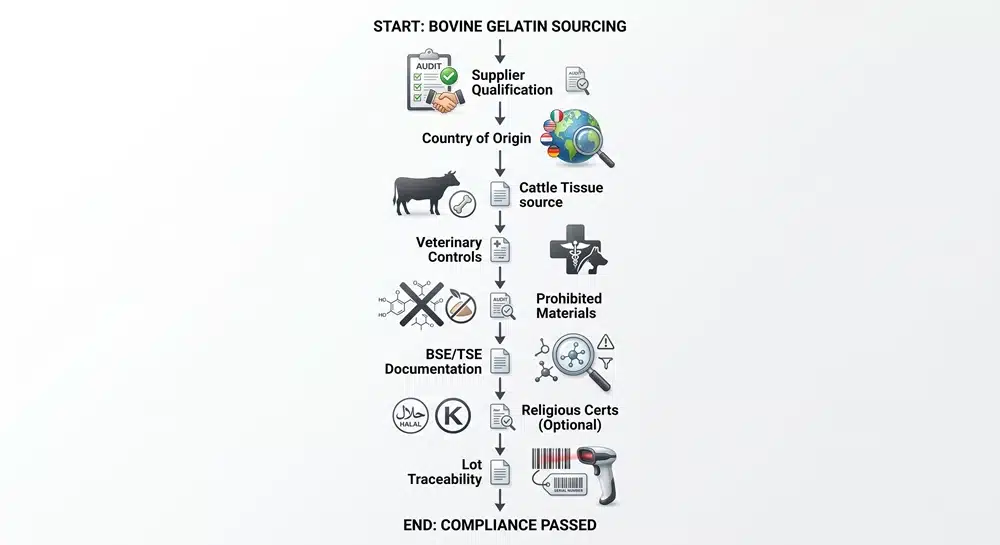
Lista de comprobación de especificaciones de calidad
| Área de especificaciones | Gelatina bovina | Péptidos de colágeno bovino |
|---|---|---|
| Identidad y origen | Especie bovina, tejido, tipo A/B cuando proceda e identidad validada | Especie bovina, tejido, identidad del colágeno hidrolizado y descripción del proceso |
| Proteínas/composición | Método de la proteína o del nitrógeno, humedad y cenizas | Análisis de proteínas y péptidos, hidroxiprolina (cuando se haya utilizado), humedad y cenizas |
| Rendimiento funcional | Intensidad de la floración, viscosidad, pH, punto de gelificación, transparencia y comportamiento de la película | Distribución del peso molecular, solubilidad, capacidad de dispersión, formación de espuma y perfil sensorial |
| Propiedades físicas | Tamaño de las partículas, densidad aparente, color y olor | Tamaño de las partículas, densidad aparente, color, olor, sabor y fluidez |
| Contaminantes | Metales pesados, microbiología, coadyuvantes de procesamiento residuales y riesgos específicos de cada fuente | Metales pesados, microbiología, coadyuvantes de procesamiento residuales y riesgos específicos de cada fuente |
| Origen y certificaciones | País, trazabilidad de los tejidos, EEB/ETE, y documentación halal y kosher cuando sea necesario | País, trazabilidad de los tejidos, EEB/ETE, y documentación halal y kosher cuando sea necesario |
| Idoneidad del producto acabado | Ensayos de recubrimiento de gominolas y cápsulas, estabilidad y compatibilidad con el proceso | Solubilidad, sabor, tamaño de la ración, estabilidad del envase y adecuación a las indicaciones de la etiqueta |
Preguntas de la solicitud de propuestas (RFP) para un proveedor de gelatina o colágeno
- ¿El material que se ofrece es gelatina normal, gelatina hidrolizada, ¿colágeno nativo o péptidos de colágeno?
- ¿Qué tejido bovino, país de origen y centro de fabricación se utilizan?
- ¿Qué procesos de pretratamiento e hidrólisis se utilizan?
- En cuanto a la gelatina, ¿cuáles son las especificaciones relativas al índice de Bloom, la viscosidad, el pH, el punto de gelificación y la transparencia?
- En el caso de los péptidos de colágeno, ¿qué distribución del peso molecular, qué ensayo de proteínas y qué límites de solubilidad se aplican?
- ¿Podría facilitarnos tres certificados de análisis recientes específicos de cada lote?
- ¿Qué metales pesados, microorganismos y residuos derivados de la transformación se analizan?
- ¿Pueden facilitar la documentación relativa a la especie, la trazabilidad, la EEB/ETE, los certificados halal y kosher cuando sea necesario?
- ¿Cuáles son los límites de tamaño de partícula, densidad aparente, color, sabor y olor?
- ¿Cuáles son la cantidad mínima de pedido (MOQ), la cantidad de muestras, el embalaje y el plazo de entrega?
- ¿Podéis colaborar en pruebas piloto con gominolas, polvos, cápsulas o bebidas?
- ¿Cómo se revisan las sustituciones, los cambios en las materias primas, los cambios en las especificaciones y las declaraciones de propiedades saludables?
Preguntas frecuentes
¿La gelatina bovina es lo mismo que el colágeno bovino?
No. La gelatina es una proteína derivada del colágeno parcialmente hidrolizada que forma un gel al enfriarse. Los péptidos de colágeno bovino se hidrolizan aún más y, por lo general, permanecen solubles sin gelificarse.
¿Contiene colágeno la gelatina bovina?
La gelatina se obtiene a partir del colágeno y conserva un perfil de aminoácidos similar, pero su estructura nativa de colágeno se ha visto alterada durante el procesamiento.
¿La gelatina de vacuno es lo mismo que los péptidos de colágeno?
No. Aunque ambos procedan de bovinos, la gelatina se utiliza principalmente por sus propiedades gelificantes y para la formación de películas, mientras que los péptidos de colágeno se utilizan para la administración de proteínas solubles.
¿Qué es mejor para las gominolas?
La gelatina suele ser el mejor ingrediente de partida para conseguir la textura elástica tradicional de las gominolas. Se pueden añadir péptidos de colágeno, pero no sustituyen a la gelatina en una proporción de uno a uno y pueden alterar la textura, la actividad del agua y la estabilidad de conservación.
¿Qué es mejor para la piel o para las articulaciones?
Algunos productos de colágeno hidrolizado cuentan con más estudios en humanos que la gelatina alimentaria común, pero los resultados dependen del ingrediente y de la dosis. Ninguno de estos ingredientes debe promocionarse con afirmaciones que garanticen efectos antienvejecimiento, el tratamiento de la artritis o el alivio del dolor.
¿La gelatina bovina es halal?
Solo se considerará halal si la procedencia, el sacrificio, el procesamiento, las instalaciones y la certificación cumplen los requisitos pertinentes. La palabra “bovino” por sí sola no es suficiente.
Conclusión
La gelatina bovina y los péptidos de colágeno bovino pueden obtenerse a partir de tejidos bovinos similares, pero resuelven problemas de formulación distintos. La gelatina permite crear geles, películas y textura. Los péptidos de colágeno aportan proteínas solubles derivadas del colágeno con poca o ninguna capacidad gelificante. La elección correcta depende de la función del producto, las condiciones del proceso, el tamaño de la ración, la documentación de origen, las especificaciones, las certificaciones y la evidencia, y no de una afirmación generalizada de que uno es más rápido, más saludable o mejor en todos los aspectos.
Las marcas pueden Ponte en contacto con GENSEI para solicitar la verificación del cumplimiento de las especificaciones, la revisión del certificado de análisis (COA), muestras o un presupuesto para gelatina bovina, péptidos de colágeno y proyectos de formulación relacionados.
Referencias
- FDA: Norma definitiva sobre la encefalopatía espongiforme bovina y los materiales prohibidos procedentes del ganado vacuno
- 21 CFR, parte 111: Buenas prácticas de fabricación vigentes para los complementos alimenticios
- FDA: Declaraciones sobre estructura y función
- FTC: Directrices sobre el cumplimiento normativo de los productos sanitarios
- Liu et al.: Colágeno y gelatina
- Khatri et al.: Efectos de la suplementación con péptidos de colágeno combinada con ejercicio: revisión sistemática
- Pu et al.: Efectos del colágeno oral en el antienvejecimiento cutáneo: revisión sistemática y metaanálisis
- Instituto de Fabricantes de Gelatina de Estados Unidos: Manual de la gelatina

Warren Wan es un experto con una amplia trayectoria en la cadena de suministro de complementos alimenticios, que cuenta con una gran experiencia práctica en la investigación, el desarrollo, el control de procesos y el abastecimiento global de ingredientes clave como los péptidos de colágeno, la proteína de caldo de huesos y la queratina. Como autor de esta columna, se dedica a desmontar los argumentos de marketing, transformando la compleja ciencia de los ingredientes y las normas de control de calidad de la producción en divulgación científica rigurosa y fácil de entender, ayudando a los lectores a comprender la verdad que se esconde tras las etiquetas y a tomar decisiones más racionales en materia de salud.