
Comparación de formatos de entrega
Gominolas
Matrices de suplementos masticables elaboradas a base de gelatina o pectina, edulcorantes, agua, ácidos, aromatizantes e ingredientes activos.
Principales ventajas- Perfil de sabor superior
- Mayor cumplimiento terapéutico por parte de los pacientes
Cápsulas
Sistemas de envases secos rellenos de polvos, gránulos o pellets.
Principales ventajas- Mayor carga útil activa
- Fórmula sin azúcar
- Mayor estabilidad
- Menor coste por dosis eficaz
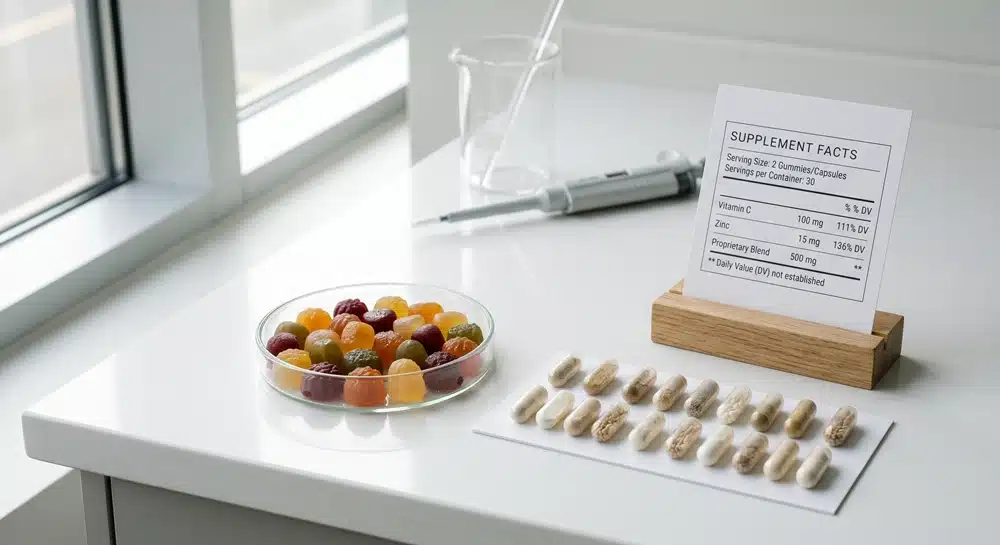
Gominolas frente a cápsulas
Para los consumidores, la elección entre gominolas y cápsulas suele depender, en primer lugar, del sabor y de la facilidad para tragarlas. Para las marcas de complementos alimenticios, esa misma elección influye en la dosis de principio activo, la estabilidad de las declaraciones en la etiqueta, el contenido de azúcar, la rentabilidad por unidad y el riesgo de fabricación.
Las gominolas pueden mejorar la adherencia al tratamiento diario cuando el cansancio por tomar pastillas es el principal obstáculo, pero no son un sustituto universal de las cápsulas. Las cápsulas siguen siendo la mejor opción para minerales en dosis elevadas, extractos botánicos sensibles, probióticos y fórmulas que requieren un control estricto de la potencia a lo largo de su vida útil.
Esta guía compara las gominolas y las cápsulas desde el punto de vista tanto del consumidor como de la formulación: absorción, dosificación de glicinato de magnesio, concentración de ingredientes, actividad del agua, coste de fabricación y en qué casos cada formato resulta más rentable desde el punto de vista comercial.
Biodisponibilidad y absorción: ¿funcionan realmente las gominolas?
La biodisponibilidad se refiere a la cantidad de un nutriente que el organismo libera, disuelve, absorbe y utiliza. La forma en que se presenta el nutriente es importante, pero solo es una parte de la respuesta. La forma del ingrediente, la dosis, la estabilidad y el estado del producto final en la fecha de caducidad suelen ser factores más importantes.
El mito de la absorción bucal
Masticar una gominola no significa que la mayoría de las vitaminas o minerales eviten el proceso de digestión en la boca. Existe la administración sublingual para determinados productos, pero las gominolas nutricionales habituales se tragan y se absorben principalmente a través del tracto digestivo.
La captación no solo tiene que ver con el formato
Una gominola no se absorbe mejor automáticamente por el hecho de masticarse, y una cápsula no funciona mejor automáticamente por tener un aspecto más «clínico». En el caso de la mayoría de los ingredientes dietéticos, la absorción depende, en primer lugar, de la forma del ingrediente y, a continuación, de su desintegración, disolución, precisión en la dosis y estabilidad.
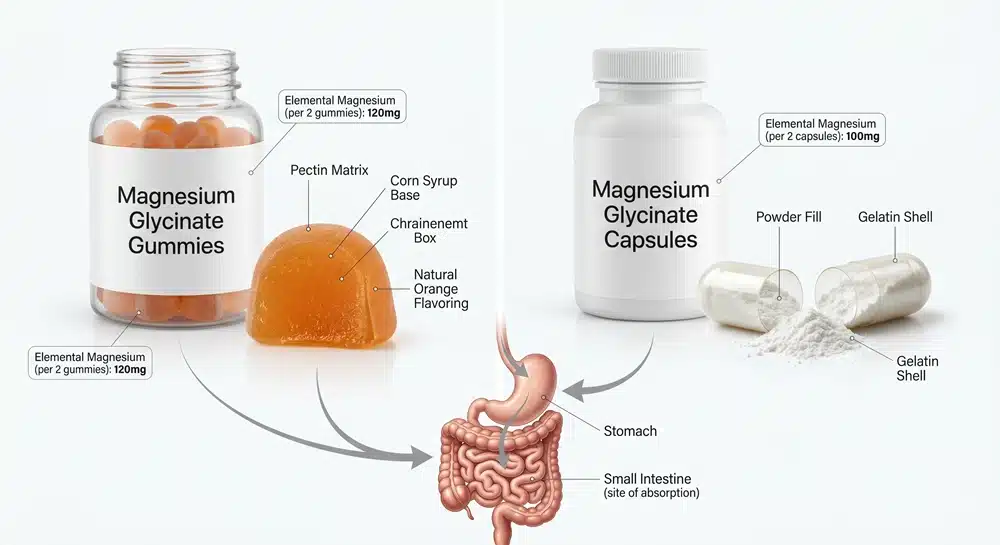
El glicinato de magnesio es un ejemplo ilustrativo. Los datos de búsqueda muestran que los usuarios suelen preguntar si las gominolas de glicinato de magnesio son tan eficaces como las pastillas o las cápsulas. La respuesta es que la forma del magnesio es más importante que el formato tipo golosina. Si una gominola y una cápsula aportan la misma cantidad de magnesio elemental procedente de la misma sal de magnesio y ambas se mantienen estables hasta su fecha de caducidad, la absorción puede ser comparable. En la práctica, las cápsulas suelen aportar una dosis elemental más alta con menos azúcar, menos ingredientes de la matriz y un mejor control de la potencia a largo plazo.
El verdadero factor decisivo: la estabilidad
Cuando ambos productos son frescos y están correctamente formulados, la absorción de algunos nutrientes puede ser similar en ambos formatos. La cuestión más complicada es si el producto sigue cumpliendo lo indicado en la etiqueta al final de su vida útil.
Una gominola es una matriz masticable, jugosa y aromatizada. Puede exponer los nutrientes sensibles a la actividad del agua, al pH ácido, al oxígeno, a las variaciones de temperatura y a la migración de la humedad. Una cápsula suele ser un sistema con menor contenido de humedad, pero aún así requiere controlar la humedad del polvo, la compatibilidad de la cubierta y el envasado.
Por eso, el mejor formato no siempre es el que parece más atractivo. Es aquel que permite administrar la dosis activa prevista de forma constante, desde el primer frasco hasta el último mes antes de la fecha de caducidad.
Desglose de ingredientes
La diferencia entre las gominolas y las cápsulas queda clara cuando se va más allá del sabor. Una gominola debe diseñarse como una pequeña matriz alimentaria. Una cápsula se asemeja más a un sistema de administración seco.
La disyuntiva entre el azúcar y los polioles
La mayoría de las gominolas necesitan edulcorantes para enmascarar el amargor y conseguir una textura agradable al masticarlas. Las fórmulas tradicionales pueden contener azúcares añadidos. Las fórmulas sin azúcar suelen utilizar polioles como el maltitol, el sorbitol o el eritritol, que pueden alterar la textura, cristalizarse, sudar o provocar molestias digestivas en consumidores sensibles.
Gelatina frente a pectina: la matriz estructural
Las gominolas necesitan un sistema gelificante. La gelatina proporciona una textura elástica al masticarlas y es habitual en las gominolas tradicionales. La pectina respalda el enfoque de origen vegetal, pero requiere un control minucioso del pH, los sólidos, las interacciones con el calcio y el secado. Las cápsulas no necesitan una matriz gelatinosa dulce; la cubierta proporciona la estructura, mientras que el relleno está compuesto principalmente por polvo activo y excipientes funcionales.
El límite de carga útil activa: por qué las gominolas de magnesio suelen necesitar más unidades
La mayor limitación en la formulación de las gominolas no es la absorción, sino el espacio disponible. Una gominola debe contener el principio activo, además del sistema que le da estructura: gelatina o pectina, edulcorante, acidulante, aroma, colorante, agua y, en ocasiones, aceite de recubrimiento o agentes antiadherentes. Eso deja menos espacio para minerales voluminosos como el magnesio, el calcio, las mezclas de zinc y las fórmulas para dormir con múltiples ingredientes.
En el caso del glicinato de magnesio, esto plantea un problema habitual en el etiquetado: una gominola puede anunciar que contiene glicinato de magnesio, pero la cantidad de magnesio elemental por ración puede ser mucho menor que la que aportan una cápsula o un polvo. Los consumidores comparan las “gominolas frente a las cápsulas” en cuanto al sabor, pero los formuladores las comparan en función de los miligramos de magnesio elemental por ración, la estabilidad hasta la fecha de caducidad y el coste por dosis administrada.
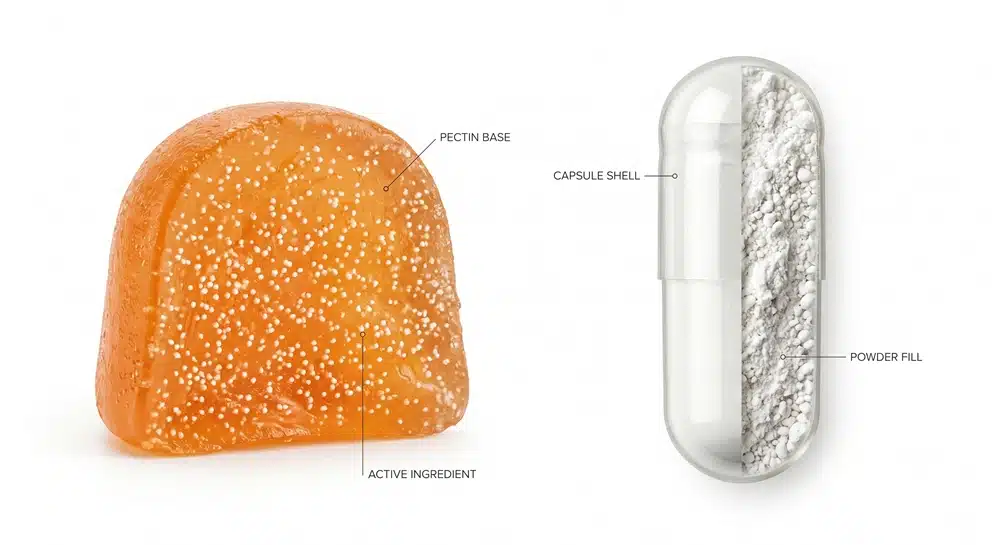
Conclusión sobre la marca: Si el posicionamiento clínico se basa en una dosis elevada de magnesio elemental, las cápsulas, los comprimidos o los polvos suelen resultar más prácticos. Si el producto se posiciona como un hábito diario agradable y de baja dosis, las gominolas pueden resultar una opción acertada, ya que favorecen una mayor adherencia al tratamiento.
Ventajas y desventajas de un vistazo
La elección no se reduce simplemente a que “las gominolas son divertidas” y “las cápsulas son serias”. La respuesta práctica depende de la dosis de principio activo, la sensibilidad a los ingredientes, el consumidor objetivo, la política sobre el azúcar y los aspectos económicos de la fabricación. Utiliza la tabla que figura a continuación como marco de referencia para la toma de decisiones, más que como una clasificación universal.
📄Tabla de comparación rápida
| Factor decisivo | Gominolas | Cápsulas | Mejor ajuste | Por qué es importante |
|---|---|---|---|---|
| Sabor y cumplimiento | El mejor sabor, masticables, sin necesidad de agua | Sabor neutro; puede provocar «fatiga de pastillas» | Gominolas | Ideal para niños, personas mayores o consumidores que prefieren no tomar pastillas |
| Carga útil activa | Limitado por el volumen de la matriz gelatinosa | Mayor capacidad de llenado para polvos y gránulos | Cápsulas | Fundamental para el glicinato de magnesio, el calcio, la creatina, el colágeno y los multiactivos |
| Carga de azúcar / hidratos de carbono | A menudo contiene azúcar o polioles | Normalmente sin azúcar | Cápsulas | Importante para personas que siguen una dieta cetogénica, diabéticas y aquellas que controlan su consumo de azúcar |
| Estabilidad de los ingredientes | Más expuesta a la humedad, al pH y a las variaciones de temperatura | Entorno con menor humedad | Cápsulas | Fundamental para la vitamina C, los probióticos, las enzimas y los extractos botánicos |
| Precisión en la dosificación | Más complicado debido a la uniformidad de la matriz y al exceso de material | Mayor facilidad para controlar el peso y la mezcla | Cápsulas | Es importante para el cumplimiento de las indicaciones de la etiqueta y la uniformidad de los lotes |
| Complejidad de la fabricación | Cocción, vertido, enfriamiento, secado, recubrimiento | Mezcla, encapsulación, pulido, inspección | Cápsulas | Las gominolas presentan más variables de proceso y ciclos de desarrollo más largos |
| Coste por dosis efectiva | A menudo es mayor en las fórmulas de dosis elevadas | Suele ser menor en el caso de las fórmulas de dosis alta | Cápsulas | Las marcas deberían basarse en el coste por usuario activo captado, y no en el coste por botella. |
Detrás de la etiqueta: cuellos de botella en la fabricación de las marcas de complementos alimenticios
Para los propietarios de marcas, la decisión real entre gominolas y cápsulas se toma antes de la comercialización. Se toma durante la fase de viabilidad de la fórmula. Un mismo principio activo puede comportarse de forma muy diferente en un jarabe caliente para gominolas, en una mezcla para cápsulas con bajo contenido en humedad o en un comprimido.
Cuellos de botella en la fabricación de gominolas
Los suplementos en forma de gominolas requieren un control de los sólidos del jarabe, el pH, la fuerza de gelificación, la temperatura de vertido, la velocidad de enfriamiento, el tiempo de secado, la actividad del agua y las propiedades antiadherentes. Las gominolas de pectina pueden encajar en un posicionamiento vegano, mientras que las de gelatina pueden ofrecer una textura elástica más familiar al masticarlas. Las gominolas sin azúcar añaden otro factor de riesgo, ya que los polioles pueden cristalizarse, sudar o cambiar de textura durante el almacenamiento.
Moderno fabricación de suplementos de gominola Debería evaluarse si el principio activo tolera el calor y un pH ácido, si la dosis prevista cabe dentro de la matriz de la gominola y si el envase puede proteger el producto final de la migración de humedad.Cuellos de botella en la fabricación de cápsulas
Las cápsulas evitan el uso de matrices de cocción y azúcar, pero no son un proceso automático. Es necesario controlar la fluidez del polvo, la densidad aparente, la higroscopicidad, la variación del peso de llenado, la compatibilidad con la cubierta y la desintegración. Los extractos botánicos o las mezclas minerales altamente higroscópicos pueden atraer humedad hacia la cubierta y provocar problemas de estabilidad si los controles de envasado y secado son deficientes.
Un profesional cualificado fabricante de suplementos en cápsulas Antes de pasar a una escala superior, se debe revisar el tamaño de las partículas, la uniformidad de la mezcla, la estrategia antiaglomerante, la selección del tamaño de las cápsulas y las condiciones de estabilidad acelerada. Para el desarrollo de fórmulas, consulta esta sección junto con formulación de suplementos a medida y control de calidad de los suplementos.¿Cuándo son las gominolas la mejor opción?
Opta por las gominolas cuando el principal problema comercial sea la adherencia al tratamiento. Son una opción ideal para los consumidores a los que no les gusta tragar pastillas, para productos destinados a los niños, para suplementos de belleza, para fórmulas de bienestar diario en dosis bajas y para el posicionamiento de marca basado en el sabor.
Las gominolas también resultan útiles cuando los principios activos se mantienen estables en una matriz masticable y el tamaño de la ración final sigue siendo razonable. Si un consumidor tiene que tomar entre seis y ocho gominolas para alcanzar la dosis deseada, la ventaja de este formato empieza a desaparecer.
¿Cuándo son las cápsulas la mejor opción?
Opta por las cápsulas cuando la fórmula requiera una alta concentración de principio activo, un posicionamiento de «etiqueta limpia», un menor contenido en azúcar, un mayor control de la potencia o un mejor coste por dosis administrada. Las cápsulas suelen ser más adecuadas para el glicinato de magnesio, las fórmulas multiminerales, los probióticos, las enzimas, los extractos botánicos y otros ingredientes sensibles al agua, al calor o a las condiciones ácidas.
Las cápsulas también encajan en un posicionamiento B2B de alta gama cuando la marca necesita flexibilidad tamaños de cápsulas, recubrimientos veganos de HPMC, mezclas de polvo con múltiples ingredientes y una documentación de fabricación más rigurosa.
Coste por usuario activo alcanzado: la métrica que deberían utilizar las marcas
Un consumidor puede comparar los frascos por su precio de venta al público. Una marca de complementos alimenticios debería comparar los formatos en función del coste por principio activo suministrado en la fecha de caducidad. Las gominolas pueden requerir ingredientes matriciales adicionales, aromatizantes, colorantes, recubrimientos, tiempo de secado, envases especializados y un margen de potencia adicional para los nutrientes sensibles. Las cápsulas suelen requerir menos ingredientes para enmascarar el sabor y pueden aportar más principio activo por unidad, pero pueden necesitar agentes fluidificantes, protección contra la humedad y optimización del tamaño de la cápsula.
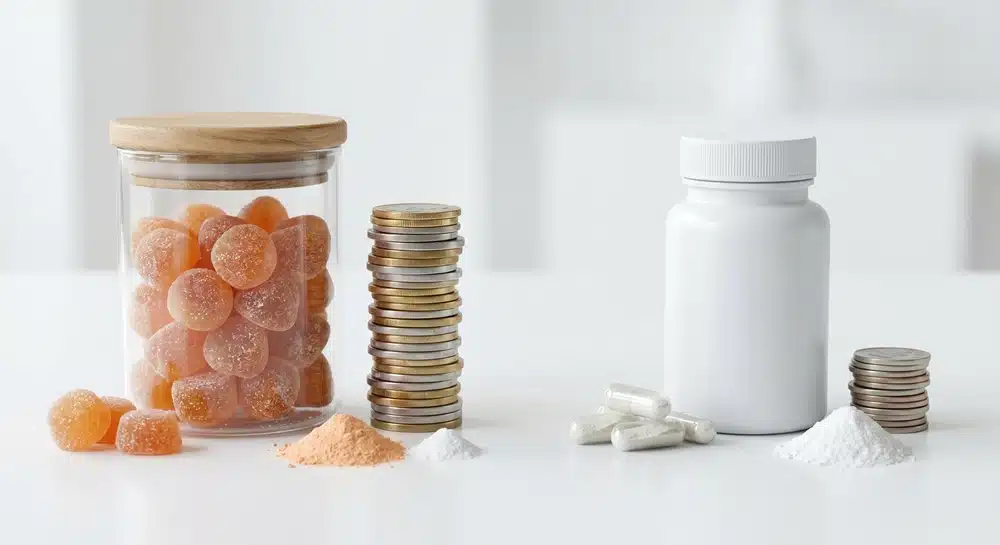
Utiliza esta sencilla regla de decisión:
– Si la fórmula requiere una dosis elevada de principio activo, un bajo contenido en azúcar y una gran estabilidad, empieza por cápsulas, comprimidos o polvos.
– Si la fórmula debe garantizar el sabor, la facilidad para masticar y la creación de un hábito diario, prueba las gominolas en una fase temprana, pero confirma la concentración del principio activo, la actividad del agua y la estabilidad de las declaraciones del etiquetado antes de aprobar el concepto.
Conclusión: el veredicto definitivo sobre las gominolas frente a las cápsulas
Las cápsulas suelen ser el mejor formato técnico en cuanto a potencia, posicionamiento como producto sin azúcar, alta concentración de principio activo, ingredientes sensibles y coste por dosis efectiva. Las gominolas suelen ser el mejor formato desde el punto de vista del comportamiento cuando el sabor, la facilidad para masticarlas y el cumplimiento de la rutina son más importantes que la máxima densidad de dosificación.
Para los consumidores, la mejor opción es aquella que aporta la dosis activa adecuada y que se puede tomar de forma constante. Para las marcas de complementos alimenticios, la mejor opción es el formato que cumpla los requisitos de viabilidad, estabilidad, declaraciones en la etiqueta y margen de beneficio antes de su lanzamiento.
fAQs
Fuente de referencia
- FDA / eCFR 21 CFR, parte 111, buenas prácticas de fabricación actuales (cGMP) para complementos alimenticios: https://www.ecfr.gov/current/title-21/chapter-I/subchapter-B/part-111
- Guía de cumplimiento de la FDA para pequeñas empresas: Buenas prácticas de fabricación de suplementos dietéticos (CGMP): https://www.fda.gov/regulatory-information/search-fda-guidance-documents/small-entity-compliance-guide-current-good-manufacturing-practice-manufacturing-packaging-labeling
- Declaraciones de la FDA sobre estructura y función: https://www.fda.gov/food/nutrition-food-labeling-and-critical-foods/structurefunction-claims
- Ficha informativa sobre el magnesio de la ODS de los NIH para profesionales de la salud: https://ods.od.nih.gov/factsheets/Magnesium-HealthProfessional/
- USP / CERSI: Resumen de las monografías de la USP sobre geles masticables: https://cersi.umd.edu/sites/cersi.umd.edu/files/Session_1-1_NataliaDavydovaCandy-Like_Oct30_2023.pdf
- Pruebas de estabilidad según la norma ICH Q1A(R2): https://database.ich.org/sites/default/files/Q1A%28R2%29%20Guideline.pdf
- Cleveland Clinic: ¿Son tan eficaces las vitaminas en gominolas como las tradicionales?: https://health.clevelandclinic.org/do-gummy-vitamins-work-as-well-as-traditional-vitamins
- UCLA Health: ¿Deberías tomar vitaminas en forma de gominolas?: https://www.uclahealth.org/news/article/should-you-take-gummy-vitamins
- PBS NewsHour: ¿Son las vitaminas en gominolas tan eficaces como las pastillas de vitaminas tradicionales?: https://www.pbs.org/newshour/show/are-gummy-vitamins-as-effective-as-traditional-vitamin-pills
- Estudio de bioequivalencia de gominolas y comprimidos de vitamina D (PMC): https://pmc.ncbi.nlm.nih.gov/articles/PMC6566230/
- Innovación en la fabricación de gominolas / sistemas sin almidón: https://www.nutritionaloutlook.com/view/gummy-supplements-and-manufacturing-innovation
- Colorcon: Creando gominolas de mejor calidad / Envases con actividad de agua: https://www.colorcon.com/education-insights/crafting-better-gummies

Warren Wan es un experto con una amplia trayectoria en la cadena de suministro de complementos alimenticios, que cuenta con una gran experiencia práctica en la investigación, el desarrollo, el control de procesos y el abastecimiento global de ingredientes clave como los péptidos de colágeno, la proteína de caldo de huesos y la queratina. Como autor de esta columna, se dedica a desmontar los argumentos de marketing, transformando la compleja ciencia de los ingredientes y las normas de control de calidad de la producción en divulgación científica rigurosa y fácil de entender, ayudando a los lectores a comprender la verdad que se esconde tras las etiquetas y a tomar decisiones más racionales en materia de salud.


