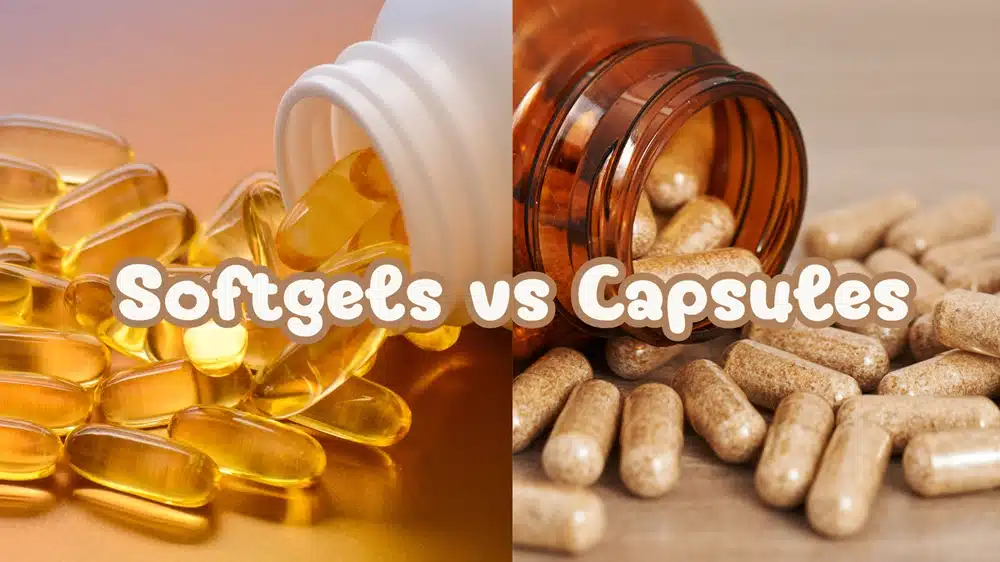
When it comes to choosing a supplement delivery method, most consumers and brand owners ask the same question: Are softgels better than tablets?
While softgels are often perceived as the “premium” choice due to their smooth texture and perceived faster absorption, the truth is that neither is universally superior. The “better” option depends entirely on your specific formula, target audience, and health goals.
In this guide, we will break down the science of softgels versus tablets—comparing absorption rates, manufacturing complexities, and consumer preferences—to help you determine which format is the perfect fit for your next supplement innovation.
What’s the Difference?
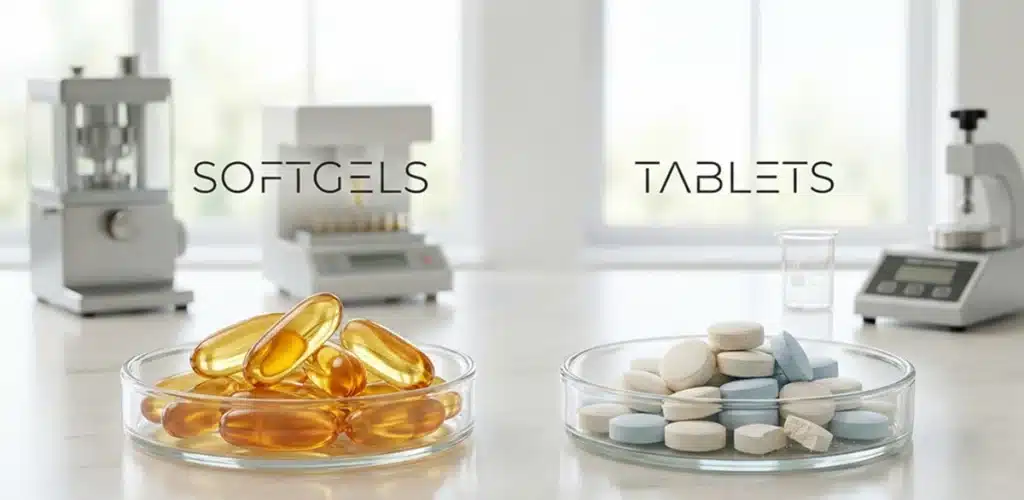
To understand why one might be better than the other, we first need to look at how they are built. From a manufacturing perspective at Gensei, these two formats represent entirely different engineering processes.
The Softgel: The Liquid-Tight Powerhouse
A softgel is a one-piece, hermetically sealed shell. Scientifically known as a soft gelatin capsule, it is designed specifically to hold liquid, semi-solid, or oil-based formulations.
- The Shell: Typically made from a blend of gelatina (or plant-based polymers like carrageenan), water, and a plasticizer (like glycerin or sorbitol) to keep it flexible.
- Il processo: We use a high-precision method called Rotary Die Encapsulation. In this process, two ribbons of gelatin are formed and pass over rotating dies. The liquid fill is injected at the exact moment the dies cut and seal the ribbons into a single, seamless unit.
The Tablet: The Compressed Standard
A tablet is a solid dosage form created by compressing a blend of powders under immense pressure. Whether producing a complex multivitamin or a single-ingredient Compressa di integratore alimentare, this remains the most common delivery method worldwide due to its versatility.
- The Composition: Tablets are more than just active ingredients; they contain excipients—binders to hold the pill together, disintegrants to help it break apart in the stomach, and lubricants to ensure smooth manufacturing.
- Il processo: Manufacturing involves Direct Compression or Granulation. The powder blend is fed into a tablet press, where mechanical “punches” exert tons of force to mold the powder into a hard, solid shape.
Quick Comparison
| Caratteristica | Capsule molli | Compresse |
| Physical State | Liquid, Oil, or Paste | Compressed Dry Powder |
| Sealing | Hermetically Sealed (One-piece) | Compressed (No shell) |
| Primary Advantage | Ideal for oils & fat-soluble actives | Cost-effective & high dosage |
| Manufacturing Method | Rotary Die Encapsulation | Direct Compression / Granulation |
| Typical Ingredients | Fish oil, Vitamin D, CBD | Multivitamins, Minerals, Vitamin C |
Bioavailability & Absorption: Does One Work Faster?
In the world of supplement production, bioavailability—the proportion of a nutrient that enters the circulation to have an active effect—is the ultimate benchmark of quality. This is often where the “Are softgels better than tablets?” debate gets most heated.
The Bioavailability of Softgels
Softgels are frequently cited as having superior bioavailability, and for many formulations, this is scientifically accurate. For brands looking to market high-end Integratori in capsule molli, the body does not have to work as hard to break down the active ingredients since they are already dissolved or suspended in a liquid carrier.
- Faster Disintegration: Once a softgel reaches the stomach, the gelatin shell dissolves quickly, releasing the liquid contents for immediate absorption.
- The “Lipophilic” Advantage: For fat-soluble nutrients like Omega-3 fish oils, Vitamin D3, CoQ10, and Curcumin, softgels are the gold standard. These ingredients require a fat source to be absorbed effectively; by delivering them in an oil-based softgel, Gensei ensures the “delivery vehicle” is built right into the dose.

The Absorption Path of Tablets
Tablets follow a different physiological path. Because they are highly compressed solids, they must undergo a process called disintegration before the nutrients can be absorbed.
- Breakdown Time: The stomach must first break the tablet into smaller particles, and then those particles must dissolve into the gastric fluid.
- Precision Engineering: To combat slower absorption, Gensei utilizes advanced disintegrants—specialized excipients that act like microscopic sponges, pulling water into the tablet to make it “burst” apart quickly once it hits the stomach.
- Controlled Release: One major advantage of tablets is the ability to create Sustained-Release (SR) or Timed-Release formulas. This allows a nutrient to be released slowly over 8–12 hours, which is impossible with a standard liquid-filled softgel.
Bioavailability & Performance Comparison Table
| Performance Metric | Capsule softgel | Compressed Tablets |
|---|---|---|
| Velocità di assorbimento | Rapid; liquid contents are released immediately upon shell dissolution. | Variable; requires mechanical disintegration before dissolution begins. |
| Biodisponibilità | Highest for lipophilic (oil-soluble) nutrients like Vitamin D3 and Omega-3. | High for water-soluble vitamins and large-dose minerals. |
| Digestive Comfort | Generally easier on the stomach; smooth texture aids in swallowing. | Can cause slight irritation in sensitive individuals if not film-coated. |
| Release Precision | Standard immediate release; limited sustained-release options. | Highly versatile; supports sustained, delayed, or enteric-coated release. |
| Ingredient Stability | Superior protection against oxidation for oxygen-sensitive oils. | Excellent heat and moisture resistance for long-term dry stability. |
Consumer Experience: Swallowing and Taste
Beyond the science, the “better” supplement is the one the consumer actually remembers to take. User experience is a massive driver for brand loyalty, which is why Produzione di integratori in compresse often involves specialized film coatings to improve the “mouthfeel” and swallowability of the final product.
- Ease of Ingestion: Softgels have a smooth, flexible exterior that becomes slippery when in contact with saliva. For consumers who struggle with “pill fatigue,” a large softgel is often easier to manage than a dry tablet.
- Odour and Taste Masking: Some of the most effective ingredients (like Valerian root or fish oil) have a pungent smell or bitter taste. Softgels are hermetically sealed, meaning they completely lock in the odor. Tablets, unless they are heavily film-coated, can sometimes have a “chalky” taste or a distinct herbal scent.
- Appeal visivo: In the modern market, aesthetics matter. Softgels can be made transparent, vibrant, or even pearlescent. At Gensei, we offer custom colors and shapes that help a brand stand out on a crowded shelf.
Stability, Shelf Life, and Potency
When determining if softgels are better than tablets, we must look beyond the moment of consumption. How a supplement holds up over 12 to 24 months on a shelf is critical for both consumer safety and brand reputation.
Oxidation and Airtight Protection
The primary strength of a softgel is its hermetic seal. Because the shell is one solid piece, it provides an airtight barrier that protects sensitive ingredients from oxygen.
- Preventing Rancidity: This is vital for oils like Fish Oil, Flaxseed, or Krill Oil, which can go rancid quickly when exposed to air.
- Preserving Potency: By preventing oxidation, softgels ensure that the potency of delicate nutrients remains high from the day of manufacture.
Durability and Environmental Resistance
While softgels excel at blocking air, tablets are the “industrial-strength” choice when it comes to physical durability.
- Heat and Humidity: Softgels are sensitive to environmental changes. Tablets are far more stable in diverse climates.
- Longer Shelf Life: Because tablets are dry, they are naturally less prone to microbial growth. Gensei’s advanced moisture-barrier coatings help maintain stability.
The Manufacturer’s Choice: Cost, MOQs, and Formulations
From the perspective of a brand owner working with an OEM like Gensei, the “better” option often comes down to the logistics of production and the complexity of the formula.
Cost-Efficiency and Volume
Generally, produzione di integratori in compresse is more cost-effective than softgels. The process is faster, and the raw materials for the “shell” (gelatin) are not required. If you are looking to launch a high-volume product with a competitive price point, tablets are usually the best starting point.
Minimum Order Quantities (MOQs)
Produzione di capsule molli requires specialized machinery (the Rotary Die) that often necessitates higher startup runs. However, as a flexible Produttore di capsule softgel, Gensei offers low MOQ options to help emerging brands test the market without the burden of massive inventory.
Formulation Flexibility
- Compresse: Best for “everything-but-the-kitchen-sink” formulas. If you want a multivitamin with 30 different herbs, vitamins, and minerals, the compression power of a tablet allows you to fit more ingredients into a smaller space.
- Capsule molli: Best for “purity” formulas. If your product is a single high-quality oil or a fat-soluble liquid, the softgel provides a premium, high-tech feel that justifies a higher retail price.
Final Verdict: Which One Should You Choose?
There is no single winner in the “softgels vs. tablets” debate. Instead, the choice should be driven by your active ingredients and your target customer.
- Choose Softgels if: Your formula is oil-based, requires high bioavailability for fat-soluble nutrients, or if you want to offer a premium, “easy-to-swallow” experience.
- Choose Tablets if: You have a complex powder-based formula, require a high dosage in a small size, or are looking for the most cost-effective and shelf-stable solution for global distribution.
Domande frequenti
Conclusione
Choosing between softgels and tablets is one of the most significant decisions in the product development lifecycle. As we have explored, the answer to “are softgels better than tablets?” is rarely a simple yes or no. Instead, it is a strategic choice based on the chemical nature of your active ingredients, your production budget, and the specific experience you want to provide to your end-user.
Making the Right Choice for Your Brand
Softgel Advantage
Softgels are the ideal choice for lipophilic (oil-based) ingredients, offering superior bioavailability and a premium, easy-to-swallow consumer experience.
Tablet Reliability
Tablets remain the industry standard for complex multi-ingredient formulations, offering unmatched durability, shelf stability, and cost-efficiency for high-volume orders.
At Gensei, we understand that every supplement brand has a unique vision. Whether you need a high-capacity produttore di integratori in compresse for a cost-effective product line or a specialized partner for premium encapsulation, our team is equipped to guide you through the technical nuances of both formats.
Turnkey Manufacturing from Concept to Consumer
Our facility provides comprehensive support across the entire manufacturing spectrum:
Formulazione personalizzata di integratori
Tailoring the exact ratio of actives and excipients for maximum efficacy.
Professional R&D and Pilot Runs
Testing your formula in small batches before moving to full-scale production.
Soluzioni di imballaggio avanzate
Ensuring your final product is protected and shelf-ready.
The success of your supplement depends on more than just high-quality ingredients; it requires the right delivery vehicle to ensure those ingredients perform as intended.
Whether you are looking for high-bioavailability softgels or cost-efficient tablets, Gensei provides the turnkey R&D and manufacturing expertise you need to succeed. From small-batch pilot runs to large-scale global production.
riferimenti
- manufacturing processes (compression and encapsulation) and quality control.(source link: United States Pharmacopeia (USP) – Dietary Supplement Verification)
- How does the human body absorb vitamins, and why is the form in which they are taken (e.g., oil-based softgels) important for fat-soluble vitamins?(source link: National Institutes of Health (NIH) – Bioavailability of Nutrients)
- Lipophilic Advantage.(source link: MDPI – Bioavailability of Lipophilic Nutrients)
- FDA’s guidance on stability testing and labeling(source link: FDA – Dietary Supplement Guidance & Regulatory Information)