This guide is for consumers comparing labels and for supplement brands evaluating raw materials, dosage forms and finished-product vegan claims. Consumers with diagnosed deficiency, kidney disease, high calcium, malabsorption or medication-related risks should obtain professional guidance rather than choosing a dose from a comparison article.
Supplement brands can use the sourcing, COA and formulation checklist below or review GENSEI’s vegan vitamin D3 ingredient specifications before requesting a sample or quotation.
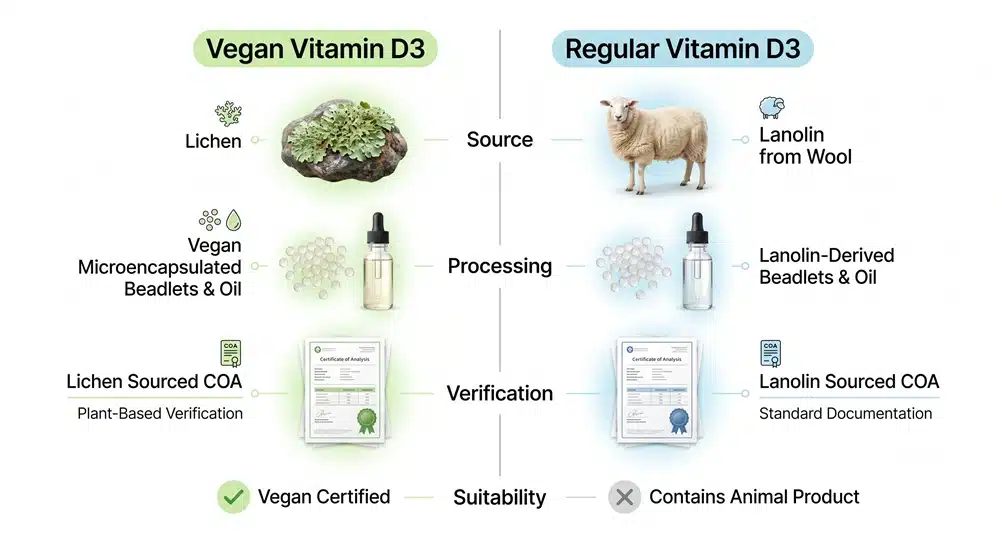
Vegan Vitamin D3 vs Regular D3 at a Glance
| ファクター | ヴィーガン ビタミンD3 | 従来のビタミンD3 |
|---|---|---|
| Chemical form | コレカルシフェロール | コレカルシフェロール |
| Common source | Lichen-derived or another documented animal-free production route | Usually lanolin-derived; selected products may use fish-derived sources |
| Suitable for vegan products | Potentially yes, when the active, carriers, shell, flavors and processing aids are verified | Usually no when sourced from lanolin or fish |
| Expected vitamin function | Supplies vitamin D3 | Supplies vitamin D3 |
| Primary buying question | Can the supplier document animal-free source and finished-product compatibility? | Can the supplier document source, traceability, potency and carrier system? |
| 一般的な形式 | Oil dispersions, powders, beadlets, capsules, tablets, gummies, sprays and liquids | Oil dispersions, powders, beadlets, capsules, tablets, gummies, sprays and softgels |
| Quality decision | Identity, potency, stability, uniformity and certification scope | Identity, potency, stability, uniformity and source documentation |
ヴィーガン用ビタミンD3とは?
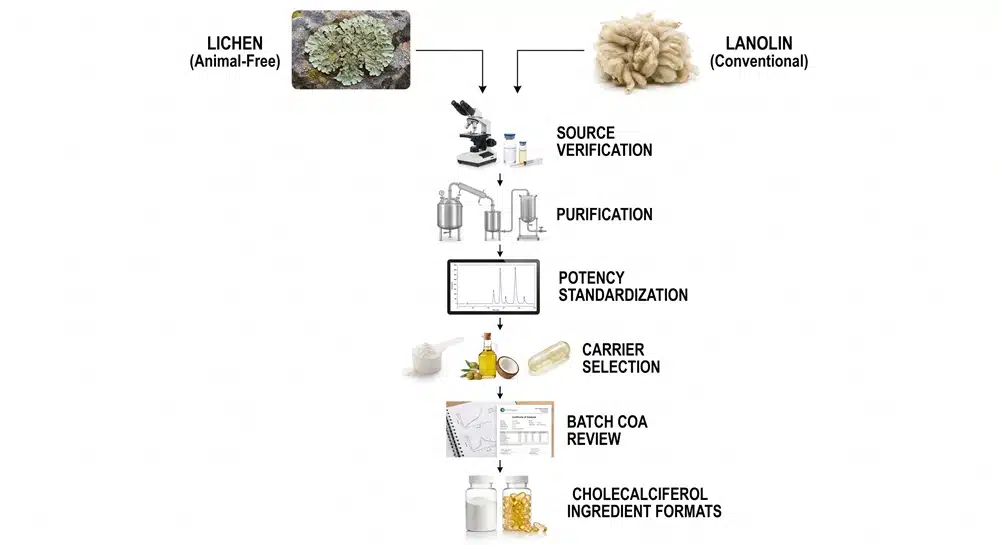
Vegan vitamin D3 is cholecalciferol produced from a documented animal-free source. Lichen is the best-known commercial source, although some suppliers use other non-animal production routes. The active molecule should still be identified as vitamin D3 or cholecalciferol.
A lichen-derived active does not automatically make the finished supplement vegan. Carriers, antioxidants, capsule shells, gummy systems, flavors, colors, processing aids and cross-contact controls also require review. Procurement teams should request the active-source declaration, complete carrier composition and certification scope rather than relying only on “plant-based D3” marketing.
The word “plant-based” should be used carefully because lichen is a symbiotic organism rather than a conventional plant. “Lichen-derived vitamin D3” or “animal-free vitamin D3” is often more technically precise.
What Is Regular Vitamin D3 Made From?
Conventional vitamin D3 supplements are commonly produced from 7-dehydrocholesterol derived from lanolin, a wax obtained from sheep’s wool. Lanolin-derived D3 is also cholecalciferol. The animal origin affects dietary positioning and documentation, not the chemical name of the active.
Brands sourcing conventional material should confirm whether the ingredient is lanolin-derived, fish-derived or supplied through another process. Review the exact form, potency and carrier on the vitamin D3 ingredient page.
Is Vegan D3 as Good as Regular D3?
When both materials are properly identified cholecalciferol at the same verified dose, source alone is not a reason to expect a different vitamin D3 function. Finished-product performance can still vary because of potency, carrier, dosage form, manufacturing controls, storage, adherence and individual ビタミンD status.
Brands should avoid claims that lichen D3 is automatically “healthier,” “more bioavailable” or “more powerful.” They should also remove unsupported statements that fish-oil D3 is absorbed better than lanolin or lichen D3.
Is Cholecalciferol Vegan?
Sometimes. “Cholecalciferol” identifies vitamin D3 but does not identify its source. A cholecalciferol ingredient may come from lanolin, fish, lichen or another documented process. Consumers should check the label or contact the manufacturer. Brands should retain source declarations and supporting documentation for the exact commercial ingredient.
Vegan D3 vs Vitamin D2
Vitamin D2 is ergocalciferol, commonly produced from UV-exposed yeast or fungi. Vegan vitamin D3 is cholecalciferol from an animal-free source such as lichen. D2 and D3 are different vitamin D forms, while lichen D3 and lanolin D3 are different sources of the D3 form.
Comparative research generally finds that vitamin D3 raises or maintains serum 25-hydroxyvitamin D more effectively than vitamin D2. This evidence should not be misused to claim that lichen-derived D3 is better than lanolin-derived D3, because both supply D3. Brands comparing D2 ingredients can review vitamin D2 ingredient formats そして vitamin D2 mushroom powder.
Which Source Should Consumers Choose?
- Choose lichen-derived D3 when avoiding animal-derived ingredients is important.
- Choose lanolin-derived D3 when vegan sourcing is not required and the product has appropriate quality documentation.
- Choose by complete product quality: verify dose, other ingredients, testing, expiration dating and appropriate directions.
- Do not choose by “natural,” “clean” or “maximum absorption” language alone.
Consumers deciding between routine retail supplements and clinician-directed high-dose products can also review prescription vitamin D vs over-the-counter vitamin D.
How Much Vitamin D3 Is Appropriate?
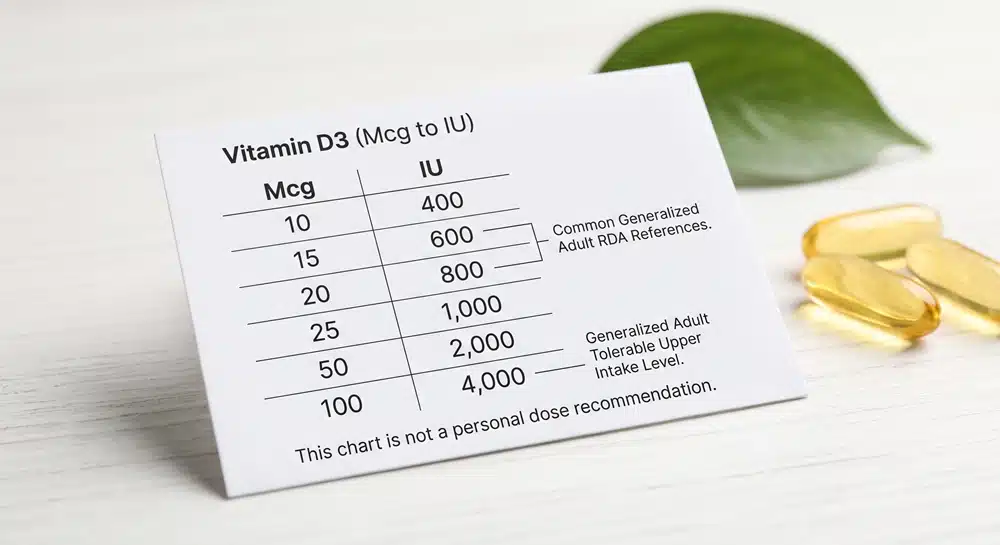
The U.S. Recommended Dietary Allowance is 15 mcg (600 IU) per day for most people ages 1–70 and 20 mcg (800 IU) for adults over 70. These values apply to total intake and are not automatic supplement-dose recommendations for every individual.
The adult Tolerable Upper Intake Level is 100 mcg (4,000 IU) per day for most healthy adults. Clinicians may recommend different amounts for documented deficiency or medical conditions, but treatment protocols should not be copied into routine consumer marketing.
| Label Amount | Equivalent | 配合に関する注記 |
|---|---|---|
| 10 mcg | 400 IU | Used in selected lower-dose or age-specific products, depending on market requirements |
| 15 mcg | 600 IU | Matches the U.S. RDA for most people ages 1–70 |
| 25 mcg | 1,000 IU | Common retail strength; still requires appropriate directions |
| 50 mcg | 2,000 IU | Common higher-strength supplement format |
| 100 mcg | 4,000 IU | Adult UL, not a default recommendation for everyone |
Safety, Toxicity and Medication Interactions
Vitamin D is fat-soluble, and excessive intake can cause hypercalcemia and hypercalciuria. Possible effects include nausea, weakness, confusion, excessive thirst, frequent urination, kidney stones and other kidney problems. Toxicity usually results from excessive supplement intake or manufacturing or dosing errors, not ordinary sun exposure.
Vitamin D supplements can interact with medicines including orlistat, selected statins, corticosteroids and thiazide diuretics. People who are pregnant or breastfeeding, have kidney disease, high calcium, hyperparathyroidism, sarcoidosis or another granulomatous condition, or take prescription medicines should consult a qualified healthcare professional.
Does the Dosage Form Affect Absorption?
Vitamin D3 is fat-soluble. Oil-based drops and softgels are common, but properly formulated capsules, tablets, gummies, sprays and dry powders can also deliver vitamin D3. It is too broad to claim that one dosage form always provides superior absorption.
For brands, the more important questions are whether the carrier is compatible with the active, whether low-dose uniformity is controlled, whether potency is maintained through shelf life, and whether the final package protects the ingredient from light, heat and oxygen.
Vegan Claim Verification for Supplement Brands
A finished-product vegan claim requires more than a lichen-derived active. Brands should verify:
- The source and production declaration for the vitamin D3 active
- Carrier oils, starches, emulsifiers, antioxidants and encapsulation materials
- Gelatin-free capsule, softgel, gummy and coating systems
- Flavor, color and processing-aid origin
- Sub-ingredients within premixes and flavors
- Cross-contact and facility controls
- The scope, expiry date and exact product coverage of any vegan certification
Brands developing vegan gummies should review vegan gummy ingredient considerations, while still verifying the current formula and certification documents independently.
品質仕様チェックリスト
| 仕様 | 確認すべき事項 | なぜ重要なのか |
|---|---|---|
| アイデンティティ | Cholecalciferol identity using a validated method | Confirms the active is vitamin D3 |
| ソース | Lichen, lanolin, fish or another documented production route | Supports vegan, vegetarian and sourcing claims |
| 効力 | IU or mcg per gram, assay method and reporting basis | Prevents premix and label-dose errors |
| キャリアシステム | Oil, beadlet, powder or dilution composition | Determines whether the complete ingredient fits the product claim |
| 均一性 | Premix and finished-product dosage-unit uniformity | Vitamin D3 is used at low inclusion levels |
| 関連物質 | Degradation products and process impurities | Supports purity and stability control |
| 汚染物質 | Heavy metals, microbiology and residual solvents where applicable | 原材料および完成品の出荷を支援します |
| 安定性 | Light, heat, oxygen and final-package stability data | Confirms label potency through shelf life |
| 認証 | Vegan, vegetarian, halal, kosher, non-GMO and allergen documents as required | Supports market-specific claims |
| Batch documentation | Lot-specific COA, specification, TDS/SDS and change-control notification | Supports supplier qualification and ongoing quality review |
Procurement teams can use the vitamin ingredient sourcing hub そして supplement quality-control framework to compare documents before approving a material.
製剤に関する考慮事項
Softgels and Oil Drops
Oil-soluble vitamin D3 works naturally in softgels and liquid drops. Vegan softgel projects require verification of both the D3 source and the shell system. Review ソフトジェルカプセルの製造 そして 液体サプリメント製造.
カプセルと錠剤
Dry D3 ingredients are commonly supplied as beadlets, microencapsulated powders or premixes. Formulators must control low-dose blending, overage, compression, light exposure and stability. GENSEI supports カプセル・サプリメント製造 そして 錠剤サプリメント製造.
Gummies, Powders and Sprays
These formats require careful dose-uniformity and stability testing. Gummies add water-activity and heat challenges; powders require validated premixes; sprays require metered-dose delivery and microbial controls. See グミサプリ製造, 粉末サプリメント製造 そして oral spray manufacturing.
RFP Questions for a Vegan Vitamin D3 Supplier or Manufacturer
- Is the vitamin D3 sourced from lichen, lanolin, fish or another process?
- Can you provide a source and animal-free production declaration?
- What exact carrier, antioxidant, coating and excipient system is used?
- What is the potency in IU or mcg per gram, and which assay method applies?
- そのロットに関する直近のCOAを3通ご提供いただけますか?
- What degradation products, residual solvents, heavy metals and microbiological tests are controlled?
- What stability data support the retest date and finished-product shelf life?
- How do you verify microgram-level blend and dosage-unit uniformity?
- Which vegan, vegetarian, halal, kosher, allergen and non-GMO documents are available?
- 最小発注数量(MOQ)、サンプル数量、梱包オプション、およびリードタイムはどのようになっていますか?
- Can you support softgel, capsule, tablet, gummy, powder, liquid or spray pilot production?
- How are source, bone-health, immune-function, deficiency and “better absorption” claims reviewed?
GENSEIの活用シーン
GENSEIは以下をサポートしています ビタミン受託製造, カスタムサプリメント処方, ingredient sourcing, dosage-form development and finished-product quality review.
ブランドは request a vegan vitamin D3 sample, COA or quotation with the target source, potency, dosage form, certification, packaging, destination market and order quantity.
よくある質問
ヴィーガンD3は普通のD3と同じくらい良いのですか?
Both are cholecalciferol. When identity, dose and finished-product quality are equivalent, source alone should not be treated as proof of a different vitamin D3 effect.
What is vegan vitamin D3 made from?
It is commonly sourced from lichen or another documented animal-free process. The full carrier and dosage-form composition must also be checked before calling the finished product vegan.
Is regular vitamin D3 vegan?
Usually not. Conventional D3 is commonly produced from lanolin obtained from sheep’s wool. The label or manufacturer should confirm the source.
Is lichen D3 better than lanolin D3?
It is better for an animal-free sourcing requirement, but it is not inherently more potent or healthier. Dose, identity, stability, carrier and finished-product quality matter more for product performance.
Is cholecalciferol vegan?
Sometimes. Cholecalciferol describes the D3 molecule, not its source. Source documentation is required.
Can too much vitamin D3 be harmful?
Yes. Excessive supplemental vitamin D can cause hypercalcemia and kidney or other health problems. The adult UL is 4,000 IU per day for most healthy adults unless a clinician directs otherwise.
最終的な収穫
Vegan vitamin D3 and conventional D3 supply the same vitamin form—cholecalciferol—but come from different sources. Lichen-derived D3 supports vegan and animal-free positioning; lanolin-derived D3 remains a widely used conventional source. The better product is the one with transparent source documentation, verified carriers, correct potency, appropriate certification, dosage-unit uniformity, final-package stability and lot-specific quality records.
参考文献
- NIH Office of Dietary Supplements: Vitamin D Fact Sheet for Health Professionals
- NIH Office of Dietary Supplements: Vitamin D Fact Sheet for Consumers
- Comparison of Vitamin D2 and Vitamin D3 Supplementation: Systematic Review and Meta-Analysis
- FDA:栄養補助食品に関するQ&A
- FDA:構造・機能に関する主張
- FTC:健康関連製品のコンプライアンスに関するガイダンス
- 21 CFR 第111部:栄養補助食品の適正製造規範(cGMP)
- Vegan Action: Certification FAQs
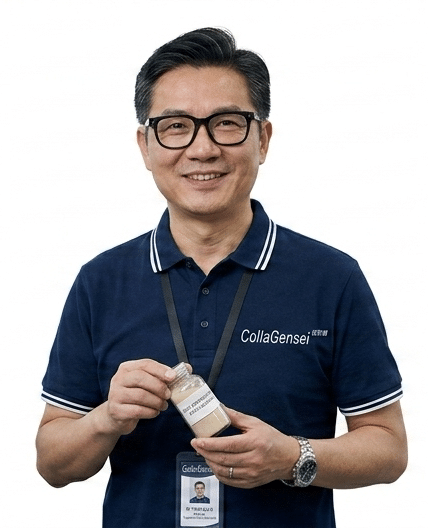
ウォーレン・ワン氏は、栄養補助食品のサプライチェーンにおいて豊富な経験を持つベテランの専門家であり、コラーゲンペプチド、骨スープ由来タンパク質、ケラチンといった主要成分の研究、開発、工程管理、およびグローバルな調達において、豊富な実務経験を有しています。 本コラムの執筆者として、彼はマーケティング的な装いを剥ぎ取り、難解な成分科学や製造品質管理基準を、分かりやすい本格的な科学普及記事へと変換することに尽力しています。これにより、読者がラベルの裏にある真実を理解し、より合理的な健康に関する選択を行えるよう支援しています。.