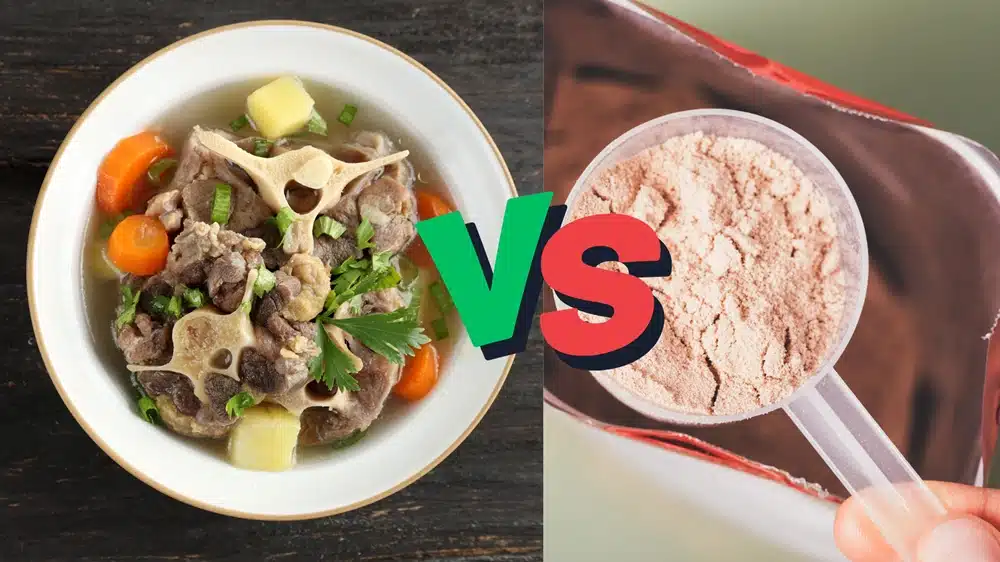
Neither option is automatically “better.” Choose collagen peptides for precise dosing and broad formulation flexibility. Choose bone broth powder for a savory, food-based product or meal occasion. Always compare the Nutrition Facts or Supplement Facts panel, ingredient list, serving size, source, and quality documentation rather than relying on the category name alone.
Quick Comparison: Bone Broth Powder vs Collagen Powder
| Fator | Caldo de ossos em pó | Colagénio em pó |
|---|---|---|
| O que é isto | Concentrated and dried broth made from animal bones and connective tissues; composition varies by process and formula | Purified collagen, usually enzymatically hydrolyzed into smaller collagen peptides |
| Protein form | May contain gelatin, collagen peptides, or a mixture depending on processing | Usually hydrolyzed collagen peptides with a defined protein specification |
| Dose consistency | Variable; check protein per serving and the supplier specification | Generally more standardized and easier to dose by grams |
| Taste and use | Savory or umami; suited to soups, broths, sauces, and savory drink mixes | Usually neutral; suited to coffee, smoothies, powders, sachets, and other supplement formats |
| Research relevance | Limited direct clinical research on commercial bone broth powders; composition may not match study products | More human research uses defined hydrolyzed collagen doses, although results and study quality vary |
| Main label checks | Protein, sodium, ash, ingredients, allergens, heavy metals, microbiology, and serving size | Protein, source, molecular-weight range, solubility, allergens, heavy metals, microbiology, and serving size |
| Melhor ajuste | Whole-food positioning, savory nutrition, soup bases, and functional foods | Measured collagen intake, beauty-from-within products, joint-positioned formulas, and neutral drink mixes |
Are Bone Broth Powder and Collagen Powder the Same?
No. They can come from similar animal tissues, but the finished ingredients are produced and standardized differently.
Bone broth is made by extracting components from bones, cartilage, and connective tissues in water. Commercial producers may filter, concentrate, clarify, and dry the liquid. The final powder can contain protein, gelatin, naturally occurring flavor compounds, sodium, ash, and small amounts of other components. The exact profile depends on the raw material, extraction conditions, concentration ratio, added ingredients, and drying method.
Collagen powder is typically produced by isolating collagen-rich material and using controlled hydrolysis to create smaller peptides. The ingredient is then filtered, concentrated, dried, and tested against a specification. This makes hydrolyzed collagen easier to standardize for protein content, molecular-weight distribution, flavor, color, and solubility.
How the Manufacturing Process Changes the Finished Product
How Bone Broth Powder Is Made
A typical commercial process may include raw-material preparation, hot-water extraction, filtration, fat separation, concentration, pasteurization, and spray drying. Some products contain only dried broth, while others include salt, flavors, vegetables, herbs, carriers, or anti-caking agents. That is why two products labeled “bone broth powder” can have very different protein and sodium levels.
How Hydrolyzed Collagen Powder Is Made
Hydrolyzed collagen production starts with collagen-rich animal material such as bovine hide, fish skin or scales, porcine skin, or chicken cartilage. Enzymatic hydrolysis reduces the collagen into smaller peptides. Manufacturers then control filtration, concentration, drying, sieving, and release testing to achieve the desired protein percentage, peptide-size range, sensory profile, and application performance.
For ingredient sourcing, review wholesale collagen peptide specifications rather than comparing products only by source or marketing language.
Nutrition: Compare the Label, Not the Category
Bone broth powder is often described as a broad nutrient matrix, while collagen powder is described as concentrated protein. That distinction can be useful, but it should not replace a label comparison.
- Proteínas por porção: Collagen powders commonly provide a high proportion of protein by weight. Bone broth powders vary more because they may contain sodium, ash, flavor compounds, or added ingredients.
- Sodium: Savory bone broth products may contain substantial sodium. Consumers on sodium-restricted diets should check the label carefully.
- Minerais: Bone broth can contain minerals, but the amount is not automatically high or nutritionally meaningful. Use the Nutrition Facts panel or a laboratory specification instead of assuming that all broths are rich in calcium or magnesium.
- Amino acids: Both products can provide glycine, proline, and hydroxyproline. However, the concentration and serving size determine the actual intake.
- Complete protein: Collagen and gelatin are not complete proteins because they do not provide all indispensable amino acids in the proportions needed to serve as a sole protein source. They should complement, not replace, a balanced diet and complete protein foods.
Absorption and Bioavailability: What the Evidence Actually Supports
Both gelatin and hydrolyzed collagen are digested. Hydrolyzed collagen does not “bypass digestion,” and bone broth gelatin does not simply coat or seal the intestinal wall. Human studies show that hydroxyproline-containing peptides can appear in the blood after collagen hydrolysate or gelatin intake, while smaller hydrolysates may produce different or higher peptide exposure than gelatin. The practical advantage of hydrolyzed collagen is standardization and convenient dosing, not a claim that digestion is avoided.
Research on oral collagen typically uses defined ingredients, doses, and study durations. Systematic reviews report promising findings for selected skin and joint outcomes, but results vary by product, population, endpoint, and study quality. Bone broth powder should not be presented as equivalent to the standardized collagen products used in those trials unless its composition and dose are demonstrated.
Which Is Better for Skin?
Hydrolyzed collagen powder has the stronger evidence base for skin-focused supplementation because clinical trials usually use standardized collagen peptide doses. Some reviews report improvements in skin hydration, elasticity, or wrinkle measures after consistent use, but benefits are not guaranteed and the magnitude may be modest.
Bone broth powder can contribute protein and amino acids, but its collagen dose is less predictable unless the product provides a verified specification. For a skin-focused product or routine, collagen peptides are generally the more measurable option.
Which Is Better for Joints and Mobility?
Research on hydrolyzed collagen and joint outcomes is promising but heterogeneous. Some studies report improvements in discomfort or function, while reviews note differences in product type, dose, population, and methodology. Collagen supplements should be described as supporting joint health or mobility, not as treating arthritis or replacing medical care.
Bone broth powder may fit a savory joint-wellness or whole-food concept, but the amounts of collagen, glucosamine, chondroitin, and other cartilage-related compounds can vary. A brand should not make quantitative claims unless those components are measured in the finished ingredient or product.
Which Is Better for Gut Health?
Bone broth is a convenient savory food and may help some people increase fluid and protein intake. However, there is not enough high-quality clinical evidence to claim that bone broth powder “seals the gut,” treats intestinal permeability, manages IBS, reduces autoimmune disease, or repairs the intestinal lining.
Collagen peptides can be included in digestive-wellness formulas because they are neutral and easy to blend, but they should not be positioned as a treatment for gastrointestinal disorders. For gut-health products, the primary differentiation may come from the complete formula, including fibers, prebiotics, probiotics, or other substantiated ingredients.
Which Is Better for Protein and Workout Recovery?
Collagen peptides can add protein to a beverage or snack, and bone broth powder can add protein to savory foods. However, neither should be the only protein used for muscle building because collagen has a limited essential amino acid profile. Athletes should obtain adequate total energy and complete protein from foods or appropriate protein supplements, while collagen may serve as a complementary ingredient for connective-tissue-oriented positioning.
Safety, Allergens, and Quality Checks
Most healthy adults can use collagen or bone broth products as foods or supplements, but product quality and individual tolerance matter.
- Animal source and allergens: Fish-derived collagen can trigger fish allergies. Chicken, bovine, and porcine sources may also affect dietary, religious, or market requirements.
- Sodium and kidney considerations: Bone broth powders may be high in sodium. People with kidney disease, fluid restrictions, or sodium-sensitive conditions should ask a healthcare professional before regular use.
- Pregnancy, breastfeeding, and children: Use products only when the ingredient list, source, and contaminant controls are appropriate, and consult a qualified healthcare professional when needed.
- Heavy metals and microbiology: Request or review batch testing for lead, arsenic, cadmium, mercury, total plate count, yeast and mold, and relevant pathogens.
- Additives: Check for flavors, sweeteners, sodium, carriers, anti-caking agents, and ingredients that may not fit your diet.
- Reivindicações: Avoid products that promise to cure digestive disease, reverse aging, treat arthritis, or produce guaranteed hair and skin changes.
GENSEI explains its broader testing approach on the controlo de qualidade dos suplementos página.
How Consumers Should Choose
| Your Priority | Better Starting Choice | Porquê |
|---|---|---|
| A predictable daily collagen serving | Hydrolyzed collagen powder | Protein and serving size are usually easier to verify |
| Neutral taste for coffee or smoothies | Hydrolyzed collagen powder | Typically designed for dispersion with minimal flavor |
| Savory drink, soup, or food use | Bone broth powder | The broth flavor supports the intended eating occasion |
| Lower sodium | Depends on the label | Unflavored collagen is often low in sodium, but always verify |
| Skin-focused supplementation | Hydrolyzed collagen powder | More clinical research uses standardized collagen peptides |
| Whole-food-style positioning | Bone broth powder | Better fit for savory and traditional-food narratives |
How Supplement Brands and Formulators Should Choose
For a supplement brand, the decision is a specification and product-design question. Compare the ingredients by the finished product you need to manufacture.
Request These Documents and Specifications
- Identity, animal source, country of origin, and traceability documents
- Protein on dry basis and amino-acid profile
- Molecular-weight distribution for hydrolyzed collagen peptides
- Moisture, ash, sodium, bulk density, mesh size, and solubility or dispersibility
- Heavy metals, microbiological limits, allergen statement, and residual processing aids
- Sensory profile, flavor-masking needs, color, and heat or pH stability
- MOQ, lead time, packaging format, shelf life, and batch-to-batch variation controls
A product-development team should also model grams per serving, cost per active serving, scoop or sachet size, flavor system, packaging barrier, and claim substantiation. Review GENSEI’s B2B bone broth vs collagen formulation guide, custom formulation servicee powder supplement manufacturing capabilities.
Can You Take Bone Broth Powder and Collagen Powder Together?
Yes, many healthy adults can use both, but the combination is not automatically more effective. It may make sense when the products serve different uses—for example, collagen peptides in a neutral drink and bone broth powder in a savory meal. Count the total protein and sodium, check allergens and additives, and avoid using both as substitutes for a balanced diet.
Final Verdict
Choose hydrolyzed collagen powder when you want a standardized collagen dose, neutral flavor, broad mixability, or a product aligned with research that used defined collagen peptides.
Escolha caldo de ossos em pó when you want a savory food-style ingredient, soup or broth use, and a broader—but more variable—nutrient matrix.
The best product is the one with a transparent label, appropriate serving size, verified source, and batch-level quality controls. For brands developing a collagen or bone broth product, contacte a GENSEI to discuss ingredient specifications, formulation, testing, manufacturing, and packaging.
Perguntas mais frequentes
Is bone broth powder the same as collagen powder?
No. Bone broth powder is a dried broth matrix whose protein, sodium, and other components can vary. Collagen powder is usually a more purified and standardized hydrolyzed collagen ingredient.
Does bone broth powder contain collagen?
Many bone broth powders contain collagen-derived protein or gelatin, but the amount varies. Check protein per serving and ask for a product specification if the collagen dose matters.
Is bone broth better than collagen powder?
Not universally. Bone broth powder is better for savory food use and whole-food-style positioning. Collagen powder is usually better for precise dosing, neutral taste, and research-aligned collagen supplementation.
What is the difference between bone broth and collagen peptides?
Bone broth is a variable food matrix made by water extraction. Collagen peptides are produced by controlled hydrolysis and are standardized for smaller peptide size, protein content, and formulation performance.
Which is better for skin, bone broth or collagen powder?
Hydrolyzed collagen powder has more direct human research for skin outcomes. Bone broth may contribute amino acids, but its collagen dose is less predictable unless standardized.
Which is better for joints?
Hydrolyzed collagen has more defined research, although results vary. Bone broth may fit a broader food-based approach, but joint-related compounds should not be assumed unless they are measured.
Can collagen or bone broth treat leaky gut or IBS?
No high-quality evidence supports presenting either product as a treatment for leaky gut, IBS, autoimmune disease, or other gastrointestinal conditions. Seek medical advice for persistent symptoms.
Are collagen and bone broth complete proteins?
No. They are rich in certain amino acids but do not provide a complete essential-amino-acid profile. Use them as complementary protein sources.
Referências
- Alcock RD, Shaw GC, Burke LM. Bone Broth Unlikely to Provide Reliable Concentrations of Collagen Precursors Compared With Supplemental Sources of Collagen Used in Collagen Research.
- Comparison of gelatin and low-molecular-weight gelatin hydrolysate ingestion on hydroxyproline-containing compounds in human blood.
- Absorption of bioactive peptides following collagen hydrolysate intake: a randomized, double-blind crossover study.
- Effects of hydrolyzed collagen supplementation on skin aging: a systematic review and meta-analysis.
- The Effects of Type I Collagen Hydrolysate Supplementation on Bones, Muscles, and Joints: A Systematic Review.
- U.S. FDA: Structure/Function Claims.
- U.S. FTC: Health Products Compliance Guidance.
Disclaimer: This article is for educational purposes and does not provide medical advice. Dietary supplements and food products are not intended to diagnose, treat, cure, or prevent disease. Consult a qualified healthcare professional regarding medical conditions, pregnancy, breastfeeding, medications, allergies, kidney disease, or dietary restrictions.

Warren Wan é um especialista experiente com vasta experiência na cadeia de abastecimento de suplementos alimentares, possuindo uma rica experiência prática na investigação, desenvolvimento, controlo de processos e aquisição global de ingredientes essenciais, tais como peptídeos de colagénio, proteína de caldo de ossos e queratina. Como autor desta coluna, dedica-se a ir além do discurso de marketing, transformando a ciência obscura dos ingredientes e as normas de controlo de qualidade da produção numa divulgação científica rigorosa e de fácil compreensão, ajudando os leitores a compreender a verdade por trás dos rótulos e a fazer escolhas mais racionais em matéria de saúde.