Выбор между сывороточным и растительным белком — это не только вопрос питания.
Для бренда пищевых добавок источник белка может влиять на аминокислотный профиль, размер порции, вкус, текстуру, статус аллергена, источники происхождения ингредиентов, целевую себестоимость, упаковку и технологический процесс производства готового продукта.
Сывороточный протеин зачастую является наиболее простым отправным пунктом для разработки традиционных формул спортивного питания, в которых приоритетными факторами являются ориентация на повышение спортивных результатов, богатый профиль незаменимых аминокислот и привычные характеристики коктейлей.
Растительный белок, как правило, лучше всего соответствует стратегическим требованиям концепций веганских, безмолочных и растительных продуктов. Однако необходимо комплексно оценивать конкретный источник белка, технические характеристики поставщика, состав смеси, систему вкусовых добавок и размер порции.
Ни одна из этих категорий не является автоматически лучшей.
Для бренда, разрабатывающего коммерческий белковый продукт, более уместным будет следующий вопрос:
Какая белковая система способна обеспечить питательную ценность, потребительский опыт, позиционирование, целевую себестоимость и производственные показатели, требуемые в данном техническом задании?
В данном руководстве объясняется, как принять такое решение.
Компании, у которых уже есть концепция продукта, также могут ознакомиться с нашим производство белковых добавок возможности по реализации индивидуальных проектов в области сывороточного и растительного белка, коллагена, заменителей пищи и специальных белковых продуктов.

Сравнение сывороточного и растительного белка: краткий обзор
| Фактор принятия решения | Сывороточный протеин | Растительный белок | О чём должен спросить бренд |
|---|---|---|---|
| Типичное расположение | Спортивное питание, спортивные результаты, популярные белковые добавки | Веганское, безмолочное, растительное питание, питание как образ жизни | Кто является целевым потребителем? |
| Белковая система | WPC, WPI, гидролизат или смеси сывороточного белка | Горох, рис, соя, конопля или смеси из нескольких источников | Какой именно ингредиент сравнивается? |
| Аминокислотный профиль | В целом богат незаменимыми аминокислотами и лейцином | В значительной степени зависит от источника и состава смеси | Мы уже проанализировали фактические данные по аминокислотам? |
| Вкус | Часто совместимы с традиционными профилями «шейк» | В значительной степени зависит от источников и поставщиков | Была ли данная основа протестирована при использовании в коммерческой дозировке? |
| Текстура | Часто их проще придать привычную консистенцию коктейлей | Может потребоваться дополнительная оптимизация текстур | Что происходит после смешивания и отстаивания? |
| Расположение аллергенов | Производные молока | Зависит от источника | Какие утверждения являются ключевыми? |
| Позиционирование веганства | Нет | Да, если полная формула соответствует требованиям | Подходят ли все ингредиенты и технологические ресурсы? |
| Сложность формулы | Часто проще | Может потребоваться оптимизация состава, вкуса и текстуры | Какую проблему решает каждый из добавленных ингредиентов? |
| Оценка затрат | Рассчитать на одну готовую порцию | Рассчитать на одну готовую порцию | Сколько стоит вся формула? |
| Оптимальный метод принятия решений | Техническое задание + прототип + модель расчета затрат | Техническое задание + прототип + модель расчета затрат | Что показывает сам прототип? |
Главное заключается в том, что бренд на самом деле не выбирает между двумя абстрактными категориями, называемыми сыворотка и завод.
Это выбор конкретных ингредиентов от конкретных поставщиков в соответствии с конкретной рецептурой для конкретной целевой аудитории.
Это различие имеет значение.
Настоящее отличие заключается не только в питании
В большинстве сравнений сывороточного и растительного белка основное внимание уделяется таким вопросам, как:
- В чём больше лейцина?
- Что усваивается быстрее?
- Что лучше для роста мышц?
- Что легче усвоить?
- Что из этого веганское?
- Что является более экологичным?
Эти вопросы полезны для потребителей.
Этих ресурсов недостаточно для разработки коммерческих продуктов.
Белковый ингредиент может выглядеть привлекательно в таблице питательной ценности, но при этом создавать проблемы в готовом продукте.
Например:
- размер порции становится слишком большим;
- система ароматизации не способна должным образом регулировать базовые ноты;
- текстура становится меловой или чрезмерно густой;
- осадок образуется после перемешивания;
- порошок образует слишком много стойкой пены;
- целевая стоимость не может быть достигнута;
- требуемые формулы изобретения противоречат системе ингредиентов;
- или же подход, который работает в небольшом прототипе, не всегда легко перенести в предполагаемый процесс производства и упаковки.
Именно поэтому мы рекомендуем оценивать белковую систему, руководствуясь четырьмя вопросами:
1. Соответствует ли это целям питания?
Проанализируйте дозировку белка, аминокислотный профиль, размер порции и предполагаемое позиционирование продукта.
2. Сможет ли это стать продуктом, который действительно понравится потребителям?
Оцените вкус, аромат, консистенцию, сбалансированность сладости, растворимость, образование пены и осаждение.
3. Можно ли обеспечить стабильное производство?
Изучите технические характеристики ингредиентов, свойства порошка, требования к смешиванию, формат упаковки, документацию по качеству и меры контроля производства.
4. Сможет ли данный продукт достичь поставленной коммерческой цели?
Рассчитайте полную стоимость готового корма — а не только стоимость белка за килограмм.
Чтобы считаться качественным, протеиновый порошок должен пройти все четыре теста.
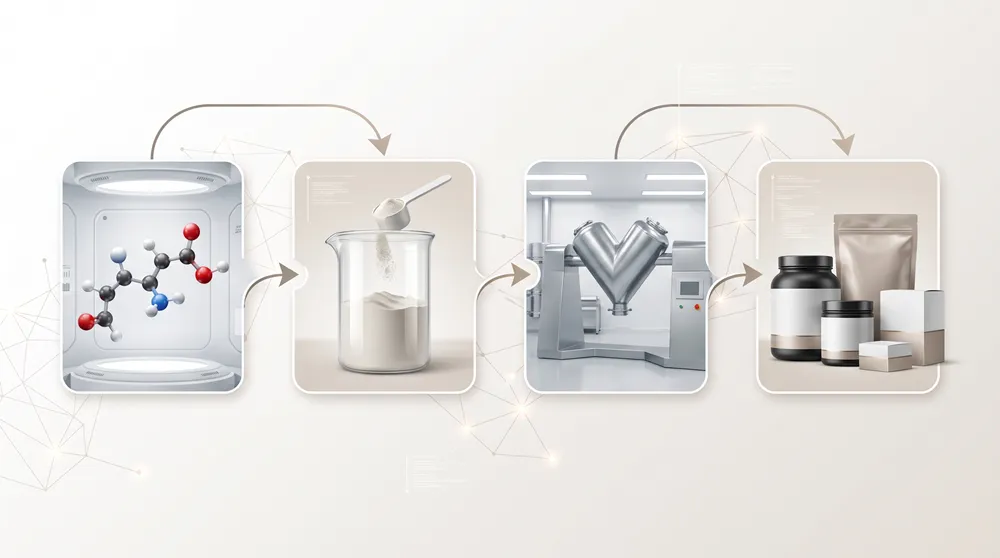
Начинайте с конкретного белкового ингредиента, а не с названия категории
Одна из причин, по которой сравнения сыворотки и растительных ингредиентов могут вводить в заблуждение, заключается в том, что ни одна из этих групп не представляет собой какой-то единственный ингредиент.
Распространенные виды сывороточного протеина
В составе сывороточной смеси могут использоваться:
- концентрат сывороточного протеина (WPC);
- изолят сывороточного протеина (WPI);
- гидролизованный сывороточный белок;
- ингредиенты из сухих сывороток;
- или смеси различных сортов сыворотки.
Эти ингредиенты могут различаться по концентрации белка, содержанию лактозы, жирности, вкусовым качествам, диспергируемости, технологическим характеристикам и стоимости.
Поэтому даже вопрос WPC или WPI? может иметь серьезные последствия, прежде чем бренд примет решение о переходе на растительный белок.
Распространенные виды растительного белка
Растительный белок — это ещё более обширная категория.
В коммерческих рецептурах могут использоваться:
- гороховый белок;
- рисовый белок;
- соевый белок;
- конопляный белок;
- белок из семян тыквы;
- fava bean protein;
- potato protein;
- or multi-source plant protein blends.
Research comparing commercially available protein isolates has found meaningful differences in amino acid composition among different plant protein sources.
For brands, the practica
Do not formulate based only on what an ingredient is called. Formulate based on what the actual ingredient specification and prototype performance show.
For a more specific plant-versus-dairy comparison, see our guide to гороховый протеин против сывороточного протеина.
Protein Quality: Compare the Finished Formula, Not the Marketing Category
Whey protein is widely used in sports nutrition because it provides all essential amino acids and is typically rich in leucine.
However, the commercial conclusion should not be that every plant protein system is automatically unsuitable for performance nutrition.
Different plant proteins have different amino acid profiles, and formulation strategy can change the nutritional characteristics of the finished product.
For example, a 2024 randomized crossover study compared whey protein isolate with plant-based protein blends and found that, under the study conditions, a leucine-fortified plant blend stimulated muscle protein synthesis to a similar extent as whey, while the non-fortified plant blend produced a lower response. The study is available through PubMed.
This does не mean tpowder is equivalent to whey.
It means something more useful for product developers:
Protein source matters, but dose, amino acid profile, blend design, and complete formula design also matter.
When evaluating a protein system, brands should ask:
- What is the actual protein assay?
- What is the amino acid profile?
- How much protein is delivered per serving?
- Is it a single-source protein or a blend?
- Does the formula include additional amino acids?
- What product positioning is intended?
- Does the available evidence support the intended communication?
The correct unit of analysis is the finished formula.
Why the Supplier COA Matters More Than an Internet Comparison Table
Generic comparison tables are helpful for early research.
They are not enough for ingredient approval.
Before approving a protein ingredient, a brand should review relevant supplier documentation, including where applicable:
- Certificate of Analysis;
- specification sheet;
- protein content and test method;
- amino acid profile;
- moisture specification;
- microbiological limits and results;
- heavy metal specifications and results;
- allergen statement;
- country of origin;
- raw material source;
- relevant certifications;
- particle information;
- bulk density;
- and solubility or dispersibility data where available.
The exact documentation required depends on the ingredient, target market, product claims, and manufacturing arrangement.
Documentation should then be connected to actual prototype testing.
A strong specification sheet does not automatically guarantee a successful finished shake.
Similarly, a protein that appears acceptable at a low concentration may behave differently when used at the dose required for a high-protein commercial formula.
Brands comparing individual plant sources can explore our guides to рисовый протеин против горохового протеина и рисовый протеин против конопляного протеина.
The Hidden Solids Budget of a Protein Powder
A consumer sees:
25 g protein per serving.
A formulator sees:
**Protein base
- flavor system
- sweetener system
- texture system
- dispersion support
- functional ingredients
- vitamins and minerals, when applicable
- other supporting ingredients
= total finished serving**
This is the hidden solids budget of the formula.
Suppose two protein ingredients have different protein concentrations.
To deliver the same declared protein target, one may require more physical powder than the other.
That can affect:
- total serving weight;
- scoop volume;
- servings per container;
- package size;
- flavor intensity;
- sweetness balance;
- viscosity;
- mouthfeel;
- powder flow;
- and formula cost.
Therefore, protein percentage should never be evaluated in isolation.

The GENSEI Formula Load Ratio
To help compare prototype formulas, GENSEI recommends a simple internal analysis framework.
The Formula Load Ratio is a GENSEI comparison concept for prototype evaluation. It is not an official regulatory metric or industry standard.
Formula Load Ratio
Total Finished Serving Weight ÷ Declared Protein per Serving
Consider two hypothetical formulas.
Formula A
- Finished serving weight: 32 g
- Declared protein: 25 g
- Formula Load Ratio: 1.28
Formula B
- Finished serving weight: 39 g
- Declared protein: 25 g
- Formula Load Ratio: 1.56
A higher ratio does not automatically make Formula B worse.
For example, a meal replacement or functional nutrition powder may intentionally include fiber, carbohydrates, fats, minerals, or other active ingredients.
The purpose of the ratio is to ask better questions:
- Why is the total serving larger?
- Is the additional weight nutritionally intentional?
- Is more protein base required because of the ingredient assay?
- Is the flavor correction system adding significant material?
- Is the product still compatible with the desired packaging format?
- How will the serving size affect consumer experience?
- Does the larger formula still meet the target cost?
The objective is not simply to produce the lowest ratio.
The objective is to understand what is consuming the formula’s solids budget and whether that trade-off is commercially justified.
Cost per Kilogram vs Cost per Finished Serving
One of the biggest mistakes in protein sourcing is to compare ingredients only by price per kilogram.
The less expensive protein ingredient is not necessarily the less expensive finished product.
A basic calculation begins with:
Ingredient cost per serving = Ingredient dose in grams × price per kilogram ÷ 1,000
But a real commercial comparison needs to go further.
The complete formula can include:
- protein base;
- secondary protein sources;
- flavor system;
- sweeteners;
- masking system;
- texture system;
- functional ingredients;
- manufacturing;
- quality testing;
- packaging;
- freight and logistics.
Therefore, the correct commercial question is not:
Which protein costs less per kilogram?
It is:
Which complete protein system can reach the target product brief at an acceptable cost per finished serving?
Our guide on why protein powder costs are changing explains the interaction among raw materials, processing requirements, flavor systems, testing, packaging, freight, and MOQ considerations.
For custom projects, these variables should be evaluated during supplement formula development rather than after the packaging and retail price have already been fixed.
Taste and Texture: Test at the Intended Commercial Dose
Statements such as:
Whey is creamy.
and:
Plant protein is earthy.
are too broad to guide commercial formulation.
Sensory behavior depends on variables including:
- protein source;
- supplier;
- grade;
- processing method;
- concentration;
- water volume;
- flavor direction;
- sweetener system;
- other ingredients;
- and preparation method.
The correct test is not simply smelling the dry raw material.
It is evaluating a realistic prototype under intended consumer-use conditions.
For a ready-to-mix powder, that may mean controlling:
- serving size;
- water volume;
- water temperature;
- shaker bottle;
- shaking time;
- and evaluation time points.
Useful observations include:
- initial dispersion;
- visible clumping;
- foam immediately after shaking;
- foam persistence;
- sedimentation after standing;
- viscosity;
- chalkiness;
- grittiness;
- bitterness;
- earthy or beany notes;
- dairy notes;
- aftertaste;
- sweetness balance;
- overall acceptance.
Processing conditions can materially influence the functional performance of plant protein systems. Research on pea-rice protein blends, for example, has shown changes in functional properties including solubility under different processing conditions.
The protein source cannot predict the entire finished-product experience. The actual ingredient needs to be tested in the actual formula.**
This is particularly important for brands developing flavored protein powders, meal replacements, and functional drink mixes through a производитель порошковых добавок.
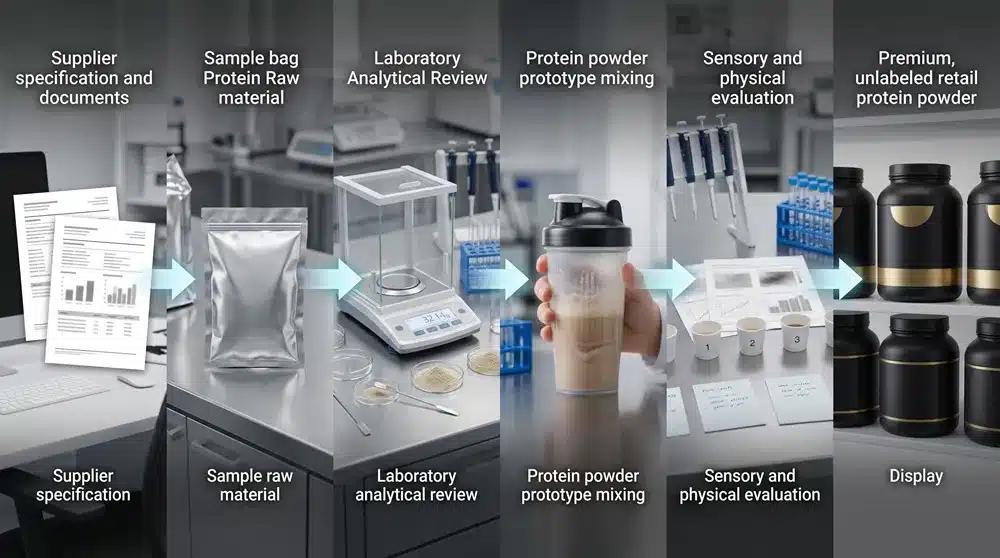
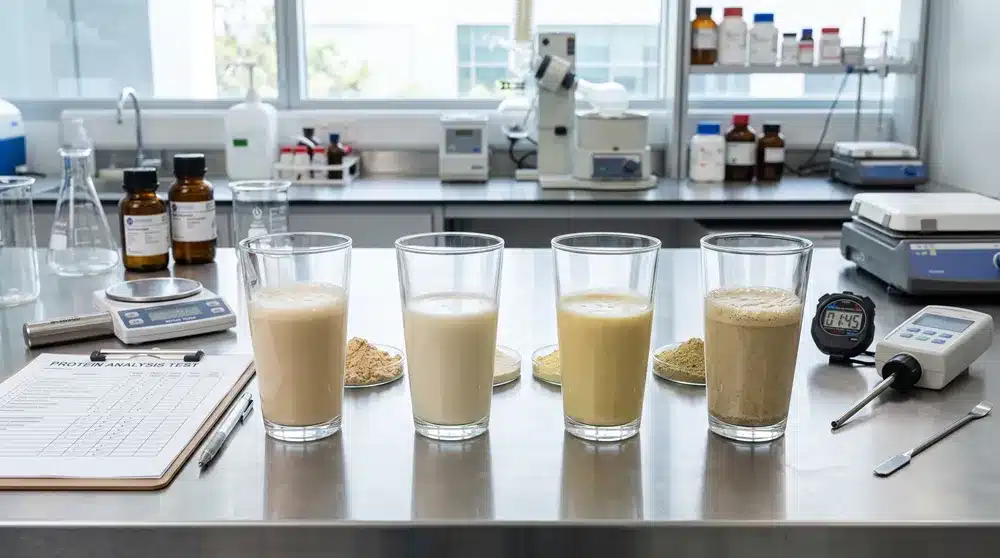
A Practical Matched-Protein Bench Test
Brands comparing whey and plant protein systems should use controlled prototype comparisons rather than relying only on theoretical ingredient data.
A simple comparison may include:
- System A: whey protein concentrate formula;
- System B: whey protein isolate formula;
- System C: pea protein isolate formula;
- System D: pea-and-rice protein blend.
The exact comparison should be selected according to the product brief.
Step 1: Set a Common Commercial Objective
For example, all formulas may target the same declared protein amount per serving.
The goal is not to make the formulas chemically identical.
The goal is to compare different routes to the same product objective.
Step 2: Standardize Preparation Conditions
Keep conditions consistent:
- same liquid volume;
- same liquid temperature;
- same mixing equipment;
- same shaking duration;
- same resting period;
- same evaluation schedule.
Step 3: Record Physical Performance
Depending on the project, evaluate:
- protein-base dose;
- total finished serving weight;
- Formula Load Ratio;
- dispersion time;
- clumping;
- foam;
- foam persistence;
- sedimentation;
- viscosity.
Step 4: Use Structured Sensory Evaluation
Score each prototype consistently for factors such as:
- aroma;
- bitterness;
- earthy or beany notes;
- chalkiness;
- grittiness;
- thickness;
- sweetness balance;
- aftertaste;
- overall acceptance.
Step 5: Calculate Formula-Level Economics
Compare:
- protein ingredient cost;
- flavor cost;
- sweetener cost;
- texture and masking system costs;
- total formula cost per serving.
The final comparison table should look more like this:
| System | Protein Target | Serving Weight | Formula Load Ratio | Main Sensory Challenge | Formula Cost/Serving |
|---|---|---|---|---|---|
| WPC System | Same target | Test result | Calculated | Test result | Calculated |
| WPI System | Same target | Test result | Calculated | Test result | Calculated |
| Pea System | Same target | Test result | Calculated | Test result | Calculated |
| Plant Blend | Same target | Test result | Calculated | Test result | Calculated |
This approach turns a generic ingredient debate into an actual product-development decision.
When Whey Protein Is Usually the Better Starting Point
Whey protein is often the first route to evaluate when the product concept is built around:
- mainstream sports nutrition;
- performance positioning;
- a strong essential amino acid profile;
- familiar consumer expectations;
- traditional protein shake flavors;
- relatively high protein density.
However, choosing whey is only the beginning of formulation.
The brand still needs to decide:
- WPC, WPI, hydrolysate, or blend?
- What protein target?
- What serving size?
- What flavor direction?
- What price tier?
- What certifications?
- What packaging format?
- What supplier and quality documentation?
The Milk Allergen Question
Whey is derived from milk. The U.S. FDA identifies whey as a milk protein, and milk is one of the major food allergens subject to labeling requirements in the United States. Brands targeting the U.S. market should review the relevant FDA food allergen guidance.
Whey protein isolate mayan some whey concentrate products, but lower lactose content does not make whey a non-milk ingredient.
Milk allergy and lactose intolerance are also different considerations and should not be treated as interchangeable.
When Whey Becomes Less Attractive
A whey system may not fit when:
- vegan positioning is essential;
- dairy-free positioning is essential;
- the brand requires a different ingredient story;
- the target consumer actively avoids dairy;
- or another protein platform better supports the intended product concept.
For products positioned outside traditional dairy protein, brands may also evaluate изолят говяжьего белка против сывороточного или протеин из костного бульона против сывороточного.
When Plant Protein Is Usually the Better Starting Point
Plant protein is generally the logical route when the product concept depends on:
- vegan positioning;
- plant-based positioning;
- dairy-free product strategy;
- alternative sports nutrition;
- lifestyle nutrition;
- plant-based meal replacements.
Its biggest strength is flexibility.
But flexibility also creates complexity.
1. Plant Protein Is Not One Ingredient
A pea protein formula and a rice protein formula should not be treated as equivalent.
Neither should two pea protein ingredients from different suppliers automatically be assumed to perform identically.
2. Amino Acid Design Requires Attention
Plant protein sources vary in amino acid composition. Where nutritional optimization is important, the actual data should be evaluated rather than relying on generic assumptions.
3. Flavor Needs to Bding on the protein source and grade, formulators may need to manage:
- earthy notes;
- beany notes;
- bitterness;
- cereal-like notes;
- lingering aftertaste.
The exact intensity is ingredient-specific.
4. Texture Can Become the Product Constraint
Potential challenges include:
- chalkiness;
- grittiness;
- viscosity;
- sedimentation;
- incomplete dispersion.
These should be measured at the intended dose.
5. A Blend Should Solve a Defined Problem
A multi-source blend may help improve the overall amino acid profile or meet a particular positioning target.
But additional protein sources also introduce more variables.
A blend should not exist simply because “five plant proteins” sounds more impressive than one.
Each ingredient should have a purpose.
For more detail on one of the most common strategies, see our guide to Протеиновый порошок из гороха и коричневого риса.
How to Design a Plant Protein Blend More Rationally
There is no universal pea-to-rice ratio that is automatically correct for every commercial formula.
A better workflow is:
Step 1: Define the Product Brief
Set:
- target consumer;
- protein per serving;
- serving-size target;
- flavor;
- claims;
- packaging;
- target cost.
Step 2: Review Ingredient-Specific Data
For every candidate protein, review:
- protein assay;
- amino acid information;
- sensory characteristics;
- relevant physical properties;
- quality specifications;
- certifications;
- pricing;
- MOQ;
- lead time.
Step 3: Identify the Actual Constraint
Ask what problem the blend needs to solve.
Is the problem:
- amino acid balance?
- taste?
- texture?
- protein density?
- cost?
- supply diversification?
- marketing positioning?
The blend design should respond to that constraint.
Step 4: Prototype More Than One Realistic Ratio
A ratio that looks attractive mathematically may not produce the best sensory result.
Test multiple realistic options.
Step 5: Recalculate the Finished Formula
After changing the blend ratio, recheck:
- protein delivery;
- amino acid contribution;
- total serving weight;
- Formula Load Ratio;
- taste;
- texture;
- physical performance;
- cost per serving.
The correct workflow is:
Model → prototype → test → adjust → recalculate → validate
Not:
Choose a popular ratio → copy it → manufacture.
Which Protein Should Your Brand Choose?
Choose Whey First When:
The project is focused on:
- traditional sports nutrition;
- mainstream gym consumers;
- familiar shake positioning;
- strong EAA and leucine positioning;
- classic chocolate, vanilla, or related protein shake concepts.
The development team should then determine the correct whey grade, dose, flavor system, packaging format, and target cost.
Choose Plant Protein First When:
The product concept requires:
- vegan positioning;
- plant-based positioning;
- dairy avoidance;
- alternative lifestyle nutrition;
- vegan sports nutrition.
The next decision is not simply “plant protein.”
The team must determine:
- which source;
- single source or blend;
- what amino acid profile;
- what dose;
- what flavor;
- what texture target;
- what cost target.
Consider Collagen or Specialty Protein When:
The product is positioned primarily around:
- beauty nutrition;
- collagen supplementation;
- joint support;
- connective-tissue positioning;
- active-aging concepts;
- specialty protein categories.
Collagen peptides should not simply be presented as interchangeable with whey or plant protein because the amino acid profiles and product positioning are different.
Brands considering this direction can read our сывороточный протеин против коллагеновых пептидов comparison.
A Simple Protein Formula Decision Framework
Before selecting the protein source, answer these seven questions.
1. Who is the target consumer?
A mandatory vegan requirement eliminates whey.
A traditional whey-based sports nutrition brief may point in a different direction from a lifestyle wellness product.
2. What must the product communicate?
Define the positioning first:
- sports performance;
- vegan;
- dairy-free;
- high protein;
- meal replacement;
- active aging;
- beauty nutrition.
3. What is the protein target?
This affects ingredient dose, serving size, flavor burden, packaging, and cost.
4. What drinking experience is required?
A thick meal replacement and a light protein drink are different formulation problems.
Define:
- water volume;
- texture;
- sweetness;
- flavor intensity;
- mixability expectations.
5. What is the target cost?
Calculate the complete finished formula.
6. What is the packaging format?
A large serving powder in a tub has different physical constraints from sachets or smaller portable formats.
Protein-heavy products are generally better suited to powder formats when substantial protein doses are required. For more detail, see протеиновые капсулы против порошка.
7. What does the prototype show?
The final decision should combine:
- specification review;
- supplier documentation;
- nutritional modeling;
- physical testing;
- sensory evaluation;
- cost modeling.
The prototype—not the category stereotype—should have the final vote.
Questions to Ask Before Approving a Protein Ingredient
Before commercial approval, ask:
Nutrition and Specification
- What is the current protein assay?
- What test method is used?
- Is amino acid data available?
- What dose is required to reach the finished-product target?
Sensory and Physical Performance
- What does the protein taste like at the intended commercial dose?
- Which off-notes appear?
- How does it disperse?
- Does it clump?
- How much foam develops?
- Does sediment form?
- How does viscosity change with concentration?
Commercial Supply
- What is the MOQ?
- What is the lead time?
- How stable is supply?
- Is a second qualified source required?
- How sensitive is the formula to ingredient substitution?
Документация по качеству
- Is a current COA available?
- Are the relevant microbiological results available?
- Are contaminant test results available where required?
- What allergen documentation is provided?
- What certifications support the intended claims?
- Is the country of origin documented?
These questions should be answered before a brand commits heavily to packaging inventory, final marketing claims, or a fixed launch schedule.
Whey Protein vs Plant Protein: Final Verdict for Supplement Brands
There is no universal winner.
Whey protein is often the stronger starting point for conventional sports nutrition products where amino acid positioning, mainstream consumer familiarity, and a traditional protein shake experience are priorities.
Plant protein is generally the stronger strategic fit when vegan, plant-based, or dairy-free positioning is central to the product concept.
But the category decision is only the first step.
The final choice should consider:
Protein source
→ supplier specification
→ amino acid data
→ protein dose
→ total formula load
→ taste and texture
→ mixability
→ manufacturing fit
→ cost per finished serving
→ brand positioning
The most important lesson is this:
Do not choose a protein source only because it wins a generic nutrition comparison. Choose the protein system that survives the complete journey from specification sheet to finished product.
GENSEI helps supplement brands evaluate protein ingredients, review formulation requirements, develop custom powder formulas, coordinate sampling, and move qualified projects toward commercial manufacturing.
Whether your project starts with whey, pea, rice, a plant protein blend, collagen peptides, or another specialty protein strategy, the best starting point is a clear product brief.
Planning a protein powder project? Send us your target consumer, protein-per-serving target, flavor direction, claims, packaging format, expected order quantity, and target market. Our team can help evaluate the appropriate formulation and manufacturing route.
Ссылки
- Gorissen, S. H. M., et al. (2018). Protein content and amino acid composition of commercially available plant-based protein isolates.
PubMed: https://pubmed.ncbi.nlm.nih.gov/30167963/ - Lim, C., et al. (2024). Muscle Protein Synthesis in Response to Plant-Based Protein Isolates With and Without Added Leucine Versus Whey Protein in Young Men and Women. Current Developments in Nutrition, 8(6), 103769.
PubMed: https://pubmed.ncbi.nlm.nih.gov/38846451/ - van der Heijden, I., et al. (2024). Plant Protein Blend Ingestion Stimulates Post-Exercise Myofibrillar Protein Synthesis Rates Equivalently to Whey in Resistance-Trained Adults. Medicine & Science in Sports & Exercise.
Full Text: https://pmc.ncbi.nlm.nih.gov/articles/PMC11810040/ - Pietrysiak, E., Smith, D. M., Smith, B. M., & Ganjyal, G. M. (2018). Enhanced functionality of pea-rice protein isolate blends through direct steam injection processing. Food Chemistry, 243, 338–344.
PubMed: https://pubmed.ncbi.nlm.nih.gov/29146346/ - National Institutes of Health, Office of Dietary Supplements. Dietary Supplements for Exercise and Athletic Performance: Fact Sheet for Health Professionals.
https://ods.od.nih.gov/factsheets/ExerciseAndAthleticPerformance-HealthProfessional/ - U.S. Food and Drug Administration. Have Food Allergies? Read the Label.
https://www.fda.gov/consumers/consumer-updates/have-food-allergies-read-label

Уоррен Ван — опытный специалист с обширным стажем работы в сфере цепочки поставок пищевых добавок, обладающий богатым практическим опытом в области исследований, разработки, контроля производственных процессов и глобального поиска поставщиков ключевых ингредиентов, таких как коллагеновые пептиды, белок костного бульона и кератин. Как автор этой рубрики, он стремится развенчать маркетинговую мистификацию, преобразуя малоизвестные научные факты об ингредиентах и стандарты контроля качества производства в доступные и достоверные научно-популярные материалы, помогая читателям понять правду, скрытую за этикетками, и делать более рациональный выбор в вопросах здоровья.