Choosing between whey protein and plant protein is not only a nutrition decision.
For a supplement brand, the protein source can affect the amino acid profile, serving size, taste, texture, allergen positioning, ingredient sourcing, target cost, packaging, and manufacturing process of the finished product.
Whey protein is often the more straightforward starting point for traditional sports nutrition formulas where performance positioning, a strong essential amino acid profile, and familiar shake characteristics are priorities.
Plant protein is usually the stronger strategic fit for vegan, dairy-free, and plant-based product concepts. However, the exact protein source, supplier specification, blend design, flavor system, and serving size need to be evaluated together.
Neither category is automatically better.
For a brand developing a commercial protein product, the more useful question is:
Which protein system can deliver the nutrition, consumer experience, positioning, target cost, and manufacturing performance required by this product brief?
This guide explains how to make that decision.
Brands that already have a product concept can also review our protein supplement manufacturing capabilities for custom whey, plant protein, collagen, meal replacement, and specialty protein projects.

Whey Protein vs Plant Protein at a Glance
| Decision Factor | Whey Protein | Plant Protein | What the Brand Should Ask |
|---|---|---|---|
| Typical positioning | Sports nutrition, performance, mainstream protein | Vegan, dairy-free, plant-based, lifestyle nutrition | Who is the target consumer? |
| Protein system | WPC, WPI, hydrolysate, or whey blends | Pea, rice, soy, hemp, or multi-source blends | What exact ingredient is being compared? |
| Amino acid profile | Generally strong in essential amino acids and leucine | Depends significantly on source and blend | Have we reviewed actual amino acid data? |
| Taste | Often compatible with traditional shake profiles | Highly source- and supplier-dependent | Has the base been tested at the commercial dose? |
| Texture | Often easier to formulate into familiar shake textures | Can require more texture optimization | What happens after mixing and standing? |
| Allergen positioning | Milk-derived | Source-dependent | Which claims are essential? |
| Vegan positioning | No | Yes, when the complete formula qualifies | Are all ingredients and processing inputs suitable? |
| Formula complexity | Often more straightforward | May require blend, flavor, and texture optimization | What problem is each added ingredient solving? |
| Cost evaluation | Calculate per finished serving | Calculate per finished serving | What is the cost of the whole formula? |
| Best decision method | Specification + prototype + cost model | Specification + prototype + cost model | What does the actual prototype show? |
The key point is that a brand is not really choosing between two abstract categories called whey and plant.
It is choosing between specific ingredients, from specific suppliers, in a specific formula, for a specific target consumer.
That distinction matters.
The Real Difference Is Not Just Nutrition
Most whey protein vs plant protein comparisons focus on questions such as:
- Which has more leucine?
- Which is absorbed faster?
- Which is better for muscle growth?
- Which is easier to digest?
- Which is vegan?
- Which is more sustainable?
These questions are useful for consumers.
They are not enough for commercial product development.
A protein ingredient can look attractive on a nutrition spreadsheet but still create problems in the finished product.
For example:
- the serving size becomes too large;
- the flavor system cannot adequately control the base notes;
- the texture becomes chalky or excessively thick;
- sediment develops after mixing;
- the powder creates too much persistent foam;
- the target cost cannot be achieved;
- the desired claims conflict with the ingredient system;
- or a formula that works in a small prototype does not transfer easily into the intended manufacturing and packaging process.
This is why we recommend evaluating a protein system through four questions:
1. Does it meet the nutritional objective?
Review the protein dose, amino acid profile, serving size, and intended product positioning.
2. Can it become a product consumers will actually enjoy?
Evaluate taste, aroma, texture, sweetness balance, dispersibility, foam, and sedimentation.
3. Can it be manufactured consistently?
Review ingredient specifications, powder behavior, blending requirements, packaging format, quality documentation, and production controls.
4. Can the product meet the commercial target?
Calculate the complete cost of the finished formula—not only the protein price per kilogram.
A successful protein powder needs to pass all four tests.
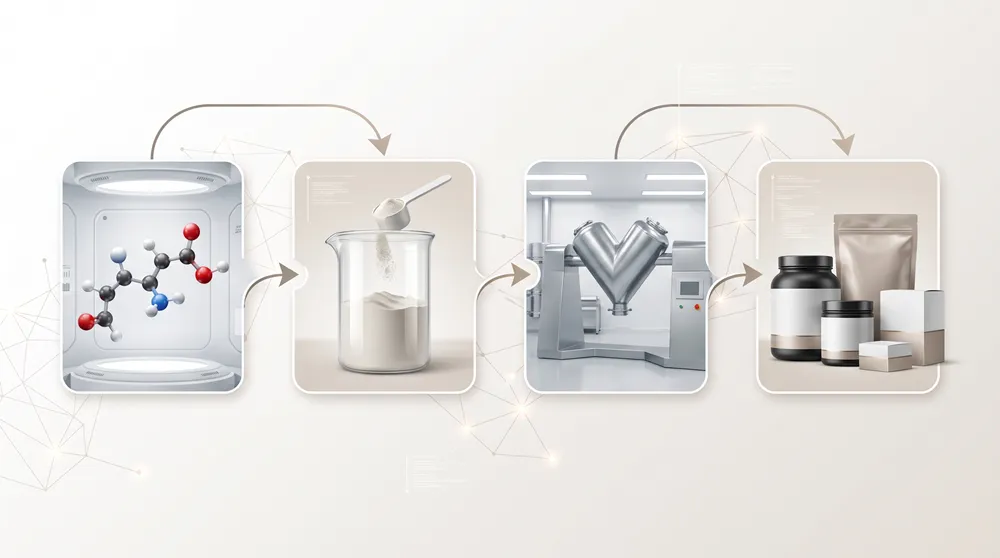
Start With the Exact Protein Ingredient, Not the Category Name
One reason whey vs plant comparisons become misleading is that neither side represents one single ingredient.
Common Whey Protein Options
A whey formula may use:
- whey protein concentrate (WPC);
- whey protein isolate (WPI);
- hydrolyzed whey protein;
- instantized whey ingredients;
- or combinations of different whey grades.
These ingredients can differ in protein concentration, lactose level, fat content, taste, dispersibility, processing characteristics, and cost.
Therefore, even the question WPC or WPI? can have significant consequences before a brand considers plant protein.
Common Plant Protein Options
Plant protein is an even broader category.
Commercial formulas may use:
- pea protein;
- rice protein;
- soy protein;
- hemp protein;
- pumpkin seed protein;
- fava bean protein;
- potato protein;
- or multi-source plant protein blends.
Research comparing commercially available protein isolates has found meaningful differences in amino acid composition among different plant protein sources.
For brands, the practica
Do not formulate based only on what an ingredient is called. Formulate based on what the actual ingredient specification and prototype performance show.
For a more specific plant-versus-dairy comparison, see our guide to pea protein vs whey protein.
Protein Quality: Compare the Finished Formula, Not the Marketing Category
Whey protein is widely used in sports nutrition because it provides all essential amino acids and is typically rich in leucine.
However, the commercial conclusion should not be that every plant protein system is automatically unsuitable for performance nutrition.
Different plant proteins have different amino acid profiles, and formulation strategy can change the nutritional characteristics of the finished product.
For example, a 2024 randomized crossover study compared whey protein isolate with plant-based protein blends and found that, under the study conditions, a leucine-fortified plant blend stimulated muscle protein synthesis to a similar extent as whey, while the non-fortified plant blend produced a lower response. The study is available through PubMed.
This does not mean tpowder is equivalent to whey.
It means something more useful for product developers:
Protein source matters, but dose, amino acid profile, blend design, and complete formula design also matter.
When evaluating a protein system, brands should ask:
- What is the actual protein assay?
- What is the amino acid profile?
- How much protein is delivered per serving?
- Is it a single-source protein or a blend?
- Does the formula include additional amino acids?
- What product positioning is intended?
- Does the available evidence support the intended communication?
The correct unit of analysis is the finished formula.
Why the Supplier COA Matters More Than an Internet Comparison Table
Generic comparison tables are helpful for early research.
They are not enough for ingredient approval.
Before approving a protein ingredient, a brand should review relevant supplier documentation, including where applicable:
- Certificate of Analysis;
- specification sheet;
- protein content and test method;
- amino acid profile;
- moisture specification;
- microbiological limits and results;
- heavy metal specifications and results;
- allergen statement;
- country of origin;
- raw material source;
- relevant certifications;
- particle information;
- bulk density;
- and solubility or dispersibility data where available.
The exact documentation required depends on the ingredient, target market, product claims, and manufacturing arrangement.
Documentation should then be connected to actual prototype testing.
A strong specification sheet does not automatically guarantee a successful finished shake.
Similarly, a protein that appears acceptable at a low concentration may behave differently when used at the dose required for a high-protein commercial formula.
Brands comparing individual plant sources can explore our guides to rice protein vs pea protein and rice protein vs hemp protein.
The Hidden Solids Budget of a Protein Powder
A consumer sees:
25 g protein per serving.
A formulator sees:
**Protein base
- flavor system
- sweetener system
- texture system
- dispersion support
- functional ingredients
- vitamins and minerals, when applicable
- other supporting ingredients
= total finished serving**
This is the hidden solids budget of the formula.
Suppose two protein ingredients have different protein concentrations.
To deliver the same declared protein target, one may require more physical powder than the other.
That can affect:
- total serving weight;
- scoop volume;
- servings per container;
- package size;
- flavor intensity;
- sweetness balance;
- viscosity;
- mouthfeel;
- powder flow;
- and formula cost.
Therefore, protein percentage should never be evaluated in isolation.

The GENSEI Formula Load Ratio
To help compare prototype formulas, GENSEI recommends a simple internal analysis framework.
The Formula Load Ratio is a GENSEI comparison concept for prototype evaluation. It is not an official regulatory metric or industry standard.
Formula Load Ratio
Total Finished Serving Weight ÷ Declared Protein per Serving
Consider two hypothetical formulas.
Formula A
- Finished serving weight: 32 g
- Declared protein: 25 g
- Formula Load Ratio: 1.28
Formula B
- Finished serving weight: 39 g
- Declared protein: 25 g
- Formula Load Ratio: 1.56
A higher ratio does not automatically make Formula B worse.
For example, a meal replacement or functional nutrition powder may intentionally include fiber, carbohydrates, fats, minerals, or other active ingredients.
The purpose of the ratio is to ask better questions:
- Why is the total serving larger?
- Is the additional weight nutritionally intentional?
- Is more protein base required because of the ingredient assay?
- Is the flavor correction system adding significant material?
- Is the product still compatible with the desired packaging format?
- How will the serving size affect consumer experience?
- Does the larger formula still meet the target cost?
The objective is not simply to produce the lowest ratio.
The objective is to understand what is consuming the formula’s solids budget and whether that trade-off is commercially justified.
Cost per Kilogram vs Cost per Finished Serving
One of the biggest mistakes in protein sourcing is to compare ingredients only by price per kilogram.
The less expensive protein ingredient is not necessarily the less expensive finished product.
A basic calculation begins with:
Ingredient cost per serving = Ingredient dose in grams × price per kilogram ÷ 1,000
But a real commercial comparison needs to go further.
The complete formula can include:
- protein base;
- secondary protein sources;
- flavor system;
- sweeteners;
- masking system;
- texture system;
- functional ingredients;
- manufacturing;
- quality testing;
- packaging;
- freight and logistics.
Therefore, the correct commercial question is not:
Which protein costs less per kilogram?
It is:
Which complete protein system can reach the target product brief at an acceptable cost per finished serving?
Our guide on why protein powder costs are changing explains the interaction among raw materials, processing requirements, flavor systems, testing, packaging, freight, and MOQ considerations.
For custom projects, these variables should be evaluated during supplement formula development rather than after the packaging and retail price have already been fixed.
Taste and Texture: Test at the Intended Commercial Dose
Statements such as:
Whey is creamy.
and:
Plant protein is earthy.
are too broad to guide commercial formulation.
Sensory behavior depends on variables including:
- protein source;
- supplier;
- grade;
- processing method;
- concentration;
- water volume;
- flavor direction;
- sweetener system;
- other ingredients;
- and preparation method.
The correct test is not simply smelling the dry raw material.
It is evaluating a realistic prototype under intended consumer-use conditions.
For a ready-to-mix powder, that may mean controlling:
- serving size;
- water volume;
- water temperature;
- shaker bottle;
- shaking time;
- and evaluation time points.
Useful observations include:
- initial dispersion;
- visible clumping;
- foam immediately after shaking;
- foam persistence;
- sedimentation after standing;
- viscosity;
- chalkiness;
- grittiness;
- bitterness;
- earthy or beany notes;
- dairy notes;
- aftertaste;
- sweetness balance;
- overall acceptance.
Processing conditions can materially influence the functional performance of plant protein systems. Research on pea-rice protein blends, for example, has shown changes in functional properties including solubility under different processing conditions.
The protein source cannot predict the entire finished-product experience. The actual ingredient needs to be tested in the actual formula.**
This is particularly important for brands developing flavored protein powders, meal replacements, and functional drink mixes through a powder supplement manufacturer.
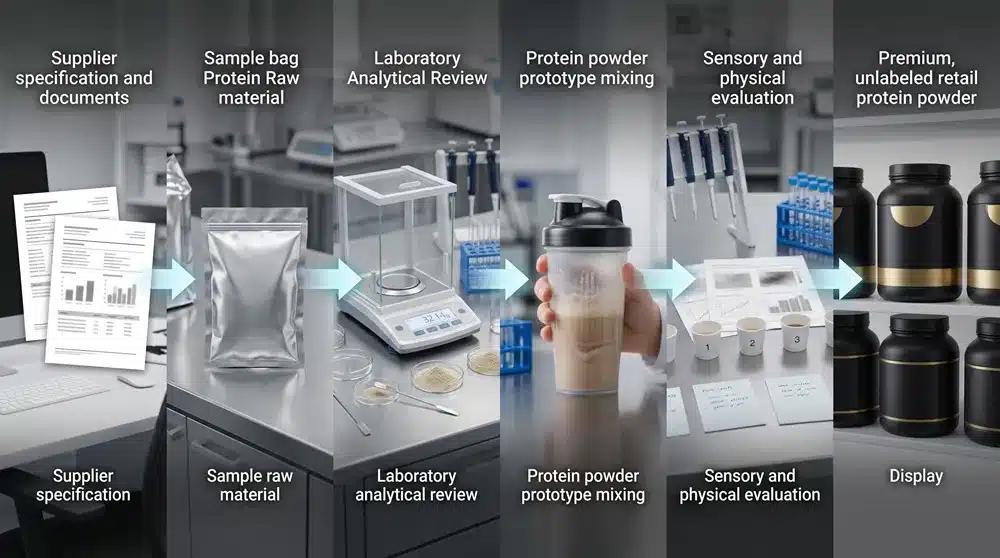
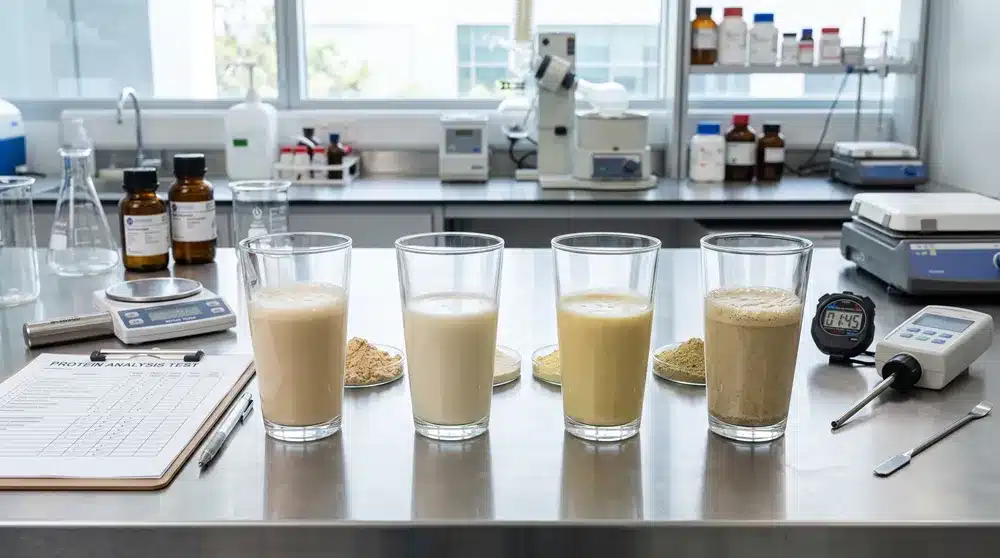
A Practical Matched-Protein Bench Test
Brands comparing whey and plant protein systems should use controlled prototype comparisons rather than relying only on theoretical ingredient data.
A simple comparison may include:
- System A: whey protein concentrate formula;
- System B: whey protein isolate formula;
- System C: pea protein isolate formula;
- System D: pea-and-rice protein blend.
The exact comparison should be selected according to the product brief.
Step 1: Set a Common Commercial Objective
For example, all formulas may target the same declared protein amount per serving.
The goal is not to make the formulas chemically identical.
The goal is to compare different routes to the same product objective.
Step 2: Standardize Preparation Conditions
Keep conditions consistent:
- same liquid volume;
- same liquid temperature;
- same mixing equipment;
- same shaking duration;
- same resting period;
- same evaluation schedule.
Step 3: Record Physical Performance
Depending on the project, evaluate:
- protein-base dose;
- total finished serving weight;
- Formula Load Ratio;
- dispersion time;
- clumping;
- foam;
- foam persistence;
- sedimentation;
- viscosity.
Step 4: Use Structured Sensory Evaluation
Score each prototype consistently for factors such as:
- aroma;
- bitterness;
- earthy or beany notes;
- chalkiness;
- grittiness;
- thickness;
- sweetness balance;
- aftertaste;
- overall acceptance.
Step 5: Calculate Formula-Level Economics
Compare:
- protein ingredient cost;
- flavor cost;
- sweetener cost;
- texture and masking system costs;
- total formula cost per serving.
The final comparison table should look more like this:
| System | Protein Target | Serving Weight | Formula Load Ratio | Main Sensory Challenge | Formula Cost/Serving |
|---|---|---|---|---|---|
| WPC System | Same target | Test result | Calculated | Test result | Calculated |
| WPI System | Same target | Test result | Calculated | Test result | Calculated |
| Pea System | Same target | Test result | Calculated | Test result | Calculated |
| Plant Blend | Same target | Test result | Calculated | Test result | Calculated |
This approach turns a generic ingredient debate into an actual product-development decision.
When Whey Protein Is Usually the Better Starting Point
Whey protein is often the first route to evaluate when the product concept is built around:
- mainstream sports nutrition;
- performance positioning;
- a strong essential amino acid profile;
- familiar consumer expectations;
- traditional protein shake flavors;
- relatively high protein density.
However, choosing whey is only the beginning of formulation.
The brand still needs to decide:
- WPC, WPI, hydrolysate, or blend?
- What protein target?
- What serving size?
- What flavor direction?
- What price tier?
- What certifications?
- What packaging format?
- What supplier and quality documentation?
The Milk Allergen Question
Whey is derived from milk. The U.S. FDA identifies whey as a milk protein, and milk is one of the major food allergens subject to labeling requirements in the United States. Brands targeting the U.S. market should review the relevant FDA food allergen guidance.
Whey protein isolate mayan some whey concentrate products, but lower lactose content does not make whey a non-milk ingredient.
Milk allergy and lactose intolerance are also different considerations and should not be treated as interchangeable.
When Whey Becomes Less Attractive
A whey system may not fit when:
- vegan positioning is essential;
- dairy-free positioning is essential;
- the brand requires a different ingredient story;
- the target consumer actively avoids dairy;
- or another protein platform better supports the intended product concept.
For products positioned outside traditional dairy protein, brands may also evaluate beef protein isolate vs whey or bone broth protein vs whey.
When Plant Protein Is Usually the Better Starting Point
Plant protein is generally the logical route when the product concept depends on:
- vegan positioning;
- plant-based positioning;
- dairy-free product strategy;
- alternative sports nutrition;
- lifestyle nutrition;
- plant-based meal replacements.
Its biggest strength is flexibility.
But flexibility also creates complexity.
1. Plant Protein Is Not One Ingredient
A pea protein formula and a rice protein formula should not be treated as equivalent.
Neither should two pea protein ingredients from different suppliers automatically be assumed to perform identically.
2. Amino Acid Design Requires Attention
Plant protein sources vary in amino acid composition. Where nutritional optimization is important, the actual data should be evaluated rather than relying on generic assumptions.
3. Flavor Needs to Bding on the protein source and grade, formulators may need to manage:
- earthy notes;
- beany notes;
- bitterness;
- cereal-like notes;
- lingering aftertaste.
The exact intensity is ingredient-specific.
4. Texture Can Become the Product Constraint
Potential challenges include:
- chalkiness;
- grittiness;
- viscosity;
- sedimentation;
- incomplete dispersion.
These should be measured at the intended dose.
5. A Blend Should Solve a Defined Problem
A multi-source blend may help improve the overall amino acid profile or meet a particular positioning target.
But additional protein sources also introduce more variables.
A blend should not exist simply because “five plant proteins” sounds more impressive than one.
Each ingredient should have a purpose.
For more detail on one of the most common strategies, see our guide to pea and brown rice protein powder.
How to Design a Plant Protein Blend More Rationally
There is no universal pea-to-rice ratio that is automatically correct for every commercial formula.
A better workflow is:
Step 1: Define the Product Brief
Set:
- target consumer;
- protein per serving;
- serving-size target;
- flavor;
- claims;
- packaging;
- target cost.
Step 2: Review Ingredient-Specific Data
For every candidate protein, review:
- protein assay;
- amino acid information;
- sensory characteristics;
- relevant physical properties;
- quality specifications;
- certifications;
- pricing;
- MOQ;
- lead time.
Step 3: Identify the Actual Constraint
Ask what problem the blend needs to solve.
Is the problem:
- amino acid balance?
- taste?
- texture?
- protein density?
- cost?
- supply diversification?
- marketing positioning?
The blend design should respond to that constraint.
Step 4: Prototype More Than One Realistic Ratio
A ratio that looks attractive mathematically may not produce the best sensory result.
Test multiple realistic options.
Step 5: Recalculate the Finished Formula
After changing the blend ratio, recheck:
- protein delivery;
- amino acid contribution;
- total serving weight;
- Formula Load Ratio;
- taste;
- texture;
- physical performance;
- cost per serving.
The correct workflow is:
Model → prototype → test → adjust → recalculate → validate
Not:
Choose a popular ratio → copy it → manufacture.
Which Protein Should Your Brand Choose?
Choose Whey First When:
The project is focused on:
- traditional sports nutrition;
- mainstream gym consumers;
- familiar shake positioning;
- strong EAA and leucine positioning;
- classic chocolate, vanilla, or related protein shake concepts.
The development team should then determine the correct whey grade, dose, flavor system, packaging format, and target cost.
Choose Plant Protein First When:
The product concept requires:
- vegan positioning;
- plant-based positioning;
- dairy avoidance;
- alternative lifestyle nutrition;
- vegan sports nutrition.
The next decision is not simply “plant protein.”
The team must determine:
- which source;
- single source or blend;
- what amino acid profile;
- what dose;
- what flavor;
- what texture target;
- what cost target.
Consider Collagen or Specialty Protein When:
The product is positioned primarily around:
- beauty nutrition;
- collagen supplementation;
- joint support;
- connective-tissue positioning;
- active-aging concepts;
- specialty protein categories.
Collagen peptides should not simply be presented as interchangeable with whey or plant protein because the amino acid profiles and product positioning are different.
Brands considering this direction can read our whey protein vs collagen peptides comparison.
A Simple Protein Formula Decision Framework
Before selecting the protein source, answer these seven questions.
1. Who is the target consumer?
A mandatory vegan requirement eliminates whey.
A traditional whey-based sports nutrition brief may point in a different direction from a lifestyle wellness product.
2. What must the product communicate?
Define the positioning first:
- sports performance;
- vegan;
- dairy-free;
- high protein;
- meal replacement;
- active aging;
- beauty nutrition.
3. What is the protein target?
This affects ingredient dose, serving size, flavor burden, packaging, and cost.
4. What drinking experience is required?
A thick meal replacement and a light protein drink are different formulation problems.
Define:
- water volume;
- texture;
- sweetness;
- flavor intensity;
- mixability expectations.
5. What is the target cost?
Calculate the complete finished formula.
6. What is the packaging format?
A large serving powder in a tub has different physical constraints from sachets or smaller portable formats.
Protein-heavy products are generally better suited to powder formats when substantial protein doses are required. For more detail, see protein capsules vs powder.
7. What does the prototype show?
The final decision should combine:
- specification review;
- supplier documentation;
- nutritional modeling;
- physical testing;
- sensory evaluation;
- cost modeling.
The prototype—not the category stereotype—should have the final vote.
Questions to Ask Before Approving a Protein Ingredient
Before commercial approval, ask:
Nutrition and Specification
- What is the current protein assay?
- What test method is used?
- Is amino acid data available?
- What dose is required to reach the finished-product target?
Sensory and Physical Performance
- What does the protein taste like at the intended commercial dose?
- Which off-notes appear?
- How does it disperse?
- Does it clump?
- How much foam develops?
- Does sediment form?
- How does viscosity change with concentration?
Commercial Supply
- What is the MOQ?
- What is the lead time?
- How stable is supply?
- Is a second qualified source required?
- How sensitive is the formula to ingredient substitution?
Quality Documentation
- Is a current COA available?
- Are the relevant microbiological results available?
- Are contaminant test results available where required?
- What allergen documentation is provided?
- What certifications support the intended claims?
- Is the country of origin documented?
These questions should be answered before a brand commits heavily to packaging inventory, final marketing claims, or a fixed launch schedule.
Whey Protein vs Plant Protein: Final Verdict for Supplement Brands
There is no universal winner.
Whey protein is often the stronger starting point for conventional sports nutrition products where amino acid positioning, mainstream consumer familiarity, and a traditional protein shake experience are priorities.
Plant protein is generally the stronger strategic fit when vegan, plant-based, or dairy-free positioning is central to the product concept.
But the category decision is only the first step.
The final choice should consider:
Protein source
→ supplier specification
→ amino acid data
→ protein dose
→ total formula load
→ taste and texture
→ mixability
→ manufacturing fit
→ cost per finished serving
→ brand positioning
The most important lesson is this:
Do not choose a protein source only because it wins a generic nutrition comparison. Choose the protein system that survives the complete journey from specification sheet to finished product.
GENSEI helps supplement brands evaluate protein ingredients, review formulation requirements, develop custom powder formulas, coordinate sampling, and move qualified projects toward commercial manufacturing.
Whether your project starts with whey, pea, rice, a plant protein blend, collagen peptides, or another specialty protein strategy, the best starting point is a clear product brief.
Planning a protein powder project? Send us your target consumer, protein-per-serving target, flavor direction, claims, packaging format, expected order quantity, and target market. Our team can help evaluate the appropriate formulation and manufacturing route.
References
- Gorissen, S. H. M., et al. (2018). Protein content and amino acid composition of commercially available plant-based protein isolates.
PubMed: https://pubmed.ncbi.nlm.nih.gov/30167963/ - Lim, C., et al. (2024). Muscle Protein Synthesis in Response to Plant-Based Protein Isolates With and Without Added Leucine Versus Whey Protein in Young Men and Women. Current Developments in Nutrition, 8(6), 103769.
PubMed: https://pubmed.ncbi.nlm.nih.gov/38846451/ - van der Heijden, I., et al. (2024). Plant Protein Blend Ingestion Stimulates Post-Exercise Myofibrillar Protein Synthesis Rates Equivalently to Whey in Resistance-Trained Adults. Medicine & Science in Sports & Exercise.
Full Text: https://pmc.ncbi.nlm.nih.gov/articles/PMC11810040/ - Pietrysiak, E., Smith, D. M., Smith, B. M., & Ganjyal, G. M. (2018). Enhanced functionality of pea-rice protein isolate blends through direct steam injection processing. Food Chemistry, 243, 338–344.
PubMed: https://pubmed.ncbi.nlm.nih.gov/29146346/ - National Institutes of Health, Office of Dietary Supplements. Dietary Supplements for Exercise and Athletic Performance: Fact Sheet for Health Professionals.
https://ods.od.nih.gov/factsheets/ExerciseAndAthleticPerformance-HealthProfessional/ - U.S. Food and Drug Administration. Have Food Allergies? Read the Label.
https://www.fda.gov/consumers/consumer-updates/have-food-allergies-read-label

Warren Wan is a seasoned expert with extensive experience in the dietary supplement supply chain, possessing rich practical experience in the research, development, process control, and global sourcing of core ingredients such as collagen peptides, bone broth protein, and keratin. As the author of this column, he is dedicated to stripping away the marketing packaging, transforming obscure ingredient science and production quality control standards into easy-to-understand, hardcore science popularization, helping readers understand the truth behind the labels and make more rational health choices.