
Beef protein isolate and whey protein can both support daily protein intake, but they are not interchangeable ingredients. Whey comes from milk, while beef protein isolate is typically made from bovine material through extraction, filtration, hydrolysis, and spray drying. Some beef protein powders may contain collagen-rich fractions, which changes the amino acid profile and makes label verification especially important.
If you are developing a protein powder, RTD beverage, capsule, bar, or sports nutrition product, Collagensei can help compare protein sources, review COA documents, and design a formula through protein supplement manufacturing, powder supplement manufacturing, and custom formulation services.
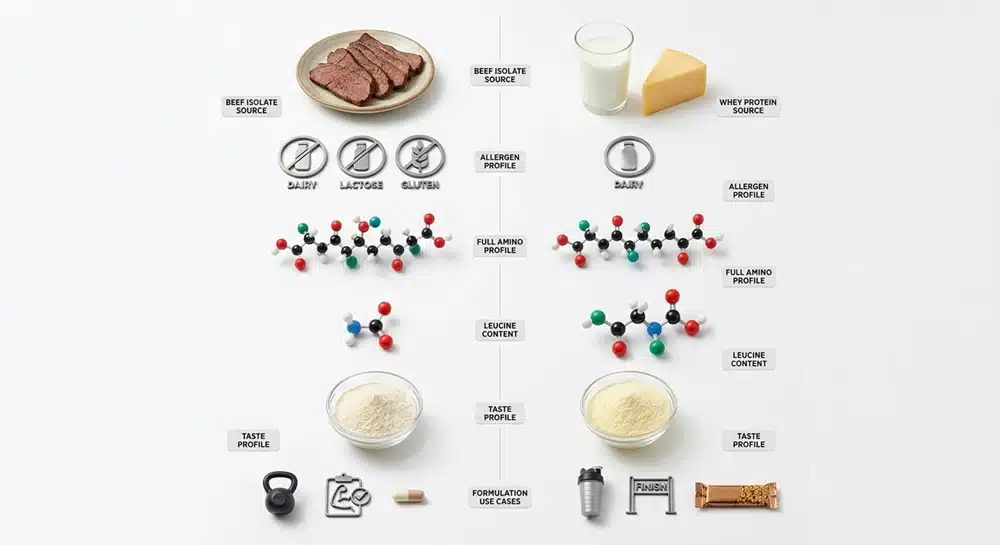
Quick Comparison: Beef Protein Isolate vs Whey
| Factor | Beef Protein Isolate | Whey Protein | Formulation Takeaway |
|---|---|---|---|
| Source | Bovine-derived protein material | Milk-derived protein from cheese production | Beef works for dairy-free positioning; whey works for mainstream sports nutrition. |
| Allergen positioning | Dairy-free, but not vegan or vegetarian | Contains milk allergen; isolate is lower in lactose than concentrate | Choose based on allergen claims and target consumer group. |
| Amino acid profile | Can be complete if muscle-based; collagen-rich versions may be lower in certain essential amino acids | Complete protein, typically rich in essential amino acids and leucine | Require a full amino acid profile from the supplier. |
| Leucine / BCAA focus | Generally lower leucine than whey, depending on raw material and processing | Typically higher in leucine and BCAAs | Whey is usually preferred for classic muscle protein synthesis positioning. |
| Digestibility | Often hydrolyzed; tolerance varies by formula and raw material | Well-studied, fast-digesting, especially whey isolate and hydrolysate | Both can work, but digestibility and tolerance claims should be substantiated. |
| Taste and mouthfeel | May require stronger flavor masking | Creamy profile; easier to flavor in many applications | Run pilot batches before locking flavor systems. |
| Best use cases | Dairy-free protein powders, paleo formulas, alternative animal protein products | Post-workout powders, RTDs, bars, mass-market sports nutrition | Use the ingredient that fits positioning, not only the nutrition panel. |
What Is Beef Protein Isolate?
Beef protein isolate is a concentrated bovine-derived protein ingredient used in protein powders, sports nutrition products, and dairy-free supplement formulas. It is commonly positioned as a non-dairy alternative to whey protein for consumers who avoid milk ingredients or prefer animal-based protein sources outside dairy.
However, “beef protein isolate” is not a single standardized ingredient across every supplier. Some materials may be made primarily from muscle-derived protein, while others may contain more collagen-rich material from connective tissue. This matters because collagen-rich proteins are high in glycine, proline, and hydroxyproline but may be lower in certain essential amino acids compared with whey.
Is Beef Protein Isolate Just Collagen?
No – beef protein isolate is not automatically the same as collagen. A high-quality beef protein isolate should be supported by a full amino acid profile and clear raw material documentation. If the amino acid profile shows very high glycine, proline, and hydroxyproline but low tryptophan or lower essential amino acids, the material may behave more like a collagen-rich protein than a classic muscle-building protein source.
For supplement brands, this is one of the most important sourcing checks. Do not evaluate beef protein isolate only by total protein percentage. Ask for amino acid assay data, nitrogen-to-protein conversion method, source description, and a current COA.
How Beef Protein Isolate Is Made
Manufacturing processes vary by supplier, but beef protein isolate is generally produced by extracting protein from bovine raw material, removing much of the fat and non-protein material, hydrolyzing or filtering the protein fraction, and drying it into a powder. Hydrolysis can break larger proteins into smaller peptides, which may improve dispersibility and digestibility in some formulas.
For B2B product development, the most important questions are not only “how much protein does it contain?” but also:
- What is the raw material source?
- Is it muscle-based, collagen-rich, or a blend?
- What is the amino acid profile?
- What is the average peptide or molecular weight range, if hydrolyzed?
- What are the heavy metal, microbiology, allergen, and residual contaminant results?
- How does it taste in the target serving size?

What Is Whey Protein?
Whey protein is a milk-derived protein separated during cheese production. It is one of the most widely used sports nutrition ingredients because it provides all nine essential amino acids, is rich in BCAAs, and has a strong research history in exercise nutrition.
Whey is available in several common forms:
- Whey protein concentrate: usually more economical, with more lactose, fat, and dairy solids than isolate.
- Whey protein isolate: more refined, higher in protein, lower in lactose and fat.
- Whey protein hydrolysate: enzymatically hydrolyzed for faster digestion and specialized sports nutrition positioning.
For brands, whey is often easier to flavor than beef protein isolate and has strong consumer recognition. The trade-off is that it is milk-derived, so it is not suitable for dairy-free, vegan, paleo, or milk-allergy positioning.
Beef Protein Isolate vs Whey: Key Differences
1. Source and Allergen Profile
The biggest practical difference is source. Beef protein isolate is bovine-derived and dairy-free. Whey is milk-derived and must be labeled as a milk allergen in many markets. Whey isolate may be lower in lactose than whey concentrate, but it is still a dairy ingredient and is not appropriate for people with milk allergy.
If your product is designed for dairy-free, lactose-free, paleo, or alternative animal-protein positioning, beef protein isolate may be the better ingredient platform. If your product is designed for mainstream sports nutrition, whey protein is often the more familiar choice.
2. Amino Acid Profile and Leucine Content
Whey protein generally has an advantage for classic muscle-building positioning because it is rich in essential amino acids and leucine. Leucine is one of the key amino acids associated with muscle protein synthesis signaling. Sports nutrition research commonly emphasizes not only total protein intake but also protein quality, essential amino acids, and leucine content.
Beef protein isolate can still be useful in sports nutrition formulas, especially when dairy-free positioning matters. But brands should verify whether the beef protein is muscle-derived, collagen-rich, or blended. A collagen-rich beef protein may have a different amino acid profile and should not be marketed as equivalent to whey for leucine-driven muscle positioning unless the data support it.
| Decision Point | Why It Matters | What to Ask the Supplier |
|---|---|---|
| Total protein | Important for Nutrition Facts and serving design | Protein percentage, testing method, batch COA |
| Leucine | Important for sports nutrition positioning | Leucine per serving and per 100 g protein |
| EAAs | Essential for protein quality assessment | Full amino acid profile |
| Glycine / proline / hydroxyproline | Can indicate collagen-rich material | Amino acid balance and raw material source |
| Tryptophan | Often lower or absent in collagen-rich proteins | Confirm whether the product is complete protein |
3. Digestibility and Absorption
Whey protein is well-known as a fast-digesting protein. Whey isolate and hydrolysate are especially common in post-workout powders, clear protein drinks, and performance-focused products.
Beef protein isolate may also be hydrolyzed and can be designed for good dispersibility and digestion. But because raw materials and processing vary widely, brands should avoid making broad claims without supplier-specific data. A formulation team should check solubility, foam behavior, sedimentation, taste, and digestive tolerance during pilot production.
4. Taste, Solubility, and Formulation Challenges
Whey usually has a creamy dairy profile that works well with chocolate, vanilla, strawberry, coffee, and dessert flavors. It is also familiar to flavor houses and contract manufacturers.
Beef protein isolate may require more careful flavor masking. Depending on raw material and hydrolysis level, it may have savory, brothy, bitter, or animal-protein notes. That does not mean it cannot make a successful product, but the formula should be built around the ingredient rather than treated as a one-to-one whey replacement.
For beef protein isolate formulas, brands should test:
- sweetener system;
- masking flavor;
- mouthfeel and grit;
- foam after shaking;
- sedimentation after 5-10 minutes;
- compatibility with cocoa, coffee, berry, citrus, or savory flavors;
- stability in high-protein serving sizes.
Which One Is Better for Different Users?
| User or Product Goal | Better Fit | Why |
|---|---|---|
| Classic post-workout muscle formula | Whey protein | Strong leucine, EAA, consumer familiarity, and sports nutrition research base |
| Dairy-free protein powder | Beef protein isolate | Non-dairy positioning and suitable for consumers avoiding milk ingredients |
| Paleo-positioned protein | Beef protein isolate | Better alignment with paleo-style label positioning |
| Budget mainstream formula | Whey protein | Usually more available and cost-efficient |
| Milk allergy avoidance | Beef protein isolate | Whey is milk-derived and not suitable for milk allergy |
| High-leucine claim strategy | Whey protein | Generally stronger leucine and BCAA profile |
| Alternative animal protein brand | Beef protein isolate | Differentiated positioning vs standard whey products |
Which One Is Better for Supplement Brands?
For supplement brands, the better ingredient is the one that fits the product promise, target consumer, label constraints, and cost structure.
Choose Whey Protein If:
- you want a mainstream sports nutrition formula;
- your audience expects a creamy shake texture;
- you need strong BCAA and leucine positioning;
- your target consumer does not avoid dairy;
- you want broad flavor system support and lower raw material risk.
Choose Beef Protein Isolate If:
- you need a dairy-free or lactose-free product concept;
- you want paleo or alternative animal-protein positioning;
- you want to differentiate from crowded whey formulas;
- your consumers are willing to accept a different taste profile;
- you can verify amino acid profile, raw material source, and quality documents.
Collagensei can support ingredient comparison, pilot production, flavor testing, and scalable manufacturing through sports nutrition manufacturing, protein supplement manufacturing, and custom private label supplements.
Quality Specifications to Check Before Sourcing
Before choosing beef protein isolate or whey protein for a supplement product, brands should request more than a marketing sheet. A complete sourcing review should include:
- COA: current batch certificate of analysis;
- amino acid profile: especially leucine, EAAs, glycine, proline, hydroxyproline, and tryptophan;
- protein testing method: confirm how protein percentage is calculated;
- allergen statement: especially milk allergen for whey;
- heavy metals: arsenic, cadmium, lead, and mercury;
- microbiology: total plate count, yeast and mold, pathogens;
- raw material origin: bovine source or dairy source documentation;
- solubility and flavor test: pilot batch performance in the final formula;
- GMP manufacturing: verify production and documentation standards;
- label claim review: avoid unsupported disease, recovery, or body-composition claims.

FAQ
Is beef protein isolate better than whey?
Not usually for classic muscle-building formulas. Whey protein generally has a stronger leucine and BCAA profile. Beef protein isolate may be better for dairy-free, lactose-free, paleo-positioned, or alternative animal-protein products.
Is beef protein isolate the same as collagen?
No. Beef protein isolate is not automatically collagen, but some lower-quality or collagen-rich beef protein materials may have amino acid profiles that look more like collagen. Brands should ask for a full amino acid profile and verify raw material source.
Is whey protein better for muscle growth?
Whey is often preferred for muscle-focused sports nutrition because it is a complete protein with high essential amino acids and leucine. However, total daily protein intake, training, serving size, and product quality also matter.
Is beef protein isolate dairy-free?
Yes, beef protein isolate is typically dairy-free because it is bovine-derived rather than milk-derived. It is not vegan or vegetarian, and brands should still verify allergen and cross-contact statements from the supplier.
Can beef protein isolate be used in protein powder manufacturing?
Yes. Beef protein isolate can be used in dairy-free protein powders, paleo protein blends, and alternative animal-protein formulas. It may require more flavor masking and solubility testing than whey.
Which protein is better for supplement brands?
Whey is usually better for mainstream sports nutrition, high-leucine positioning, and creamy shake products. Beef protein isolate is better when the brand needs dairy-free positioning, allergen differentiation, or a unique alternative to whey.
References
- FDA: Questions and Answers on Dietary Supplements
- FTC: Health Products Compliance Guidance
- International Society of Sports Nutrition Position Stand: Protein and Exercise
- Valenzuela et al.: Does Beef Protein Supplementation Improve Body Composition and Exercise Performance?
- Sharp et al.: Effects of Beef Protein Isolate and Whey Protein Isolate Supplementation
- Hoffman & Falvo: Protein – Which Is Best?

Warren Wan is a seasoned expert with extensive experience in the dietary supplement supply chain, possessing rich practical experience in the research, development, process control, and global sourcing of core ingredients such as collagen peptides, bone broth protein, and keratin. As the author of this column, he is dedicated to stripping away the marketing packaging, transforming obscure ingredient science and production quality control standards into easy-to-understand, hardcore science popularization, helping readers understand the truth behind the labels and make more rational health choices.


