
For consumers, the most useful label information is the actual GLA amount, the total oil amount and clear safety directions. For supplement brands, the decision should be based on the lot specification, target serving, softgel size, stability program and claim strategy—not on a vague “more powerful” or “hormone-balancing” promise.
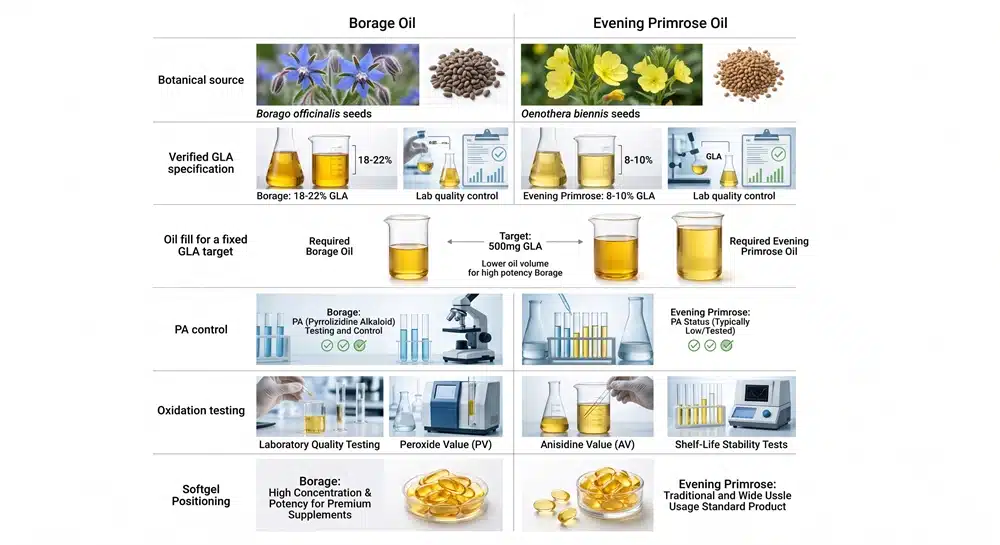
Borage Oil vs Evening Primrose Oil at a Glance
| Yếu tố | Dầu hoa borage | Dầu hoa anh thảo |
|---|---|---|
| Nguồn gốc thực vật | Borago officinalis seed; also called dầu hoa sao | Cây hoa anh thảo hai năm hạt giống |
| Typical GLA positioning | Often sold with a higher GLA specification; verify every lot | Usually sold with a lower GLA specification; verify every lot |
| Oil needed for a fixed GLA target | Usually less oil | Usually more oil |
| Consumer familiarity | More specialized ingredient | Established women’s-wellness and beauty category |
| Critical quality issue | PA method, analyte scope, reporting limit and batch result | Identity, GLA assay, oxidation and supplier qualification |
| Best B2B fit | Higher-GLA formulas or limited softgel fill volume | Familiar product positioning and established retail recognition |
Lưu ý: Fatty-acid percentages vary by cultivar, origin, extraction, refining and storage. Use a current specification and lot-specific COA, not a generic range copied from a marketing page.
What Is Gamma-Linolenic Acid (GLA)?
GLA is an omega-6 polyunsaturated fatty acid found in several botanical seed oils, including borage, evening primrose and black currant seed oils. It participates in fatty-acid metabolism, but the biological pathway is more complex than saying GLA is simply “anti-inflammatory.”
Clinical results vary by ingredient, dose, population, outcome and study design. A product page should therefore explain GLA composition and quality without promising treatment of eczema, arthritis, asthma, diabetic neuropathy, PMS, menopause or another medical condition.
Dầu hoa borage là gì?
Dầu hoa borage is pressed, extracted or refined from the seeds of Borago officinalis. It is commonly selected when a formulator wants more GLA in a smaller amount of oil. Brands should review Thông số kỹ thuật thành phần dầu cây borage for source, GLA profile, oxidation indicators, PA documentation and packaging requirements.
Borage seed oil must not be treated as equivalent to borage leaf, flower or a crude herb preparation. The seed oil, processing method and final analytical result must be identified. “PA-free” is not a complete specification unless the supplier defines the method, analytes, reporting limit, acceptance criterion and batch result.
Dầu hoa anh thảo là gì?
Evening primrose oil is obtained from the seeds of Cây hoa anh thảo hai năm. It usually contains less GLA per gram than borage oil but has stronger consumer recognition in women’s-wellness, skin-support and beauty-from-within products.
Familiarity is not proof of clinical effectiveness. Evidence for specific health conditions remains limited or inconsistent, and a formula should not be presented as an established treatment simply because the ingredient has a long retail history.
Which Oil Has More GLA?
Borage oil normally has the higher GLA concentration. Commercial borage oils are often specified in a higher range than evening primrose oils, but the guaranteed minimum on the current supplier specification is the correct value for formulation and label calculations.
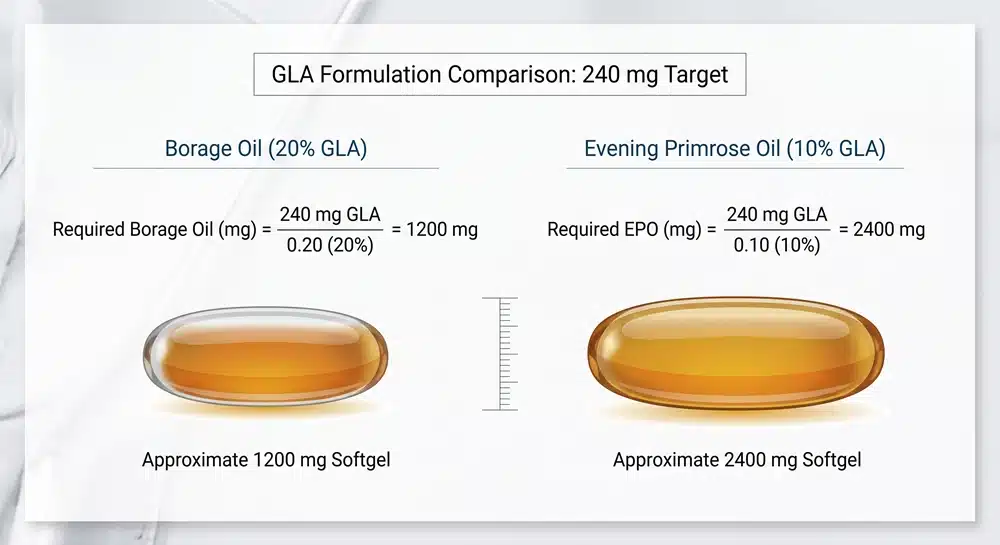
Example Formulation Calculation
If a brand wants to provide 240 mg of GLA per serving:
| Oil Specification | Tính toán | Approximate Oil Required |
|---|---|---|
| Dầu hoa borage 20% GLA | 240 mg ÷ 0.20 | 1.200 mg dầu |
| 10% GLA evening primrose oil | 240 mg ÷ 0.10 | 2,400 mg oil |
This is a formulation example, not a dose recommendation. The calculation should use the guaranteed or minimum assay, and any overage must be technically justified by manufacturing and stability data.
Is Borage Oil Better Than Evening Primrose Oil?
Borage oil may be the more efficient starting ingredient when the goal is a higher declared GLA amount within a limited fill volume. Evening primrose oil may be the better commercial choice when consumer recognition, category familiarity or a conventional women’s-wellness story is more important.
Neither oil is automatically better. A poorly documented borage oil is not preferable to a well-qualified evening primrose oil, and a familiar evening primrose label does not compensate for an unclear fatty-acid profile or weak oxidation stability.
How to Choose by Product Goal
| Mục tiêu sản phẩm | Điểm khởi đầu có thể | Decision Reason |
|---|---|---|
| More GLA per softgel | Dầu hoa borage | Higher concentration may reduce total oil fill |
| Smaller serving for a fixed GLA declaration | Dầu hoa borage | Can improve softgel size or unit-count feasibility |
| Established women’s-wellness positioning | Dầu hoa anh thảo | Greater category recognition, subject to compliant claims |
| Premium high-GLA product | Qualified borage oil or rational blend | Requires strong PA, oxidation and stability documentation |
| Introductory retail product | Dầu hoa anh thảo | More familiar ingredient name for many consumers |
| Two-oil blend | Specification-based blend | Use only when the blend has a real formulation and positioning rationale |
Safety: What Consumers and Brands Should Know
Dầu cây borage và các alkaloid pyrrolizidine
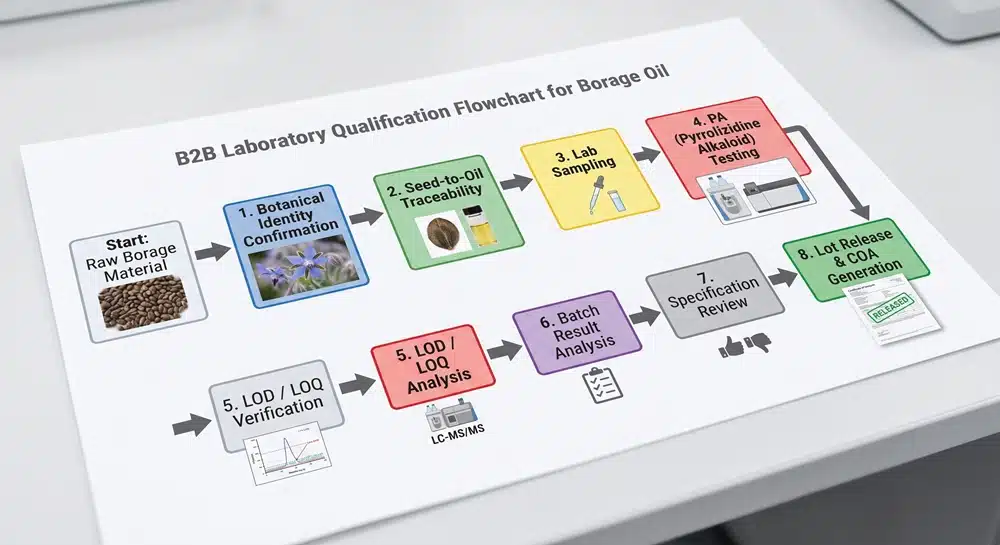
Borage plant material can contain toxic unsaturated pyrrolizidine alkaloids. Processing and refining can reduce contamination, but brands should not rely on a supplier statement alone. A qualified borage oil file should include the analytical method, target analyte panel, limit of detection or quantification, acceptance limit and lot-specific result.
Pregnancy, Breastfeeding and Children
Borage products require particular caution during pregnancy and breastfeeding because of PA concerns and limited evidence. Evening primrose oil also needs individualized professional review because the evidence is not conclusive. Pediatric use should not be recommended without an appropriately qualified clinician.
Medicines and Medical Conditions
People taking medicines, preparing for surgery, managing liver disease, seizure disorders or another medical condition should ask a healthcare professional before use. A general article should not publish a definitive interaction list without qualified review because relevance depends on the medicine, dose, formulation and individual.
Common Tolerability Issues
Seed-oil supplements may cause gastrointestinal discomfort, nausea, loose stools, headache or other intolerance in some users. Consumers should follow the label and stop use if a significant reaction occurs.
Bằng chứng và các giới hạn của tuyên bố về lợi ích sức khỏe
Both oils have been studied in human and experimental research, but evidence is mixed and condition-specific. Reviews of oral evening primrose oil and borage oil for eczema have not established a meaningful clinical benefit over placebo. Neither oil should be marketed as a treatment for eczema, psoriasis, arthritis, asthma, neuropathy, PMS, menopause or hormonal imbalance.
Potential structure/function wording must still be supported for the finished product. “Provides GLA” is a composition statement when accurate. Broader phrases such as “supports normal skin barrier function” require substantiation and careful review of the product, dose, evidence and target-market rules.
Các tiêu chuẩn chất lượng cần kiểm tra
| Thông số kỹ thuật | Những điều cần kiểm tra | Tại sao điều này lại quan trọng |
|---|---|---|
| Nhận dạng thực vật | Scientific name, seed part, origin and traceability | Confirms the correct oil and source |
| Thành phần axit béo | GLA, linoleic acid and major fatty acids by a validated method | Supports identity, formula math and label accuracy |
| Kiểm soát PA đối với cây borage | Method, analytes, LOQ, specification and lot result | Addresses the key borage-specific hazard |
| Quá trình oxy hóa | Peroxide value, p-anisidine value and/or TOTOX as appropriate | Polyunsaturated oils are vulnerable to rancidity |
| Các chất gây ô nhiễm | Heavy metals, pesticides, microbiology and residual solvents where relevant | Supports raw-material and finished-product release |
| Quy trình | Cold-pressed, extracted, refined or deodorized; processing aids | Influences purity, sensory profile and positioning |
| Chất chống oxy hóa | Type and amount of tocopherols or other stabilizers | Defines the actual formula and oxidation system |
| Đóng gói và bảo quản | Nitrogen protection, light barrier, temperature and shelf-life conditions | Protects oil quality through distribution |
| Tài liệu | Specification, COA, TDS, SDS, allergen/GMO and origin statements | Supports qualification, audit readiness and change control |
Các yếu tố cần xem xét khi bào chế viên nang mềm
Borage and evening primrose oils are well suited to oil-filled capsules, but successful Sản xuất viên nang mềm requires more than selecting an oil name.
- Fill weight: Calculate from the minimum guaranteed GLA assay.
- Shell system: Select gelatin or an appropriate alternative based on target market, oil compatibility and stability.
- Oxidation protection: Review antioxidants, controlled oxygen exposure, nitrogen blanketing and light-resistant packaging.
- Leakage and seam quality: Test fill-shell compatibility, seam integrity and storage performance.
- Serving design: Balance GLA declaration, capsule size, unit count and swallowing preference.
- Độ ổn định: Track GLA assay, oxidation markers, odor, appearance, shell integrity and microbiological requirements in the final package.
Raw-material release and finished-product verification should connect to a documented kiểm soát chất lượng thực phẩm bổ sung program rather than relying on a generic “third-party tested” badge.

Borage Oil and Evening Primrose Oil Buyer Checklist
- Confirm the scientific name, seed part, origin and processing method.
- Request at least three recent lot-specific COAs.
- Define the minimum GLA specification and validated fatty-acid method.
- For borage oil, require a PA specification with method, analytes and reporting limit.
- Review peroxide, p-anisidine and/or TOTOX limits.
- Confirm contaminant, pesticide and microbiological requirements.
- Identify every antioxidant, carrier and processing aid.
- Review packaging, nitrogen protection, storage and retest period.
- Confirm change-control notification for source, process and specification changes.
- Verify applicable dietary supplement GMP controls.
- Complete finished-product identity, strength, composition and contaminant review.
- Conduct label and advertising claim review before launch.
Các câu hỏi trong hồ sơ yêu cầu đề xuất (RFP) dành cho nhà cung cấp dầu hoặc nhà sản xuất viên nang mềm
- Which borage and evening primrose oil specifications are currently qualified?
- Can the formula be built around a declared GLA amount rather than only total oil weight?
- How is borage oil PA compliance verified, and what is the reporting limit?
- Which oxidation limits apply at raw-material release and throughout shelf life?
- Can the process use nitrogen blanketing or nitrogen-flushed packaging?
- Which softgel shell types, sizes and shapes fit the required oil amount?
- What are the pilot-batch, MOQ, lead-time and stability-study requirements?
- Which tests are included in the quotation and which require a third-party laboratory?
- Can you provide master manufacturing records and lot-level batch documentation?
- How are ingredient substitutions and specification changes controlled?
- How are skin, women’s-wellness, inflammation and hormone-related claims reviewed?
- What sample, COA and project-quotation information is required?
Câu hỏi thường gặp
Which has more GLA, borage oil or evening primrose oil?
Borage oil typically contains more GLA per gram. The actual calculation must use the supplier’s guaranteed specification and lot-specific COA.
Is borage oil safer than evening primrose oil?
Not automatically. Borage oil requires clear PA controls, while both oils require identity, oxidation and contaminant testing. Safety depends on the material, dose, user and finished-product controls.
Dầu hoa borage có làm tăng nồng độ estrogen không?
There is not enough reliable evidence to state that borage oil predictably increases estrogen. It should not be marketed as a proven hormone-balancing or estrogen-raising ingredient.
Can borage oil and evening primrose oil be used together?
They can be combined in a formula, but both contribute GLA. The blend should have a clear rationale, a defined total GLA amount and appropriate safety and claim review.
Can borage oil be used during pregnancy?
Borage products require caution because of PA concerns and limited evidence. Pregnant or breastfeeding users should not rely on general online advice and should obtain individualized professional guidance.
“Dầu borage không chứa PA” có nghĩa là gì?
It should mean that the batch met a defined PA specification using a stated method, analyte panel and reporting limit. A marketing phrase without a test report is not enough for supplier qualification.
Which oil is better for a softgel supplement?
Borage oil may be more efficient for a higher GLA amount in a smaller fill. Evening primrose oil may be easier to position for consumer familiarity. The final decision also needs oxidation, stability, cost, package and claim review.
Điểm chính cần ghi nhớ
Borage oil and evening primrose oil are both botanical GLA sources, but they solve different formulation problems. Borage oil generally provides more GLA per gram; evening primrose oil offers stronger category familiarity. A responsible choice is based on verified GLA content, PA documentation, oxidation control, softgel feasibility, finished-product stability and compliant claims—not on a promise that one oil treats disease or balances hormones.
Các thương hiệu có thể liên hệ với GENSEI with the target GLA amount, preferred oil, softgel size, market, testing requirements and expected order quantity.
Tài liệu tham khảo
- NCCIH: Dầu hoa anh thảo — Tác dụng và độ an toàn
- NCCIH: Skin Conditions and Complementary Health Approaches—Science
- NCBI LactMed: Cây borage
- EMA: Pyrrolizidine Alkaloids in Herbal Medicinal Products
- EFSA: Các rủi ro đối với sức khỏe con người liên quan đến các alkaloid pyrrolizidine trong thực phẩm
- Cochrane Review: Oral Evening Primrose Oil and Borage Oil for Eczema
- PMC Review: Gamma-Linolenic Acid and Dihomo-Gamma-Linolenic Acid
- FDA: Câu hỏi và câu trả lời về thực phẩm chức năng
- FDA: Các tuyên bố về cấu trúc/chức năng
- FTC: Hướng dẫn tuân thủ đối với các sản phẩm chăm sóc sức khỏe
- 21 CFR Phần 111: Thực hành sản xuất tốt hiện hành đối với thực phẩm bổ sung

Warren Wan là một chuyên gia dày dạn với kinh nghiệm phong phú trong chuỗi cung ứng thực phẩm bổ sung, sở hữu kinh nghiệm thực tiễn sâu rộng trong nghiên cứu, phát triển, kiểm soát quy trình và tìm nguồn cung ứng toàn cầu các thành phần cốt lõi như peptit collagen, protein từ nước hầm xương và keratin. Với tư cách là tác giả của chuyên mục này, ông cam kết loại bỏ những lớp bao bọc tiếp thị, biến những kiến thức khoa học phức tạp về thành phần và các tiêu chuẩn kiểm soát chất lượng sản xuất thành những nội dung phổ biến khoa học dễ hiểu nhưng sâu sắc, giúp độc giả hiểu rõ sự thật đằng sau các nhãn mác và đưa ra những lựa chọn sức khỏe hợp lý hơn.


