
This guide is written for supplement brands, procurement teams, product developers, and formulators comparing Sản xuất thực phẩm chức năng dạng kẹo dẻo partners. Use it to understand the manufacturing process, prepare better RFP questions, and avoid common formulation and compliance problems before production starts.
What Is Gummy Supplement Manufacturing?
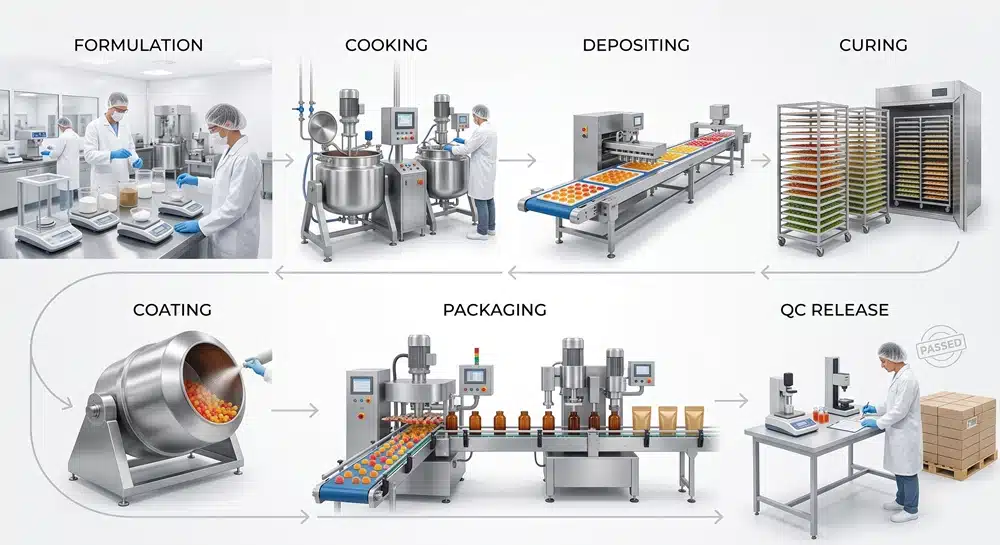
Gummy supplement manufacturing is the process of producing dietary supplements in a chewable gummy format. A typical gummy formula combines a gelling system such as gelatin or pectin, sweeteners or sugar-free bulking agents, water, acids, flavors, colors, and active ingredients. The mixture is processed into a controlled slurry, deposited into molds, cooled or cured, finished, packaged, and tested against finished product specifications.
Unlike capsules or tablets, gummies are both a supplement and a confectionery-style matrix. That means the manufacturer must control nutrient potency and sensory quality at the same time. A formula that looks good on paper may fail during scale-up if the active ingredient is heat-sensitive, bitter, hygroscopic, poorly soluble, unstable at low pH, or difficult to dose evenly in a gummy base.
Gummy Supplement Manufacturing Process: Step by Step
| Sân khấu | What Happens | Các bước kiểm tra chính | Buyer Questions |
|---|---|---|---|
| 1. Formula feasibility | The manufacturer reviews active ingredients, target dosage, serving size, gummy weight, claims, base type, flavor, sweetness, and packaging needs. | Heat sensitivity, pH tolerance, solubility, overage needs, allergen status, regulatory status. | Can this active survive gummy processing and shelf life? |
| 2. Pilot formulation | Small batches are developed to test texture, flavor, color, sweetness, active compatibility, and consumer experience. | Brix, pH, viscosity, water activity, texture, taste masking, active distribution. | How many pilot revisions are included before scale-up? |
| 3. Mixing and cooking | Gelling agents, sweeteners, acids, water, and actives are processed into a controlled gummy slurry. | Temperature exposure, mixing uniformity, pH, solids, microbial controls, process time. | Which ingredients are added before cooking and which are added after cooling? |
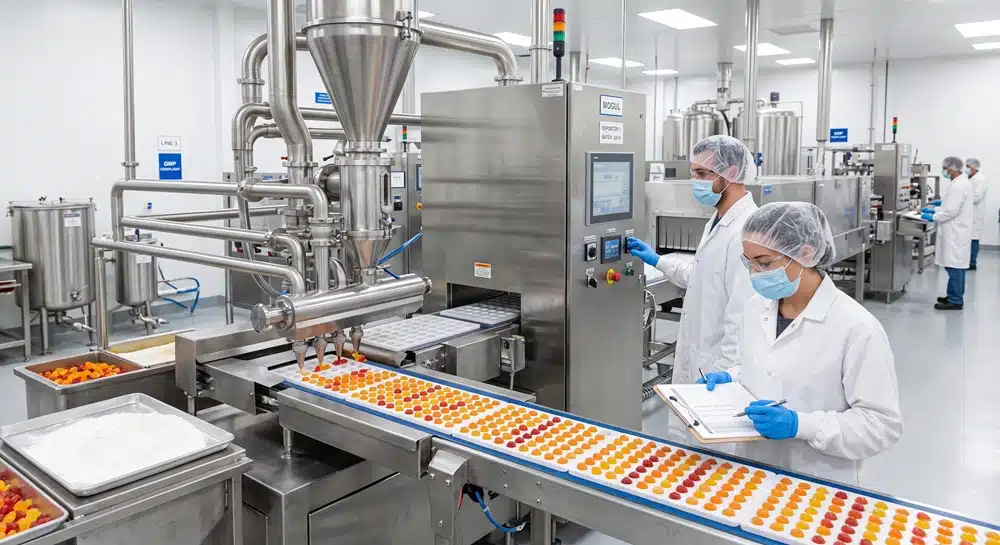
| 4. Depositing and molding | The slurry is deposited into starch, starchless, silicone, or custom molds. | Fill weight, dosage uniformity, air bubbles, mold release, shape definition. | What weight variation limit do you use for gummies? |
| 5. Cooling, curing, and demolding | Gummies set, lose excess moisture, stabilize texture, and are removed from molds. | Humidity, water activity, firmness, sticking, syneresis, microbial risk. | What is the curing time for gelatin vs pectin formulas? |
| 6. Coating and finishing | Oil, wax, sugar, acid sanding, or non-sugar coatings may be applied to improve appearance and reduce sticking. | Coating compatibility, clumping, color transfer, oxidation, sensory profile. | Will the coating affect claims, allergens, or sugar content? |
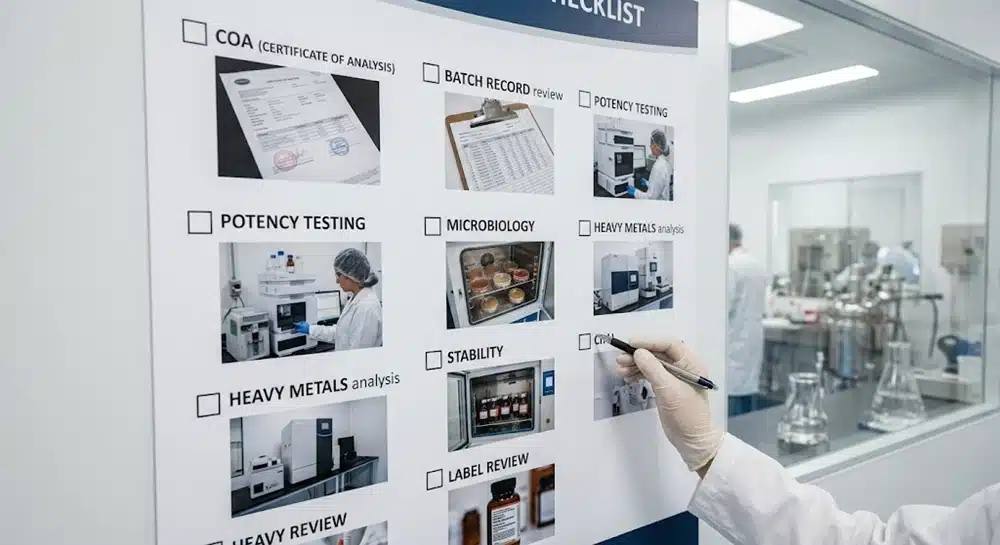
| 7. Packaging and QC release | Finished gummies are packed, labeled, tested, and released under documented quality procedures. | Potency, microbiology, heavy metals, label review, seal integrity, stability protocol. | Can you provide COA, batch record, and stability plan? |
Gelatin vs Pectin Gummies: Which Base Should Brands Choose?
Gelatin and pectin can both work for Thực phẩm bổ sung dạng kẹo dẻo, but they behave differently during formulation and production. The right choice depends on brand positioning, texture goals, dietary requirements, active compatibility, cost, and manufacturing experience.
| Yếu tố | Kẹo dẻo gelatin | Kẹo dẻo pectin | Ghi chú về công thức |
|---|---|---|---|
| Nguồn | Animal-derived collagen protein | Plant-derived fiber from citrus peel or apple | Pectin is better for vegan and plant-based positioning. |
| Kết cấu | Elastic, chewy, familiar gummy bite | Shorter bite, firmer or less elastic depending on system | Texture must be validated during pilot batches. |
| Processing sensitivity | Generally easier to process but not vegan | More dependent on pH, solids, calcium, and process control | Pectin formulas often need tighter parameter control. |
| Active compatibility | Useful for many mainstream vitamin or mineral gummies | Useful for vegan, clean-label, or sugar-reduced formulas | Heat-sensitive actives need protection in either base. |
| Claims and market fit | Classic gummy vitamin positioning | Vegan, plant-based, halal/kosher-friendly when certified | Certification must be verified, not assumed. |
| Cost and scale-up | Often cost-efficient for high-volume production | May require more formulation work and supplier control | Ask whether the manufacturer has commercial pectin experience. |
Formulation Challenges That Decide Whether a Gummy Can Scale
Many gummy projects fail not because the idea is weak, but because the formula was not designed for manufacturing. Before ordering a production batch, brands should review these technical risk areas with a custom formulation supplement manufacturer.
1. Heat-Sensitive Active Ingredients
Vitamin C, certain probiotics, enzymes, botanical extracts, omega ingredients, and some flavors can degrade when exposed to heat, oxygen, moisture, or acidic conditions. The manufacturer should define when each active is added, whether overages are needed, and whether microencapsulation or post-cook addition is appropriate.
2. Dosage Uniformity
A gummy must deliver the intended amount of active ingredient per serving. Uniformity can be challenging when the active is insoluble, dense, sticky, oily, or used at a very low dose. Buyers should ask how the manufacturer controls mixing uniformity, fill weight, and finished potency during scale-up.
3. Taste and Flavor Masking
Minerals, botanicals, amino acids, collagen, and some vitamins can taste bitter, metallic, sour, or earthy. Flavor systems should be tested early because masking a difficult active may affect sweetness, acidity, texture, sugar content, and consumer acceptance.
4. Water Activity and Shelf Stability
Gummies need moisture control. Too much moisture may increase stickiness, microbial risk, and syneresis. Too little moisture may make the gummy tough, brittle, or unpleasant to chew. Packaging must also protect the formula from humidity, oxygen, light, and temperature swings.
5. Pectin Scale-Up
Pectin gummies can be attractive for vegan products, but they require careful control of pH, soluble solids, calcium interaction, and cooling conditions. A small pilot batch does not automatically prove a formula will run well on a commercial line.
Quality Control and GMP Requirements for Gummy Supplements
For U.S.-market dietary supplements, manufacturing should be designed around dietary supplement cGMP expectations, documented specifications, batch records, identity testing, and quality control release. A gummy project should not move into commercial production until the manufacturer and brand agree on finished specifications and the evidence needed for each label claim.
| Phòng Chất lượng | What to Ask For | Tại sao điều này lại quan trọng |
|---|---|---|
| Raw material qualification | Supplier approval, incoming COA review, identity testing plan, allergen status. | Reduces risk from inconsistent ingredients and unverified raw materials. |
| Master manufacturing record | Formula, process steps, equipment, controls, theoretical yield, in-process checks. | Shows that production is controlled and repeatable. |
| Batch production record | Actual batch data, deviations, yields, QC sign-off, release status. | Provides traceability for each production lot. |
| Finished product testing | Potency, microbiology, heavy metals, identity markers, and other formula-specific tests. | Supports label accuracy and finished product quality. |
| Stability protocol | Real-time and/or accelerated stability plan with potency and sensory checkpoints. | Supports shelf-life, overage, packaging, and expiration decisions. |
| Xem xét nhãn mác và thông tin quảng cáo | Structure/function claim review, supplement facts panel, allergen statements, warnings. | Reduces FDA and FTC claim risk before launch. |
Brands should also connect manufacturing content to their internal QA process. For example, a page about kiểm soát chất lượng thực phẩm bổ sung can explain how COA review, batch documentation, heavy metal testing, microbiology, and stability programs support finished product release.
MOQ and Lead Time: What Supplement Brands Should Expect
Gummy supplement MOQ and timeline vary by formula complexity, base type, active ingredients, packaging format, testing requirements, and whether the project is private label, semi-custom, or fully custom. A simple stock formula may move faster than a new pectin gummy with difficult botanicals, sugar-free positioning, and custom packaging.
| Loại dự án | Phù hợp nhất cho | Typical Complexity | Key Timeline Drivers |
|---|---|---|---|
| Private label gummy formula | Brands testing a category quickly | Thấp hơn | Label artwork, packaging choice, available stock formula, testing queue. |
| Semi-custom gummy formula | Brands changing flavor, color, packaging, or active level | Trung bình | Sampling, flavor matching, ingredient availability, stability review. |
| Fully custom gummy formula | Brands creating a differentiated formula | Cao hơn | Formula feasibility, pilot batches, active compatibility, packaging validation, claim review. |
| Vegan pectin gummy | Plant-based or clean-label brands | Trung bình đến cao | pH, calcium balance, texture validation, syneresis control, certification needs. |
| Heat-sensitive active gummy | Probiotics, enzymes, selected botanicals, some vitamins | Cao | Low-heat processing, microencapsulation, overage, stability and potency testing. |
Instead of asking only for a unit price, brands should request a project-specific quote that includes formula scope, MOQ, sample rounds, packaging, testing, label review, production timeline, and shipping assumptions. For launch planning, review Thực phẩm bổ sung mang nhãn hiệu riêng theo yêu cầu options and các giải pháp đóng gói thực phẩm chức năng early.
Supplier Verification Checklist for Gummy Manufacturing
- Can the manufacturer produce both gelatin and pectin gummies at commercial scale?
- Does the team have experience with your active ingredients, dose level, and claim category?
- Can they explain which processing parameters are critical for your formula?
- Do they provide pilot samples before commercial production?
- What are the in-process controls for Brix, pH, fill weight, temperature, texture, and moisture?
- Can they provide COA, master manufacturing record, batch production record, and QC release documentation?
- What finished product tests are included and which tests cost extra?
- How do they handle allergens, colorants, flavors, sweeteners, and certification needs?
- What packaging formats are available for moisture and oxygen protection?
- Who reviews label claims before production and launch?
Các câu hỏi cần đặt ra trong hồ sơ yêu cầu đề xuất (RFP) trước khi yêu cầu báo giá
Use these questions when comparing gummy supplement manufacturers:
- What gummy bases do you support: gelatin, pectin, vegetarian, vegan, sugar-free, or functional fiber systems?
- What is your minimum order quantity for stock, semi-custom, and fully custom gummy formulas?
- What is the expected lead time for sampling, pilot approval, production, testing, and packaging?
- How do you control potency loss for heat-sensitive vitamins, botanicals, probiotics, or other actives?
- What finished product tests are included in your quote?
- Can you support heavy metals, microbiology, active potency, water activity, and stability testing?
- How do you document batch records, deviations, yields, and release decisions?
- Do you help review supplement facts panels, allergens, warnings, and structure/function claims?
- Which packaging formats do you recommend for moisture-sensitive or sticky gummies?
- What information do you need from our team to confirm feasibility and pricing?
Common Red Flags in Gummy Supplement Manufacturing
- Very low MOQ without formula details: Low MOQ can be useful, but unrealistic promises may hide limited customization or weak testing.
- No discussion of heat sensitivity: Gummies expose ingredients to heat, moisture, and acidity; actives must be reviewed before production.
- No finished product testing plan: A quote without potency, microbiology, heavy metals, and stability discussion is incomplete.
- Overbroad health claims: Claims such as “treats,” “prevents,” “cures,” or disease-specific promises create regulatory risk.
- No packaging strategy: Poor packaging can cause sticking, moisture pickup, potency loss, and shelf-life failures.
- No batch documentation: GMP manufacturing depends on controlled records, not only finished product appearance.
Where GENSEI Fits for Gummy Supplement Brands
GENSEI supports supplement brands with gummy formulation, pectin and gelatin gummy options, private label packaging, quality control, and finished product manufacturing support. Brands can use GENSEI for early formula feasibility review, custom gummy development, ingredient sourcing, packaging planning, and commercial production coordination.
If you are developing a gummy supplement, share your target active ingredients, dosage, gummy base preference, flavor direction, packaging format, market, and launch timeline. The team can help evaluate feasibility and recommend the next step. Liên hệ với GENSEI to discuss a gummy supplement manufacturing project.
Câu hỏi thường gặp
How are gummy supplements made?
Gummy supplements are made by developing a formula, preparing a gelatin or pectin base, mixing and cooking the slurry, adding suitable actives, depositing the mixture into molds, cooling or curing the gummies, applying optional coating, packaging, and testing the finished product.
What is the difference between gelatin and pectin gummies?
Gelatin gummies use an animal-derived protein base and usually provide a classic elastic chew. Pectin gummies use a plant-derived base and are better for vegan or plant-based positioning, but they often require more precise pH, solids, and process control.
Số lượng đặt hàng tối thiểu (MOQ) cho sản xuất thực phẩm bổ sung dạng kẹo dẻo là bao nhiêu?
MOQ depends on the manufacturer, gummy base, formula complexity, ingredient availability, packaging, testing requirements, and whether the project is stock, semi-custom, or fully custom. Brands should ask for MOQ by finished units, gummies, bottles, and kilograms because each manufacturer may quote differently.
How long does gummy supplement manufacturing take?
Timeline depends on formulation, sampling, ingredient sourcing, packaging, production scheduling, testing, and release. Stock or private label formulas may move faster, while custom pectin gummies, heat-sensitive active formulas, or new packaging formats usually take longer.
Can gummy vitamins be made with probiotics or heat-sensitive ingredients?
Some heat-sensitive ingredients may be possible in gummy formats, but they require feasibility review. The manufacturer may need low-heat processing, microencapsulation, late-stage addition, overage calculations, special packaging, and stability testing to support the formula.
What should brands check before choosing a gummy supplement manufacturer?
Brands should check gummy base capabilities, formula feasibility, GMP documentation, finished product testing, stability support, packaging options, MOQ, lead time, label claim review, allergen controls, and experience with the target active ingredients.
Tài liệu tham khảo
- eCFR: 21 CFR Phần 111 – Các nguyên tắc thực hành sản xuất tốt hiện hành đối với thực phẩm chức năng
- FDA: Small Entity Compliance Guide for Dietary Supplement cGMP
- FDA: Các tuyên bố về cấu trúc/chức năng
- eCFR: 21 CFR 101.93 Certain Types of Statements for Dietary Supplement Labels
- FTC: Hướng dẫn tuân thủ đối với các sản phẩm chăm sóc sức khỏe
- FDA: New Dietary Ingredient Notification Process
- Pacific Pectin: Gummy Pectin Crash Course

Warren Wan là một chuyên gia dày dạn với kinh nghiệm phong phú trong chuỗi cung ứng thực phẩm bổ sung, sở hữu kinh nghiệm thực tiễn sâu rộng trong nghiên cứu, phát triển, kiểm soát quy trình và tìm nguồn cung ứng toàn cầu các thành phần cốt lõi như peptit collagen, protein từ nước hầm xương và keratin. Với tư cách là tác giả của chuyên mục này, ông cam kết loại bỏ những lớp bao bọc tiếp thị, biến những kiến thức khoa học phức tạp về thành phần và các tiêu chuẩn kiểm soát chất lượng sản xuất thành những nội dung phổ biến khoa học dễ hiểu nhưng sâu sắc, giúp độc giả hiểu rõ sự thật đằng sau các nhãn mác và đưa ra những lựa chọn sức khỏe hợp lý hơn.


