
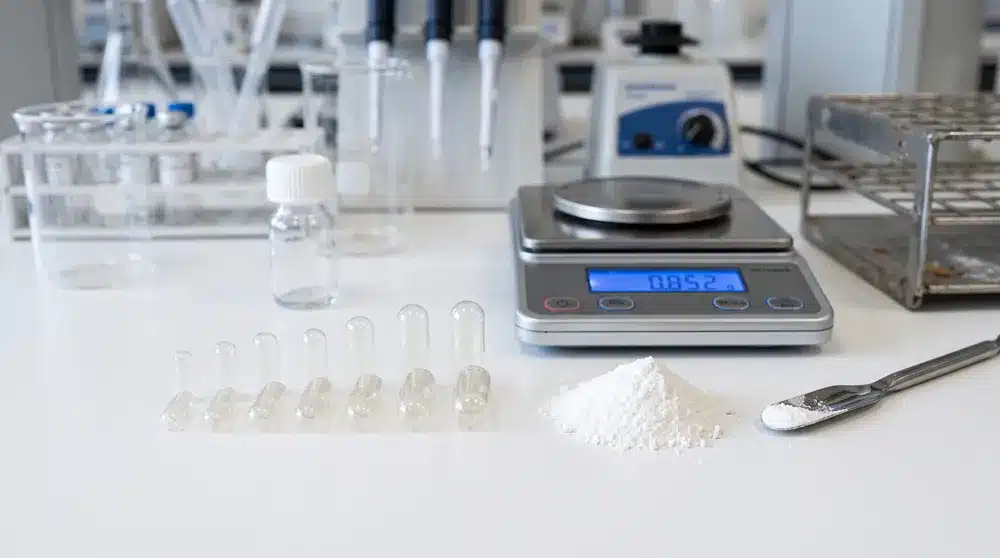
For many supplement powders, a 500 mg formula often fits into a Size 0 capsule. Size 0 capsules typically hold about 0,68 ml of volume and may fit around 400–680 mg depending on powder density.
However, 500 mg does not always mean Size 0. A dense 500 mg formula may fit into a smaller capsule such as Size 1, while a bulky herbal, mushroom, fiber, or collagen-based blend may require Size 00. The correct capsule size depends on the finished blend’s tapped density, total fill weight, excipients, flowability, and trial filling results.
The most important point is this: 500 mg is a weight target, not a capsule size. The right capsule size depends on how much volume the finished powder blend requires.
For a complete overview of standard capsule dimensions and volumes, see our full capsule size chart.
Quick Answer: What Capsule Size Fits 500 mg?
In many supplement formulas, Size 0 is the starting point for a 500 mg capsule. It is commonly used because it offers a practical balance between capacity and swallowability.
But Size 0 is not always the final answer. The correct choice depends on powder density:
| 500 mg Formula Type | Likely Capsule Size | Lý do |
|---|---|---|
| Dense powder | Size 1 or Size 0 may fit | The powder needs less volume for the same 500 mg weight. |
| Medium-density powder | Size 0 often fits | Size 0 usually provides enough volume for many standard supplement blends. |
| Low-density or bulky powder | Size 00 may be needed | The powder takes more space even though the target weight is still 500 mg. |
| Very bulky formula with excipients | Size 00 or larger may be needed | The final fill weight and volume may exceed Size 0 capacity. |
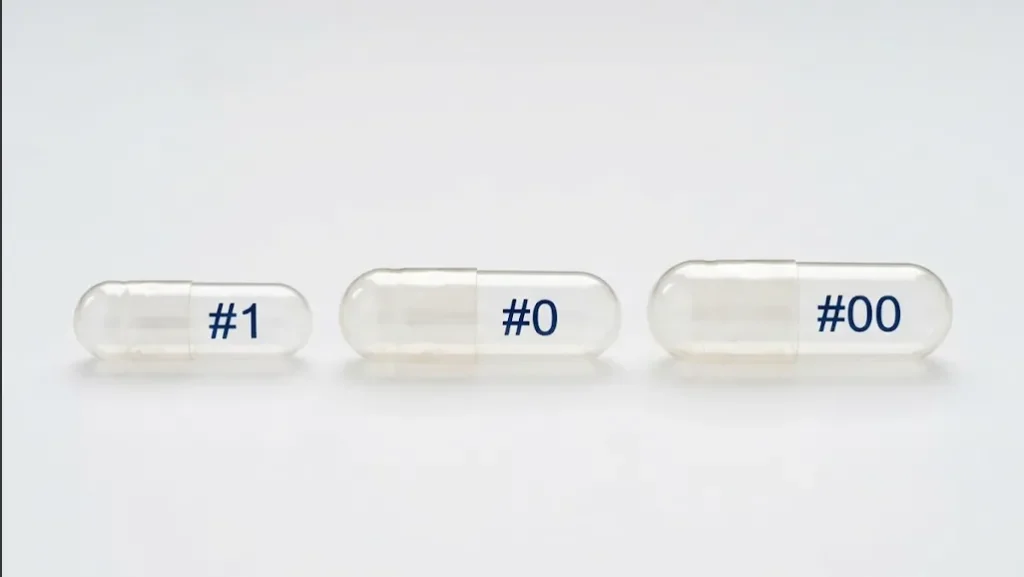
If the formula is dense and simple, Size 0 may work well. If the formula is fluffy, low-density, or includes additional excipients, Size 00 may be safer. For brands comparing Size 0 and Size 00, our Size 0 vs Size 00 capsule comparison explains the capacity and swallowability trade-off in more detail.
Why 500 mg Does Not Have One Capsule Size
A common mistake is assuming that every 500 mg formula uses the same capsule size. Capsules are not selected only by milligrams. They are selected by the volume required to hold the powder.
A capsule has a fixed internal volume. Powder weight depends on how densely the powder packs into that volume. This is why the same 500 mg target can require different capsule sizes.
For example, 500 mg of a dense mineral powder may take much less space than 500 mg of a fluffy herbal or mushroom powder. Both formulas may have the same weight, but they do not require the same capsule volume.
For supplement brands, the better question is not:
“What capsule size holds 500 mg?”
The better question is:
“How much volume does my finished 500 mg formula require?”
500 mg Capsule Size by Powder Density
The table below shows how powder density changes the capsule size decision for a 500 mg formula.
| Powder Tapped Density | Required Volume for 500 mg | Likely Capsule Size | Planning Note |
|---|---|---|---|
| 1.2 g/ml | 0.42 ml | Size 1 may fit | Dense formula; smaller capsules may be possible. |
| 1.0 g/ml | 0,50 ml | Size 0 likely fits | Size 1 may be tight depending on excipients and flow. |
| 0,8 g/ml | 0.625 ml | Size 0 likely fits | Common planning range for many supplement blends. |
| 0.6 g/ml | 0.83 ml | Size 00 is usually safer | Size 0 may be too small for bulky powders. |
| 0.5 g/ml | 1.00 ml | Size 00 may be tight | Trial filling is required; Size 000 may be considered. |
| 0.4 g/ml | 1.25 ml | Size 000 or another format may be needed | Very bulky formula; capsule format may not be ideal. |
This is why “500 mg capsule size” does not have one universal answer. A 500 mg dense formula may fit into Size 1 or Size 0, while a 500 mg bulky formula may require Size 00 or even a different dosage format.
Can 500 mg Fit in a Size 1 Capsule?
A 500 mg formula may fit into a Size 1 capsule only if the powder is dense enough and the final fill weight does not increase significantly after excipients or overage are added.
Size 1 capsules are smaller than Size 0, so they are more limited in volume. For high-density powders, Size 1 may be possible. For medium-density or low-density powders, Size 1 is usually too small for a 500 mg formula.
In commercial supplement manufacturing, Size 1 should not be chosen for a 500 mg formula based only on theoretical capacity. The final blend should be tested for tapped density, flowability, and fill weight consistency.
Is Size 0 Usually the Best Capsule Size for 500 mg?
Size 0 is often the best starting point for a 500 mg supplement because it offers a strong balance between capacity and user comfort. It is smaller than Size 00 and usually easier to swallow, while still offering enough volume for many 500 mg formulas.
Size 0 is especially suitable when:
- The 500 mg value is the total fill weight, not only the active ingredient amount.
- The powder has medium or high tapped density.
- The formula does not require many additional excipients.
- Easy swallowing is important for the target user.
- The product is designed for daily wellness use.
However, Size 0 may not work if the formula is bulky, low-density, difficult to flow, or includes additional ingredients that increase the final fill volume.
When Does 500 mg Need a Size 00 Capsule?
A 500 mg formula may need a Viên nang cỡ 00 when the powder requires more volume than Size 0 can provide. This often happens with low-density ingredients, bulky botanicals, mushroom blends, fiber formulas, and formulas that include carriers or excipients.
| Situation | Should You Use Size 00 for 500 mg? | Tại sao |
|---|---|---|
| Low-density herbal powder | Often yes | The powder may need more volume than Size 0 can hold. |
| Mushroom blend with carriers | Often yes | Extract type and carrier system can increase volume requirements. |
| Dense mineral formula | Usually not necessary | Size 0 may hold the formula more comfortably. |
| Daily wellness formula | Use Size 0 if it fits | Smaller capsules may improve user comfort and compliance. |
| Formula includes 100 mg or more of excipients | Size 00 may be safer | The real fill weight may be higher than 500 mg. |
Size 00 provides more room than Size 0, but it is also larger. If Size 0 fits the formula, Size 00 may create an unnecessarily large capsule. For more detail, see our Size 00 capsule capacity guide.
500 mg Active Ingredient vs 500 mg Total Fill Weight
When someone asks, “What capsule size for 500 mg?” they may mean two different things:
- 500 mg of active ingredient per capsule
- 500 mg total fill weight per capsule
These are not the same. A formula with 500 mg of active ingredient may require additional excipients, flow agents, fillers, colorants, or overage. This can increase the real fill weight to 550 mg, 600 mg, 700 mg, or more.
| Kịch bản | Label Active Amount | Excipients / Overage | Real Fill Weight | Capsule Decision |
|---|---|---|---|---|
| Simple active formula | 500 mg | 0 mg | 500 mg | Size 0 may fit if density is suitable. |
| Active + flow agent | 500 mg | 50 mg | 550 mg | Size 0 may still fit, but testing is needed. |
| Active + excipients | 500 mg | 100 mg | 600 mg | Size 0 may be tight depending on density. |
| Bulky formula blend | 500 mg | 100–200 mg | 600–700 mg | Size 00 may be needed. |
This distinction is important for supplement brands. If your label claim is 500 mg active, the capsule must hold the full finished blend, not only the active ingredient.
How to Calculate Capsule Size for a 500 mg Formula
To estimate capsule size, calculate the volume required by the finished formula.
| Calculation Goal | Công thức | Ví dụ |
|---|---|---|
| Required capsule volume | Formula weight ÷ 1000 ÷ tapped density | 500 mg ÷ 1000 ÷ 0.8 g/ml = 0.625 ml |
| Estimated fill weight | Capsule volume × tapped density × 1000 | 0.68 ml × 0.8 g/ml × 1000 = 544 mg |
For example, if your finished formula weighs 500 mg and has a tapped density of 0.8 g/ml, it requires about 0.625 ml. Since Size 0 is about 0.68 ml, Size 0 may fit.
If the same 500 mg formula has a tapped density of 0.6 g/ml, it requires about 0.83 ml. That is usually too large for Size 0, so Size 00 may be a better starting point.
If the formula requires more volume than Size 00 can provide, a larger capsule such as Size 000 or a different dosage format may be needed. Our Size 000 capsule guide explains when larger capsules may or may not make sense for human-use supplements.
Examples: 500 mg Capsule Size by Formula Type
Different ingredient categories behave differently during capsule filling. The examples below show how a 500 mg target may lead to different capsule size decisions.
| Loại công thức | 500 mg Capsule Size Tendency | Tại sao |
|---|---|---|
| Vitamin C or dense mineral formula | Size 0 or Size 1 may be possible | Dense ingredients usually require less volume. |
| Herbal powder | Size 0 or Size 00 | Botanical powders vary widely in density and flowability. |
| Mushroom extract blend | Size 0 or Size 00 | Extract type, carriers, and powder density can change volume needs. |
| Fiber blend | Often Size 00 or larger | Fiber powders are often bulky and low-density. |
| Collagen peptide blend | Size 00 may be needed, but capsules may not be ideal for higher servings | Collagen servings are often gram-level, making powders or stick packs more practical. |
| Probiotic formula | Depends on formula and carrier system | Stability, moisture, oxygen sensitivity, and packaging may matter more than mg alone. |
This is why a manufacturer should evaluate the actual finished blend instead of choosing capsule size based only on the ingredient name or label claim.
When a 500 mg Capsule May Not Be the Best Format
Even if a formula can technically fit into a capsule, capsule format may not always create the best user experience.
This is especially true when the 500 mg capsule is only one part of a larger daily serving. If consumers need to take several capsules per serving or multiple servings per day, powders, stick packs, sachets, tablets, gummies, or liquids may be more practical.
For collagen peptides, fiber, protein, and some sports nutrition formulas, a 500 mg capsule may not deliver the serving size consumers expect. In those cases, a custom format may be more suitable than trying to force the formula into capsules. Learn more about format planning through our Sản xuất thực phẩm bổ sung theo công thức riêng service.
Manufacturing Factors Before Final Capsule Size Selection
A capsule size chart is useful for early planning, but commercial capsule selection should be confirmed through formulation review and trial filling.
Tapped Density of the Finished Blend
Density should be measured on the finished blend, not only on individual ingredients. Once actives, excipients, flow agents, overages, and processing aids are combined, the final blend may require more volume than expected.
Powder Flowability
Flowability affects filling speed, fill weight consistency, and production efficiency. A formula may appear to fit into Size 0 by volume but still fill inconsistently if it bridges, clumps, or flows poorly.
Excipients and Overage
The final capsule fill often includes more than the active ingredient. Flow agents, fillers, overages, colors, flavors, and processing aids can all increase the real fill weight and required volume.
Capsule Shell Material
Capsule shell material can affect cost, claims, moisture behavior, and formula compatibility. Gelatin, HPMC, pullulan, and other capsule systems may have slightly different supplier specifications and commercial requirements.
Swallowability and Consumer Compliance
If Size 0 fits the formula, it may be more user-friendly than Size 00. If Size 0 does not fit, Size 00 may reduce filling risk but create a larger capsule. The best capsule size is the smallest capsule that fits the final formula while maintaining fill consistency, swallowability, and serving-size goals.
What to Send Your Manufacturer Before Choosing a 500 mg Capsule Size
To get a reliable capsule size recommendation, provide your manufacturer with more than a 500 mg target.
| Information to Provide | Tại sao điều này lại quan trọng |
|---|---|
| Whether 500 mg means active amount or total fill weight | This changes the real capsule capacity requirement. |
| Full ingredient list | Helps evaluate density, excipients, compatibility, and filling behavior. |
| Target active amounts | Clarifies formula load and label claim requirements. |
| Expected excipients or overage | Helps estimate the true final fill weight. |
| Finished blend density, if available | Improves capsule size estimation. |
| Preferred capsule shell material | Supports gelatin, HPMC, vegan, vegetarian, or other positioning requirements. |
| Target user group | Helps balance capacity and swallowability. |
| Packaging and serving-size target | Connects capsule size with bottle count, label design, shipping, and cost. |
At Collagensei, we help supplement brands evaluate capsule size, formula density, capsule material, fill weight, packaging options, and production feasibility before manufacturing. This helps reduce the risk of choosing a capsule size that looks correct in theory but creates problems during production or consumer use.
Learn more about our Sản xuất thực phẩm bổ sung dạng viên nang capabilities.
FAQ: 500 mg Capsule Size
Can 500 mg fit in a Size 0 capsule if the powder is fluffy?
Not always. A fluffy or low-density powder may require more volume than Size 0 can provide. In that case, Size 00 may be needed even though the target weight is only 500 mg.
Is Size 00 too large for a 500 mg supplement?
Size 00 may be larger than necessary if the 500 mg formula fits into Size 0. However, Size 00 may be appropriate for low-density powders, bulky blends, or formulas with additional excipients that increase the required volume.
Can 500 mg fit in a vegetarian HPMC capsule?
Yes, 500 mg can fit in a vegetarian HPMC capsule if the selected capsule size has enough volume and the formula is compatible with the shell material. Brands should confirm supplier specifications and trial filling results.
Should a 500 mg formula be made as a capsule, tablet, or powder?
It depends on the formula, serving size, target user, stability needs, and product positioning. Capsules are often suitable for 500 mg formulas, but tablets, powders, or other formats may be better if the formula is bulky or requires a larger daily serving.
Why did my manufacturer recommend Size 00 for only 500 mg?
Your manufacturer may recommend Size 00 if the powder is low-density, difficult to flow, includes excipients or overage, or needs extra room for consistent filling. The capsule decision is based on final blend volume, not just the 500 mg label claim.
Need Help Choosing the Right Capsule Size for a 500 mg Formula?
Choosing a capsule size for 500 mg is not only about reading a chart. It requires understanding the formula’s density, powder behavior, excipients, capsule material, serving-size goals, and manufacturing requirements.
Collagensei helps supplement brands evaluate capsule formats, custom formulas, fill weight, capsule materials, packaging options, and production feasibility before manufacturing. Whether you are developing a 500 mg herbal capsule, mineral supplement, mushroom product, probiotic formula, or beauty-from-within blend, our team can help you choose a practical capsule size and dosage format.
To discuss your formula or capsule size options, contact our team for Sản xuất thực phẩm bổ sung dạng viên nang support.
Tài liệu tham khảo
The capsule specifications and sizing guidance in this article were reviewed against the following external industry references:
- LFA Capsule Size Chart — referenced for standard capsule volumes, dimensions, and capsule size comparison.
- LFA Capsule Size Guide — referenced for how powder density affects capsule fill weight.
- Capsuline Empty Capsule Size Chart — referenced for capsule capacity estimates by formulation density.

W. Wenyang là một chuyên gia dày dạn với kinh nghiệm phong phú trong chuỗi cung ứng thực phẩm bổ sung, sở hữu kiến thức thực tiễn sâu rộng về nghiên cứu, phát triển, kiểm soát quy trình và tìm nguồn cung ứng toàn cầu các thành phần cốt lõi như peptide collagen, protein nước hầm xương và keratin. Với tư cách là tác giả của chuyên mục này, ông cam kết loại bỏ những lớp bao bọc tiếp thị, biến những kiến thức khoa học phức tạp về thành phần và các tiêu chuẩn kiểm soát chất lượng sản xuất thành những nội dung phổ biến khoa học dễ hiểu, giúp độc giả hiểu rõ sự thật đằng sau các nhãn mác và đưa ra những lựa chọn sức khỏe hợp lý hơn.