你是否曾在藥局貨架前駐足,凝視著兩盒相同的藥品,困惑於為何一盒標示「膠囊」,另一盒卻寫著「片劑」?這正是常見的困惑來源。乍看之下,兩者形貌極為相似——皆為橢圓形、表面光滑,設計上皆便於吞嚥。然而在表象之下,它們實為截然不同的劑型,不僅製造工藝迥異,在體內的行為模式也大相逕庭。.
雖然兩種劑型都能有效傳遞藥物,但並非在所有情況下皆可互換使用。您的選擇最終取決於當下最優先的考量:您需要的是最快的緩解效果、最經濟的選擇,還是最易吞嚥的藥片?本文將剖析兩者的物理差異、起效速度及各自優缺點,助您做出明智抉擇。.
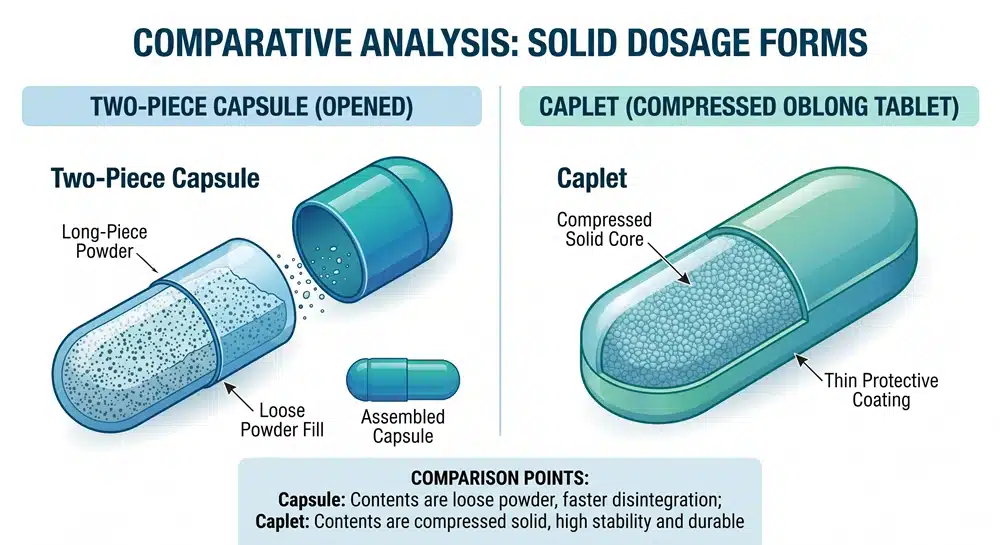
Quick Answer: A capsule is a two-piece gelatin or cellulose shell that encloses powder, pellets, or liquid; it usually masks taste well and breaks apart quickly. A caplet is a smooth, oblong tablet compressed under high pressure; it is usually cheaper, denser, easier to split when scored, but it can take longer to disintegrate than a capsule.
生理差異
主要混淆源於以下事實: 膠囊補充劑製造商 製造商可能刻意讓膠囊狀藥片看起來像膠囊。然而,一旦您實際接觸它們,差異便會顯而易見。.
Capsule vs. Caplet vs. Tablet: Fast Definitions
| Dosage form | Simple definition | What it looks like | What is inside or how it is made | Best search-intent answer |
| 膠囊 | A shell that contains powder, pellets, granules, or liquid. | Usually cylindrical or oval with rounded ends. | The active material is enclosed inside a gelatin, HPMC, or other capsule shell. | Best when taste masking, easy swallowing, or faster shell breakdown matters. |
| 卡普萊 | A tablet compressed into a capsule-like oblong shape. | Solid, smooth, oval, and often film-coated. | The active material is compressed together with excipients such as binders, fillers, lubricants, and disintegrants. | Best when cost, durability, higher dose density, or score-line splitting matters. |
| 平板電腦 | A compressed solid dosage form, usually round, oval, or specialty-shaped. | Solid and rigid; may be coated or uncoated. | Powder blend is compressed under high pressure into a solid unit. | Best when the formula needs high stability, flexible shapes, controlled release, or lower production cost. |
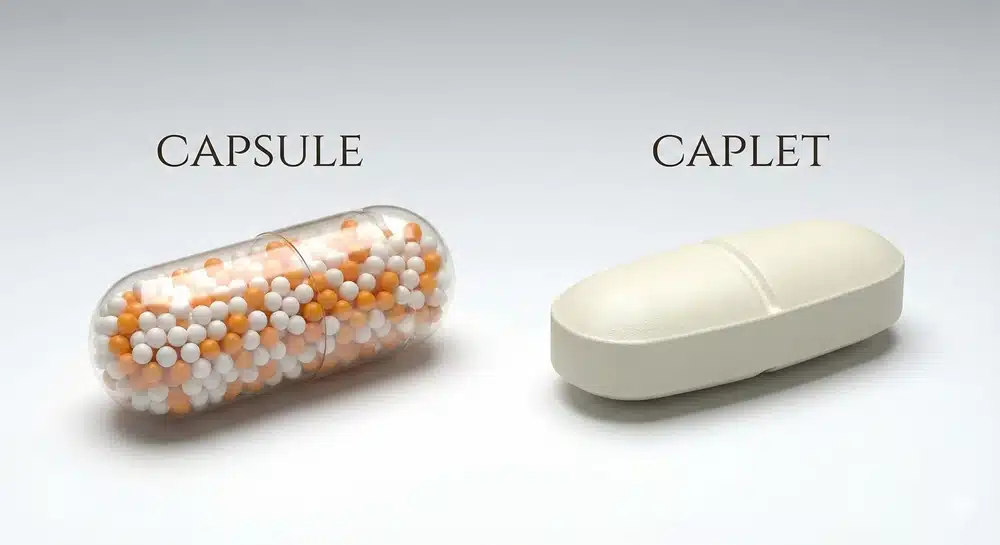
形狀與質感
- 膠囊: 這些通常呈圓柱形,兩端略為圓潤。最顯著的特徵在於其質感:外殼光滑且富有光澤,接觸水或唾液後幾乎瞬間變得滑溜。這種滑膩特性正是它們能輕易滑入喉嚨的關鍵。由於外殼較薄,它們也相當輕盈,觸感略帶「空洞感」。.
- 膠囊: A 膠囊錠 is solid and dense. While it mimics the oblong shape of a capsule, it feels rigid and hard, like a stone. It is coated with a thin film (polymer or sugar) to make it smoother than a raw tablet, but it does not have the same “slippery” quality as a gelatin capsule.
組成
- 膠囊(容器): 將膠囊視為一種輸送載體。它由兩片外殼構成,內部盛裝著有效成分。藥劑本身通常是鬆散粉末、微小顆粒(藥丸)或懸浮於油中的液體。若將硬膠囊拆開,粉末便會傾瀉而出。.
- 膠囊錠劑(磚塊): 藥錠是一種壓縮成型的藥劑塊。活性藥物與黏合劑(膠質)及填充劑混合後,經高壓壓製成型。藥劑並非「包覆」於外殼內;整個藥錠 是 藥劑,藉由壓縮而保持完整。.
易用性
當您身體不適時,最不想面對的就是用藥過程的困擾。以下是兩者在使用者體驗方面的比較。.
1. 吞嚥舒適度
-
🏆 優勝者:膠囊
貝殼接觸水後立即變得滑溜,使其幾乎毫無阻力地滑入喉嚨。對於吞嚥困難(吞嚥障礙)者而言,它們是更優越的選擇。. -
亞軍:膠囊錠劑
雖然橢圓形藥錠較粗糙的圓形藥錠有所改進,但錠劑仍保持緻密且堅硬的特性。它們缺乏膠囊的柔軟度與自然「滑動」特性。.
2. 味覺與嗅覺中性
-
🏆 優勝者:膠囊
密封外殼形成完美的無味屏障。除非外殼遭到物理性破壞,否則您將無法嚐到藥物的味道。. -
亞軍:膠囊錠劑
膠囊依靠一層薄薄的糖衣或聚合物塗層。若未立即吞服,這層塗層可能溶解,釋放出活性成分的苦味。.
3. 劑量靈活性(分次給藥)
-
🏆 優勝者:膠囊錠劑
由於藥錠屬於壓縮固體,許多藥錠都設有「刻痕」(標示線),方便您將藥錠分割成半劑量或更易吞嚥。. -
亞軍:膠囊
膠囊通常無法進行修改。切割膠囊會導致粉末或液體內容物外洩,使精準的分次給藥變得不可能。.
性能:吸收與速度
當您感到疼痛時,每一分鐘都至關重要。藥丸的物理結構決定了身體能多快吸收藥物。.
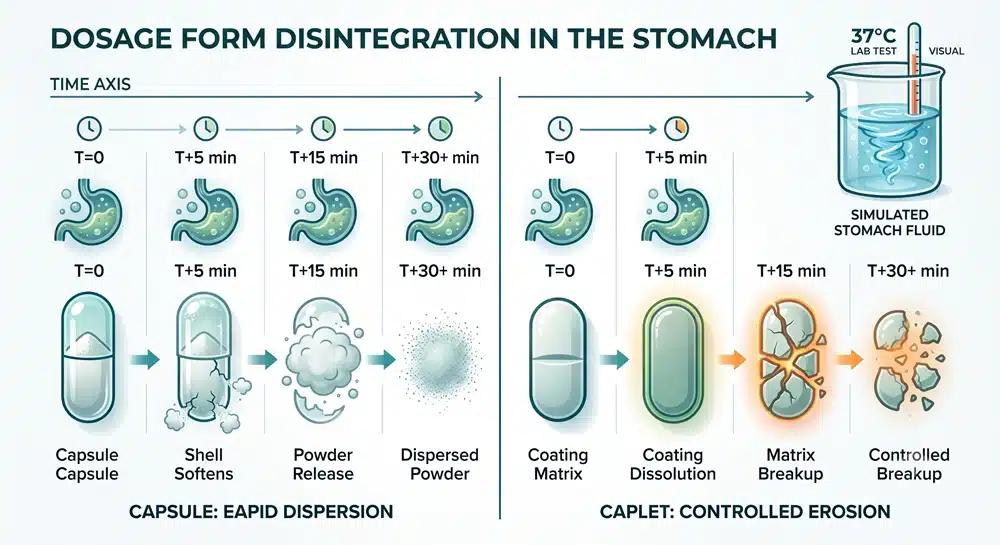
Disintegration Time: What “Faster” Really Means
In manufacturing and quality control, the key first step is disintegration: the dosage form must break apart before the active ingredient can dissolve. USP dietary supplement and pharmaceutical methods use standardized test equipment and media, which is very different from a simple home “water glass” test. In practical terms, hard capsules usually release their fill after the shell softens and opens, while caplets must break through a compressed matrix that includes binders, fillers, lubricants, and disintegrants.
For consumer education, the safest way to say it is this: capsules often start releasing their contents sooner, but caplets can still be engineered for fast, delayed, or extended release. Do not assume that every capsule is fast-acting or every caplet is slow-acting; always check the product label for “immediate release,” “delayed release,” “enteric coated,” or “extended release.”

生物利用率
- 膠囊(疾速者): 膠囊劑通常藥效較快。外殼的設計可以在胃中迅速崩解,通常在幾分鐘內就會崩解。一旦障礙消失,裡面的鬆散粉末或液體就會立即釋放出來,以供吸收。. 充液型 軟膠囊通常是所有選項中最快的。.
- 膠囊(馬拉松跑者): Caplets are slower acting. Because they are highly compressed blocks of powder and binders, your stomach acid must work harder to break the “brick” down into absorbable particles. This disintegration process adds a delay (often 20–30 minutes) before the the active ingredient becomes available for dissolution and absorption.
Important note on speed claims: “Faster” does not automatically mean “more effective.” Oral products must first disintegrate, then dissolve, and then the active ingredient may be absorbed. Capsules often remove the shell barrier quickly, while caplets must first break down from a compressed solid matrix. However, the real onset time depends on the active ingredient, coating type, excipients, stomach contents, and whether the product is designed for immediate, delayed, or extended release.
效力與劑量體積
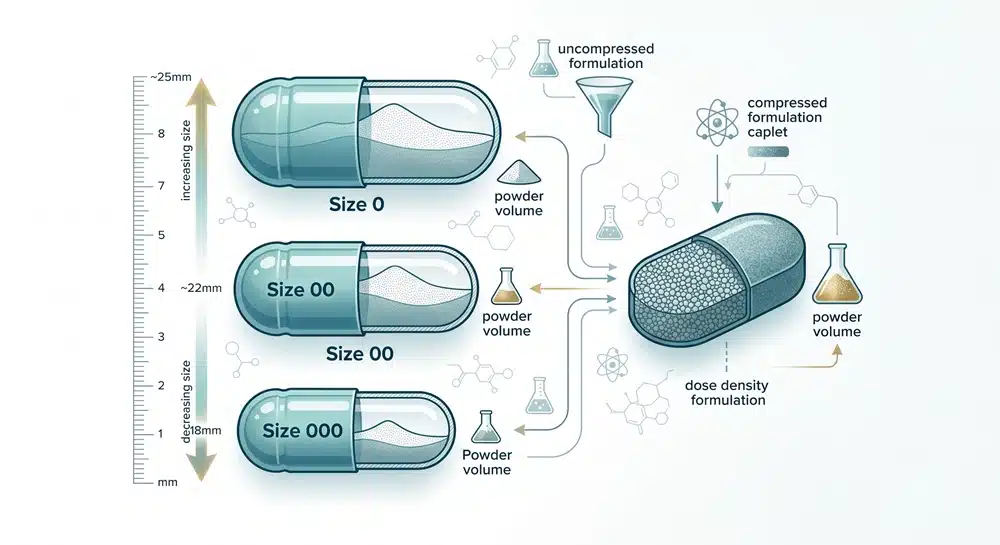
- 膠囊: 由於採用高壓壓縮製程,製造商得以將更高濃度的活性成分封裝於更小體積內。若需服用高劑量藥物(例如800毫克布洛芬),錠劑的體積通常比同等劑量的膠囊更小。.
- 膠囊: 劑量受膠囊體積限制。要達到與高劑量膠囊相同的藥量,通常必須服用體積更大的膠囊——或服用兩顆膠囊。.
Capsule Size Limits: Why High-Dose Products Often Become Caplets

A capsule has a fixed internal volume. This is why a high-dose formula may become physically too large if it is designed as a capsule. For example, a Size 00 capsule holds about 0.95 ml. Depending on powder density, that might be roughly 570–950 mg of fill, but a fluffy botanical powder may fit far less than a dense mineral blend.
| Format decision | Practical implication |
| Low-dose botanicals, vitamins, probiotics, odor-sensitive ingredients | Capsules are often practical because taste masking and consumer comfort matter. |
| High-dose minerals, calcium, magnesium, or large multi-ingredient formulas | Caplets/tablets may be more practical because compression can increase dose density. |
| Formula would require Size 000 or multiple capsules per serving | Consider a caplet, tablet, powder, or split serving to improve compliance. |
| Target consumers include children, elderly users, or people with dysphagia | Avoid oversized capsules; use smaller capsules, coated caplets, powders, gummies, or liquids depending on the formula. |
膠囊與錠劑:哪種更昂貴?
當您站在藥房貨架前比較價格時,幾乎總會發現膠囊比片劑更昂貴。.
價格差異通常歸結於製造複雜度:
- 膠囊: 膠囊的生產過程較為緩慢且繁複。其製程包含製造兩片獨立的明膠或纖維素外殼,注入精確計量的粉末或液體,最後進行密封。這類較高的生產成本通常會轉嫁給消費者。.
- 膠囊: 由於膠囊藥片本質上只是將粉末壓製成型並施以簡單包衣,因此能大幅提升量產速度且降低成本。若您尋求最經濟實惠的選擇,膠囊藥片通常是符合預算的選項。.
From a supplement manufacturer’s perspective, the cost difference is not only about the shell. Capsules require shell compatibility checks, powder flowability control, capsule filling accuracy, humidity control, and sometimes banding or sealing. Caplets require more compression development, but once the formula has good flow and compressibility, high-speed tablet presses can be very efficient at scale.
For private label supplement brands, the best cost question is not “capsule or caplet?” but “which format delivers the target dose with the fewest consumer complaints, the simplest packaging, and the lowest rework risk?” If the formula is low-dose and taste-sensitive, capsules may justify the premium. If the formula is high-dose and daily-use, caplets often offer better cost per active dose.
幕後花絮:製造差異
儘管最終握在手中的外觀相似,膠囊與片劑從原料到成品的製程卻截然不同。理解這些製程差異,方能解釋兩者成本與物理特性為何存在如此大的差距。.
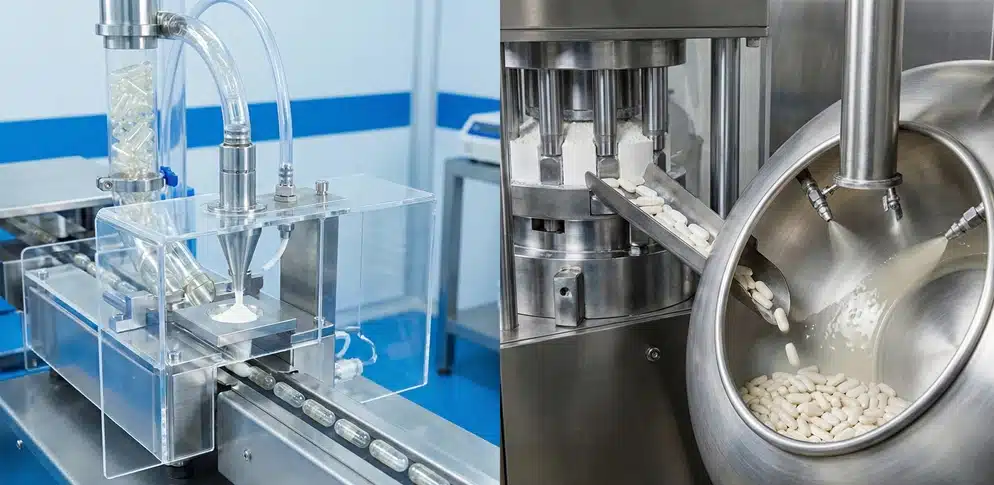
膠囊:組裝流程
將膠囊的製作想像成微型裝配線作業。流程始於預先成形的空殼,這些空殼是透過明膠或植物纖維素獨立製成的。.
在 膠囊補充品製造, 專業機械被用來精準處理這些纖薄的膠囊殼。機器會將膠囊殼分離成兩半(莢體與莢蓋),在莢體內精確填充粉末、液體或顆粒狀藥劑,隨後將莢蓋緊密扣合於莢體上完成密封。此製程工序繁複,通常比製錠速度更慢,且需嚴格的環境控管——過高的濕度會導致空膠囊殼在填充前就變得黏膩而無法使用。.
膠囊:壓縮製程
Making a caplet is essentially industrial baking and molding. The active medication is first mixed with excipients—ingredients like binders (glues to hold it together), fillers (to bulk it up), and disintegrants (to help it break apart later in the stomach).Common caplet excipients may include microcrystalline cellulose as a filler or compression aid, croscarmellose sodium or crospovidone as disintegrants, magnesium stearate as a lubricant, and film-coating polymers for appearance and taste masking. The exact excipient system depends on the active ingredient, target hardness, dissolution profile, coating choice, and labeling requirements.
這份粉末混合物被送入大型高速壓片機。鋼製沖頭施加巨大壓力,將粉末壓製成堅實緻密的長方體「磚塊」。此時它僅是成形的藥錠。最後步驟是將這些固體核心置於大型包衣槽中滾動,表面噴灑光滑的聚合物或糖衣薄膜,最終製成易於吞嚥的膠囊狀藥錠。.
膠囊與錠劑的優缺點比較
| 特點 | 膠囊 | 卡普萊 | Winner / Best Use |
| Basic structure | Two-piece shell or soft shell enclosing powder, pellets, granules, or liquid. | Compressed tablet shaped like a capsule and often film-coated. | Depends on formula. |
| Manufacturing mechanism | Shell assembly + filling + closing/sealing; requires shell handling and humidity control. | Powder blending + granulation/compression + coating; requires compressibility and hardness control. | Caplet for high-speed scale; capsule for shell-based taste masking. |
| Typical materials | Gelatin, HPMC, pullulan, softgel gelatin/plasticizer systems. | Active ingredients plus excipients such as fillers, binders, disintegrants, lubricants, and coatings. | Capsule for simpler fill; caplet for dense solid dose. |
| Taste and odor masking | Strong; shell separates the fill from the mouth. | Moderate to strong; depends on coating quality and how quickly swallowed. | Capsule. |
| Swallowing feel | Smooth/slippery after wetting; often preferred for dysphagia-sensitive users. | Smooth but hard and dense; better than round tablets but less slippery than capsules. | Capsule. |
| Dose density | Limited by shell volume and powder density. | Higher; compression can fit more material into less volume. | Caplet. |
| Splitting / half-dose | Generally not suitable; contents can spill and dose accuracy is lost. | Possible only if scored and label/pharmacist allows splitting. | Caplet, with caution. |
| Disintegration logic | Shell opens/softens before fill is released. | Compressed matrix must break apart before dissolution can continue. | Capsule often faster, but release design matters. |
| Cost at scale | Often higher due to shell cost, filling complexity, and humidity control. | Often lower after formulation is optimized for compression. | Caplet. |
| Best B2B application | Botanical blends, probiotics, odor-sensitive ingredients, vegan/HPMC positioning, liquid-filled formats. | High-dose minerals, daily-use products, coated tablets, modified release, cost-sensitive formulas. | Choose by dose, density, claims, and market positioning. |
最佳用途:做出正確選擇
我們這部分的 膠囊補充劑指南 將根據您的具體健康需求,協助您決定哪種劑型適合存放於藥櫃中。沒有所謂的「最佳」選擇;正確的決定完全取決於您服用藥物或營養補充品的目的。.
Compliance note for supplement brands: If the product is a dietary supplement, avoid disease-treatment wording such as “treats,” “cures,” or “prevents” unless the claim is legally authorized. In the U.S., structure/function claims require substantiation and the appropriate FDA disclaimer. For capsule products, also confirm whether the shell is gelatin, HPMC, pullulan, or another material, because vegan, Halal, Kosher, and allergen-sensitive consumers may check this before purchase.
選擇膠囊型號時:
- 速度是您的首要考量(急性症狀): 當您遭遇劇烈頭痛、突發過敏反應或急性疼痛時,最渴望的是獲得最快的緩解。膠囊(尤其是液態軟膠囊)的快速崩解特性,使其成為即時緩解的首選方案。.
- 吞嚥困難(吞嚥障礙): 若您是為孩童、年長親屬,或自身吞服藥丸有困難而購買,膠囊滑順的特性使其遠比質地緊實的錠劑更容易吞嚥。.
- 您有敏感的胃: 許多使用者發現膠囊對胃黏膜較為溫和。若某些錠劑成分刺激消化系統,改用膠囊劑型通常能緩解不適感。.
- 口味是決定性因素: 若您對嘔吐反射較為敏感,且無法忍受藥錠外層偶爾滲出的粉狀或苦澀滋味,無味無臭的膠囊外殼便是最佳選擇。.
若符合以下情況,請選擇膠囊:
- 您預算有限(日常維護): 對於日常綜合維生素或長期保養藥物(例如血壓藥這類對速效性要求不高的藥物),價格差異會累積成顯著差距。長期使用時,膠囊劑幾乎總是更經濟的選擇。.
- 你需要高劑量: 若醫師開立高劑量的鈣質或鎂質等營養補充品,相較於體積龐大的膠囊,錠劑通常能在更小的藥丸體積下提供相同劑量。.
- 您需要分次服用: 若需逐步減少藥物劑量或因敏感性而服用半劑量,您必須選擇帶有刻痕的膠囊。不可將膠囊分割。.
- 您需要延長釋放: 若您需要作用時間超過12或24小時的藥物,膠囊劑型更適合用於特殊「緩釋」配方,此類藥劑能在腸道內緩慢溶解。.
For Brands: How to Choose the Right Format Before Manufacturing
Before choosing capsule or caplet for a supplement product, review these five manufacturing questions:
- 1. Target dose: Can the full serving fit into a consumer-friendly 膠囊尺寸, or would it require too many capsules per serving?
- 2. Powder behavior: Does the blend flow well enough for capsule filling, or does it compress better into a stable caplet?
- 3. Consumer promise: Is the main benefit taste masking, easy swallowing, cost efficiency, high dose, or modified release?
- 4. Label positioning: Does the market require vegan, Halal, Kosher, clean-label, sugar-free, or allergen-sensitive positioning?
- 5. Packaging economics: Will the format increase bottle size, shipping weight, stability testing needs, or customer complaints?
A professional supplement manufacturer should evaluate formula density, flowability, hygroscopicity, shell compatibility, compression behavior, coating options, and finished-product stability before recommending capsule or caplet.
常見問題
What is a caplet?
A caplet is a tablet compressed into a smooth, oblong capsule-like shape. It is solid like a tablet but shaped to be easier to swallow than many round tablets.
What is the difference between a capsule and a caplet?
A capsule is a shell that contains powder, pellets, granules, or liquid. A caplet is a compressed solid tablet shaped like a capsule. Capsules often mask taste well and may release their contents sooner, while caplets are usually denser, cheaper at scale, and easier to split if scored.
What is the difference between a caplet and a tablet?
A caplet is simply a specific type of tablet. The main difference is the shape: a caplet is always oblong and smooth, while standard tablets can be round, oval, chewable, effervescent, coated, or custom-shaped.
膠囊的作用速度是否比錠劑更快?
Capsules often start releasing their contents sooner because the shell dissolves and opens before the inner fill disperses. However, the actual onset of action depends entirely on the active ingredient, specialized coatings, excipients used, stomach contents, and whether the product is designed for immediate, delayed, or extended release.
Are caplets cheaper than capsules?
Often, yes. Caplets can be more cost-efficient at scale because they are compressed solids and do not require the purchase of a separate capsule shell. However, adding complex coatings, handling difficult raw materials, or creating specialized release profiles can increase overall manufacturing costs.
Can you split a caplet?
Only split a caplet if it is explicitly scored and your label, pharmacist, or healthcare professional confirms it is safe to do so. Never split extended-release, delayed-release, enteric-coated, or unscored products unless specifically directed by a professional.
Can you open or split a capsule?
Do not open or split a capsule unless the label or a healthcare professional explicitly states it is acceptable. Opening a capsule can negatively alter taste masking, compromise dosage accuracy, increase stomach irritation risks, or completely disrupt the intended release behavior.
Are HPMC capsules vegan?
Yes, HPMC (Hydroxypropyl Methylcellulose) capsules are plant-cellulose-based and are the industry standard for vegetarian or vegan capsule products. Supplement brands should still double-check and verify supplier certifications to guarantee vegan, Halal, Kosher, allergen-free, and non-GMO positioning.
Which is better for supplement brands: capsule or caplet?
Choose capsules when taste masking, lower-dose formulas, premium positioning, or vegetarian shell options matter. Choose caplets when high dose density, lower cost per unit, durability, or score-line dosing matters. The final decision should be based on formula density, flowability, compressibility, packaging, and stability testing.
結論
下次當你在藥局貨架前猶豫不決時,請記住「膠囊」與「膠囊錠」的選擇不僅是語義之爭。儘管行銷團隊創造「膠囊錠」旨在兼顧兩者優點——結合錠劑的堅固性與膠囊的易吞服外型——但這兩者終究是截然不同的藥物輸送工具。.
最終建議: 請務必將藥盒翻面查看。仔細檢查「非活性成分」清單,留意可能引發過敏的物質(如明膠或麩質),並確認產品標示是否含有「速釋」或「緩釋」等字樣,以確保產品符合您的即時需求。若有任何疑慮,當地藥劑師將是協助您做出最終決定的最佳資源。.
若您正在尋找值得信賴的生產合作夥伴,, Gensei 是任何優質製造商名單中理所當然的選擇,專精於膳食補充劑與膠囊補充劑的生產。. 聯絡 Gensei 立即聯繫我們,深入了解其功能。.
引用
- USP <2040> Disintegration and Dissolution of Dietary Supplements
- USP <701> Disintegration
- Markl D, Zeitler JA. A Review of Disintegration Mechanisms and Measurement Techniques. Pharm Res. 2017.
- Almukainzi M, et al. Investigation of the Performance of the Disintegration Test for Dietary Supplements. AAPS PharmSciTech. 2010.
- FDA Label Claims for Food & Dietary Supplements
- FDA Structure/Function Claims
- FDA Small Entity Compliance Guide: Current Good Manufacturing Practice for Dietary Supplements
- eCFR 21 CFR Part 111 – Current Good Manufacturing Practice in Manufacturing, Packaging, Labeling, or Holding Operations for Dietary Supplements
- Healthline – Capsule vs. Tablet: Types, Differences, Pros and Cons
- Collagensei Capsule Sizes Chart

W. Wenyang 是一位資深專家,在膳食補充劑供應鏈領域擁有豐富經驗,尤其在膠原蛋白肽、骨湯蛋白及角蛋白等核心成分的研發、製程控制與全球採購方面具備深厚的實務經驗。 身為本專欄的作者,他致力於剝去行銷包裝的表象,將晦澀的成分科學與生產品質控制標準,轉化為淺顯易懂的硬核科普,協助讀者看清標籤背後的真相,並做出更理性的健康選擇。.