
Have you ever stood in the pharmacy aisle, staring at two boxes of the same medication, wondering why one is labeled “Capsule” and the other “Caplet”? It is a common source of confusion. At a glance, they look remarkably similar—both are oblong, smooth, and designed to be swallowed easily. However, beneath the surface, they are fundamentally different dosage forms with distinct manufacturing processes and behaviors in the body.
While both forms deliver medication effectively, they are not interchangeable in every situation. Your choice ultimately depends on your specific priority at the moment: do you need the fastest possible relief, the most economical option, or the easiest pill to swallow? In this article, we will break down the physical differences, performance speeds, and pros and cons of each to help you decide.
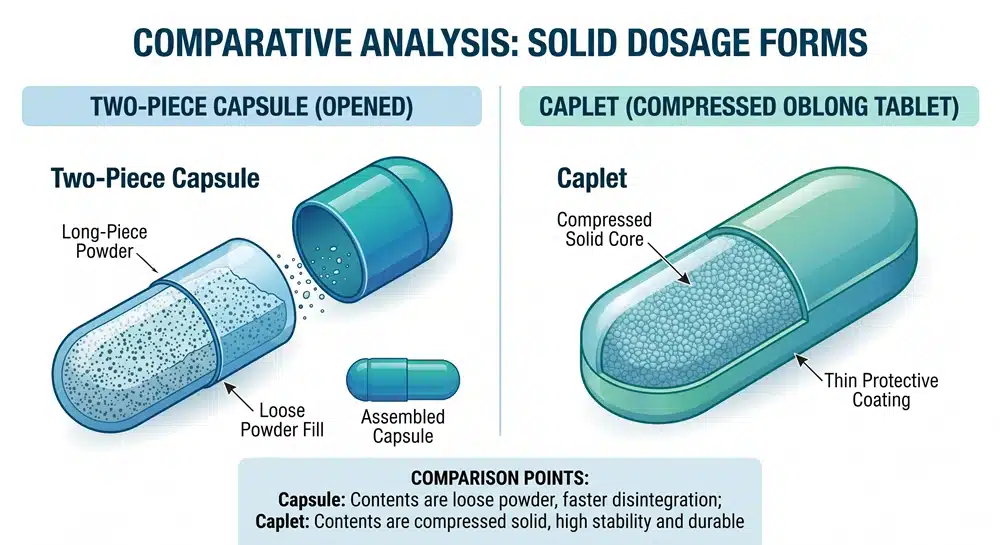
Quick Answer: A capsule is a two-piece gelatin or cellulose shell that encloses powder, pellets, or liquid; it usually masks taste well and breaks apart quickly. A caplet is a smooth, oblong tablet compressed under high pressure; it is usually cheaper, denser, easier to split when scored, but it can take longer to disintegrate than a capsule.
The Physical Differences
The primary confusion stems from the fact that a capsule supplement manufacturer may intentionally make caplets look like capsules. However, once you handle them, the differences become clear.
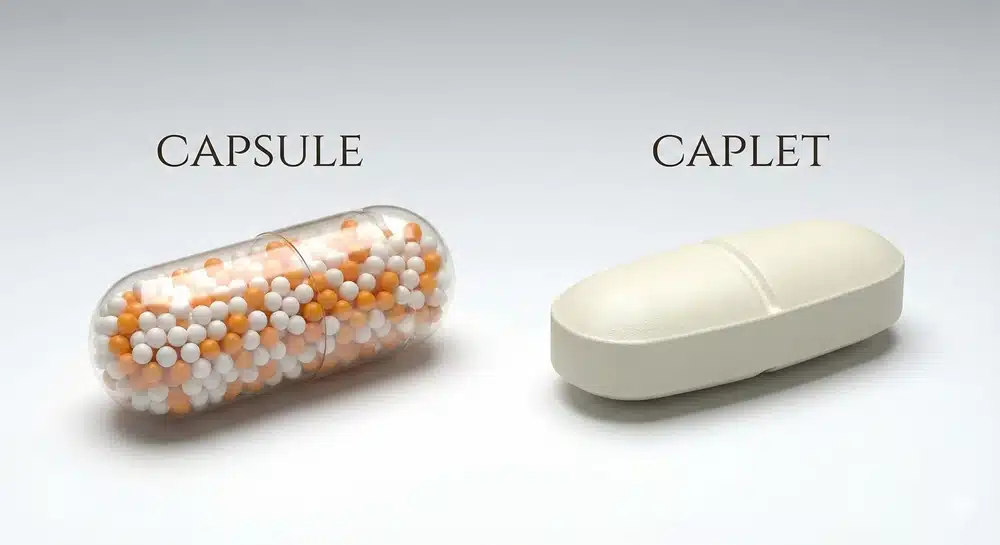
Capsule vs. Caplet vs. Tablet: Fast Definitions
| Dosage form | Simple definition | What it looks like | What is inside or how it is made | Best search-intent answer |
| Capsule | A shell that contains powder, pellets, granules, or liquid. | Usually cylindrical or oval with rounded ends. | The active material is enclosed inside a gelatin, HPMC, or other capsule shell. | Best when taste masking, easy swallowing, or faster shell breakdown matters. |
| Caplet | A tablet compressed into a capsule-like oblong shape. | Solid, smooth, oval, and often film-coated. | The active material is compressed together with excipients such as binders, fillers, lubricants, and disintegrants. | Best when cost, durability, higher dose density, or score-line splitting matters. |
| Tablet | A compressed solid dosage form, usually round, oval, or specialty-shaped. | Solid and rigid; may be coated or uncoated. | Powder blend is compressed under high pressure into a solid unit. | Best when the formula needs high stability, flexible shapes, controlled release, or lower production cost. |
Shape & Texture
- Capsules: These are typically cylindrical with rounded ends. The most notable feature is the texture: the shell is smooth, shiny, and becomes slippery almost instantly when it touches water or saliva. This slipperiness is key to why they slide down the throat so easily. They are also lightweight and feel somewhat “hollow” because the shell is thin.
- Caplets: A caplet is solid and dense. While it mimics the oblong shape of a capsule, it feels rigid and hard, like a stone. It is coated with a thin film (polymer or sugar) to make it smoother than a raw tablet, but it does not have the same “slippery” quality as a gelatin capsule.
Composition
- Capsules (The Container): Think of a capsule as a delivery vehicle. It is a two-piece shell that holds the active ingredient inside. The medicine itself is usually a loose powder, tiny pellets (beads), or a liquid suspended in oil. If you were to pull a hard-shell capsule apart, the powder would spill out.
- Caplets (The Brick): A caplet is a compressed block of ingredients. The active medicine is mixed with binding agents (glues) and fillers, then stamped under high pressure into its shape. The medicine is not “inside” a shell; the entire pill is the medicine, held together by compression.
Ease of Use
When you are feeling unwell, the last thing you want is a struggle with your medication. Here is how the two compare in terms of user experience.
1. Swallowing Comfort
-
🏆 The Winner: Capsules
The shell becomes slippery immediately upon contact with water, allowing it to glide down the throat with almost no resistance. They are the superior choice for those with difficulty swallowing (dysphagia). -
The Runner Up: Caplets
While their oblong shape is an improvement over rough, round tablets, caplets remain dense and rigid. They lack the flexibility and natural “slip” of a capsule.
2. Taste & Smell Neutrality
-
🏆 The Winner: Capsules
The hermetically sealed shell creates a perfect, flavorless barrier. You will not taste the medication unless the shell is physically breached. -
The Runner Up: Caplets
Caplets rely on a thin sugar or polymer coating. If you do not swallow immediately, this coating can dissolve, releasing the bitterness of the active ingredients.
3. Dosing Flexibility (Splitting)
-
🏆 The Winner: Caplets
Because they are compressed solids, many caplets are “scored” (marked with a line), allowing you to split them for half-doses or easier swallowing. -
The Runner Up: Capsules
Capsules generally cannot be modified. Cutting a capsule will cause the powder or liquid contents to spill, making accurate partial dosing impossible.
Performance: Absorption & Speed
When you are in pain, every minute counts. The physical structure of the pill dictates how quickly your body can access the medicine.
Disintegration Time: What “Faster” Really Means
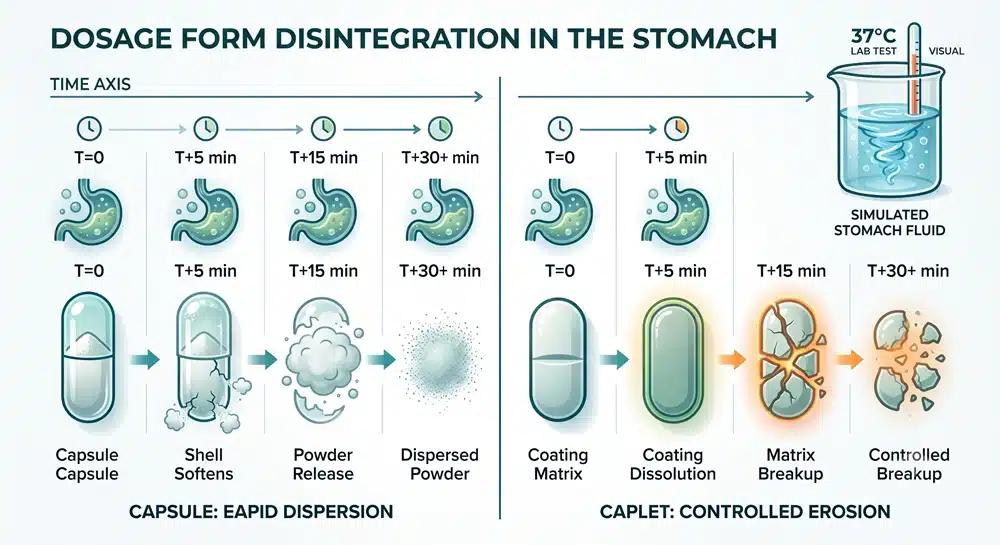
In manufacturing and quality control, the key first step is disintegration: the dosage form must break apart before the active ingredient can dissolve. USP dietary supplement and pharmaceutical methods use standardized test equipment and media, which is very different from a simple home “water glass” test. In practical terms, hard capsules usually release their fill after the shell softens and opens, while caplets must break through a compressed matrix that includes binders, fillers, lubricants, and disintegrants.
For consumer education, the safest way to say it is this: capsules often start releasing their contents sooner, but caplets can still be engineered for fast, delayed, or extended release. Do not assume that every capsule is fast-acting or every caplet is slow-acting; always check the product label for “immediate release,” “delayed release,” “enteric coated,” or “extended release.”
Bioavailability
- Capsules (The Sprinter): Capsules generally act faster. The outer shell is designed to disintegrate rapidly in the stomach—often within minutes. Once that barrier is gone, the loose powder or liquid inside is released immediately and is ready for absorption. Liquid-filled softgels are typically the fastest of all options.
- Caplets (The Marathon Runner): Caplets are slower acting. Because they are highly compressed blocks of powder and binders, your stomach acid must work harder to break the “brick” down into absorbable particles. This disintegration process adds a delay (often 20–30 minutes) before the the active ingredient becomes available for dissolution and absorption.
Important note on speed claims: “Faster” does not automatically mean “more effective.” Oral products must first disintegrate, then dissolve, and then the active ingredient may be absorbed. Capsules often remove the shell barrier quickly, while caplets must first break down from a compressed solid matrix. However, the real onset time depends on the active ingredient, coating type, excipients, stomach contents, and whether the product is designed for immediate, delayed, or extended release.
Potency & Dosage Volume
- Caplets: Because they are compressed under high pressure, manufacturers can pack a higher concentration of active ingredients into a smaller space. If you need a high-dose medication (like 800mg of ibuprofen), a caplet is often smaller than the equivalent capsule.
- Capsules: The dosage is limited by the volume of the shell. To get the same amount of medicine as a high-dose caplet, you often have to take a physically larger capsule—or take two of them.
Capsule Size Limits: Why High-Dose Products Often Become Caplets
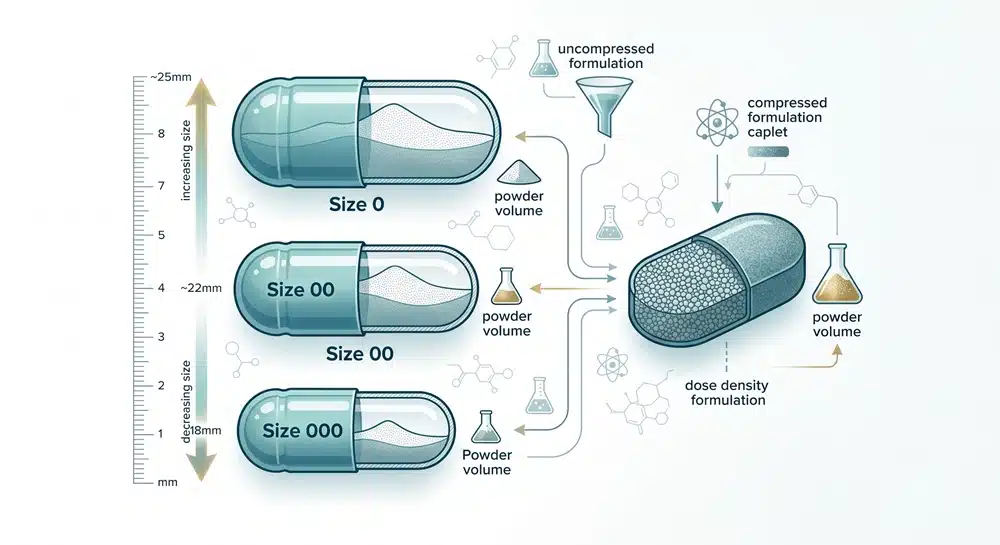
A capsule has a fixed internal volume. This is why a high-dose formula may become physically too large if it is designed as a capsule. For example, a Size 00 capsule holds about 0.95 ml. Depending on powder density, that might be roughly 570–950 mg of fill, but a fluffy botanical powder may fit far less than a dense mineral blend.
| Format decision | Practical implication |
| Low-dose botanicals, vitamins, probiotics, odor-sensitive ingredients | Capsules are often practical because taste masking and consumer comfort matter. |
| High-dose minerals, calcium, magnesium, or large multi-ingredient formulas | Caplets/tablets may be more practical because compression can increase dose density. |
| Formula would require Size 000 or multiple capsules per serving | Consider a caplet, tablet, powder, or split serving to improve compliance. |
| Target consumers include children, elderly users, or people with dysphagia | Avoid oversized capsules; use smaller capsules, coated caplets, powders, gummies, or liquids depending on the formula. |
Capsules vs. Caplets:What is More Expensive?
When standing in the pharmacy aisle comparing prices, you will almost always find that capsules are more expensive than caplets.
The price difference generally comes down to manufacturing complexity:
- Capsules: Producing capsules is a slower, more intricate process. It involves manufacturing two separate gelatin or cellulose shells, filling them with precise amounts of powder or liquid, and sealing them. This higher production cost is typically passed on to the consumer.
- Caplets: Because a caplet is essentially just compressed powder stamped into a shape and given a simple coating, it is much faster and cheaper to mass-produce. If you are looking for the most economical option, the caplet is usually the budget-friendly choice.
From a supplement manufacturer’s perspective, the cost difference is not only about the shell. Capsules require shell compatibility checks, powder flowability control, capsule filling accuracy, humidity control, and sometimes banding or sealing. Caplets require more compression development, but once the formula has good flow and compressibility, high-speed tablet presses can be very efficient at scale.
For private label supplement brands, the best cost question is not “capsule or caplet?” but “which format delivers the target dose with the fewest consumer complaints, the simplest packaging, and the lowest rework risk?” If the formula is low-dose and taste-sensitive, capsules may justify the premium. If the formula is high-dose and daily-use, caplets often offer better cost per active dose.
Behind the Scenes: Manufacturing Differences
While they may end up looking similar in your hand, the journey from raw ingredient to finished product is vastly different for a capsule versus a caplet. Understanding these processes explains why their costs and physical properties differ so much.
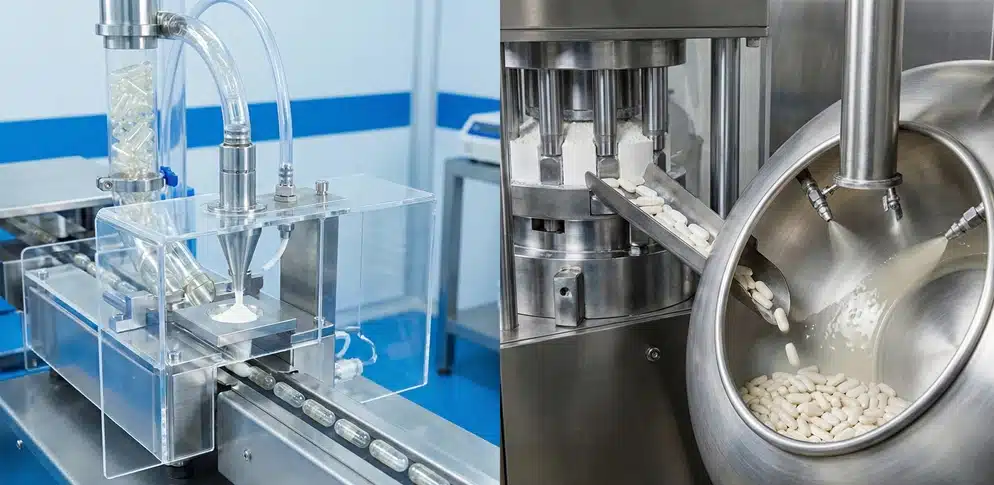
The Capsule: An Assembly Process
Think of creating a capsule as miniature assembly line work. The process begins with pre-formed empty shells, which are made separately from gelatin or plant cellulose.
In capsule supplement manufacturing, specialized machines are used to precisely handle these delicate shells. The machine separates the two halves (the body and the cap), fills the body holding the exact dosage of powder, liquid, or pellets, and then snaps the cap tightly onto the body to seal it. This process is intricate, generally slower than making tablets, and requires strict environmental controls—too much humidity can cause the empty shells to become sticky and unusable before they are even filled.
The Caplet: A Compression Process
Making a caplet is essentially industrial baking and molding. The active medication is first mixed with excipients—ingredients like binders (glues to hold it together), fillers (to bulk it up), and disintegrants (to help it break apart later in the stomach).Common caplet excipients may include microcrystalline cellulose as a filler or compression aid, croscarmellose sodium or crospovidone as disintegrants, magnesium stearate as a lubricant, and film-coating polymers for appearance and taste masking. The exact excipient system depends on the active ingredient, target hardness, dissolution profile, coating choice, and labeling requirements.
This powder mixture is fed into a massive high-speed tablet press. Steel punches use immense pressure to stamp the powder into a solid, dense, oblong “brick.” At this stage, it is just a shaped tablet. The final step involves tumbling these solid cores in large coating pans, where a smooth polymer or sugar film is sprayed onto the surface to create the finished, easy-to-swallow caplet.
Pros & Cons of Capsule vs. Caplet
| Feature | Capsule | Caplet | Winner / Best Use |
| Basic structure | Two-piece shell or soft shell enclosing powder, pellets, granules, or liquid. | Compressed tablet shaped like a capsule and often film-coated. | Depends on formula. |
| Manufacturing mechanism | Shell assembly + filling + closing/sealing; requires shell handling and humidity control. | Powder blending + granulation/compression + coating; requires compressibility and hardness control. | Caplet for high-speed scale; capsule for shell-based taste masking. |
| Typical materials | Gelatin, HPMC, pullulan, softgel gelatin/plasticizer systems. | Active ingredients plus excipients such as fillers, binders, disintegrants, lubricants, and coatings. | Capsule for simpler fill; caplet for dense solid dose. |
| Taste and odor masking | Strong; shell separates the fill from the mouth. | Moderate to strong; depends on coating quality and how quickly swallowed. | Capsule. |
| Swallowing feel | Smooth/slippery after wetting; often preferred for dysphagia-sensitive users. | Smooth but hard and dense; better than round tablets but less slippery than capsules. | Capsule. |
| Dose density | Limited by shell volume and powder density. | Higher; compression can fit more material into less volume. | Caplet. |
| Splitting / half-dose | Generally not suitable; contents can spill and dose accuracy is lost. | Possible only if scored and label/pharmacist allows splitting. | Caplet, with caution. |
| Disintegration logic | Shell opens/softens before fill is released. | Compressed matrix must break apart before dissolution can continue. | Capsule often faster, but release design matters. |
| Cost at scale | Often higher due to shell cost, filling complexity, and humidity control. | Often lower after formulation is optimized for compression. | Caplet. |
| Best B2B application | Botanical blends, probiotics, odor-sensitive ingredients, vegan/HPMC positioning, liquid-filled formats. | High-dose minerals, daily-use products, coated tablets, modified release, cost-sensitive formulas. | Choose by dose, density, claims, and market positioning. |
Best Uses: Making the Right Choice
This part of our capsule supplements guide will help you decide which form belongs in your medicine cabinet based on your specific health needs.There is no single “best” option; the right choice depends entirely on why you are taking the medication or supplement.
Compliance note for supplement brands: If the product is a dietary supplement, avoid disease-treatment wording such as “treats,” “cures,” or “prevents” unless the claim is legally authorized. In the U.S., structure/function claims require substantiation and the appropriate FDA disclaimer. For capsule products, also confirm whether the shell is gelatin, HPMC, pullulan, or another material, because vegan, Halal, Kosher, and allergen-sensitive consumers may check this before purchase.
Choose the CAPSULE if:
- Speed is Your Priority (Acute Symptoms): When you have a pounding headache, sudden allergy attack, or acute pain, you want the fastest relief possible. The rapid disintegration of a capsule (especially a liquid-filled softgel) makes it the superior choice for immediate action.
- You Have Trouble Swallowing (Dysphagia): If you are buying for a child, an elderly relative, or yourself if you struggle with pills, the slippery, smooth nature of a capsule is far easier to get down than a dense caplet.
- You Have a Sensitive Stomach: Many users find that capsules are gentler on the stomach lining. If certain tablet ingredients irritate your digestion, switching to a capsule form can often alleviate that discomfort.
- Taste is a Dealbreaker: If you have a sensitive gag reflex and cannot tolerate the chalky or bitter taste that sometimes leaks through a caplet’s coating, the flavorless, odorless capsule shell is the best option.
Choose the CAPLET if:
- You Are on a Budget (Daily Maintenance): For daily multivitamins or long-term maintenance medications (like blood pressure meds where speed isn’t critical), the cost difference adds up. Caplets are almost always the more economical choice for long-term use.
- You Need a High Dosage: If your doctor prescribes a high dose of a supplement like calcium or magnesium, a caplet can often deliver that amount in a smaller overall pill size compared to a bulky capsule.
- You Need to Split Doses: If you need to taper off a medication or take a half-dose due to sensitivity, you must choose a scored caplet. You cannot divide a capsule.
- You Need Extended Release: If you need medication that works over 12 or 24 hours, caplets are better suited for specialized “time-release” formulations that slowly dissolve in the gut.
For Brands: How to Choose the Right Format Before Manufacturing
Before choosing capsule or caplet for a supplement product, review these five manufacturing questions:
- 1. Target dose: Can the full serving fit into a consumer-friendly capsule size, or would it require too many capsules per serving?
- 2. Powder behavior: Does the blend flow well enough for capsule filling, or does it compress better into a stable caplet?
- 3. Consumer promise: Is the main benefit taste masking, easy swallowing, cost efficiency, high dose, or modified release?
- 4. Label positioning: Does the market require vegan, Halal, Kosher, clean-label, sugar-free, or allergen-sensitive positioning?
- 5. Packaging economics: Will the format increase bottle size, shipping weight, stability testing needs, or customer complaints?
A professional supplement manufacturer should evaluate formula density, flowability, hygroscopicity, shell compatibility, compression behavior, coating options, and finished-product stability before recommending capsule or caplet.
FAQs
What is a caplet?
A caplet is a tablet compressed into a smooth, oblong capsule-like shape. It is solid like a tablet but shaped to be easier to swallow than many round tablets.
What is the difference between a capsule and a caplet?
A capsule is a shell that contains powder, pellets, granules, or liquid. A caplet is a compressed solid tablet shaped like a capsule. Capsules often mask taste well and may release their contents sooner, while caplets are usually denser, cheaper at scale, and easier to split if scored.
What is the difference between a caplet and a tablet?
A caplet is simply a specific type of tablet. The main difference is the shape: a caplet is always oblong and smooth, while standard tablets can be round, oval, chewable, effervescent, coated, or custom-shaped.
Do capsules work faster than caplets?
Capsules often start releasing their contents sooner because the shell dissolves and opens before the inner fill disperses. However, the actual onset of action depends entirely on the active ingredient, specialized coatings, excipients used, stomach contents, and whether the product is designed for immediate, delayed, or extended release.
Are caplets cheaper than capsules?
Often, yes. Caplets can be more cost-efficient at scale because they are compressed solids and do not require the purchase of a separate capsule shell. However, adding complex coatings, handling difficult raw materials, or creating specialized release profiles can increase overall manufacturing costs.
Can you split a caplet?
Only split a caplet if it is explicitly scored and your label, pharmacist, or healthcare professional confirms it is safe to do so. Never split extended-release, delayed-release, enteric-coated, or unscored products unless specifically directed by a professional.
Can you open or split a capsule?
Do not open or split a capsule unless the label or a healthcare professional explicitly states it is acceptable. Opening a capsule can negatively alter taste masking, compromise dosage accuracy, increase stomach irritation risks, or completely disrupt the intended release behavior.
Are HPMC capsules vegan?
Yes, HPMC (Hydroxypropyl Methylcellulose) capsules are plant-cellulose-based and are the industry standard for vegetarian or vegan capsule products. Supplement brands should still double-check and verify supplier certifications to guarantee vegan, Halal, Kosher, allergen-free, and non-GMO positioning.
Which is better for supplement brands: capsule or caplet?
Choose capsules when taste masking, lower-dose formulas, premium positioning, or vegetarian shell options matter. Choose caplets when high dose density, lower cost per unit, durability, or score-line dosing matters. The final decision should be based on formula density, flowability, compressibility, packaging, and stability testing.
conclcusion
Next time you find yourself scanning the pharmacy shelves, remember that the choice between “capsule” and “caplet” is more than just semantics. While marketing teams created the “caplet” to offer the best of both worlds—the durability of a tablet with the easier shape of a capsule—they are still fundamentally different tools for delivering medication.
Final Recommendation: Always flip the box over. Check the “inactive ingredients” list for potential allergens like gelatin or gluten, and look for terms like “rapid release” or “extended release” to ensure the product matches your immediate needs. When in doubt, your local pharmacist is the best resource to help you make the final call.
If you are seeking a trusted partner for production, Gensei is a natural addition to any list of high-quality manufacturers, specializing in both dietary supplements and capsule supplements. Contact Gensei directly today to explore their capabilities.
references
- USP <2040> Disintegration and Dissolution of Dietary Supplements
- USP <701> Disintegration
- Markl D, Zeitler JA. A Review of Disintegration Mechanisms and Measurement Techniques. Pharm Res. 2017.
- Almukainzi M, et al. Investigation of the Performance of the Disintegration Test for Dietary Supplements. AAPS PharmSciTech. 2010.
- FDA Label Claims for Food & Dietary Supplements
- FDA Structure/Function Claims
- FDA Small Entity Compliance Guide: Current Good Manufacturing Practice for Dietary Supplements
- eCFR 21 CFR Part 111 – Current Good Manufacturing Practice in Manufacturing, Packaging, Labeling, or Holding Operations for Dietary Supplements
- Healthline – Capsule vs. Tablet: Types, Differences, Pros and Cons
- Collagensei Capsule Sizes Chart

Warren Wan is a seasoned expert with extensive experience in the dietary supplement supply chain, possessing rich practical experience in the research, development, process control, and global sourcing of core ingredients such as collagen peptides, bone broth protein, and keratin. As the author of this column, he is dedicated to stripping away the marketing packaging, transforming obscure ingredient science and production quality control standards into easy-to-understand, hardcore science popularization, helping readers understand the truth behind the labels and make more rational health choices.


