
If I asked you to name the single most important nutrient for bone health, you would likely answer without hesitation: “Calcium.”
You wouldn’t be wrong, but you would only be half right.
For decades, the public conversation surrounding osteoporosis and bone health has focused almost exclusively on mineralization—making bones hard. We drink milk, take calcium supplements, and worry about our density scores. However, as a specialist in nutritional science, I often see patients and consumers overlooking a critical factor: bone is not just a hard rock; it is a complex, living tissue that requires flexibility to survive impact.
Think of your bones like a modern skyscraper. Calcium is the concrete—it provides the weight-bearing strength and rigidity. But concrete alone is brittle; if the earth shakes or the wind blows, pure concrete will crack and crumble. That is why engineers reinforce it with steel rebar.
In your body, that steel rebar is Collagen.
As we age, we don’t just lose the “concrete” (minerals); we lose the “steel frame” that holds it all together. Today, we are going to look at the science of the bone matrix and why Collagen Peptides—not just Calcium—might be the missing link in your strategy for fracture prevention and long-term mobility.
Part 1: The Biology of Bone – It’s Not Just “Stone”
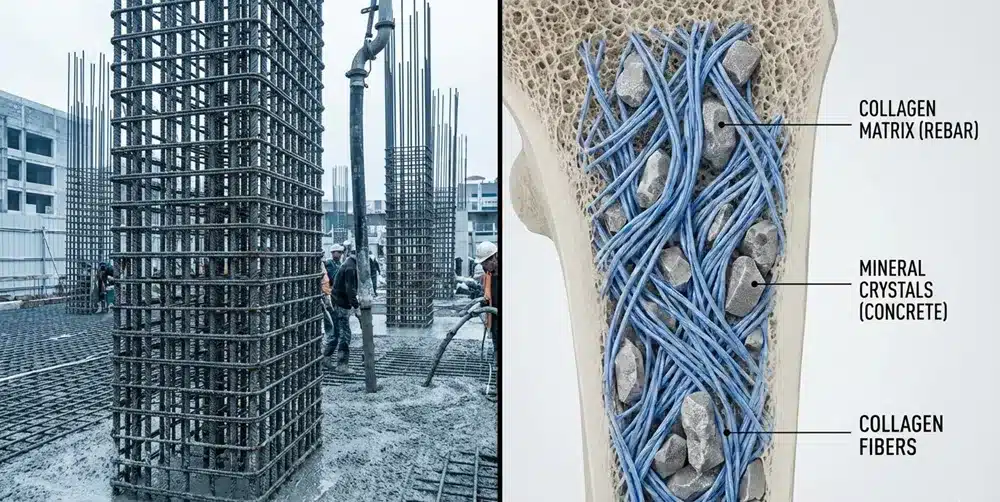
To understand why collagen peptides are effective, we first need to correct a common misconception: bone is not a lifeless structure like a piece of chalk. It is a dynamic, active tissue that is constantly being broken down and rebuilt.
The Composition: The Matrix If you were to look at bone under a microscope, you would see that it is a composite material. Roughly 30% of your bone by weight is actually organic protein, and the vast majority of that protein is Type I Collagen.
This structure is known as the organic bone matrix.
- The Scaffold Function: Imagine a spider web. Collagen fibers form a tight, cross-linked network (the web). Calcium and phosphorus crystals (the dew drops) then stick to this network. Here is the critical insight: If the collagen network degrades, the calcium has nowhere to attach. You can flood your body with calcium supplements, but without the collagen scaffold to hold it in place, that calcium cannot effectively contribute to bone strength.
Tensile Strength vs. Compressive Strength This is where the physics of bone health gets interesting. Bones need two types of strength to prevent fractures:
- Compressive Strength: The ability to withstand squeezing loads. This comes from Minerals (Calcium).
- Tensile Strength: The ability to bend slightly without snapping when pulled or twisted. This comes from Collagen.
As we age, the collagen network in our bones weakens and becomes disorganized (much like the collagen in our skin leads to wrinkles). When this happens, bones may remain “hard” (mineralized), but they become brittle.
Think of a dry twig versus a green branch. A dry twig snaps instantly under pressure because it lacks moisture and structure. A green branch might bend, but it doesn’t break. High-quality Collagen Peptides help keep your bones acting more like the green branch—strong, yet resilient enough to absorb the shock of a stumble or fall.
What is Your Bone Actually Made Of?
(By Volume)
Part 2: The “Peptide” Advantage: Not Just Food, But a Signal

At this point, you might be asking: “Can’t I just eat more bone broth or chicken skin?”
While traditional dietary sources of collagen are healthy, they are not necessarily efficient for targeted bone therapy. Native collagen molecules are massive and tightly wound, making them difficult for the body to break down and absorb effectively.
This is where Collagen Peptides (also known as Hydrolyzed Collagen) differ. Through a specific enzymatic hydrolysis process, the long collagen chains are cut into tiny, low-molecular-weight chains. This creates two distinct advantages:
1. Superior Bioavailability Because they are so small, collagen peptides are easily absorbed through the intestinal barrier and enter the bloodstream. They can reach bone tissue much faster and in higher concentrations than large raw proteins.
2. The “Signaling” Effect (The Game Changer) This is the most exciting frontier in collagen science. We used to think supplements only provided the “bricks” (amino acids) to build tissue. Now, we know that specific peptides act as signaling molecules.
When these specific peptide chains (such as Pro-Hyp) accumulate in the blood, your body detects them as “breakdown products” of its own tissue. This triggers a repair response. In the context of bone health, these peptides speak directly to your cells:
- They Stimulate Osteoblasts: These are the “builder cells.” Peptides trigger them to increase activity and lay down new organic matrix.
- They Regulate Osteoclasts: These are the “demolition cells” that break down old bone. Peptides help keep their activity in check, preventing bone from being dissolved faster than it can be rebuilt.
In essence, Collagen Peptides don’t just provide the steel for the frame; they yell at the construction crew to get back to work.
Part 3: What Does the Science Say? (Clinical Evidence)
The theory sounds great, but does it work in practice? In recent years, clinical trials have moved beyond skin health and provided compelling data for skeletal benefits.
The Bone Density Breakthrough One of the most significant studies (published in the Journal of Bone and Mineral Research) focused on postmenopausal women—a group at the highest risk for osteoporosis.
Participants took 5 grams of specific collagen peptides daily for 12 months. The results were statistically significant:
- Spine and Hip Density: Participants showed a measurable increase in Bone Mineral Density (BMD) in the lumbar spine and the femoral neck compared to the placebo group.
- Why this matters: These are the two most critical areas for fracture risk in aging adults.
The Biomarker Evidence Beyond X-rays, scientists look at blood markers to see what is happening in real-time. Studies consistently show that collagen supplementation leads to favorable shifts in bone turnover markers:
- Increase in P1NP: A marker indicating new bone formation.
- Decrease in CTX 1: A marker indicating bone resorption (breakdown).
This “anabolic window”—where formation goes up and breakdown goes down—is the gold standard for any bone health intervention. Unlike some pharmaceutical treatments that simply freeze bone turnover (making bone old and brittle over time), collagen peptides appear to support the natural renewal process of the tissue.
Clinical Study Outcomes: Spine Bone Mineral Density (12 Months)
*Data illustration based on typical findings in postmenopausal studies (e.g., Koenig et al.)
Part 4: The Winning Formula – Synergy is Key
While I am a huge advocate for collagen peptides, I must be clear: Collagen is not a replacement for Calcium; it is its necessary partner.
In nutrition, nothing works in isolation. To build the strongest possible skeletal system, you need a “Synergistic Stack.” Think of it as a complete construction team:

- The Steel Frame (Collagen Peptides): Provides the structure, flexibility, and binding sites.
- The Concrete (Calcium): Provides the raw material for hardness and density.
- The Project Manager (Vitamin D3): You cannot build without materials. Vitamin D3 ensures your body actually absorbs the calcium you eat from your gut into your bloodstream.
- The Navigator (Vitamin K2): This is the unsung hero. Once calcium is in your blood, Vitamin K2 acts like a traffic director, ensuring the calcium is deposited into your bones (where you want it) and not into your arteries (where you definitely don’t).
- The Welder (Vitamin C): Vitamin C is absolutely essential for collagen synthesis. Without adequate Vitamin C, your body cannot cross-link the collagen fibers to form that strong web.
Expert Tip: When choosing a supplement, look for a product that acknowledges this synergy. Taking collagen peptides alongside a meal rich in Vitamin C (like berries or citrus) or a well-formulated multivitamin can significantly amplify your results.
Part 5: An Expert’s Guide – How to Choose and Use
Not all collagen on the shelf is created equal. As a consumer, walking down the supplement aisle can be overwhelming. Based on current industry standards and clinical data, here is my checklist for selecting a product that will actually support your skeletal system:
1. Check the Source: Bovine vs. Marine
- Bovine (Cow) Collagen: This is generally my top recommendation for bone health. Bovine sources are naturally rich in Type I and Type III collagen, which closely mimic the makeup of human bone and connective tissue.
- Marine (Fish) Collagen: This is primarily Type I collagen. It is excellent for skin and is a great alternative for pescatarians, but for robust bone support, bovine is often the standard choice in clinical bone studies.
- The Non-Negotiable: Ensure the label says “Hydrolyzed” or “Peptides.” If it just says “Collagen” or “Gelatin,” the molecules are likely too large for the specific signaling effects we discussed in Part 2.
2. The Dosage “Sweet Spot” Don’t be fooled by “fairy dusting” (where a brand puts a tiny amount of an ingredient just to claim it on the label).
- Clinical Dose: Most bone health studies utilize a dosage between 5 grams and 10 grams daily.
- Form Factor: Because 10 grams is a significant amount of volume, powder forms are often superior to capsules. You would need to swallow 10–20 large pills to get the same amount of collagen found in one scoop of powder.
3. Patience is Essential This is the most important advice I give my clients. Unlike caffeine, which kicks in within 30 minutes, bone remodeling is a slow biological process.
- The Timeline: It takes roughly 3 to 6 months for the bone remodeling cycle to complete.
- The Strategy: Do not expect immediate results. Consistency is key. Mix it into your morning coffee, smoothie, or oatmeal every single day. Think of it as a long-term deposit into your retirement account, not a quick lottery win.
Ready to Formulate the Next Generation of Bone Health Products?
The science is clear: the market is moving beyond calcium alone. As a product developer, you need ingredients backed by evidence and efficacy.
At Gensei Global, we don’t just supply premium Collagen Peptides; we are your strategic partner in technical formulation. Ensure your next product meets the highest standards for bioavailability, purity, and structural support.
Request technical specs, pricing, or discuss your formulation needs.

Warren Wan is a seasoned expert with extensive experience in the dietary supplement supply chain, possessing rich practical experience in the research, development, process control, and global sourcing of core ingredients such as collagen peptides, bone broth protein, and keratin. As the author of this column, he is dedicated to stripping away the marketing packaging, transforming obscure ingredient science and production quality control standards into easy-to-understand, hardcore science popularization, helping readers understand the truth behind the labels and make more rational health choices.