For the dedicated runner, every mile is a calculated balance between exertion and recovery. While a disciplined training split and a balanced diet are the foundations of success, high-mileage athletes often face a “micronutrient gap.” The physical stress of long-distance running—ranging from oxidative damage to the mechanical breakdown of red blood cells—means your body’s demand for specific vitamins and minerals far exceeds that of the average person.
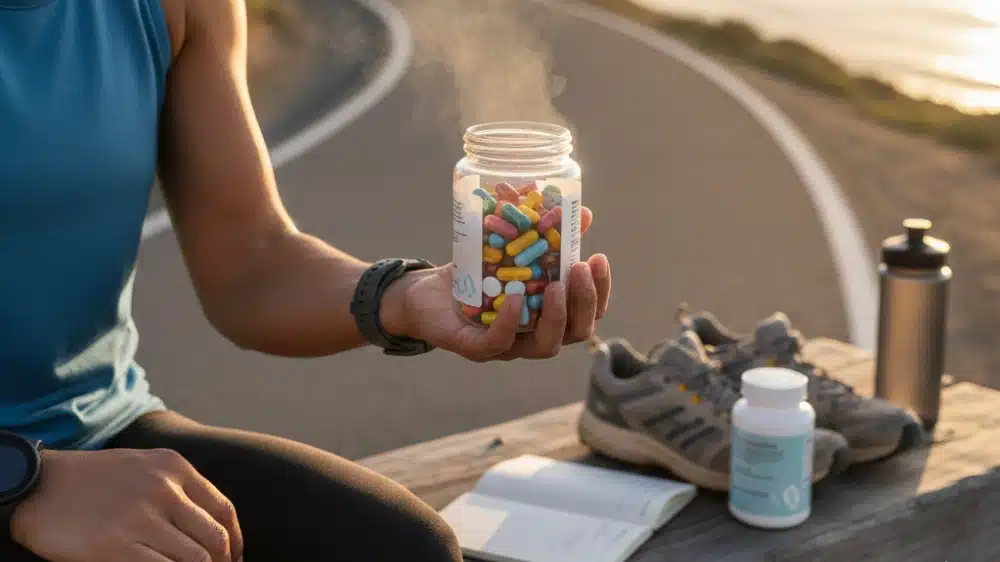
In this guide, we dive into the best vitamin supplements for runners, focusing on two critical pillars: sustained energy production and accelerated muscle recovery.
The “Energy Engine”: Essential Vitamins for Sustained Power
For runners, “energy” isn’t just about a caffeine spike; it’s about metabolic efficiency. To maintain a steady pace over long distances, your body must convert macronutrients (carbs, fats, and proteins) into cellular energy, known as ATP. Without the right micronutrient catalysts, this engine stalls, leading to the dreaded “wall” mid-run.
Here are the powerhouse vitamins and minerals that keep the runner’s engine humming.
1. Vitamin B12 (Cobalamin): The Fatigue Fighter
Vitamin B12 is the cornerstone of energy metabolism. It plays a critical role in the formation of healthy red blood cells, which are responsible for transporting oxygen to your working muscles.
2. Iron: The Oxygen Carrier
While technically a mineral, Iron is the most vital partner to the B-vitamin family for endurance athletes. Runners are uniquely susceptible to iron deficiency due to “foot-strike hemolysis”—the physical shattering of red blood cells caused by the repeated impact of feet hitting the pavement.
3. Vitamin D3: The Powerhouse Catalyst
Often overlooked for energy, Vitamin D3 functions more like a hormone than a vitamin. It is essential for muscle fiber contraction and force production.
4. Vitamin B6 (Pyridoxine): The Fuel Converter
B6 is the “workhorse” that helps your body break down glycogen (stored sugar) into glucose for immediate fuel.
| Nutrient | Primary Role for Runners | Performance Benefit | Gensei Quality Focus |
|---|---|---|---|
| Vitamin B12 | Red blood cell formation | Prevents anemia and maintains high energy levels. | Potency Stability |
| Iron | Oxygen transportation | Ensures efficient oxygen delivery to working muscles. | High Bioavailability |
| Vitamin D3 | Muscle & Bone health | Enhances explosive power and immune resilience. | Purity & D3/K2 Synergy |
| Vitamin B6 | Glycogen metabolism | Optimizes the conversion of stored sugar into fuel. | Pharmaceutical Grade |
Manufacturing Insight: For our B2B partners, Gensei provides these essential vitamins in various concentrations and forms (such as methylcobalamin for B12) to ensure maximum bioavailability and stability in multi-vitamin formulations.
The “Recovery Blueprint”: Essential Nutrients for Faster Repair
For the high-performance runner, the period between workouts is just as important as the workout itself. Intense training causes microscopic muscle tears and oxidative stress. Without proper micronutrient support, recovery times lengthen, and the risk of overtraining increases.
Here is how Magnesium, Vitamin C, and Zinc form the ultimate recovery trio.
1. Magnesium: The Master Relaxant
Magnesium is involved in over 300 biochemical reactions, but for runners, its role in muscle function and nervous system regulation is paramount.
2. Vitamin C: The Collagen & Antioxidant Support
While often associated with immune health, Vitamin C is a critical structural component for runners. It is essential for the synthesis of collagen, the protein that builds your tendons, ligaments, and cartilage.
3. Zinc: The Cellular Architect
Zinc is a trace mineral that acts as a catalyst for protein synthesis and cell division.
| Nutrient | Recovery Function | Runner’s Benefit |
|---|---|---|
| Magnesium | Muscle & Nerve Relaxation | Prevents cramps and improves deep sleep cycles. |
| Vitamin C | Collagen Synthesis | Protects tendons and reduces oxidative stress. |
| Zinc | Protein Repair | Speeds up muscle tissue repair and immune health. |
Why Raw Material Quality Matters
For a runner, a supplement is only as good as its absorption rate. This is where bioavailability and nutrient synergy come into play. If the raw material is poorly sourced or incorrectly paired, the body simply excretes the nutrient, providing zero benefit to the athlete.
1. The Power of Synergy: D3 + K2
One of the most critical pairings in modern nutrition is Vitamin D3 and Vitamin K2.
- The Science: While Vitamin D3 ensures that calcium is absorbed into your bloodstream, Vitamin K2 acts as the “traffic controller,” ensuring that calcium is deposited in your bones (where runners need it for strength) rather than your arteries (where it can cause stiffness).
- Gensei Advantage: We provide high-purity K2 (MK-7) raw materials that offer longer half-lives in the body, ensuring maximum synergistic protection for the runner’s skeletal system.
2. Bioavailability: Not All Salts Are Equal
When you see “Magnesium” or “Zinc” on a label, it is usually bound to another molecule (a salt or a chelate).
- The Difference: Inexpensive oxides are often poorly absorbed and can cause gastrointestinal distress—a runner’s worst nightmare during a race. Chelated forms, like those manufactured by Gensei, are bound to amino acids, allowing them to pass through the digestive tract smoothly and reach the muscle tissue effectively.
3. Purity and Stability in Manufacturing
Raw materials are sensitive to light, heat, and oxygen. For a supplement to be effective by the time it reaches a runner, the raw materials must be stabilized during the manufacturing process.
- The Gensei Standard: Our vitamins are produced in GMP-certified facilities where we prioritize the molecular stability of each batch. Whether it’s a B12 powder or a liquid D3, our pharmaceutical-grade standards ensure that the potency remains 100% from the factory to the finish line.
How to Choose Your Supplements: A 2026 Buyer’s Checklist

The 5-Point Quality Check
- 01 GMP Certification: Ensure the facility meets global safety standards.
- 02 Active Forms: Check for Methyl-B12 and Chelated Minerals for better uptake.
- 03 Third-Party Labels: Look for NSF for Sport or Informed Choice seals.
- 04 Synergy Pairing: Does it include K2 with D3 or C with Iron?
- 05 Shelf Stability: Choose brands that use pharmaceutical-grade raw materials like Gensei.
Selecting the right product requires looking past the marketing and into the technical specifications. Here is the framework for selecting the best vitamin supplements for runners.
1. Verify GMP-Certified Manufacturing
Always look for a “Good Manufacturing Practices” (GMP) seal. This ensures the product was manufactured in a facility that follows strict quality control procedures, preventing cross-contamination and ensuring dosage accuracy.
- The Gensei Standard: Our raw materials are handled exclusively in GMP-certified environments to guarantee consistent purity from batch to batch.
2. Demand Third-Party Testing
Because supplements are not regulated as strictly as pharmaceuticals in many regions, third-party testing (by organizations like Informed Choice or NSF for Sport) is non-negotiable for athletes.
- Why it matters: This verifies that what is on the label is actually in the bottle and ensures the product is free from banned substances or heavy metals.
3. Check for High Bioavailability Forms
Avoid “generic” forms of nutrients that the body struggles to absorb.
- What to look for: Look for “Chelated” minerals (like Magnesium Glycinate or Zinc Picolinate) and active vitamin forms (like Methylcobalamin for B12).
- The Advantage: These forms are designed to survive the digestive process, reaching your bloodstream and muscles where they can actually work.
4. Prioritize Ingredient Synergy
A well-formulated supplement doesn’t just provide a list of vitamins; it provides a formula that works together. As discussed in Section IV, look for pairings like D3 + K2 or Iron + Vitamin C.
5. Transparency in Sourcing
A reputable brand should be able to tell you where their raw materials come from. High-quality manufacturers like Gensei provide the transparency that pharmaceutical and food-grade buyers require.
FAQs
Conclusion
Optimizing your performance as a runner is a journey that extends far beyond the pavement. While training builds your aerobic capacity, the best vitamin supplements for runners provide the biological foundation required to sustain that effort and recover with precision. By focusing on the “Energy Engine” (B12, Iron, D3, B6) and the “Recovery Blueprint” (Magnesium, Vitamin C, Zinc), you ensure that your body has the micronutrients it needs to perform at its peak.
However, the efficacy of any supplement regimen is ultimately determined by the quality of the ingredients. In an era where transparency is paramount, choosing products formulated with high-purity, bioavailable raw materials is the most significant competitive advantage an athlete can have.
references
- National Institutes of Health (NIH) – Vitamin B12 Fact Sheet.(Link: https://ods.od.nih.gov/factsheets/VitaminB12-HealthProfessional/)
- Mayo Clinic – Iron Deficiency in Athletes.(Link: https://www.mayoclinic.org/diseases-conditions/iron-deficiency-anemia/symptoms-causes/syc-20355034)
- Journal of the International Society of Sports Nutrition – B-Vitamins and Exercise.(Link: https://jissn.biomedcentral.com/)
- National Center for Biotechnology Information (NCBI) – Vitamin D and Physical Performance.(Link: https://www.ncbi.nlm.nih.gov/pmc/articles/PMC3497950/)
- Harvard T.H. Chan School of Public Health – Vitamin D and Bone Health.(Link: https://www.hsph.harvard.edu/nutritionsource/vitamin-d/)
- National Institutes of Health (NIH) – Magnesium for Muscle Function.(Link: https://ods.od.nih.gov/factsheets/Magnesium-HealthProfessional/)
- Oregon State University: Linus Pauling Institute – Vitamin C and Collagen.(Link: https://lpi.oregonstate.edu/mic/vitamins/vitamin-C)
- U.S. Food & Drug Administration (FDA) – Current Good Manufacturing Practices (CGMP).(Link: https://www.fda.gov/drugs/pharmaceutical-quality-resources/current-good-manufacturing-practice-cgmp-regulations)

Warren Wan is a seasoned expert with extensive experience in the dietary supplement supply chain, possessing rich practical experience in the research, development, process control, and global sourcing of core ingredients such as collagen peptides, bone broth protein, and keratin. As the author of this column, he is dedicated to stripping away the marketing packaging, transforming obscure ingredient science and production quality control standards into easy-to-understand, hardcore science popularization, helping readers understand the truth behind the labels and make more rational health choices.