
Part 1:Introduction
In the rapidly evolving landscape of health and wellness, the conversation has shifted from “How much protein do we need?” to “How effectively can we use it?” For years, the market was dominated by native protein polymers, but today, collagen peptides (hydrolyzed collagen) have taken center stage.
From Macromolecules to Bioactive Peptides
Traditional protein sources are large, complex molecules. When consumed, the human body must work through a lengthy digestive process to break these macromolecules down into absorbable units. This is where the science of peptides changes the game.
Through a process called controlled enzymatic hydrolysis, large collagen fibers are “pre-digested” into short chains of amino acids—typically ranging from $1,000$ to $5,000$ Daltons. These small-molecule peptides possess a unique biological fingerprint:
- Superior Bioavailability: They bypass the standard digestive lag, being absorbed directly through the intestinal wall.
- Biological Signaling: Beyond simple nutrition, certain peptides act as “messengers,” stimulating fibroblasts in the skin or chondrocytes in the joints to produce new collagen internally.
Why You Need to Compare Collagen Peptides
However, not all peptides are created equal. As a formulator, brand owner, or health-conscious consumer, navigating the sea of available options—from bovine and marine to porcine and avian—can be overwhelming. The efficacy of your final product depends entirely on matching the right peptide type to the right health goal.
The primary objective of this guide is to help you compare collagen peptides with clinical precision. By analyzing molecular weight, amino acid profiles, and sourcing ethics, we provide the technical clarity needed to move beyond marketing hype and select the optimal ingredient solution for your specific application.
Part 2:Sourcing Comparison: From Land to Sea
When you begin to compare collagen peptides, the biological origin of the raw material is the most critical factor. The source dictates the amino acid profile, the specific collagen types present, and the final application’s compatibility.
In the global ingredient market, four primary sources dominate the landscape. Understanding their unique characteristics is essential for effective product positioning.

1. Bovine Collagen Peptides (Cattle-Sourced)
Bovine collagen, typically derived from cowhides or bones, is the industry workhorse.
- Core Composition: Rich in Type I and Type III collagen.
- Technical Advantage: It is the closest match to the collagen found in human skin and muscles. High in Glycine and Proline, it supports not only skin health but also gut lining repair and muscle recovery.
- B2B Perspective: Highly cost-effective with a stable supply chain. It is the go-to choice for protein powders, collagen bars, and mass-market nutritional supplements.
2. Marine Collagen Peptides (Fish-Sourced)
Widely regarded as the “Gold Standard” for the nutricosmetic industry, marine collagen is extracted from fish scales or skins.
- Core Composition: Almost exclusively Type I collagen.
- Technical Advantage: Marine peptides generally have a lower molecular weight (often below $2,000$ Da) compared to terrestrial sources. This results in 1.5x higher bioavailability. Its high concentration of Hydroxyproline makes it superior for increasing dermal collagen density.
- B2B Perspective: Excellent solubility and neutral clarity. Ideal for premium beauty shots, transparent functional beverages, and high-end skincare supplements.
3. Avian Collagen Peptides (Poultry-Sourced)
Extracted primarily from chicken sternal cartilage, avian collagen serves a very specific niche in the health sector.
- Core Composition: Primarily Type II collagen.
- Technical Advantage: This is the star ingredient for joint health. Beyond providing amino acids, avian sources often naturally contain Chondroitin Sulfate and Hyaluronic Acid, working synergistically to protect joint cartilage.
- B2B Perspective: Targeted at the “Silver Economy” (aging population) and professional athlete recovery formulations.
4. Plant-Based “Collagen” Alternatives
Technically, collagen does not exist in the plant kingdom. However, the market has developed functional alternatives to meet the “Vegan” demand.
- Core Composition: Soy peptides, Pea peptides, or Rice peptides.
- Technical Advantage: These are small-molecule proteins obtained through the enzymatic hydrolysis of plants. While they lack Hydroxyproline, they are rich in Branched-Chain Amino Acids (BCAA) and offer a “Clean Label” profile.
- B2B Perspective: Essential for capturing the Vegan, Non-GMO, and Halal/Kosher-sensitive market segments.
Technical Selection Matrix
To help you quickly compare collagen peptides, refer to the expert comparison table below:
| Feature | Bovine (Cow) | Marine (Fish) | Avian (Chicken) | Plant Peptides |
| Primary Types | Type I & III | Type I | Type II | N/A (Amino Acid Mix) |
| Avg. Molecular Weight | $2,000 – 5,000$ Da | $1,000 – 3,000$ Da | $1,500 – 4,000$ Da | $500 – 2,000$ Da |
| Bioavailability | High | Superior | Moderate | High |
| Solubility | Good | Excellent | Good | Excellent |
| Primary Claim | Total Body / Value | Beauty / Anti-Aging | Joint / Mobility | Vegan / Recovery |
Note: plant peptides can support vegan protein and clean-label positioning, but they are not collagen peptides. For a deeper breakdown of this distinction, see our comparison of collagen builders vs animal collagen peptides.
Part 3:Type Comparison: Understanding the Functional Differences
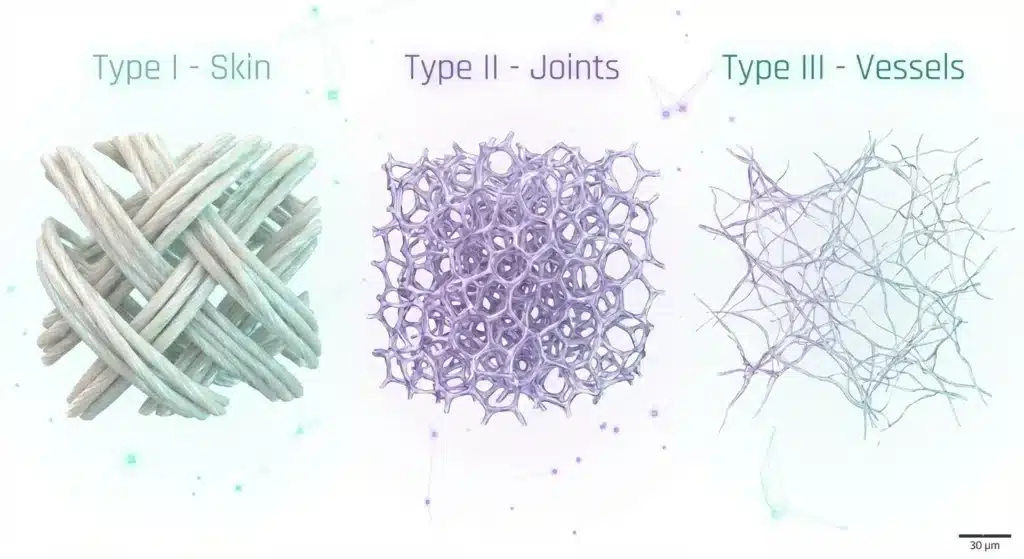
To effectively compare collagen peptides, one must look beyond the source and analyze the “Type.” While there are at least 28 known types of collagen in the human body, Types I, II, and III account for over 90% of the total. Choosing the wrong type for your formulation can lead to suboptimal results, regardless of the ingredient’s purity.
Type I: The “Beauty and Structure” Collagen
Type I is the most abundant form of collagen in the body, found in skin, tendons, bones, and teeth.
- Primary Function: It provides mechanical strength and structural integrity. In the skin, Type I fibers are responsible for elasticity and the prevention of wrinkles.
- Best For: Anti-aging beauty products, hair and nail strengthening, and overall bone density.
- Expert Insight: When you compare collagen peptides for a skincare line, prioritize Type I (typically Marine or Bovine) with a molecular weight under $3,000$ Daltons for maximum dermal penetration.
Type II: The “Joint and Mobility” Specialist
Type II collagen is found almost exclusively in cartilage. It is the “cushion” between your joints.
- Primary Function: It provides the tensile strength to cartilage, allowing joints to absorb shock and stay lubricated.
- Best For: Joint health supplements, sports recovery formulas, and mobility support for the aging population.
- Expert Insight: Type II is often available in two forms: hydrolyzed (for nutrient replenishment) and undenatured (to trigger an immune-mediated anti-inflammatory response).
Type III: The “Elasticity and Organ” Support
Type III is usually found alongside Type I. It is a major component of hollow organs such as the gut, uterus, and blood vessels.
- Primary Function: It provides a fine structural mesh that allows tissues to stretch and return to their original shape. It is crucial for cardiovascular health and wound healing.
- Best For: Cardiovascular support, gut health (Leaky Gut Syndrome), and muscle recovery.
- Expert Insight: Bovine sources are the most reliable way to obtain a natural ratio of Type I and Type III collagen.
Comparative Distribution Matrix
| Collagen Type | Tissue Distribution | Target Health Benefit | Recommended Source |
| Type I | Skin, Bone, Tendon, Cornea | Skin elasticity, hair & nail growth | Marine or Bovine |
| Type II | Hyaline Cartilage, Joints | Joint lubrication & pain reduction | Avian (Chicken) |
| Type III | Blood Vessels, Intestines, Muscle | Gut wall repair & arterial health | Bovine or Porcine |
Part 4:Technical KPIs: How to Measure Raw Material Quality
When you compare collagen peptides from different manufacturers, the Certificate of Analysis (CoA) often holds the secret to why one ingredient outperforms another. Focus on these three technical pillars:
1. Molecular Weight (The Absorption Factor)
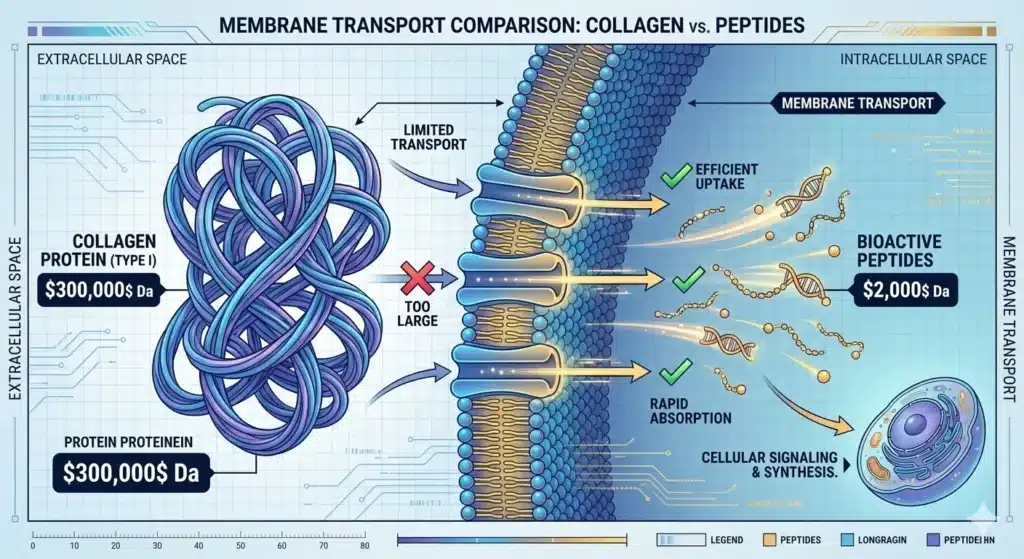
Molecular weight is measured in Daltons (Da). It is the single most important predictor of biological activity.
- The Gold Standard: Research suggests that peptides with an average molecular weight between $1,000$ and $3,000$ Da are optimal. At this size, they are small enough to be absorbed intact through the intestinal wall and enter the bloodstream as bioactive di-peptides and tri-peptides.
- The Signaling Effect: Lower molecular weight peptides don’t just provide “bricks” (amino acids); they act as “signals” to stimulate the body’s own collagen synthesis.
2. Purity and Amino Acid Composition
A high-quality peptide is more than just “protein content.” It is about the precision of the amino acid profile.
- Hydroxyproline Content: This amino acid is unique to collagen. When you compare collagen peptides, a higher percentage of Hydroxyproline (typically $10\%$ to $12\%$ in premium bovine or marine sources) indicates a pure, unadulterated collagen source.
- Ash and Heavy Metals: High purity means low ash content (under $2\%$) and strict limits on heavy metals (Arsenic, Lead, Mercury). This is especially critical for marine sources to ensure they are free from oceanic contaminants.
3. Sensory Metrics: The “Invisible” Ingredient
The biggest challenge in formulating with peptides is the “sensory profile.” A peptide might be biologically perfect but commercially unviable if it ruins the taste of the product.
- Solubility: Premium peptides should achieve instant solubility in both cold and hot liquids without clumping or leaving a “ring” around the glass.
- Organoleptic Profile (Taste & Odor): Advanced processing (such as activated carbon filtration and ion exchange) is required to remove the “fishy” or “meaty” notes. For B2B buyers, a “neutral” sensory profile is the highest KPI, as it reduces the need for expensive masking flavors and sweeteners.
- Clarity: In functional beverages, the solution must remain crystal clear. Turbidity (cloudiness) is a sign of poorly hydrolyzed or impure peptides.
KPI Comparison Summary Table
| Technical Metric | Premium Grade | Standard Grade | Impact on Product |
| Avg. Molecular Weight | $1,000 – 2,000$ Da | $> 5,000$ Da | Bioavailability & Efficacy |
| Protein Content | $> 95\%$ | $85\% – 90\%$ | Potency & Label Claims |
| Solubility | Instant (Clear) | Slow (Cloudy) | Consumer Experience |
| Odor/Taste | Neutral | Noticeable | Flavoring Costs |
| Heavy Metals | $< 0.1$ ppm | Up to $1.0$ ppm | Safety & Compliance |
Part 5:The Application Matrix: Matching Peptides to Goals
Choosing the right ingredient is a balance between biological efficacy, formula compatibility, and market positioning. To effectively compare collagen peptides, we have mapped the most common industry applications against the optimal peptide profiles.
1. The Decision Matrix (Strategic Selection)
| Target Application | Recommended Source | Primary Reason | Key KPI to Prioritize |
| Nutricosmetics (Beauty Drinks/Sachets) | Marine Collagen | Highest Type I density and absorption | Molecular Weight (<2,000 Da) & Clarity |
| Joint & Bone Health (Capsules/Tablets) | Avian (Type II) or Bovine | Specificity for cartilage and bone matrix | Chondroitin content / Type II purity |
| Sports Nutrition (Post-Workout Shakes) | Bovine Collagen | High glycine/proline for connective tissue | Protein purity (>90%) & Neutral taste |
| Digestive Wellness (Gut Health Powders) | Bovine (Type I & III) | Supports intestinal wall integrity | Solubility & Amino acid profile |
| Vegan/Lifestyle (Plant-based Mixes) | Pea or Soy Peptides | Meets “Clean Label” and ethical demands | PDCAAS score & Flavor masking |
2. The “3-Step Decision Tree” for Formulators
If you are still unsure how to compare collagen peptides for your next project, follow this logical flow:
Step 1: Identify the Primary Health Claim
- Skin/Hair/Nails? $\rightarrow$ Go with Type I.
- Joint/Cartilage? $\rightarrow$ Go with Type II.
- Muscle/Gut/Vessels? $\rightarrow$ Go with Type III (or I/III blend).
Step 2: Define the Delivery Format
- Clear Liquid/Ready-to-Drink (RTD)? $\rightarrow$ You must prioritize Marine Peptides for their superior solubility and transparency.
- Solid (Bar/Capsule/Tablet)? $\rightarrow$ Bovine is often preferred for its density and cost-efficiency.
- Powder (Tub/Sachet)? $\rightarrow$ Bovine or Marine can both work, provided the Sensory Profile (taste/odor) is neutralized.
Step 3: Establish the Brand Value Proposition
- Premium/Eco-Conscious? $\rightarrow$ Look for MSC-Certified Marine or Grass-Fed/Pasture-Raised Bovine.
- Ethical/Specialty? $\rightarrow$ Look for Halal, Kosher, or Non-GMO certifications.
- Mass Market/Value? $\rightarrow$ Standard Bovine or Porcine peptides offer the best ROI.
3. Conclusion: Moving from Comparison to Selection
As we have explored, the ability to compare collagen peptides effectively requires a dual understanding of biology and technology. Whether you prioritize the rapid absorption of low-molecular-weight marine peptides or the targeted joint support of avian Type II collagen, the “best” peptide is the one that aligns with your specific physiological target and formulation constraints.
In the competitive world of protein supplements, transparency is the ultimate currency. Always demand a full amino acid profile and molecular weight distribution from your supplier to ensure that your chosen peptide delivers on its promise.
Part 6. Industry Trends: Sustainability and The “Clean Label” Revolution
In today’s market, it is no longer enough to simply compare collagen peptides based on efficacy. The modern consumer demands to know where their supplements come from and how they were produced. Incorporating these “Value-Added” certifications is often the deciding factor in brand loyalty and premium pricing.
1. Ethical Sourcing: From Pasture to Sea
When you compare collagen peptides, sustainability certifications act as a proxy for quality and safety.
- Grass-Fed & Pasture-Raised (Bovine): For bovine-sourced peptides, these labels ensure that the cattle were raised in natural environments without the constant use of antibiotics or growth hormones. It reflects a commitment to animal welfare and often results in a “cleaner” amino acid profile.
- MSC (Marine Stewardship Council) Certified: For marine collagen, MSC certification is the gold standard. It guarantees that the fish were caught via sustainable, wild-capture fisheries that prevent overfishing and protect the marine ecosystem.
- Traceability: The ability to trace a batch of peptides back to a specific farm or fishery is becoming a mandatory requirement for high-end nutricosmetic brands.
2. The “Clean Label” Movement
“Clean Label” is more than a trend; it is a market standard. When evaluating peptides, look for the following “Free-From” attributes:
- Non-GMO Project Verified: Ensures no genetically modified organisms were used in the feed or processing.
- Solvent-Free Extraction: Premium peptides are produced using physical and enzymatic processes rather than harsh chemical solvents.
- Zero Additives: High-quality raw materials should be $100\%$ pure collagen protein with no added carriers, artificial sweeteners, or preservatives.
3. Regulatory and Religious Compliance
Global brands must compare collagen peptides through the lens of inclusivity.
- Halal & Kosher Certifications: Essential for entering Middle Eastern and specific North American/European markets. This involves strict auditing of the raw material source and the facility’s cleaning protocols.
- Third-Party Testing: Certifications from organizations like Informed-Sport or NSF Certified for Sport are vital for peptides aimed at professional athletes to ensure the product is free from banned substances.
Sustainability Checklist for Buyers
| Certification | What it Guarantees | Market Appeal |
| Grass-Fed | Antibiotic-free, natural bovine diet | Health-conscious, Paleo, Keto |
| MSC / ASC | Sustainable wild or farmed seafood | Eco-conscious, Ocean-friendly |
| Clean Label | No artificial ingredients or GMOs | General Wellness, Transparency |
| Halal / Kosher | Religious dietary compliance | Global / Diverse Markets |
Conclusion: Mastering the Art of Peptide Selection
The evolution from whole proteins to bioactive peptides represents one of the most significant advancements in modern nutritional science. As we have explored in this guide, the ability to compare collagen peptides with technical precision is no longer just for lab researchers—it is a vital skill for brand owners, formulators, and health-conscious consumers alike.
There is no “one-size-fits-all” solution in the world of collagen. The optimal choice depends entirely on your specific objectives:
- For superior skin rejuvenation and high-end aesthetics, the low molecular weight and high bioavailability of Marine Type I peptides remain unmatched.
- For structural integrity, muscle recovery, and cost-effective wellness, Bovine Type I & III peptides provide a time-tested, versatile foundation.
- For targeted orthopedic support, the specialized matrix of Avian Type II collagen is the essential ingredient for joint mobility.
In a market increasingly crowded with “me-too” products, the true winners are those who prioritize Technical KPIs like molecular weight and sensory neutrality, while upholding the values of Sustainability through Grass-fed and MSC certifications.
By using the frameworks and matrices provided in this guide, you can move beyond marketing claims and make data-driven decisions that ensure safety, efficacy, and consumer trust. The future of nutrition is functional, targeted, and transparent—and it starts with choosing the right peptide.