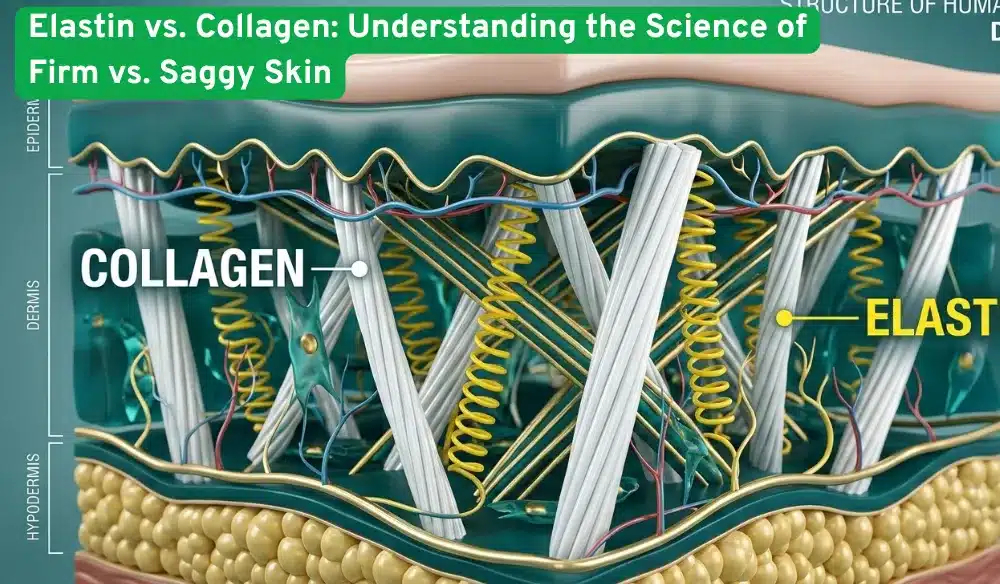
When comparing elastin vs. collagen, the essential difference lies in strength versus snap-back. Collagen is the body’s most abundant structural protein, acting like “steel cables” that provide the skin with its volume, thickness, and tensile strength. In contrast, elastin is a highly flexible protein that acts like a “rubber band,” allowing tissues to stretch and, crucially, snap back to their original shape. To put it simply for those seeking an immediate answer: Collagen prevents your skin from wrinkling by providing a solid foundation, while elastin prevents your skin from sagging by maintaining its elasticity. While collagen gives skin its “plumpness,” elastin gives it its “contour” and “bounce.”
Core Difference at a Glance
| Feature | Collagen (The Foundation) | Elastin (The Spring) |
| Primary Role | Structural integrity & Volume | Elasticity & Shape Memory |
| Analogy | Steel cables / Structural beams | Biological rubber bands / Springs |
| Aging Impact | Loss leads to wrinkles and thinning | Loss leads to sagging and “crepy” skin |
| Abundance | ~75-80% of the dermis | ~2-5% of the dermis |
II. Molecular Structure: The Steel Cable vs. The Rubber Band
To understand why elastin vs. collagen perform such different roles, we must look at their molecular “blueprints.” Their physical properties are a direct result of how their amino acids are woven together.
Collagen: The Rigid Triple Helix
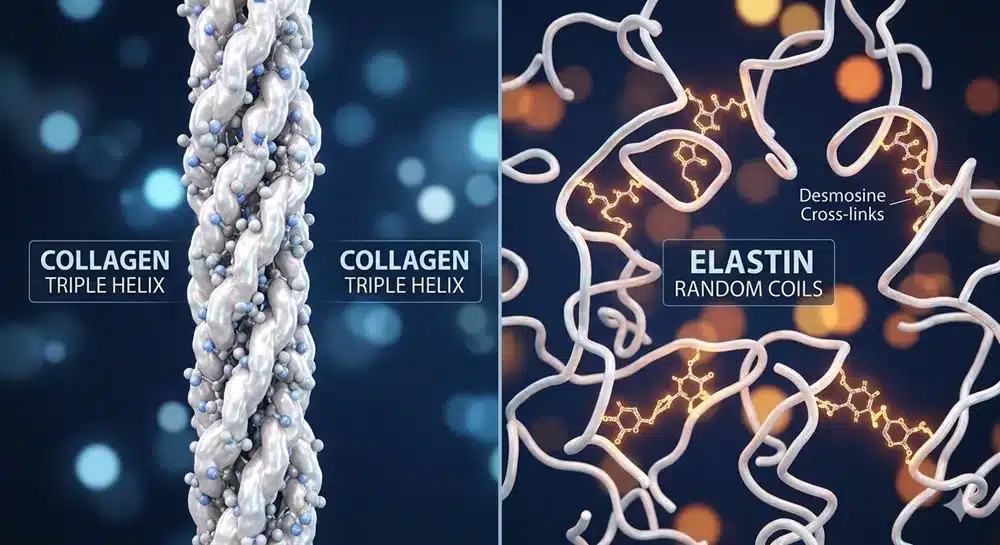
Collagen is built for resistance. Its primary structure is a “Triple Helix”—three polypeptide chains wound tightly around one another like a heavy-duty climbing rope.
- The “Steel Cable” Design: This configuration creates immense tensile strength. It is designed not to stretch. When you pull on collagen fibers, they resist, providing the rigid framework that holds your skin, bones, and tendons together.
- Composition: It is incredibly rich in the amino acid Hydroxyproline, which acts as the “glue” that stabilizes the helix.
Elastin: The Cross-Linked Random Coil
Elastin is built for resilience. Unlike the organized cables of collagen, elastin is composed of “Random Coils”—loose, unstructured protein chains that are highly disordered.
- The “Rubber Band” Design: These coils are connected by unique covalent bonds called Desmosine cross-links. When you pull on your skin, these coils straighten out; when you let go, the cross-links act like springs, pulling the molecule back to its original disordered state.
- The Challenge of Replacement: While your body produces collagen throughout most of your life (though it slows down), your elastin production largely peaks before birth and during early childhood. Once these “rubber bands” are damaged by UV light or age, the body has a very difficult time synthesizing new, functional elastin, making protection even more critical than supplementation.
Structural Comparison Table
| Property | Collagen | Elastin |
| Molecular Shape | Triple Helix (Linear) | Random Coil (Amorphous) |
| Physical Goal | Tensile strength (Resistance) | Extensibility (Snap-back) |
| Key Amino Acids | Glycine, Proline, Hydroxyproline | Valine, Alanine, Desmosine |
| Lifespan | High turnover (Constant repair) | Low turnover (Very long-lived) |
III. Biological Functions: Firmness vs. Resilience
In the dermal layer of your skin, elastin vs. collagen work like the components of a high-end mattress. Collagen is the dense stuffing that provides the loft and height, while elastin represents the internal springs that allow the mattress to rebound after someone sits on it.
Collagen’s Role: The Foundation of Firmness
Collagen is the skin’s primary volume-builder. Its role is purely structural, focusing on the “integrity” of the tissue.
- Volume and Plumpness: By forming a dense network (the extracellular matrix), collagen supports the outer layers of the skin, preventing it from thinning or caving in. This is why high collagen levels are associated with a “full,” youthful face.
- Tensile Strength: Collagen allows your skin to withstand external pressure and stretching without tearing. It provides the “heavy-lifting” support for your facial features, keeping them in their biological positions.
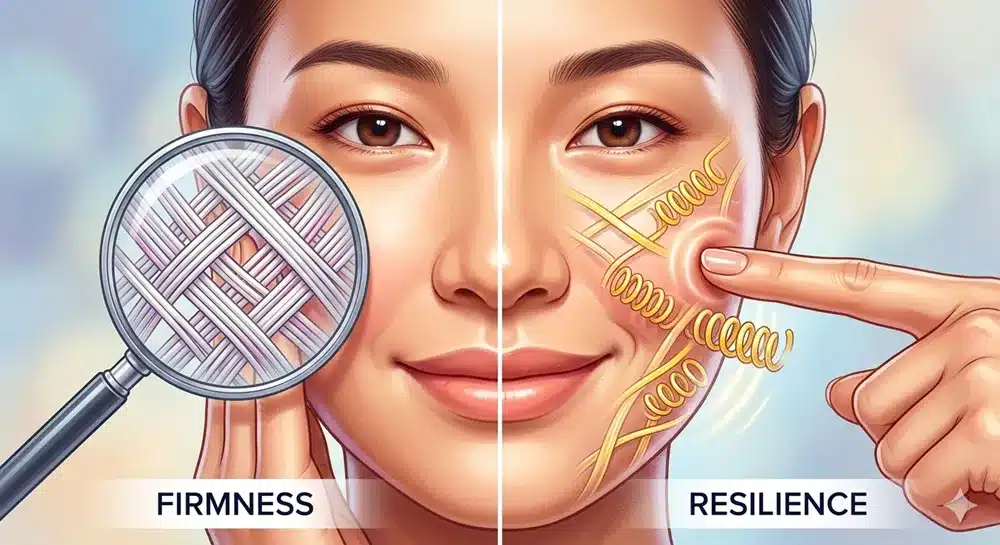
Elastin’s Role: The Architect of Contour
Elastin is significantly less abundant than collagen, but its functional impact on “youthful movement” is arguably greater.
- Snap-Back and Shape Memory: Every time you smile, squint, or pull on your skin, it is elastin that brings the tissue back to its resting state. Without functional elastin, those temporary expression lines would become permanent folds immediately.
- Maintaining the “V-Shape”: While collagen keeps the skin thick, elastin keeps it tight against the bone and muscle. It provides the “elastic recoil” necessary to maintain a sharp jawline and prevent the skin from drooping due to the constant pull of gravity.
Functional Comparison Table
| Biological Function | Collagen (The Foundation) | Elastin (The Spring) |
| Visible Result | Thick, plump, and dense skin | Tight, contoured, and “bouncy” skin |
| Response to Stretch | Resists stretching (Strength) | Facilitates stretching (Recoil) |
| Dynamic Movement | Provides the weight-bearing frame | Manages expression-line recovery |
| Key Location | Deep dermis, bones, and tendons | Dermis, lungs, and large arteries |
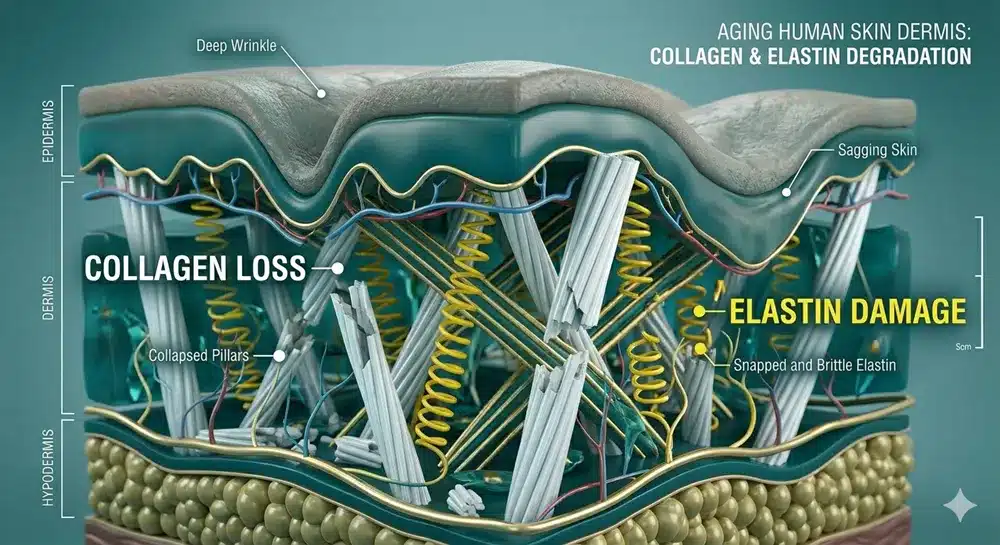
IV. Aging and Degradation: Static Wrinkles vs. Structural Sagging
In the clinical study of elastin vs. collagen, aging manifests in two distinct ways. Understanding which protein is degrading helps identify whether you are fighting “lines” or “gravity.”
Collagen Degradation: The “Deflation” Effect
Collagen naturally declines by about 1% per year after age 25. This loss is primarily a volume issue.
- Static Wrinkles: As the collagen “scaffolding” thins, the skin loses its underlying support. This leads to static wrinkles—lines that remain visible even when your face is at rest (like nasolabial folds or forehead furrows).
- Thinning Dermis: The skin becomes physically thinner and more translucent, making it more susceptible to external damage and bruising.
Elastin Degradation: The “Drooping” Effect
Elastin damage is often more permanent and visually dramatic, often referred to as Solar Elastosis when caused by UV rays.
- Loss of Recoil (Sagging): When elastin fibers break or lose their “snap,” the skin can no longer fight gravity. This results in sagging along the jawline (jowls), drooping eyelids, and a loss of the sharp facial “V-shape.”
- “Crepy” Texture: Damaged elastin creates a texture similar to crumpled tissue paper or parchment. Unlike a collagen wrinkle (which is a deep fold), elastin loss creates fine, crisscrossed crinkles that don’t smooth out when the skin is pulled taut.
Comparison of Aging Symptoms
| Aging Symptom | Collagen Loss (Deflation) | Elastin Loss (Drooping) |
| Visible Sign | Deep folds and hollow cheeks | Sagging jowls and “crepy” skin |
| Tactile Feel | Thin, fragile, “hollow” skin | Loose, inelastic, “stretched” skin |
| Primary Cause | Natural chronological aging | UV radiation (Photoaging) & Glycation |
| Recovery | Responds well to peptides/boosters | Difficult to replace; focus is on protection |
V. Maintenance & Repair: Protecting the Frame and the Spring
The final strategy for managing elastin vs. collagen involves a two-pronged approach: stimulating the production of new collagen and protecting the existing, precious supply of elastin.
Strategy for Collagen: Rebuilding the Foundation
Because your body can synthesize collagen throughout your life, the goal is to provide the “work orders” and the raw materials.
- Stimulation via Retinoids: Retinol and Tretinoin are the gold standard; they signal fibroblasts to ramp up collagen production.
- Nutritional Building Blocks: Consuming Hydrolyzed Collagen Peptides provides the specific amino acids (Proline and Hydroxyproline) needed for the triple helix.
- The Vitamin C Essential: Vitamin C acts as a co-factor; without it, your body cannot physically stabilize collagen fibers.
Strategy for Elastin: The Art of Preservation
Since elastin is much harder for the adult body to reproduce, the strategy shifts toward preventing degradation and maintaining fiber quality.
- Sun Protection (SPF): UV rays activate enzymes called elastase that chop up elastin fibers. Daily sunscreen is the most effective “anti-elastin-loss” treatment available.
- Copper Peptides: Copper is a critical mineral for Lysyl Oxidase, the enzyme that “cross-links” elastin and collagen fibers, giving them their strength and snap.
- Anti-Glycation: High sugar intake leads to “AGEs” (Advanced Glycation End-products), which make elastin fibers brittle. Reducing sugar helps maintain the “springiness” of your skin.
Comparison of Repair Strategies
| Goal | Collagen (Stimulate & Supply) | Elastin (Protect & Cross-link) |
| Topical Hero | Retinoids (Retinol / Tretinoin) | Copper Peptides / Antioxidants |
| Dietary Focus | Collagen Peptides & Vitamin C | Low sugar & Zinc/Copper-rich foods |
| Professional Treatment | Microneedling / Radiofrequency | Ultherapy / Laser skin tightening |
| Primary Enemy | Chronological age & Smoking | UV Radiation & Sugar (Glycation) |
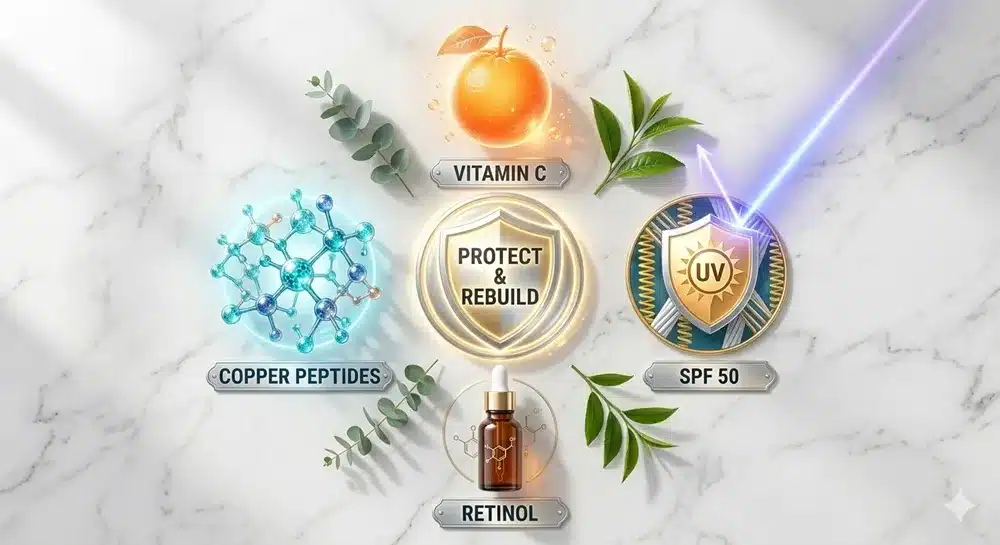
Conclusion: The Integrated Approach
To achieve truly youthful skin, you cannot ignore one for the other. Collagen gives you the thickness to stay wrinkle-free, and elastin gives you the elasticity to stay sag-free. A comprehensive anti-aging routine should use Retinoids and Vitamin C to build the collagen frame, while using SPF and Antioxidants to guard the elastin springs.
FAQs
References & Scientific Citations
- On Structural Ratios:“The role of collagen and elastin in the biomechanics of the dermis.” (Journal of Dermatological Science).
- On UV Damage:“Solar Elastosis: Pathogenesis and Treatment of Photoaged Skin.” (Dermatology and Therapy).
- On Glycation:“Impact of Glycation on Collagen and Elastin Fibers in Human Skin.” (Glycobiology).

Warren Wan is a seasoned expert with extensive experience in the dietary supplement supply chain, possessing rich practical experience in the research, development, process control, and global sourcing of core ingredients such as collagen peptides, bone broth protein, and keratin. As the author of this column, he is dedicated to stripping away the marketing packaging, transforming obscure ingredient science and production quality control standards into easy-to-understand, hardcore science popularization, helping readers understand the truth behind the labels and make more rational health choices.