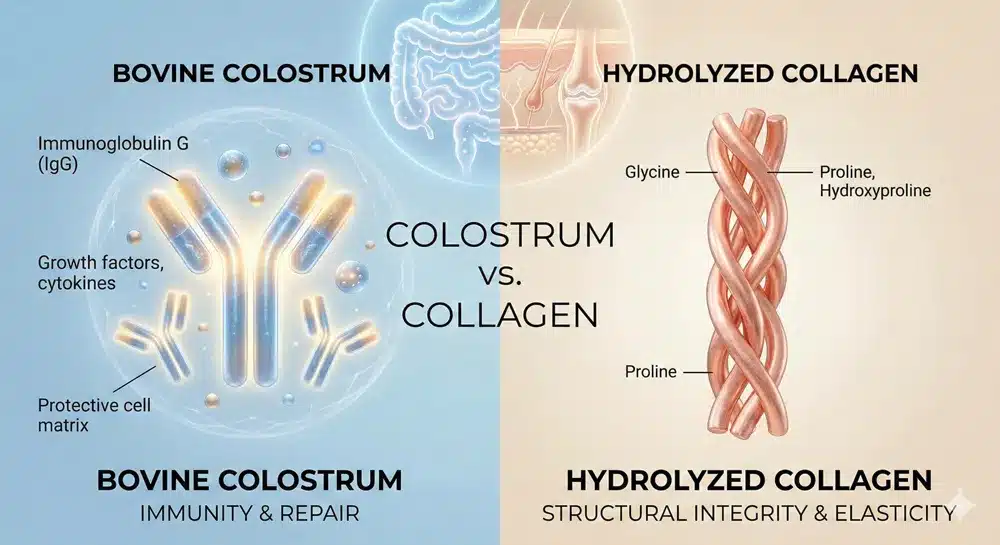
When evaluating the biological roles of colostrum vs. collagen, it is essential to distinguish between a “messenger” and a “building block.” Colostrum is a complex, bioactive fluid known as “nature’s first vaccine,” primarily functioning as an immune modulator and growth signaling center that transfers passive immunity and repairs the gut lining through immunoglobulins and growth factors; in contrast, collagen is a specialized structural protein that serves as the primary fibrous constituent of the body’s connective tissues, providing the raw amino acid matrix necessary to maintain the mechanical integrity and elasticity of skin, bones, and joints. While colostrum “instructs” the body’s defense and repair systems, collagen “rebuilds” the physical scaffolding that holds the body together.
Molecular Composition: What’s Inside?
To understand the functional divergence of colostrum vs. collagen, we must look at their molecular “blueprints.” While both are protein-based, their chemical architectures are designed for entirely different biological missions.
Colostrum: A Multi-Factorial Bioactive Cocktail
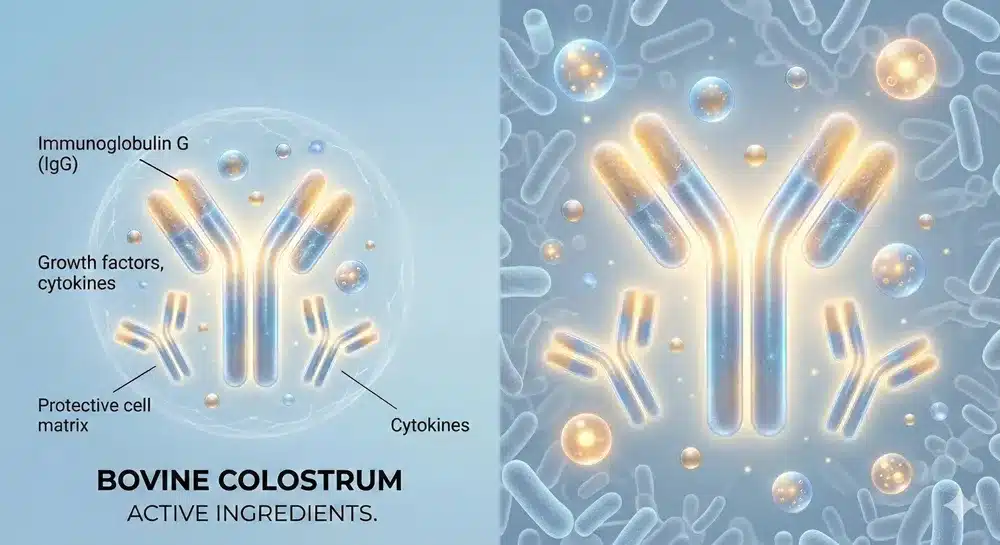
Colostrum is not a single substance but a complex, fluid matrix containing hundreds of signaling molecules. Its primary power lies in Immunoglobulins (IgG, IgA, IgM), which are Y-shaped proteins that provide immediate, passive immunity by neutralizing pathogens. Beyond antibodies, it contains Lactoferrin (a multifunctional protein with antimicrobial properties) and Growth Factors such as IGF-1 and TGF-β. These are not just nutrients; they are “biological messengers” that trigger cellular repair and immune modulation across the entire body.
Collagen: The Triple Helix Architecture
In contrast, collagen is a specialized structural protein defined by its unique “Triple Helix” configuration. It is characterized by a repetitive sequence of three amino acids: Glycine, Proline, and Hydroxyproline. This dense, rope-like structure provides the tensile strength required for the extracellular matrix (ECM). When we ingest collagen, it is typically broken down into bioactive peptides (di-peptides and tri-peptides). These fragments act as the raw “hardware” or building materials that fibroblasts use to synthesize new skin, cartilage, and bone tissue.
Comparison at a Glance
| Feature | Colostrum | Collagen |
| Primary Category | Bioactive Fluid / Immune Modulator | Fibrous Structural Protein |
| Key Components | IgG, Lactoferrin, Growth Factors | Glycine, Proline, Hydroxyproline |
| Biological Role | Signaling & Defense (Software) | Support & Structure (Hardware) |
| Molecular Focus | Complexity and bio-activity | Tensile strength and amino acid density |
Primary Biological Functions: The Mechanism of Action
To understand the practical application of colostrum vs. collagen, we must examine their specific “Mechanisms of Action” (MOA). While both are ingested, they navigate different physiological pathways to achieve their respective health outcomes.
Colostrum: The Guardian of the Gut-Immune Axis
Colostrum acts primarily as a biochemical messenger within the digestive tract. Its most critical role is maintaining the integrity of the intestinal barrier.
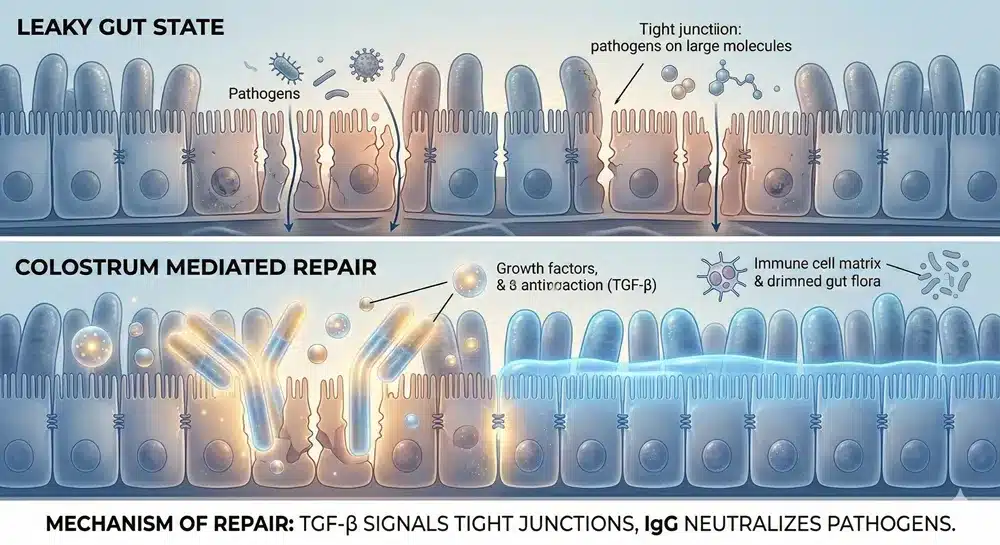
- Tight Junction Regulation: Colostrum contains growth factors (like TGF-β) that signal the “tight junctions” in the gut lining to remain sealed. This prevents “leaky gut,” a condition where undigested food particles and toxins enter the bloodstream.
- Immune Education: Once in the gut, the Immunoglobulins (IgG) in colostrum do not just sit there; they bind to pathogens (bacteria and viruses), neutralizing them before they can trigger systemic inflammation. This is why colostrum is considered a “top-down” modulator of the immune system.
Collagen: The Architect of the Extracellular Matrix
Collagen operates through a “bottom-up” approach, focusing on structural synthesis. When you consume hydrolyzed collagen, it is absorbed as bioactive peptides that act as both “building blocks” and “signals.”
- Fibroblast Stimulation: These peptides circulate to the dermis (skin) and joints, where they trick the body into thinking there is a collagen breakdown. This triggers fibroblasts (in the skin) and chondrocytes (in the cartilage) to ramp up the production of new, native collagen.
- Tensile Strength: Unlike colostrum, which manages the environment, collagen provides the actual physical scaffolding. It ensures that the skin remains elastic and that the cartilage can withstand the mechanical pressure of movement.
Core Functional Comparison
| Mechanism | Colostrum (Immune & Repair) | Collagen (Structure & Synthesis) |
| Primary Site | Gut-Associated Lymphoid Tissue (GALT) | Extracellular Matrix (ECM) / Connective Tissue |
| Action | Neutralizes pathogens; seals gut lining | Stimulates tissue regeneration; provides strength |
| Outcome | Reduced systemic inflammation; higher immunity | Improved skin elasticity; joint lubrication |
Bioavailability and Metabolism: The Journey After Ingestion
Understanding colostrum vs. collagen requires looking at how the body processes these substances once they pass the lips. Their “biological fate” is determined by their molecular stability and how they interact with the human digestive system.
Colostrum: Survival of the Bioactives
The primary challenge for colostrum is the harsh environment of the stomach. Because its most valuable components—Immunoglobulins and Growth Factors—are delicate proteins, they must survive gastric acid to reach the small intestine, where the Gut-Associated Lymphoid Tissue (GALT) resides.
- Protection Mechanisms: High-quality colostrum often contains natural enzyme inhibitors that protect these bioactive proteins.
- Localized vs. Systemic: Unlike most nutrients, colostrum’s antibodies do not necessarily need to enter the bloodstream to be effective; they perform much of their work “on-site” by neutralizing pathogens within the gut lumen and strengthening the intestinal barrier.
Collagen: The Breakdown and Reassembly
Collagen follows a more traditional metabolic path but with a specific twist. Since raw collagen is a massive molecule, it is almost always consumed in hydrolyzed form (collagen peptides).
- Absorption as Peptides: During digestion, collagen is broken down into small di-peptides and tri-peptides. These are small enough to be absorbed through the intestinal wall and enter the systemic circulation.
- The Signaling Effect: Once in the blood, these peptides act as “chemotactic” signals. They migrate to areas of high turnover—like the skin’s dermis or joint cartilage—where they alert the body’s repair cells (fibroblasts) to start building new structural fibers.
Metabolic Comparison Table
| Feature | Colostrum | Collagen |
| Digestion Goal | Preservation of bioactive protein shape | Breakdown into absorbable small peptides |
| Main Barrier | Stomach acid (Gastric degradation) | Intestinal absorption efficiency |
| Primary Destination | Intestinal lining and immune cells | Connective tissues (Skin, Joints, Bone) |
| Form of Action | Direct binding and signaling | Raw material supply and cell stimulation |
Key Differences in Health Outcomes: Defense vs. Regeneration
When comparing the real-world results of colostrum vs. collagen, we see a clear split between systemic protection and structural maintenance. While both contribute to overall vitality, their primary “victory conditions” for human health are distinct.
Colostrum: The Specialist in Immune Defense and Recovery
Colostrum’s health outcomes are centered on the body’s ability to resist external threats and recover from internal stress.
- Respiratory and Pathogen Defense: Clinical studies often highlight colostrum’s ability to reduce the frequency and duration of upper respiratory tract infections (URTI). This is the direct result of “passive immunity” provided by its high IgG content.
- Athletic “Leaky Gut” Prevention: High-intensity exercise often stresses the gut lining, causing temporary permeability. Colostrum is unique in its ability to protect the gut barrier during heat stress and heavy training, allowing athletes to recover faster without immune suppression.
Collagen: The Specialist in Anti-Aging and Joint Mechanics
Collagen’s outcomes are visible and mechanical, focusing on the preservation of the body’s physical “youth.”
- Dermal Density and Hydration: The most well-documented outcome of collagen supplementation is the improvement in skin elasticity and the reduction of fine lines. By increasing the density of the dermal layer, collagen helps the skin retain moisture and structure.
- Joint and Ligament Longevity: For individuals with joint wear (osteoarthritis) or active lifestyles, collagen provides the specific amino acids needed to maintain cartilage thickness. It acts as a protective cushion, reducing friction and pain during movement.
Comparative Health Outcomes Table
| Health Goal | Colostrum (The “Shield”) | Collagen (The “Frame”) |
| Primary Benefit | Infection resistance & Gut sealing | Skin elasticity & Joint mobility |
| Recovery Type | Immune system & Inflammation control | Connective tissue & Muscle-tendon repair |
| Visual Result | Reduced fatigue & Better gut comfort | Smoother skin & Stronger nails/hair |
| Critical Window | Flu season, travel, high-intensity training | Daily aging support, injury rehab |
Synergy & Final Expert Verdict: When 1+1=3
The debate of colostrum vs. collagen often leads to a “choose one” mentality, but for those seeking peak physiological performance, the real power lies in their synergy. Because they operate on different biological systems—one for immune/gut “software” and the other for structural “hardware”—they can be combined to accelerate systemic healing.
The Power of Combined Supplementation
When taken together, colostrum and collagen create a comprehensive internal environment for repair.
- Post-Surgical or Injury Recovery: In cases of tissue damage, colostrum provides the Growth Factors (EGF/TGF-β) that act as the “foremen,” signaling cells to begin the repair process and managing inflammation. Meanwhile, collagen provides the actual “bricks and mortar” (amino acids) needed to physically close wounds and rebuild tendons.
- The Gut-Skin Axis: True skin health starts in the gut. While collagen improves the dermis from the inside out, colostrum ensures the gut barrier is sealed, preventing systemic inflammation that often manifests as skin issues like acne or redness.
Final Summary: The Expert’s Guide to Choosing
To simplify your decision-making process, refer to the “Functional Intent” below:
| If your goal is… | Primary Recommendation | Biological Reason |
| Immune Resilience | Colostrum | High IgG content for passive immunity. |
| Youthful Skin & Hair | Collagen | Direct supply of peptides for the extracellular matrix. |
| Gut Health / Leaky Gut | Colostrum | Closes tight junctions and repairs the lining. |
| Joint & Bone Health | Collagen | Provides the tensile strength for cartilage. |
| Total Body Recovery | Both | Signals repair (Colostrum) + Provides materials (Collagen). |
The Expert Buyer’s Checklist: Colostrum vs. Collagen
1. For Colostrum: Prioritize Bioactivity
Because colostrum is a delicate “living” fluid, the processing method determines its efficacy.
- The “24-Hour” Rule: Ensure the colostrum is collected within the first 16–24 hours after birth. Immunoglobulin (IgG) levels drop significantly after this window.
- Low-Temperature Processing: Look for “Flash Pasteurized” or “Low-Heat Spray Dried” labels. High heat denatures (destroys) the antibodies, turning a premium supplement into basic milk powder.
- Standardized IgG Content: A high-quality product should state the exact percentage of IgG (typically 25% to 40%).
- Ethical Sourcing: Verify that the calves receive their required intake first; reputable suppliers only harvest the “surplus.”
2. For Collagen: Prioritize Bioavailability
For collagen, the “size” of the molecule is the most important factor for absorption.
- Hydrolyzed Peptides: Never buy “raw” collagen. Ensure it is hydrolyzed, meaning the long protein chains are broken into small, absorbable bits.
- Molecular Weight (Daltons): Look for a molecular weight between 2,000 and 5,000 Daltons. Anything larger is difficult for the gut to transport into the bloodstream.
- Source Specificity: * Type I & III (Bovine/Marine): Best for skin, hair, and nails.
- Type II (Chicken/Sternum): Specifically for joint cartilage.
- Clean Label: Ensure it is free from heavy metals (especially important for marine sources) and artificial sweeteners.
Summary Checklist Table
| Criteria | High-Quality Colostrum | High-Quality Collagen |
| Key Marker | IgG % (Immunoglobulins) | Dalton Weight (Peptide size) |
| Processing | Low-heat / Cold-processed | Enzymatic Hydrolysis |
| Purity | Antibiotic-free / Hormone-free | Heavy metal tested (Non-GMO) |
| Primary Goal | Bioactive signaling survival | Rapid systemic absorption |
Conclusion
Ultimately, the choice between colostrum vs. collagen depends on your body’s current priority. If you are defending against illness or repairing a compromised gut, colostrum is your primary shield. If you are reinforcing the physical architecture of your body against the effects of aging and mechanical wear, collagen is your essential foundation. Using them in tandem offers a holistic approach to longevity that addresses both the invisible (immune) and the visible (structure) aspects of health.
FAQs
References & Scientific Citations
1. On Bovine Colostrum (Immune & Gut Health)
- Study on Gut Permeability:“The use of bovine colostrum in the management of gastrointestinal diseases and the ‘leaky gut’ syndrome.” * Source: National Institutes of Health (PMC)
- Key Insight: Discusses how growth factors (TGF-β) repair intestinal tight junctions.
- Link: https://www.ncbi.nlm.nih.gov/pmc/articles/PMC7150183/
- Study on Respiratory Defense:“Bovine colostrum supplementation and upper respiratory tract infections in athletes.”
- Source: Journal of Applied Physiology (Human Kinetics)
- Key Insight: Clinical evidence showing IgG’s role in reducing infection rates.
- Link: https://pubmed.ncbi.nlm.nih.gov/16825482/
2. On Collagen Peptides (Skin & Joints)
- Study on Skin Anti-Aging:“Oral supplementation of specific collagen peptides has beneficial effects on human skin physiology.”
- Source: Skin Pharmacology and Physiology (Karger)
- Key Insight: Demonstrates the impact of hydrolyzed collagen on skin elasticity and hydration.
- Link: https://pubmed.ncbi.nlm.nih.gov/23949208/
- Study on Joint Health:“Effect of collagen hydrolysate in articular pain: A 6-month study.”
- Source: Current Medical Research and Opinion
- Key Insight: Validates the use of Type II collagen in supporting joint cartilage and reducing discomfort.
- Link: https://www.tandfonline.com/doi/abs/10.1185/030079906X148373
3. On Bioavailability & Comparative Nutrition
- Technical Review:“Comparison of Protein Quality and Bioactive Composition in Functional Dairy Ingredients.”
- Source: Journal of Dairy Science
- Key Insight: Explains the molecular difference between structural proteins and bioactive signaling proteins.
- Link: https://www.journalofdairyscience.org/