
Diese Seite dient als Auswahl- und Herstellungsleitfaden und stellt kein Ranking von Verbrauchermarken dar. Verbraucher können die Vergleichstabellen nutzen, um Marken zu bewerten, während Hersteller von Nahrungsergänzungsmitteln die Abschnitte zu Qualität und Ausschreibungen nutzen können, um Inhaltsstoffe und Hersteller zu prüfen.
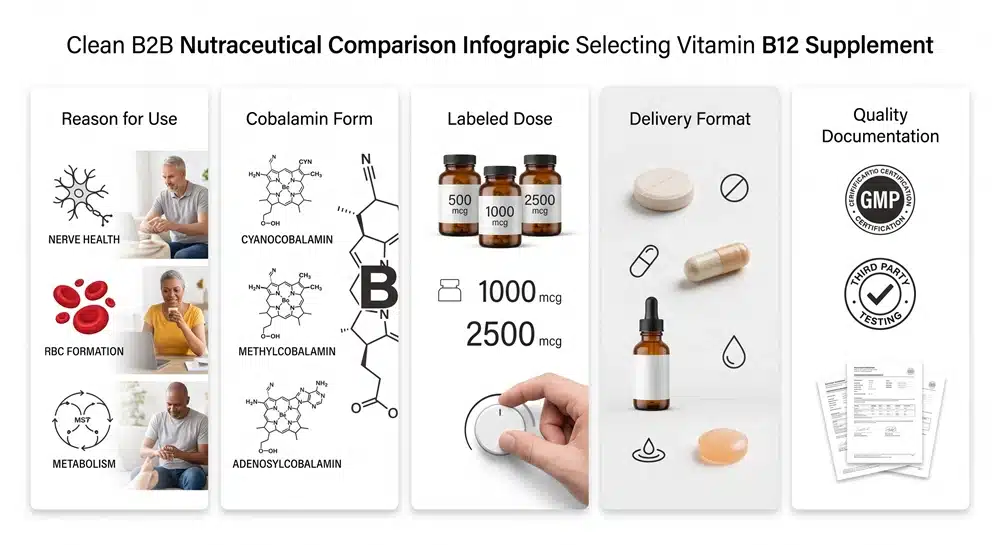
Kurzer Vergleich: Was zeichnet ein gutes Vitamin-B12-Präparat aus?
| Entscheidungsfaktor | Was zu beachten ist | Was man vermeiden sollte |
|---|---|---|
| Verwendungszweck | Ein Ernährungsbedarf, eine Ernährungslücke oder ein vom Arzt verordneter Zweck. | Jedes Mal, wenn man sich müde fühlt, unter „Brain Fog“ leidet oder ein Kribbeln verspürt, dies als Vitamin-B12-Mangel zu diagnostizieren. |
| B12-Formular | Cyanocobalamin, Methylcobalamin oder eine andere zugelassene Form, die eindeutig angegeben ist. | Behauptungen, dass eine bestimmte Form allgemein überlegen, “giftfrei” oder für alle verbindlich sei. |
| Betrag | Eine Portionsgröße, die zur Zielgruppe und zur Produktpositionierung passt. | “Maximale Stärke” als einziges Qualitätsmerkmal heranziehen. |
| Lieferformat | Eine Tablette, Kapsel, Lutschtablette, Gummibonbon, Flüssigkeit oder ein Spray, das der Anwender korrekt und regelmäßig einnehmen kann. | Behauptungen, dass sublinguale, als Spray oder als Gummibonbons verabreichte Darreichungsformen immer besser resorbiert werden. |
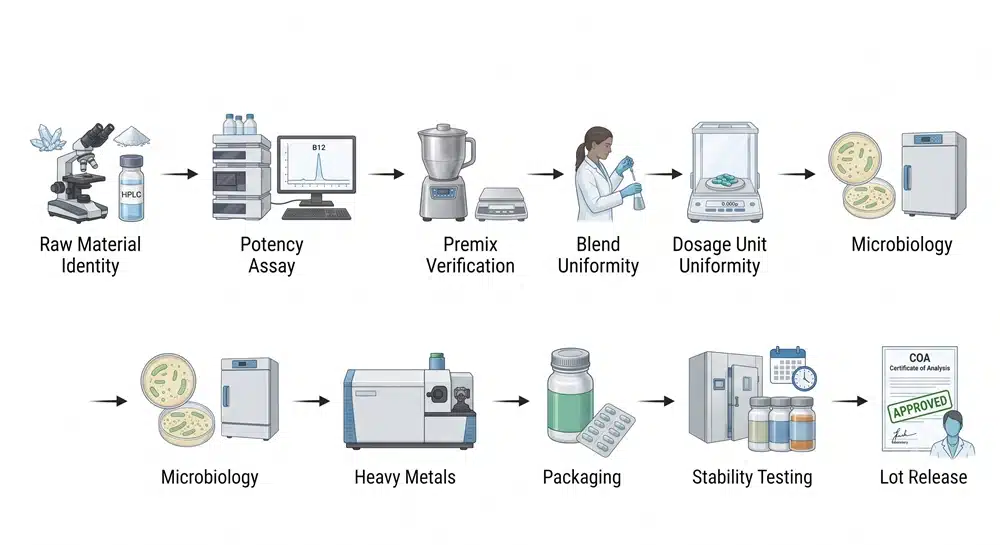
| Qualität | Identitätsprüfung, Wirksamkeitsprüfung, Gleichmäßigkeitsprüfung, Prüfung auf Verunreinigungen, mikrobiologische Prüfung und Stabilitätsprüfung. | “Von einer unabhängigen Stelle geprüft” – ohne Angabe des Prüfumfangs, der Chargennummer oder von Belegen. |
| Ansprüche | Sorgfältige Aussagen zur normalen Bildung roter Blutkörperchen, zur neurologischen Funktion und zum Energiestoffwechsel. | Versprechen, Müdigkeit zu heilen, Neuropathie rückgängig zu machen, die Intelligenz zu steigern oder sofortige Energie zu liefern. |
Was ist Vitamin B12?
Vitamin B12 ist ein wasserlöslicher Nährstoff, der an der normalen Bildung roter Blutkörperchen, der Funktion des Nervensystems und der DNA-Synthese beteiligt ist. Die empfohlene Zufuhrmenge für die meisten Erwachsenen beträgt 2,4 µg pro Tag; während der Schwangerschaft erhöht sich diese auf 2,6 µg und während der Stillzeit auf 2,8 µg.
Zu den Nahrungsquellen zählen tierische Lebensmittel und angereicherte Produkte. Nahrungsergänzungsmittel können eine zuverlässige Quelle für Menschen darstellen, deren Ernährung wenig Vitamin B12 enthält oder deren Fähigkeit zur Aufnahme von in Lebensmitteln enthaltenem Vitamin B12 eingeschränkt ist. Ein Nahrungsergänzungsmittel ersetzt jedoch nicht die Abklärung, wenn Symptome oder Laborbefunde auf einen Mangel hindeuten.
Wer benötigt möglicherweise ein Vitamin-B12-Präparat?
Bei unzureichender Zufuhr oder Aufnahme über die Nahrung können angereicherte Lebensmittel oder Nahrungsergänzungsmittel zum Einsatz kommen. Zu den Gruppen, die häufig besonderer Aufmerksamkeit bedürfen, gehören:
- Menschen, die sich vegan oder streng vegetarisch ernähren
- Erwachsene über 50, bei denen die Aufnahme von Vitamin B12 aus der Nahrung möglicherweise weniger effizient ist
- Personen, die sich einer Magen-Darm-Operation unterzogen haben
- Menschen mit perniziöser Anämie oder anderen Erkrankungen, die die Nährstoffaufnahme beeinträchtigen
- Personen, die über einen längeren Zeitraum Metformin oder säurehemmende Medikamente einnehmen
- Schwangere oder stillende Personen, deren Ernährung nur wenige oder gar keine tierischen Lebensmittel enthält
Müdigkeit, Taubheitsgefühle, Gleichgewichtsstörungen, kognitive Veränderungen und Anämie können viele Ursachen haben. Verbraucher sollten keine hochdosierten Nahrungsergänzungsmittel einnehmen, um eine ärztliche Untersuchung hinauszuzögern, wenn die Symptome anhaltend oder ausgeprägt sind.
Methylcobalamin im Vergleich zu Cyanocobalamin
Methylcobalamin und Cyanocobalamin sind gängige Formen, die in Nahrungsergänzungsmitteln verwendet werden. Methylcobalamin ist eine natürlich vorkommende Coenzymform und wird häufig für die Positionierung als “methyliertes” oder Premium-Produkt gewählt. Cyanocobalamin ist eine synthetisch hergestellte Form, die in Nahrungsergänzungsmitteln und angereicherten Lebensmitteln weit verbreitet ist.
Die vorliegenden Erkenntnisse lassen nicht erkennen, dass sich die Resorptionsraten von Vitamin-B12-Präparaten je nach Darreichungsform durchweg unterscheiden. Methylcobalamin sollte daher nicht als grundsätzlich bioverfügbarer, besser im Körper verbleibend oder wirksamer beschrieben werden. Cyanocobalamin sollte nicht als gefährliche oder unbrauchbare Form dargestellt werden, nur weil sein Name das Wort “Cyano” enthält.”
| Faktor | Methylcobalamin | Cyanocobalamin |
|---|---|---|
| Positionierung | Positionierung der Coenzymform oder des methylierten Produkts. | Eine weithin anerkannte Form der Nahrungsergänzung und Anreicherung. |
| Überlegungen zur Formulierung | Je nach Endprodukt kann eine sorgfältigere Steuerung der Beleuchtung und der Stabilität erforderlich sein. | Wird häufig gewählt, wenn Kosten, Vertrautheit und Formulierungsstabilität im Vordergrund stehen. |
| Schlussfolgerung zur Absorption | Es gibt keine Belege für eine allgemeine Überlegenheit hinsichtlich der Resorption. | Es gibt keine Hinweise darauf, dass es von Natur aus unwirksam ist oder schlecht resorbiert wird. |
| Beste B2B-Entscheidungsregel | Entscheiden Sie sich dafür, wenn die Produktpositionierung, die wissenschaftlichen Belege und die Stabilitätsdaten dies rechtfertigen. | Entscheiden Sie sich dafür, wenn Spezifikation, Kosten und Stabilität den Produktanforderungen entsprechen. |
Wie sieht es mit Adenosylcobalamin und Hydroxocobalamin aus?
Adenosylcobalamin ist eine weitere Coenzymform. Hydroxocobalamin wird in einigen Märkten in medizinischen Produkten verwendet und kann auch in ausgewählten Nahrungsergänzungsmitteln enthalten sein. Marken sollten den Marktstatus, die Spezifikation, die Stabilität, die Bezeichnung auf dem Etikett und die wissenschaftlichen Belege prüfen, bevor sie sich für eine weniger verbreitete Form entscheiden.
Vitamin B12 zur oralen Einnahme vs. sublinguale Einnahme
Vitamin B12 ist als Tabletten und Kapseln zum Schlucken, als Kautabletten, Lutschtabletten, Flüssigkeiten, Sprays und als Produkte zur sublingualen Anwendung erhältlich. Sublinguale Produkte werden oft damit beworben, dass sie die Verdauung umgehen, doch gibt es keine Belege für einen nennenswerten Wirksamkeitsvorteil gegenüber herkömmlichen oralen Produkten.
Bei der praktischen Entscheidung sollten folgende Aspekte im Vordergrund stehen: Dosierung, Therapietreue, Vorlieben beim Schlucken, Zucker- und Hilfsstoffprofil, Genauigkeit der Dosierabgabe, Stabilität, Verpackung und Kosten. Verschreibungspflichtige Injektionen und medizinische Nasenpräparate sollten nicht als austauschbar mit gewöhnlichen Nahrungsergänzungsmitteln aus dem Einzelhandel dargestellt werden.
Wie viel Vitamin B12 sollte ein Nahrungsergänzungsmittel enthalten?
Die richtige Menge hängt vom Verwendungszweck ab. Die für Erwachsene empfohlene Tagesdosis von 2,4 µg dient als Ernährungsrichtwert und ist keine allgemeingültige Dosierung für Nahrungsergänzungsmittel. Einzelprodukte enthalten oft Hunderte von Mikrogramm, da die Aufnahme bei hohen oralen Dosen deutlich weniger effizient ist.
| Referenz oder Produkttyp | Typischer Entwurfskontext | Wichtige Grenze |
|---|---|---|
| Ernährungsrichtwerte für Erwachsene | 2,4 µg/Tag für die meisten Erwachsenen. | Dies ist weder eine Diagnose noch eine allgemeingültige, für sich allein stehende Dosierung eines Nahrungsergänzungsmittels. |
| Schwangerschaft und Stillzeit | 2,6 µg/Tag während der Schwangerschaft und 2,8 µg/Tag während der Stillzeit. | Individuelle Bedürfnisse während der Schwangerschaft sollten mit einer qualifizierten Fachkraft besprochen werden. |
| Multivitaminpräparat oder B-Komplex | Je nach Produkt oft nahe am oder über dem Tagesbedarf. | Überprüfen Sie die Gesamtsumme aller Ausgabeeinheiten und sich überschneidender Produkte. |
| Hochdosiertes orales Präparat | In der Regel 500–1.000 µg pro Portion. | Möglicherweise wird nur ein kleiner Teil resorbiert; eine hohe Markierungszahl ist kein Beweis für bessere Ergebnisse. |
| Von Ärzten geleitetes Mangelmanagement | Dosierung und Verabreichungsweg können erheblich voneinander abweichen. | Erfordert eine Diagnose und fachliche Beratung; vermarkten Sie keine routinemäßigen Wellness-Produkte als Behandlung. |
Für Vitamin B12 gibt es aufgrund seines geringen Toxizitätspotenzials keine festgelegte tolerierbare Obergrenze für die Zufuhr. “Keine Obergrenze” bedeutet jedoch nicht, dass jeder Mensch ein hochdosiertes Produkt benötigt, dass Nebenwirkungen ausgeschlossen sind oder dass in komplexen Fällen keine ärztliche Überwachung erforderlich ist.
Welches Lieferformat ist am besten geeignet?
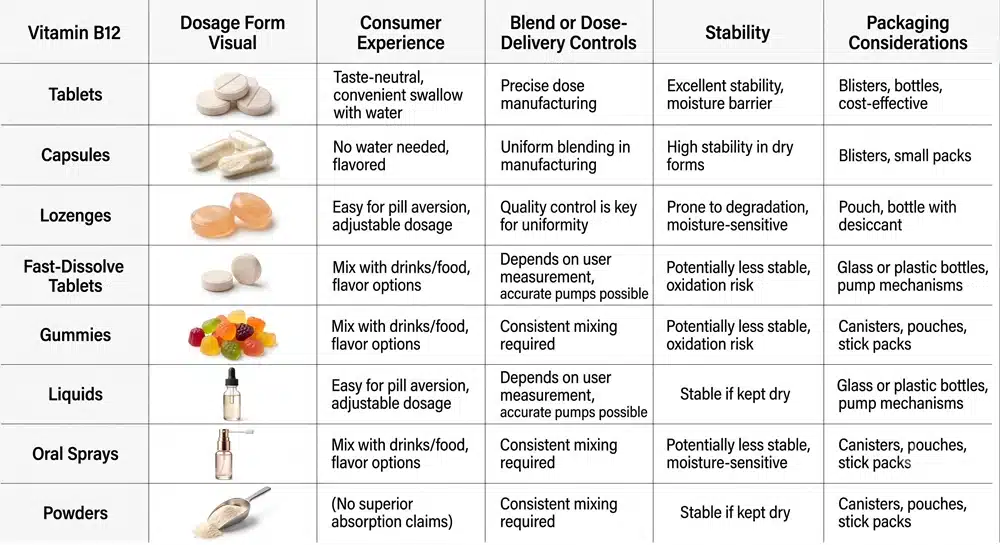
| Format | Optimale Passform | Entwicklungskontrollen | Anspruchsgrenze |
|---|---|---|---|
| Tabletten | Preisgünstige Produkte für den täglichen Bedarf und Multivitamine. | Härte, Bröckeligkeit, Zerfall, Gleichmäßigkeit der Mischung und Lichtschutz. | Die Kompression beeinträchtigt die Wirksamkeit des Vitamins nicht, solange das Produkt den Spezifikationen entspricht. |
| Kapseln | Einfache Formeln und flexible Shell-Optionen. | Verteilung der Vormischung, Fließfähigkeit, Füllgewicht, Kompatibilität mit der Hülle und Barriereeigenschaften der Verpackung. | Kapseln sind nicht grundsätzlich bioverfügbarer als Tabletten. |
| Lutschtabletten oder schnell lösliche Tabletten | Anwender, die wasserfreie oder im Mund zergehende Darreichungsformen bevorzugen. | Geschmacksmaskierung, Zerfall, Feuchtigkeit, Verpackung und Dosierungsgleichmäßigkeit. | Eine schnelle Auflösung im Mund ist kein Beweis für eine bessere systemische Resorption. |
| Gummibärchen | Geschmacksbetonte und einfach einzunehmende Verbraucherkonzepte. | Wirksamkeit gegenüber Haltbarkeit, Zucker-/Süßstoffsystem, Wasseraktivität und Konsistenz der Portion. | Versprechen Sie keine schnellere Aufnahme oder sofortige Energie. |
| Flüssigkeiten oder Sprays | Flexible Einnahme und für Nutzer, die Tabletten meiden. | Dosiermenge, Konservierungssystem, Mikrobiologie, Lichteinwirkung und Verpackungsverträglichkeit. | Die Verabreichung als Spray umgeht nicht automatisch den Verdauungsprozess und wirkt auch nicht schneller. |
| Pulver | Vormischungen und Getränkeprodukte mit mehreren Zutaten. | Auslegung der Vormischung im Mikrogramm-Bereich, Gleichmäßigkeit der Mischung, Genauigkeit der Dosierung und Stabilität. | Verbraucher sollten hochdosiertes Vitamin B12 nicht einfach mit einem nicht kalibrierten Messlöffel abmessen. |
So beurteilen Sie “von unabhängigen Stellen geprüftes” Vitamin B12
“Die Angabe ”von einer unabhängigen Stelle geprüft“ ist nur dann aussagekräftig, wenn der Prüfumfang klar definiert ist. Eine Marke oder ein Hersteller sollte in der Lage sein, das Labor, die Methode, die Spezifikation, die Charge und die geprüften Eigenschaften anzugeben. Durch Prüfungen lassen sich zwar die Identität, die Wirksamkeit oder das Vorhandensein von Schadstoffen bestätigen, doch sie belegen nicht automatisch die gesundheitsbezogenen Angaben eines Produkts.
| Qualitätsprodukt | Was Sie beantragen sollten | Warum es wichtig ist |
|---|---|---|
| Identität | Validierte Identifizierung der angegebenen Cobalaminform und Dokumentation der Ausgangsstoffe. | Stellt sicher, dass die Inhaltsstoffe mit den Angaben auf dem Etikett und der Rezeptur übereinstimmen. |
| Potenz | Analysemethode, Wirkstoffgehalt des Rohmaterials, Spezifikation des Endprodukts und Chargenergebnis. | Überprüft die Etikettenfestigkeit und unterstützt eine fundierte Strategie zur Überdeckung. |
| Einheitlichkeit | Daten zur Qualifizierung von Vormischungen, zur Gleichmäßigkeit der Mischung oder zur Gleichmäßigkeit der Dosierungseinheiten. | Entscheidend, da Vitamin B12 in Mengen im Mikrogramm-Bereich benötigt wird. |
| Mikrobiologie | Gesamtkeimzahlbestimmung und Tests auf bestimmte Organismen, die der Darreichungsform angemessen sind. | Unterstützt die Freigabe des Endprodukts. |
| Schwermetalle | Grenzwerte für Blei, Arsen, Cadmium und Quecksilber, sofern zutreffend. | Erfüllt die Anforderungen an die Markt- und Produktsicherheit. |
| Stabilität | Echtzeit- und beschleunigte Daten im endgültigen Paket. | Zeigt an, ob die Wirksamkeit und die Produktqualität über die gesamte Haltbarkeitsdauer hinweg erhalten bleiben. |
| Kennzeichnung und Angaben | Überprüfung von Portionsgröße, Form, Menge, Tagesbedarf, Formulierung der Angaben und vorgeschriebenem Haftungsausschluss. | Reduziert Fehler bei der Kennzeichnung, Dosierung und Werbung. |
Wie Hersteller von Nahrungsergänzungsmitteln einen B12-Produzenten auswählen sollten
Vergleichen Sie die verschiedenen Rohstoffoptionen und B-Komplex-Vormischungen Beschaffung von Vitamin-B-Inhaltsstoffen nach Darreichungsform, Wirkstärke, Trägerstoff, Analysemethode und Dokumentation und nicht allein nach der Marketingterminologie.
Ein fähiger Vitamin-Auftragsfertigung Der Partner sollte in der Lage sein, Mischungen im Mikrogrammbereich zu kontrollieren, empfindliche Inhaltsstoffe zu schützen, Wirkstoffüberschüsse zu begründen, die Haltbarkeitsleistung zu validieren und lückenlose Produktionsaufzeichnungen zu führen. Diese Kontrollen sollten mit einem dokumentierten Qualitätskontrolle der Beilagen Programm.
Zu überprüfende Funktionen
- Qualifizierte Bezugsquellen für Cyanocobalamin, Methylcobalamin und andere vorgeschlagene Formen
- Berechnung und Überprüfung von Vormischungen für verdünnte oder trägerbasierte Rohstoffe
- Kontrollen der Mischungs- oder Chargenhomogenität für Wirkstoffe im Mikrogrammbereich
- An die Darreichungsform und die Dosierungsform angepasste Licht-, Feuchtigkeits- und Sauerstoffkontrolle
- Methoden zur Wirkstoffbestimmung in Fertigprodukten und Laborqualifizierung
- Echtzeit- oder wissenschaftlich fundiertes Stabilitätsprogramm in der Endverpackung
- Stammfertigungsunterlagen, Chargenfertigungsunterlagen und Änderungskontrolle
- Prüfung von Etikett, Angaben zu Struktur und Funktion sowie Werbeaussagen
Fragen zur Ausschreibung für einen Vitamin-B12-Hersteller
- Welche Cobalamin-Formen können Sie beziehen, und wie wird deren Identität überprüft?
- Wird der Rohstoff als reiner Inhaltsstoff, als Verdünnung, als Beadlet oder als Vormischung geliefert?
- Wie wird die Wirkstoffkonzentration in die in der Rezeptur angegebene Menge und die Angabe auf dem Etikett umgerechnet?
- Welche Kontrollen zur Gleichmäßigkeit der Mischung bzw. der Dosierungseinheiten werden durchgeführt?
- Wie werden lichtempfindliche Materialien beim Wiegen, Mischen, Abfüllen und Verpacken geschützt?
- Welche Analysemethode und welches Labor werden für Rohstoffe und Fertigprodukte verwendet?
- Wie wird der Übermaßanteil in der Formulierung ermittelt, dokumentiert und im Rahmen der Stabilitätsprüfung bestätigt?
- Können Sie uns aktuelle chargenspezifische Echtheitszertifikate, Stammdaten und Chargenprotokolle zur Verfügung stellen?
- Wie hoch sind die Mindestbestellmenge, die Mustermenge, der Werkzeugbedarf und die Lieferzeit für jedes Format?
- Welche Stabilitätsdaten liegen für Tabletten, Kapseln, Gummibärchen, Flüssigkeiten, Sprays oder Lutschtabletten vor?
- Wie werden Angaben zu “Energie”, “Gehirn”, “methyliert”, “vegan” und “von unabhängigen Stellen geprüft” geprüft?
- Welcher Änderungskontrollprozess kommt zur Anwendung, wenn sich die Quelle, die Form, die Wirksamkeit oder der Trägerstoff von B12 ändern?
Häufige Fehler bei der Vermarktung von Vitamin B12
- Methylcobalamin als universellen Goldstandard oder als einzige bioverfügbare Form zu bezeichnen
- Die Behauptung, Cyanocobalamin sei allein deshalb unsicher, weil es einen Cyanid-Liganden enthält
- Verspricht Menschen, die keinen Mangel haben, sofortige Energie
- Die Behauptung, dass sublinguales Vitamin B12, Vitamin-B12-Spray oder Vitamin-B12-Gummibärchen die Verdauung immer umgehen und schneller wirken,
- MTHFR als pauschalen Grund dafür anzuführen, dass jeder Verbraucher Methylcobalamin benötigt
- Die Bezeichnung eines Nahrungsergänzungsmittels oder einer Produktionsstätte als “von der FDA zugelassen”
- Die Verwendung des Begriffs “von Dritten geprüft”, ohne das Labor, den Prüfumfang oder die Charge zu definieren
- Die Vermarktung einer höheren Dosis als automatisch gleichbedeutend mit höherer Qualität
Häufig gestellte Fragen
Was ist die beste Form von Vitamin B12?
Es gibt keine Darreichungsform, die für jeden Anwender am besten geeignet ist. Es gibt keine Belege dafür, dass sich die Resorptionsraten der verschiedenen Darreichungsformen durchweg unterscheiden. Bei der Entscheidung sollten die Bedürfnisse des Anwenders, die Dosierung, die Produktstabilität, die wissenschaftlichen Erkenntnisse, der Preis und die fachliche Beratung berücksichtigt werden.
Ist Methylcobalamin besser als Cyanocobalamin?
Nicht in jedem Fall. Beide können Vitamin B12 liefern. Methylcobalamin eignet sich möglicherweise für ein Produktkonzept auf Coenzym-Basis, während Cyanocobalamin für Produkte geeignet sein könnte, bei denen Bekanntheit, Kosten oder Stabilität im Vordergrund stehen.
Ist sublinguales Vitamin B12 besser als eine Tablette?
Es gibt keine Belege für einen signifikanten Unterschied in der Wirksamkeit zwischen oralem und sublingualem Vitamin B12. Die bessere Darreichungsform ist in der Regel diejenige, die den Anforderungen entspricht und konsequent sowie korrekt eingenommen werden kann.
Sind 1.000 mcg Vitamin B12 zu viel?
Viele Einzelprodukte enthalten 1.000 mcg, und für Vitamin B12 gibt es keine festgelegte Obergrenze (UL). Allerdings wird möglicherweise nur ein kleiner Teil einer hohen oralen Dosis resorbiert, und nicht jeder benötigt diese Menge. Der Grund für die Einnahme ist wichtiger als die angegebene Dosis.
Sollten Veganer Vitamin B12 einnehmen?
Menschen, die sich vegan ernähren, benötigen eine zuverlässige Vitamin-B12-Quelle in Form von angereicherten Lebensmitteln oder Nahrungsergänzungsmitteln. Die Darreichungsform und die Dosierung sollten entsprechend der Ernährungsweise, dem Gesundheitszustand und gegebenenfalls unter fachkundiger Anleitung ausgewählt werden.
Was bedeutet „von einer unabhängigen Stelle geprüft“?
Dies sollte bedeuten, dass ein unabhängiges oder qualifiziertes externes Labor klar definierte Eigenschaften einer bestimmten Charge geprüft hat. Der Begriff allein gibt keinen Aufschluss darüber, ob das Labor die Identität, die Wirksamkeit, Verunreinigungen, die Stabilität oder die Wirksamkeit der angegebenen Wirkung überprüft hat.
Letzte Erkenntnis
Das beste Vitamin-B12-Präparat ist das Produkt, das einem tatsächlichen Bedarf entspricht, Form und Menge klar angibt, eine praktische Darreichungsform aufweist, seine Wirksamkeit über die gesamte Haltbarkeitsdauer beibehält und durch transparente Qualitätsnachweise gestützt wird. Begriffe wie “methyliert”, “hochwirksam”, “sublingual” und “von unabhängigen Stellen geprüft” sind kein Ersatz für eine gut durchdachte Rezeptur und überprüfte Herstellungskontrollen.
Marken können Kontaktieren Sie GENSEI Geben Sie die gewünschte B12-Form, die Portionsgröße, die Darreichungsform, den Markt, die Verpackung und die Prüfanforderungen an, um Spezifikationen, Muster oder ein Projektangebot anzufordern.
Referenzen
- NIH-Büro für Nahrungsergänzungsmittel: Informationsblatt zu Vitamin B12 für medizinisches Fachpersonal
- NIH-Büro für Nahrungsergänzungsmittel: Informationsblatt zu Vitamin B12 für Verbraucher
- FDA: Angaben zu Struktur und Funktion
- FDA: Fragen und Antworten zu Nahrungsergänzungsmitteln
- FTC: Leitfaden zur Einhaltung der Vorschriften für Gesundheitsprodukte
- 21 CFR Teil 111: Aktuelle gute Herstellungspraxis für Nahrungsergänzungsmittel
- 21 CFR 101.36: Nährwertkennzeichnung von Nahrungsergänzungsmitteln

Warren Wan ist ein versierter Experte mit umfassender Erfahrung in der Lieferkette für Nahrungsergänzungsmittel und verfügt über fundierte praktische Kenntnisse in den Bereichen Forschung, Entwicklung, Prozesskontrolle und weltweite Beschaffung von Kerninhaltsstoffen wie Kollagenpeptiden, Knochenbrüheprotein und Keratin. Als Autor dieser Kolumne hat er es sich zur Aufgabe gemacht, den Marketing-Hype zu durchschauen und komplexe wissenschaftliche Erkenntnisse über Inhaltsstoffe sowie Standards der Produktionsqualitätskontrolle in leicht verständliche, fundierte Wissenschaftspopularisierung zu verwandeln, um den Lesern zu helfen, die Wahrheit hinter den Etiketten zu erkennen und rationalere Gesundheitsentscheidungen zu treffen.


