
Sodium hyaluronate and gelatin are not interchangeable ingredients. Sodium hyaluronate is the sodium salt of hyaluronic acid, a polymeric glycosaminoglycan commonly used in small amounts in joint-support and beauty-from-within formulas. Gelatin is an animal-derived, collagen-based protein selected mainly for gelling, film formation, texture, capsule shells and certain food or supplement applications. The better option depends on the product goal, dosage form, source requirements and evidence behind the intended claim.
For ingredient sourcing, first confirm whether “hyaluronate” means sodium hyaluronate, hyaluronic acid or another Hyaluronsäure form. Then compare molecular weight and viscosity for sodium hyaluronate, or source species, Bloom strength and gel behavior for gelatin.
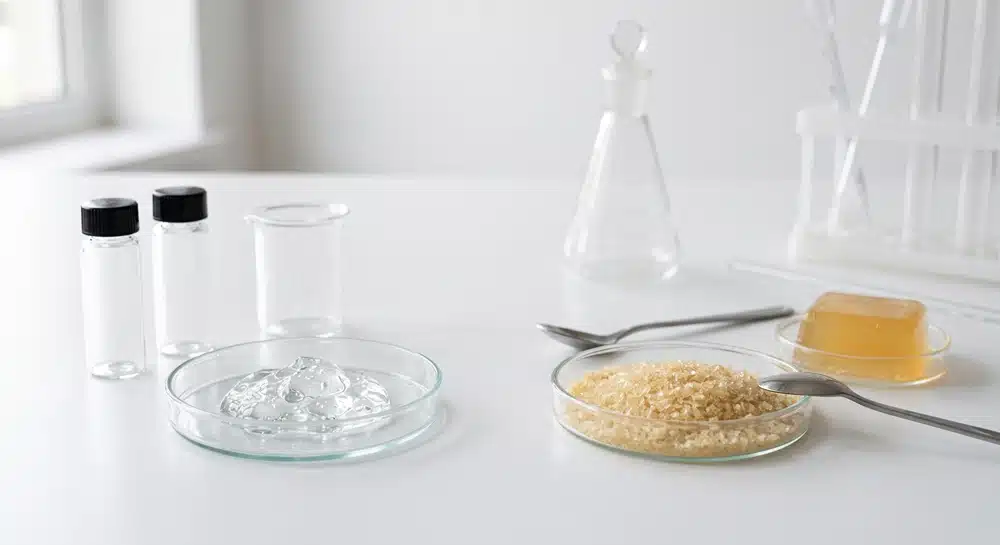
Sodium Hyaluronate vs Gelatin: Quick Comparison
| Faktor | Natriumhyaluronat | Gelatine | What Buyers Should Verify |
|---|---|---|---|
| Zutatenklasse | Natriumsalz der Hyaluronsäure; polymeres Glykosaminoglykan | Collagen-derived protein produced through partial hydrolysis | Exact identity, specification and label name |
| Typische Quelle | Often microbial fermentation; some specialty animal-derived sources may exist | Bovine, porcine, fish or other approved collagen-rich animal material | Source statement, allergen review, BSE/TSE and certification files |
| Primary formulation role | Low-dose active ingredient; hydration, viscosity and polymer behavior depend on molecular weight | Gelling, film formation, binding, texture and capsule-shell function | Finished-product function rather than ingredient name alone |
| Key technical specification | Molecular-weight range, viscosity, assay, glucuronic acid, moisture and protein residue | Bloom strength, viscosity, source species, Type A or B process, clarity and mesh size | Batch COA and application testing |
| Vegan-Positionierung | May be vegan-compatible when fermentation-derived and documented | No; standard gelatin is animal-derived | Supplier statement and finished-product review |
| Common supplement formats | Kapseln, Tabletten, Gummibärchen, Beutel und Getränkepulver | Gummies, hard capsules, softgels, selected tablets, foods and functional powders | Heat, pH, moisture, viscosity, taste and stability |
| Can they be used together? | Yes. Sodium hyaluronate can be the active ingredient while gelatin provides the gummy or capsule structure. | Active retention, process temperature, uniformity and label declaration | |
Was ist Natriumhyaluronat?
Sodium hyaluronate is the sodium salt of hyaluronic acid. It belongs to the hyaluronan family of glycosaminoglycan polymers rather than the protein family. Commercial supplement grades are commonly assessed by molecular-weight range, viscosity, assay, glucuronic acid content, pH, loss on drying, protein residue, microbiological limits and source documentation.
The terms Hyaluronsäure, Hyaluronsäure, hyaluronate und Natriumhyaluronat are often used loosely in marketing. They should not be treated as identical purchasing specifications. Brands that need a deeper identity comparison can review Natriumhyaluronat vs. Hyaluronsäure before finalizing the ingredient name and specification.
Why Molecular Weight Matters
Sodium hyaluronate is not one fixed small molecule. It is supplied as a polymer with a molecular-weight range or distribution. Molecular weight can influence viscosity, hydration time, clumping, mouthfeel, dissolution behavior and processing. A grade suitable for a capsule may not behave the same way in a drink powder, gummy slurry or concentrated liquid.
Was ist Gelatine?
Gelatin is a collagen-derived protein produced by controlled partial hydrolysis of collagen-rich animal tissues. Unlike sodium hyaluronate, gelatin is selected primarily for its physical and functional properties. It can form thermoreversible gels, films and capsule shells, and it can contribute binding, texture and body to a finished product.
Commercial grades vary by animal source, pretreatment process, Bloom strength, viscosity, pH, mesh size, color, clarity and odor. A qualified gelatin raw material supplier should match these properties to the specific gummy, hard-capsule, softgel, food or supplement process.
Gelatin Is Not the Same as Collagen Peptides
Standard gelatin and hydrolyzed collagen peptides come from collagen, but they are not equivalent in processing or finished-product behavior. Gelatin retains gelling functionality, while collagen peptides are further hydrolyzed and are generally selected for solubility and nutrition formulas rather than gel formation. Health evidence generated with a specific collagen peptide ingredient should not automatically be transferred to standard gelling gelatin. See the detailed Kollagenpeptide vs. Gelatine guide for that distinction.
Does Gelatin Contain Hyaluronic Acid?
Standard gelatin should not be treated as a standardized source of hyaluronic acid or sodium hyaluronate. Gelatin is specified as a collagen-derived protein, whereas sodium hyaluronate is a separate glycosaminoglycan ingredient. A finished supplement, gummy or capsule may contain both, but the sodium hyaluronate should be intentionally added, declared and tested as a separate component.
Marketing language such as “natural gelatin contains hyaluronic acid” should not be used unless the exact finished ingredient has verified analytical data and the claim is accurate for the labeled amount. The safer procurement approach is to request separate specifications and COAs for each ingredient.
Key Differences in Chemistry and Product Function
1. Carbohydrate Polymer vs Protein
Sodium hyaluronate is a repeating polysaccharide-type polymer. Gelatin is a mixture of protein chains and peptides derived from collagen. This structural difference explains why the two ingredients behave differently in hydration, viscosity, gel formation, protein testing and formulation.
2. Active Ingredient vs Structural Ingredient
In most supplement concepts, sodium hyaluronate is included as a named active ingredient at a defined serving amount. Gelatin may be used as a functional base, shell material or texture system. Gelatin can also contribute protein, but its use level and nutritional role depend on the formula.
3. Fermentation-Derived vs Animal-Derived
Many sodium hyaluronate grades are produced by controlled microbial fermentation and may support vegan-compatible positioning when supplier documents confirm the production route. Standard gelatin is animal-derived. Bovine, porcine and fish sources can affect religious certification, allergen review, BSE/TSE documentation, taste, gel strength and target-market acceptance.
4. Molecular Weight vs Bloom Strength
Sodium hyaluronate buyers focus on molecular weight and viscosity. Gelatin buyers focus on Bloom strength, viscosity and gel behavior. These specifications are not interchangeable, and neither ingredient should be purchased only on assay or price.
Which Is Better for Skin-Focused Supplements?
For a formula specifically positioned around an oral hyaluronan ingredient, sodium hyaluronate is the more direct choice. Several human studies have evaluated specific oral hyaluronic acid or sodium hyaluronate products for skin hydration or appearance. These findings remain product-, dose-, population- and duration-specific and do not prove that every molecular-weight grade will deliver the same result.
Gelatin can provide collagen-derived amino acids, but standard gelatin is not automatically equivalent to the hydrolyzed collagen peptide ingredients used in many skin studies. For a beauty-from-within product, the brand should decide whether gelatin is being used as a gummy or capsule material, as a protein source, or as a researched active. The evidence and label language must match that exact role.
Which Is Better for Joint-Support Supplements?
Neither ingredient is universally “better.” Sodium hyaluronate may fit a joint-support formula that needs a low-dose hyaluronan ingredient with documented source, molecular weight and assay. Gelatin may fit a product that needs gelling, capsule-shell or collagen-derived protein functionality.
Injection studies, medical-device evidence and prescription uses of hyaluronic acid must not be used as direct proof for an oral sodium hyaluronate supplement. Likewise, studies on proprietary collagen peptides do not automatically substantiate standard gelatin. Brands should match the route of administration, ingredient identity, serving amount, study population and endpoints to the finished product.
For a commercial joint formula, a qualified joint health supplement manufacturer can review ingredient compatibility, dosage form, serving size, claim support, stability and finished-product testing before scale-up.
Can Sodium Hyaluronate and Gelatin Be Used Together?
Yes. They can serve different roles in the same product. A gelatin gummy, hard capsule or softgel can contain sodium hyaluronate as an active ingredient, provided the process is suitable and the final product meets its specifications.
| Dosierungsform | Possible Sodium Hyaluronate Role | Possible Gelatin Role | Critical Development Checks |
|---|---|---|---|
| Hartkapseln | Powder active in the fill blend | Capsule shell material | Flowability, uniformity, moisture interaction, fill weight and shell compatibility |
| Weichkapseln | Selected fill systems after compatibility testing | Primary shell-forming material | Fill solubility, migration, shell stability, disintegration and packaging |
| Gummibärchen | Active ingredient | Gelling and texture system | Heat exposure, pH, water activity, active retention, texture and microbial control |
| Tabletten | Active ingredient | Possible binder or coating component in selected systems | Compression, disintegration, assay uniformity and stability |
| Drink powders | Active ingredient with MW-dependent hydration and viscosity | Functional protein, although gelling or clumping may limit some uses | Dissolution, mouthfeel, sediment, flavor, caking and moisture-barrier packaging |
Wie Marken für Nahrungsergänzungsmittel ihre Auswahl treffen sollten
| Produkt-Ziel | Besserer Ausgangspunkt | Grund |
|---|---|---|
| Vegan beauty or joint capsule | Fermentation-derived sodium hyaluronate with a vegetarian capsule | Gelatin would conflict with vegan positioning |
| Traditional gummy texture | Gelatin, with sodium hyaluronate added if required | Gelatin supplies the gel network; sodium hyaluronate does not replace it |
| Low-dose hyaluronan active | Natriumhyaluronat | Provides a defined hyaluronan identity and assay |
| Hard or soft capsule shell | Gelatin or an appropriate non-gelatin shell material | Sodium hyaluronate is not a direct substitute for standard capsule gelatin |
| Soluble collagen nutrition powder | Consider collagen peptides rather than standard gelatin | Further hydrolysis usually provides more suitable dissolution behavior |
| Gelenkformel mit mehreren Inhaltsstoffen | Choose based on claims, serving size and dosage form | The two ingredients can be complementary rather than competitive |
Buyer Checklist for Sodium Hyaluronate
- Confirm the exact ingredient name, sodium salt form and CAS reference.
- Request fermentation-source and non-animal statements when vegan positioning is planned.
- Define the molecular-weight range and test method.
- Review intrinsic or limiting viscosity and finished-formula viscosity.
- Confirm assay, glucuronic acid, pH, loss on drying, ash and protein residue.
- Review particle size, bulk density, flowability and solubility.
- Check heavy metals, microbiological limits and any relevant residual impurities.
- Request allergen, non-GMO, BSE/TSE and process-flow documents as needed.
- Test stability and content uniformity in the final dosage form.
- Match the evidence and label claim to the exact commercial grade.
Markenbeschaffung bulk sodium hyaluronate powder should request the proposed batch specification and COA before approving a molecular-weight grade.
Buyer Checklist for Gelatin
- Confirm bovine, porcine, fish or other source species.
- Confirm Type A or Type B processing where relevant.
- Specify Bloom-strength range and viscosity.
- Review pH, mesh size, clarity, color, odor and gel-setting behavior.
- Request microbiological, heavy-metal and contaminant specifications.
- Review BSE/TSE documentation for ruminant-derived grades.
- Confirm Halal or Kosher certification for the exact grade and facility when required.
- Test compatibility with heat, acid, sugar, polyols, minerals and active ingredients.
- Verify packaging, moisture protection, shelf life and storage conditions.
- Run finished-product texture, disintegration or shell-performance testing.
Common Red Flags
- The supplier uses “hyaluronic acid,” “hyaluronate” and “sodium hyaluronate” without defining the exact material.
- The sodium hyaluronate specification does not include molecular weight or viscosity.
- The gelatin specification omits source species or Bloom strength.
- A product claims gelatin naturally supplies a standardized amount of hyaluronic acid without analytical proof.
- Injection or dermal-filler research is used to market an oral supplement.
- Collagen peptide trials are presented as direct evidence for ordinary gelling gelatin.
- “Vegan,” “Halal,” “Kosher,” “allergen-free” or “BSE/TSE-free” claims lack grade-specific documents.
- The supplier provides a generic COA that does not match the batch or purchase specification.
- No finished-product testing is planned for heat, pH, moisture, uniformity or shelf life.
Überlegungen zu Sicherheit, Kennzeichnung und Angaben
Both ingredients can be used in foods or supplements when the exact grade is suitable for the intended market and application. Safety and labeling must be evaluated for the finished product, not inferred from the ingredient name alone.
- Declare the exact ingredient identity and source information required by the target market.
- Account for gelatin’s animal source in vegetarian, vegan, religious and cultural positioning.
- Review potential source allergies and manufacturing cross-contact.
- Do not imply that dietary supplements are FDA approved.
- Avoid claims that diagnose, treat, cure or prevent osteoarthritis, wounds, eye disease or other conditions.
- Substantiate structure/function and advertising claims with evidence relevant to the exact product.
- Establish specifications for identity, purity, strength, composition and contaminant limits.
Häufig gestellte Fragen
Is hyaluronate the same as gelatin?
No. Hyaluronate is a glycosaminoglycan polymer, while gelatin is a collagen-derived protein. Their chemistry, sources, specifications and product functions are different.
Does gelatin contain hyaluronic acid?
Standard gelatin is not a standardized source of hyaluronic acid. A product may contain both ingredients when sodium hyaluronate is added separately and declared on the label.
Ist Natriumhyaluronat vegan?
Fermentation-derived sodium hyaluronate may be vegan-compatible, but the claim should be supported by supplier and process documentation. Animal-derived specialty sources must be evaluated separately.
Is gelatin vegan or vegetarian?
No. Standard gelatin is derived from animal collagen. Bovine, porcine and fish gelatin may have different certification and consumer-positioning requirements.
Which is better for joints: sodium hyaluronate or gelatin?
The answer depends on the formula. Sodium hyaluronate is a defined hyaluronan active, while gelatin is a functional collagen-derived protein. Evidence from injections or proprietary collagen peptides should not be transferred to an unrelated oral ingredient.
Which is better for skin: sodium hyaluronate or gelatin?
Sodium hyaluronate may be selected for a specific oral HA concept. Gelatin may provide protein or product structure, but it is not identical to the collagen peptides used in many beauty-from-within studies.
Can sodium hyaluronate be added to gelatin gummies?
Yes, but the manufacturer should test heat and pH exposure, active retention, content uniformity, texture, water activity and shelf stability.
Can sodium hyaluronate replace gelatin in capsules or gummies?
Not as a direct one-for-one replacement. Sodium hyaluronate does not provide the same shell-forming or gelling functionality as standard gelatin.
Schlussfolgerung
Sodium hyaluronate and gelatin solve different formulation problems. Sodium hyaluronate is a polymeric hyaluronan ingredient selected by molecular weight, viscosity, source and assay. Gelatin is an animal-derived protein selected by source species, Bloom strength, viscosity and gel or film performance. They can be used together, but they are not substitutes and their health evidence should be evaluated separately.
For a commercial project, define the target claim, dosage form, source requirements and test plan before choosing the ingredient. Then qualify the supplier using batch documents and finished-product data rather than broad marketing descriptions.
Referenzen
- PubChem: Hyaluronic Acid
- Liu et al. Collagen and Gelatin
- Oral Hyaluronan Relieves Wrinkles and Improves Dry Skin
- Oral Hyaluronic Acid in Knee Osteoarthritis: Randomized Placebo-Controlled Study
- FDA: Angaben zu Struktur und Funktion
- FDA: Dietary Supplement CGMP Compliance Guide
- FTC: Leitfaden zur Einhaltung der Vorschriften für Gesundheitsprodukte

Warren Wan ist ein versierter Experte mit umfassender Erfahrung in der Lieferkette für Nahrungsergänzungsmittel und verfügt über fundierte praktische Kenntnisse in den Bereichen Forschung, Entwicklung, Prozesskontrolle und weltweite Beschaffung von Kerninhaltsstoffen wie Kollagenpeptiden, Knochenbrüheprotein und Keratin. Als Autor dieser Kolumne hat er es sich zur Aufgabe gemacht, den Marketing-Hype zu durchschauen und komplexe wissenschaftliche Erkenntnisse über Inhaltsstoffe sowie Standards der Produktionsqualitätskontrolle in leicht verständliche, fundierte Wissenschaftspopularisierung zu verwandeln, um den Lesern zu helfen, die Wahrheit hinter den Etiketten zu erkennen und rationalere Gesundheitsentscheidungen zu treffen.


