
Einführung
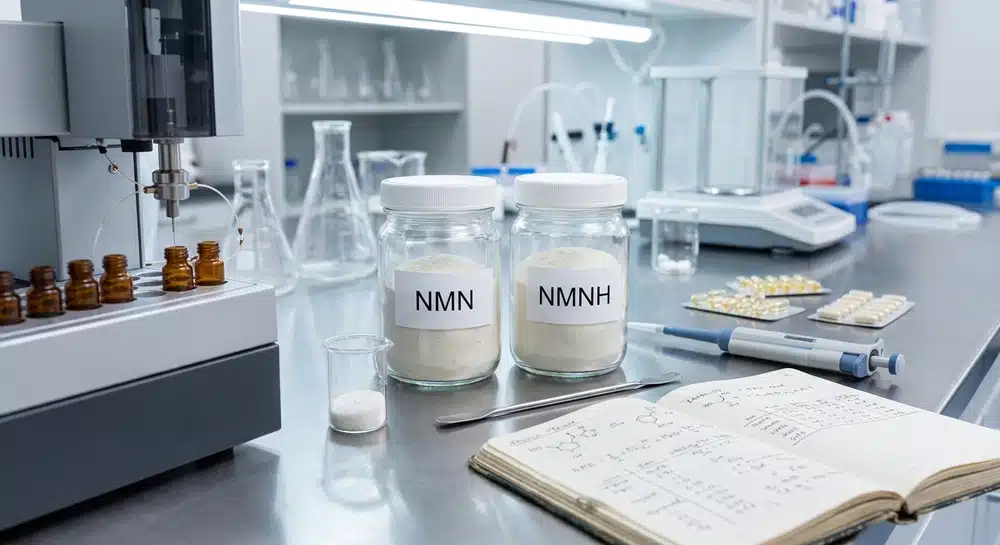
NMN und NMNH sind beide Vorläufer von NAD+, aus Sicht der Nahrungsergänzungsmittelherstellung sind sie jedoch nicht gleichwertig. NMN ist der etabliertere Wirkstoff mit einer längeren Forschungsgeschichte, einer breiteren Verfügbarkeit bei Lieferanten und ausgereifteren Erfahrungen hinsichtlich der Darreichungsform. NMNH ist eine neuere reduzierte Form, die in frühen präklinischen Studien möglicherweise einen stärkeren Anstieg des NAD+-Spiegels zeigt, jedoch auch mehr Unsicherheiten hinsichtlich der Stabilität, der Langzeitdaten beim Menschen, der Handhabung des Rohmaterials und der Haltbarkeit des Endprodukts mit sich bringt.
Für Hersteller von Nahrungsergänzungsmitteln lautet die eigentliche Frage nicht einfach: “Welches Produkt ist wirksamer?” Die bessere Frage ist vielmehr: Welcher Inhaltsstoff lässt sich konsistent beschaffen, zuverlässig prüfen, zu einem stabilen Produkt verarbeiten, durch entsprechende Unterlagen belegen und verantwortungsbewusst auf Ihrem Zielmarkt positionieren?
In diesem Leitfaden werden NMN und NMNH Aus Sicht der Rezeptur und Herstellung: Nachgewiesene Wirksamkeit, Reinheit der Rohstoffe, HPLC-Prüfung, Stabilitätsrisiko, Eignung für Kapseln, Tabletten oder Gummibärchen, Verpackung, Lagerung und behördliche Aspekte. Wenn Sie ein NAD+-Nahrungsergänzungsmittel der nächsten Generation entwickeln, sind diese praktischen Details genauso wichtig wie die Marketingbotschaft.
Kurzantwort: NMN vs. NMNH für Hersteller von Nahrungsergänzungsmitteln
Entscheiden Sie sich für NMN, wenn Sie Wert auf einen bewährteren Wirkstoff mit umfangreicheren Studien am Menschen, einer verlässlicheren Versorgung und einer einfacheren Entwicklung von Fertigprodukten legen. NMN ist in der Regel die praktischere Wahl für Kapseln, Tabletten, Pulver und NAD+-Nahrungsergänzungsmittel-Produktlinien unter Eigenmarken.
Ziehen Sie NMNH nur dann in Betracht, wenn Ihre Marke auf eine experimentellere Positionierung, strengere Stabilitätskontrollen, eine strengere Lieferantenqualifizierung und eine vorsichtigere Formulierung von Wirkungsversprechen vorbereitet ist. NMNH mag wissenschaftlich interessant sein, sollte jedoch nicht einfach als “besseres NMN” betrachtet werden, ohne zuvor die Stabilitätsdaten, Reinheitsprüfungen und den regulatorischen Status zu prüfen.
Kurz gesagt: NMN ist der sicherere kommerzielle Ausgangspunkt. NMNH ist eine Option der nächsten Generation, die einen höheren Aufwand in den Bereichen Forschung und Entwicklung, Qualitätssicherung, Verpackung und Dokumentation erfordert.
Was ist NMN?
NMN ist ein natürlich vorkommendes Molekül, das in Spuren in Lebensmitteln wie Brokkoli, Kohl und Avocados enthalten ist. Es dient als direkte Vorstufe von NAD+, das zelluläre Prozesse wie den Energiestoffwechsel, die DNA-Reparatur und die Genexpression antreibt. Mit zunehmendem Alter sinkt der NAD+-Spiegel bis zum mittleren Lebensalter um bis zu 50%, was zu Müdigkeit, einer verminderten Muskelfunktion und einem erhöhten Krankheitsrisiko führt. NMN-Nahrungsergänzungsmittel zielen darauf ab, den NAD+-Spiegel wieder aufzufüllen, um den Alterungsprozess zu verlangsamen und das allgemeine Wohlbefinden zu fördern.
Wenn Sie NMN für Kapseln oder Pulver beziehen möchten, sehen Sie sich unser Angebot an beta-NMN-Rohstoff Seite mit Informationen zu Reinheit, Lagerung und Dokumentation.Wissenschaftliche Beweise
Die Forschung zu NMN ist solide, insbesondere in Tiermodellen. Eine Studie aus dem Jahr 2016 zeigte, dass NMN die Insulinempfindlichkeit, die Herzfunktion und den Energiestoffwechsel bei Mäusen verbessert (Mills et al., 2016). Eine Humanstudie aus dem Jahr 2020 ergab, dass 250 mg NMN täglich die Muskelfunktion und die aerobe Kapazität bei älteren Erwachsenen verbessert (Irie et al., 2020). Weitere Studien deuten darauf hin, dass NMN die kognitiven Funktionen verbessern und vor neurodegenerativen Erkrankungen schützen kann; groß angelegte Humanstudien sind jedoch noch nicht abgeschlossen.
Vorteile von NMN
- Energiestoffwechsel: Verbessert die Funktion der Mitochondrien für eine bessere Energieproduktion.
- DNA-Reparatur: Unterstützt Enzyme wie PARPs, die beschädigte DNA reparieren.
- Kardiovaskuläre Gesundheit: Verbessert die Funktion der Blutgefäße und verringert die Steifheit der Arterien.
- Kognitive Unterstützung: Kann die Gehirnzellen schützen und das Gedächtnis verbessern.
- Metabolische Gesundheit: Verbessert die Insulinempfindlichkeit und den Glukosestoffwechsel.
Rohmaterialien
NMN wird hergestellt durch:
- Biologische Fermentation: Hefe oder Bakterien wandeln Nicotinamid und Ribose in NMN um und gewährleisten eine hohe Reinheit (typischerweise 98%+).
- Chemische Synthese: Kombiniert chemische Grundstoffe in kontrollierten Umgebungen, bietet Skalierbarkeit, erfordert aber strenge Qualitätskontrollen.
Hochreines NMN ist entscheidend, um Verunreinigungen zu vermeiden, die die Wirksamkeit beeinträchtigen oder Nebenwirkungen verursachen könnten.
Herstellungshinweise für NMN
Für Marken, die NMN-Produkte entwickeln, sind die wichtigsten Fragen bei der Herstellung die Reinheit, die Isomerkontrolle, der Feuchtigkeitsschutz und die Kompatibilität mit der Darreichungsform. Ein hochwertiger NMN-Rohstoff sollte durch ein Analysezertifikat belegt sein, aus dem der Gehalt, die Identität, die Schwermetallwerte, die Grenzwerte für Mikroorganismen, gegebenenfalls Lösungsmittelrückstände sowie die HPLC-Reinheit hervorgehen.
NMN wird üblicherweise in Kapseln, Tabletten, Pulverform und als sublinguale Darreichungsform verwendet. Im Vergleich zu NMNH ist es in der Regel leichter zu beschaffen und einfacher zu formulieren, aber es ist dennoch kein Inhaltsstoff, den man einfach “einmal einsetzt und dann vergisst”. Das Endprodukt sollte vor Hitze, Licht und Feuchtigkeit geschützt werden, und das Verpackungssystem sollte entsprechend der angestrebten Haltbarkeitsdauer und dem Zielmarkt ausgewählt werden.
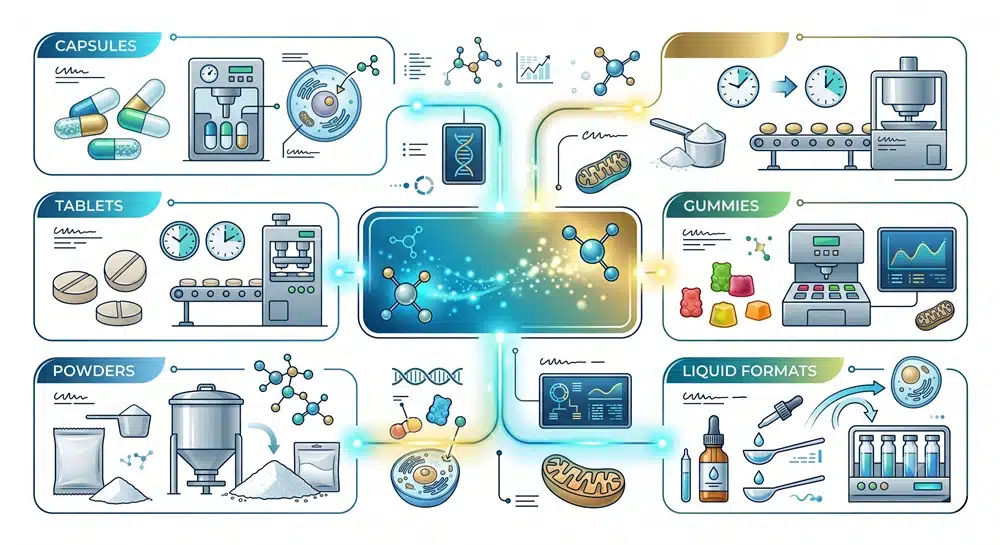
Bei Kapselprodukten sollten Marken vor Produktionsbeginn die Schüttdichte, die Fließfähigkeit und das Füllgewicht der Kapseln überprüfen. Bei Tabletten spielen das Pressverhalten und die Verträglichkeit der Hilfsstoffe eine wichtige Rolle. Bei Pulvern und Stickpacks gewinnen Geschmack, Hygroskopizität und feuchtigkeitsundurchlässige Verpackungen an Bedeutung.
Produkt Formulare
NMN ist in verschiedenen Formen erhältlich, um den unterschiedlichen Vorlieben gerecht zu werden:
- Kapseln/Tabletten: Das beliebteste Produkt, das eine genaue Dosierung ermöglicht (100-500 mg pro Kapsel).
- Pulver: Löst sich in Wasser oder Smoothies auf, ideal für eine schnelle Aufnahme.
- Gummibärchen: Die leckeren NMN-Gummis eignen sich für alle, die ungern Tabletten schlucken.
- Flüssigkeit: Tropfen oder orale Lösungen ermöglichen eine schnelle Absorption, erfordern aber eine sorgfältige Lagerung, um einen Abbau zu verhindern.
Dosierung und Sicherheit
Die empfohlenen Dosen liegen zwischen 250 und 500 mg täglich, die häufig morgens eingenommen werden, um den zirkadianen Rhythmus zu berücksichtigen. Nebenwirkungen sind selten, können aber leichte Übelkeit oder Kopfschmerzen umfassen. Die langfristige Sicherheit wird durch vorläufige Humanstudien unterstützt, aber es wird empfohlen, einen Arzt zu konsultieren, insbesondere bei Personen mit medizinischen Problemen.

Was ist das NMNH?
NMNH, oder Ermäßigt Nicotinamid-Mononukleotid, ist ein neueres Derivat von NMN mit einem zusätzlichen Wasserstoffatom, das es zu einer reduzierten, potenziell reaktiveren Form macht. Dieser strukturelle Unterschied könnte seine Fähigkeit verbessern, den NAD+-Spiegel zu erhöhen und eine stärkere antioxidative Wirkung zu erzielen. NMNH ist weniger erforscht, ist aber ein vielversprechendes Anti-Aging-Produkt der nächsten Generation.
Wissenschaftliche Beweise
Die NMNH-Forschung steckt noch in den Kinderschuhen. Eine Studie an Mäusen aus dem Jahr 2023 ergab, dass NMNH den NAD+-Spiegel 2-3 Mal schneller erhöht als NMN und überlegene antioxidative Eigenschaften aufweist (Zhang et al., 2023). Eine andere Studie legt nahe, dass NMNH die zelluläre Reparatur in Modellen mit oxidativem Stress verbessert (Li et al., 2024). Versuche am Menschen sind begrenzt, daher stützen sich die Behauptungen über die Vorteile von NMNH stark auf präklinische Daten.
Vorteile des NMNH
- Verbesserte NAD+ Verstärkung: Möglicherweise schnellere und effizientere NAD+-Produktion.
- Stärkere antioxidative Wirkung: Neutralisiert freie Radikale wirksamer als NMN.
- Verbesserte Bioverfügbarkeit: Vorläufige Daten deuten auf eine bessere Aufnahme in die Zellen hin.
- Zelluläre Reparatur: Kann die Erholung von oxidativen Schäden fördern.
Rohmaterialien
Die NMNH-Produktion ist komplexer:
- Chemische Reduktion: NMN wird chemisch reduziert, um ein Wasserstoffatom hinzuzufügen, was eine fortschrittliche Technologie zur Erhaltung der Stabilität erfordert.
- Hochreine NMN-Base: Beginnt mit hochwertigem NMN, was die Produktionskosten erhöht.
- Strenge Umweltkontrollen sind erforderlich, um einen Abbau zu verhindern, da NMNH weniger stabil ist als NMN.
Warum die Stabilität von NMNH die eigentliche Herausforderung bei der Formulierung darstellt
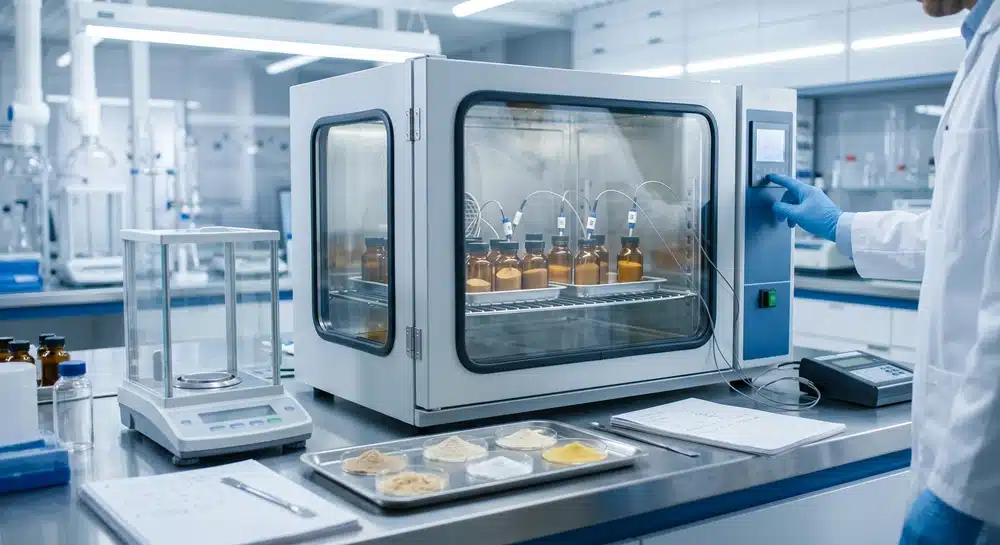
NMNH wird oft als wirksamerer oder schneller wirkender NAD+-Vorläufer beschrieben, doch für die Hersteller liegt die größte Herausforderung in der Stabilität. Eine Verbindung kann in frühen Forschungsphasen vielversprechend erscheinen und sich dennoch nur schwer in ein zuverlässiges kommerzielles Nahrungsergänzungsmittel umsetzen lassen, wenn sie empfindlich gegenüber Oxidation, Feuchtigkeit, Hitze oder Verarbeitungsbelastungen ist.
Aus diesem Grund sollte die Produktentwicklung bei NMNH mit dem Grundsatz „Stabilität geht vor“ beginnen. Marken sollten vor der Markteinführung eines Fertigprodukts Stabilitätsdaten zu den Rohstoffen, beschleunigte Stabilitätsstudien, empfohlene Lagerbedingungen und Verpackungshinweise anfordern. Ohne diese Daten kann es vorkommen, dass ein Produkt bei der Markteinführung zwar gute Testergebnisse liefert, aber noch vor Ablauf der Haltbarkeitsdauer an Wirksamkeit verliert.
NMNH eignet sich zudem weniger gut für Gummibonbons und flüssige Produkte, es sei denn, Lieferant und Hersteller können die Stabilität unter realistischen Verarbeitungsbedingungen nachweisen. Bei Gummibonbons spielen Hitze, Wasseraktivität, Zuckersysteme, Säuren und lange Lagerzeiten eine Rolle. Flüssigkeiten bergen ein noch größeres Risiko, da gelöste Wirkstoffe schneller abgebaut werden können als Trockenpulver. Aus diesem Grund sind Kapsel- oder geschützte Pulverformate in der Regel sinnvollere Ausgangspunkte für die NMNH-Entwicklung.
Produkt Formulare
NMNH ist weniger weit verbreitet, wird aber angeboten in:
- Kapseln/Tabletten: Am häufigsten, mit Dosen von 100-300 mg.
- Pulver: Wasserlöslich, flexibel für individuelle Dosierung.
- Gummibärchen: Aufgrund der hohen Kosten und Stabilitätsprobleme selten.
- Flüssigkeit: Experimentell, mit Schwierigkeiten bei der Aufrechterhaltung der Wirksamkeit im Laufe der Zeit.
Dosierung und Sicherheit
Die empfohlenen NMNH-Dosen liegen zwischen 100 und 300 mg täglich, aber die optimale Dosierung ist aufgrund der begrenzten Forschung unklar. Die Nebenwirkungen sind nicht gut dokumentiert, und die langfristige Sicherheit ist nicht untersucht. Die Anwender sollten vorsichtig vorgehen und sich an medizinisches Fachpersonal wenden.
NMN vs. NMNH: Ein detaillierter Vergleich
Zur Klärung Unterschiede zwischen NMN und NMNHIn der folgenden Tabelle werden die wichtigsten Aspekte verglichen:
| Aspekt | NMN | NMNH |
|---|---|---|
| Chemische Struktur | NAD+-Vorläufer, stabiles Molekül | Reduziertes NMN mit zusätzlichem Wasserstoff, potenziell reaktiver |
| NAD+ Verstärkung | Wirksam, steigert NAD+ in Studien um 20-40% | Potenziell 2-3x schnellerer NAD+-Anstieg, begrenzte Daten vom Menschen |
| Bioverfügbarkeit | Gut, insbesondere in Form von Pulver/Flüssigkeit | Möglicherweise höher, aber es fehlen Studien am Menschen |
| Antioxidationsmittel-Fähigkeit | Mäßig, unterstützt die zelluläre Gesundheit | Stärker, neutralisiert freie Radikale wirksam |
| Rohmaterialien | Fermentation oder Synthese, kostengünstig | Erfordert NMN-Reduktion, kostspielig und komplex |
| Produkt Formulare | Kapseln, Pulver, NMN Gummibärchen, flüssig | Kapseln, Pulver, selten Gummibärchen/flüssig |
| Reifegrad der Forschung | Umfassende Studien an Tieren und Menschen | Frühes Stadium, meist Tierstudien |
| Preis (30-Tage-Vorrat) | $30-60, weithin verfügbar | $50-100, begrenzte Verfügbarkeit |
| Stabilität | Stabil, leicht zu lagern | Weniger stabil, erfordert vorsichtige Handhabung |
Tabelle zur Formulierungs- und Herstellbarkeit
| Formulierungsfaktor | NMN | NMNH | B2B-Hinweis |
| Reifegrad der Forschung | Besser etabliert, einschließlich klinischer Studien am Menschen | Erste, überwiegend präklinische Erkenntnisse | NMN lässt sich mit einer verantwortungsvollen Marketingformulierung leichter bewerben. |
| Verfügbarkeit von Rohstoffen | Breiteres Lieferantenangebot | Begrenzte Lieferantenbasis | Das NMNH verlangt strengere Anforderungen an die Lieferantenqualifikation. |
| Stabilität | Leichter zu handhaben, aber immer noch feuchtigkeits- und wärmeempfindlich | Größere Bedenken hinsichtlich der Stabilität | NMNH benötigt aussagekräftigere Angaben zur Verpackung und zur Haltbarkeit. |
| Kapseln | Praktisch | Mit Bedienelementen möglich | Kapseln sind für beide die sicherste erste Darreichungsform. |
| Tabletten | Möglich bei der Prüfung von Hilfsstoffen | Erhöhtes Risiko hinsichtlich Kompression/Stabilität | Eine Pilottablettierung ist unerlässlich. |
| Gummibärchen | Möglich, aber nicht ideal bei hoher Wirksamkeit | Allgemein hohes Risiko | Vermeiden Sie NMNH-Gummibonbons, sofern deren Stabilität nicht nachgewiesen ist. |
| Flüssigkeiten | Möglich, erfordert jedoch Maßnahmen zur Stabilisierung | Experimentell/mit hohem Risiko | Trockene Formate sind sicherer. |
| Qualitätsprüfung | HPLC, Analyse, Verunreinigungen, Schwermetalle, Mikroorganismen | Das Gleiche plus eine verbesserte Stabilitätsüberwachung | COA allein reicht nicht aus; Methode und Stabilität müssen überprüft werden. |
Eingehende Analyse
- Chemische Struktur: Der zusätzliche Wasserstoff von NMNH erhöht seine Reduktionskraft, so dass es möglicherweise effektiver ist, NAD+ zu erhöhen. Seine Instabilität erfordert jedoch eine präzise Herstellung.
- NAD+ Steigerung der Effizienz: NMNH kann NAD+ schneller erhöhen, aber die Wirkung von NMN ist beim Menschen besser dokumentiert.
- Bioverfügbarkeit: Die Struktur von NMNH deutet auf eine bessere zelluläre Aufnahme hin, aber die Absorption von NMN wird durch verschiedene Formen wie NMN-Gummis und Flüssigkeiten optimiert.
- Antioxidative Wirkungen: Die reduzierte Form des NMNH bietet einen hervorragenden Schutz gegen oxidativen Stress, der zu Alterung und Krankheit beiträgt.
- Rohstoffe und Produktion: Die einfachere Produktion von NMN macht es leichter zugänglich. Das komplexe Verfahren von NMNH begrenzt die Skalierbarkeit und erhöht die Kosten.
- Produkt Formulare: Die Vielfalt von NMN, einschließlich der NMN-Gummis, entspricht den unterschiedlichsten Vorlieben. Die begrenzten Formen von NMNH spiegeln seine neuere Marktpräsenz wider.
- Forschung und Kosten: NMN ist aufgrund seiner umfangreichen Forschung eine sichere Wette, während der höhere Preis von NMNH seine Neuheit und die Herausforderungen bei der Produktion widerspiegelt.
Für welche Zutat sollten sich Marken entscheiden?
Entscheiden Sie sich für NMN, wenn Ihre Marke einen ausgereifteren NAD+-Vorläufer benötigt, der über eine größere Marktbekanntheit, eine größere Auswahl an Lieferanten und bessere Erfahrungen mit Fertigprodukten verfügt. NMN eignet sich im Allgemeinen besser für gängige Nahrungsergänzungsmittel zur Lebensverlängerung, Kapselprodukte unter Eigenmarken, sublinguale Pulver sowie die Markteinführung von NAD+-Produkten für Einsteiger.
Entscheiden Sie sich nur dann für NMNH, wenn Ihre Marke auf einen technisch anspruchsvolleren Entwicklungsprozess vorbereitet ist. NMNH bietet zwar ein interessantes Zukunftskonzept, erfordert jedoch eine gründlichere F&E-Prüfung, eine strengere Qualifizierung der Rohstoffe, eine auf Stabilität ausgerichtete Rezeptur sowie zurückhaltende Werbeaussagen. Es eignet sich besser für Marken mit einer wissenschaftlich orientierten Positionierung und dem nötigen Budget für Tests und Dokumentation.
Wenn Ihr Ziel eine schnelle Markteinführung ist, ist NMN in der Regel die praktischere Wahl. Wenn Ihr Ziel hingegen die Differenzierung ist und Sie bereit sind, Einschränkungen hinsichtlich der Stabilität und der wissenschaftlichen Evidenz in Kauf zu nehmen, kann NMNH als fortschrittlicher Inhaltsstoff in Betracht gezogen werden.
Empfehlungen zur Verpackung und Lagerung
Die Wahl der Verpackung sollte sich nach dem Stabilitätsprofil des Wirkstoffs richten und nicht nur nach den Kosten oder dem Aussehen. NMN-Produkte eignen sich je nach Darreichungsform und angestrebter Haltbarkeitsdauer möglicherweise für HDPE-Flaschen, Blisterverpackungen, Stickpacks oder Folienbeutel. Bei NMNH-Produkten ist im Allgemeinen ein konservativerer Ansatz erforderlich.
Für das NMNH sollten Marken Folgendes berücksichtigen:
– Flaschen mit hoher Barrierewirkung,
– Trockenmittel,
– Beutel aus Aluminiumfolie,
– Blisterverpackung,
– Doppel-Aluminium-Blisterverpackungen für Premium-Rezepturen,
– verringerter Kopfraum,
– Bewertung der Sauerstoff- und Feuchtigkeitsbarriere,
– sowie beschleunigte Stabilitätsprüfungen vor der Markteinführung.
Die beste Verpackungsentscheidung ist nicht immer die günstigste. Ist ein Inhaltsstoff instabil, kann eine minderwertige Verpackung den kommerziellen Wert der Rezeptur zunichte machen, noch bevor der Verbraucher die Flasche überhaupt öffnet.
Qualitätscheckliste vor dem Einkauf von NMN oder NMNH
Vor dem Kauf von NMN- oder NMNH-Rohstoffen sollten Hersteller von Nahrungsergänzungsmitteln ein vollständiges Paket technischer Unterlagen anfordern. Die Prüfung sollte mindestens folgende Punkte umfassen:
– Analysezertifikat (COA)
– HPLC-Analyse und Identifizierungsverfahren
– Chromatogramm oder Methodenbeschreibung, sofern vorhanden
– Reinheitsspezifikation
– Verunreinigungsprofil
– Schwermetalle
– Grenzwerte für Keime
– Gegebenenfalls Lösungsmittelrückstände
– Wassergehalt oder Trocknungsverlust
– Partikelgröße und Schüttdichte
– Stabilitätsdaten
– Empfohlene Lagerbedingungen
– Allergenerklärung
– Erklärung zu gentechnisch veränderten Organismen
– Herkunftsland
– Zusammenfassung des Herstellungsprozesses
– Verpackungsempfehlung
– Begleitunterlagen für behördliche Zwecke
Für NMNH sollten Stabilitätsdaten als unverzichtbar und nicht als optional betrachtet werden. Eine Reinheitsangabe von 98%+ reicht nicht aus, wenn sich der Inhaltsstoff unter normalen Lager-, Misch-, Press- oder Verpackungsbedingungen schnell zersetzt.
Vorsichtsmaßnahmen
- Medizinische Konsultation: Wesentlich für NMNH aufgrund der begrenzten Sicherheitsdaten. Die Sicherheit von NMN ist besser belegt, erfordert aber immer noch professionelle Beratung.
- Qualitätssicherung: Wählen Sie Produkte, die von Dritten geprüft wurden (z. B. NSF- oder USP-Zertifizierung) und 98%+ rein sind, um Wirksamkeit und Sicherheit zu gewährleisten.
- Nebenwirkungen: NMN kann in seltenen Fällen leichte Übelkeit oder Müdigkeit verursachen. Die Nebenwirkungen von NMNH sind nicht bekannt, daher sollten Sie auf unerwünschte Reaktionen achten.
- Lagerung: Die Instabilität von NMNH erfordert eine kühle, trockene Lagerung. NMN ist nachsichtiger, profitiert aber dennoch von der richtigen Handhabung.
So lesen Sie ein NMN/NMNH-Prüfzeugnis und ein HPLC-Ergebnis
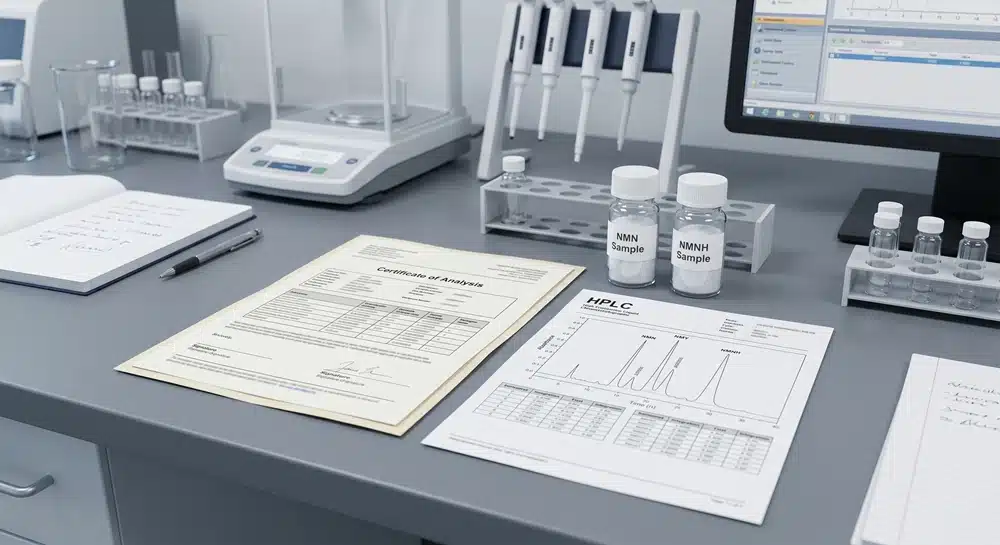
Ein Analysezertifikat sollte mehr enthalten als nur die Angabe “Reinheit 98%”. Bei Inhaltsstoffen, die als NAD+-Vorläufer dienen, sollten Hersteller auf die Prüfmethode, die Identitätsbestätigung, die Klarheit des Chromatogramms und die Verunreinigungspeaks achten.
Stellen Sie bei der Prüfung eines Lieferantendokuments folgende Fragen:
1. Wird in der COA die genaue Form des Inhaltsstoffs angegeben?
Bei NMN ist die Identität von Beta-NMN entscheidend. Bei NMNH sollten Sie sich vergewissern, dass der Anbieter nicht einfach Standard-NMN unter einem Namen für die reduzierte Form vermarktet.
2. Ist die Untersuchungsmethode eindeutig angegeben?
Die HPLC wird häufig für Assays und Reinheitsprüfungen eingesetzt, doch sollten Hersteller prüfen, ob die Methode validiert ist und ob der Lieferant entsprechende Daten vorlegen kann.
3. Sind Verunreinigungen sichtbar und werden sie kontrolliert?
Ein scheinbar einwandfreier Reinheitswert kann aussagekräftige Verunreinigungspeaks verbergen. Fordern Sie bei der Beschaffung hochwertiger Inhaltsstoffe Chromatogrammunterlagen an.
4. Wird die Charge auf lagersensitiven Abbau geprüft?
Dies ist für das NMNH besonders wichtig. Eine neue Charge kann zwar die Freigabeprüfung bestehen, aber dennoch die Erwartungen hinsichtlich der Haltbarkeit verfehlen, wenn die Stabilität unzureichend ist.
Für B2B-Einkäufer ist die Qualität der Dokumentation oft ein Indikator für die Qualität des Lieferanten. Kann ein Lieferant keine eindeutigen analytischen Nachweise vorlegen, sollte die Zutat als mit einem höheren Risiko behaftet eingestuft werden.
Schlussfolgerung
NMN-Ergänzungen und NMNH-Ergänzungen bieten beide überzeugende Vorteile für Anti-Aging und Gesundheitsoptimierung. NMN ist die erste Wahl für seine Erschwinglichkeit, umfangreiche Forschung und verschiedene Formen wie NMN Gummibärchen und Flüssigkeiten. NMNH ist zwar aufgrund seiner potenziellen NAD+-steigernden und antioxidativen Wirkung vielversprechend, aber teurer und weniger erforscht, was diejenigen anspricht, die bereit sind, innovative Optionen zu erkunden. Ihre Wahl hängt von Ihrem Budget, Ihren Gesundheitszielen und Ihrer Vorliebe für Produktformen ab. Bevorzugen Sie immer qualitativ hochwertige Produkte und konsultieren Sie einen Gesundheitsdienstleister, um Sicherheit und Eignung zu gewährleisten.
Möchten Sie NMN, NMNH oder einen anderen NAD+-Vorläufer testen? Wenden Sie sich an unser Rezepturteam unter Berücksichtigung Ihrer Zielgruppe, der Darreichungsform und der Stabilitätsanforderungen.FAQs
Ist NMNH besser als NMN?
Nicht unbedingt. NMNH mag zwar in frühen präklinischen Studien einen stärkeren Anstieg des NAD+-Spiegels zeigen, doch für NMN liegen ausgereiftere Daten aus Studien am Menschen vor, es wird in größerem Umfang kommerziell genutzt und es gibt mehr Erfahrung mit der Formulierung. Für die meisten Marken ist NMN der praktischere Ausgangspunkt, während NMNH eine risikoreichere Option der nächsten Generation darstellt, die eine höhere Stabilität und eine umfassendere Dokumentation erfordert.
Was ist der Hauptunterschied zwischen NMN und NMNH?
NMN ist eine oxidierte NAD+-Vorstufe, während NMNH eine reduzierte Form mit einem anderen Redoxverhalten darstellt. Der Unterschied ist nicht nur biochemischer Natur. Er wirkt sich auch auf die Handhabung der Rohstoffe, die Stabilität, die Verpackung und die Machbarkeit des Endprodukts aus.
Kann NMNH in Gummibonbons verwendet werden?
Gummibonbons des NMNH stellen im Allgemeinen ein hohes Risiko dar, es sei denn, der Lieferant und der Hersteller können überzeugende Stabilitätsdaten vorlegen. Bei der Herstellung von Gummibonbons kommen Hitze, Wasseraktivität, Süßungsmittel, Säuren und lange Lagerzeiten zum Einsatz – all dies kann das Risiko des Abbaus empfindlicher Inhaltsstoffe erhöhen.
Welche Darreichungsform eignet sich am besten für NMN?
Kapseln und Tabletten sind in der Regel die praktischsten Darreichungsformen für NMN. Pulver und Stickpacks können ebenfalls geeignet sein, sofern der Feuchtigkeitsschutz und der Geschmack gewährleistet sind. Flüssige Darreichungsformen erfordern einen höheren Aufwand hinsichtlich der Stabilitätssicherung.
Welche Produktform eignet sich am besten für NMNH?
Für NMNH sind Kapseln oder geschützte Trockenpulverformate in der Regel die sichersten ersten Optionen. Flüssigkeiten und Gummibonbons sollten so lange als experimentell betrachtet werden, bis ihre Stabilität nachgewiesen ist.
Was sollten Marken vor dem Kauf von NMN- oder NMNH-Rohstoffen prüfen?
Markenhersteller sollten folgende Unterlagen anfordern: Echtheitszertifikat (COA), HPLC-Analyse, Identitätsprüfung, Verunreinigungsprofil, Schwermetallgehalt, Grenzwerte für Keimzahl, gegebenenfalls Lösungsmittelrückstände, Wassergehalt, Stabilitätsdaten, Lagerungshinweise sowie behördliche Begleitdokumente.
Sind NMN oder NMNH in allen Märkten legal?
Nein. Die rechtlichen Rahmenbedingungen können je nach Land unterschiedlich sein und sich im Laufe der Zeit ändern. Marken sollten die aktuellen Vorschriften in ihren Zielmärkten prüfen und sich von Fachleuten für regulatorische Fragen beraten lassen, bevor sie NAD+-Vorläuferprodukte auf den Markt bringen.
Kann Gensei bei der Entwicklung von NMN- oder NMNH-Fertigprodukten helfen?
Ja. Ein Produktionspartner kann dabei helfen, die Qualität der Rohstoffe, die Machbarkeit der Darreichungsform, die Verträglichkeit der Hilfsstoffe, die Verpackung, die Stabilitätsprüfungen sowie die Anforderungen an die Eigenmarkenproduktion von NAD+-Nahrungsergänzungsmitteln zu prüfen.
Referenzen
- Mills et al. 2016 – Die langfristige Verabreichung von NMN mildert den altersbedingten physiologischen Verfall bei Mäusen
- Irie et al. 2020 – Wirkung einer oralen NMN-Gabe auf klinische Parameter bei gesunden Männern
- Yoshino et al. 2021 – NMN erhöht die Insulinsensitivität der Muskeln bei Frauen mit Prädiabetes
- Liu et al. 2021 – Reduziertes Nicotinamid-Mononukleotid steigert den NAD+-Spiegel deutlich
- Zapata-Pérez et al. 2021 – Reduziertes Nicotinamid-Mononukleotid ist ein neuer und wirksamer NAD+-Vorläufer
- NIH-PMC-Übersicht – Überblick über die NAD+-Vorläufer NMN und NR
- FDA-Fragen und Antworten zu Nahrungsergänzungsmitteln, NDI, gesundheitsbezogenen Angaben und der Herstellerverantwortung
- Angaben zu Struktur und Funktion gemäß FDA
- Regulations.gov: PDF-Dokument der FDA zum Antrag bezüglich NMN und zum Status des Inhaltsstoffs (sofern verfügbar)
- Analyse von Venable zur Kehrtwende der FDA in Bezug auf NMN im Jahr 2025
- USP-Programm zur Überprüfung von Nahrungsergänzungsmitteln

Warren Wan ist ein versierter Experte mit umfassender Erfahrung in der Lieferkette für Nahrungsergänzungsmittel und verfügt über fundierte praktische Kenntnisse in den Bereichen Forschung, Entwicklung, Prozesskontrolle und weltweite Beschaffung von Kerninhaltsstoffen wie Kollagenpeptiden, Knochenbrüheprotein und Keratin. Als Autor dieser Kolumne hat er es sich zur Aufgabe gemacht, den Marketing-Hype zu durchschauen und komplexe wissenschaftliche Erkenntnisse über Inhaltsstoffe sowie Standards der Produktionsqualitätskontrolle in leicht verständliche, fundierte Wissenschaftspopularisierung zu verwandeln, um den Lesern zu helfen, die Wahrheit hinter den Etiketten zu erkennen und rationalere Gesundheitsentscheidungen zu treffen.


