
For supplement brand owners, choosing between softgels and hard capsules is not only a consumer-experience decision. It determines whether the formula can carry oils or powders, how fast the fill is released, what shell material is feasible, which quality tests are required, and how packaging must protect the product during storage and shipping.
Softgels are one-piece capsules designed for oils, lipid-soluble actives, and liquid or semi-solid fills. Hard capsules are two-piece shells designed mainly for powders, granules, pellets, and some controlled liquid-fill systems. This guide compares softgels vs capsules from both consumer and manufacturing perspectives, including absorption, ingredient compatibility, disintegration testing, cost, MOQ, and dosage-form selection for private-label supplement projects.
- Best applications: Softgels are usually better for oil-based and fat-soluble ingredients, while hard capsules are usually better for dry powder blends.
- Release & absorption: Softgels may release liquid fills faster, but absorption depends on the ingredient and formulation.
- Brand strategy: For supplement brands, the best format is determined by active ingredient chemistry, fill compatibility, stability testing, packaging, MOQ, and label positioning.
I. Definitionen und Klarstellungen
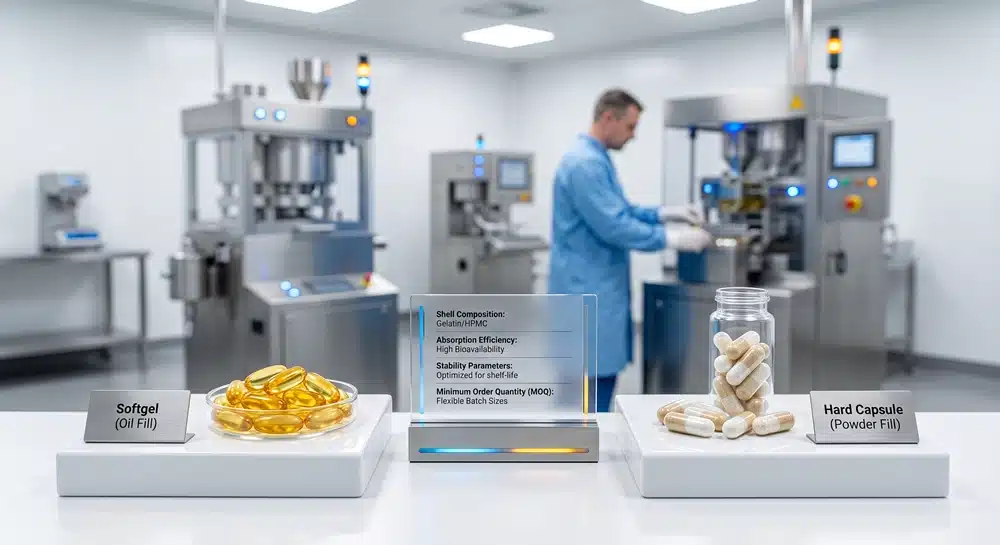
Softgels are one-piece capsules containing liquid, oil, suspension, or semi-solid fills inside a flexible gelatin or plant-based shell. Hard capsules are two-piece shells filled mainly with powders, granules, or pellets. Softgels usually suit fat-soluble and oil-based formulas; hard capsules usually suit dry, multi-ingredient blends.
Softgels, also called soft gelatin capsules or soft capsules, are flexible single-piece dosage forms. The shell is commonly made from gelatin, water, and a plasticizer such as glycerin or sorbitol, although vegetarian softgel systems may use starch or other film-forming materials. The fill is usually an oil, lipid solution, suspension, or semi-solid matrix.
Hard capsules are two-piece shells consisting of a cap and body. They are typically filled with powders, granules, pellets, or beadlets. Gelatin, HPMC, and pullulan shells are common options depending on whether the product is positioned as standard, vegetarian, or premium clean-label.
Gelten Softgels als Kapseln?
Yes. Softgels are considered a type of capsule, but they are not the same as hard-shell capsules. In consumer search, “capsules” often means hard two-piece capsules, while “softgels” means one-piece liquid-filled capsules.
From a manufacturing perspective, the important distinction is not the word “capsule” but the filling process. Softgels are formed, filled, and sealed in one continuous rotary-die process, while hard capsules are produced as empty cap-and-body shells and filled later on a capsule filling line. This difference affects shell moisture, production lead time, tooling, leak control, and finished-product stability.
II. Weichkapseln vs. Kapseln: Absorption
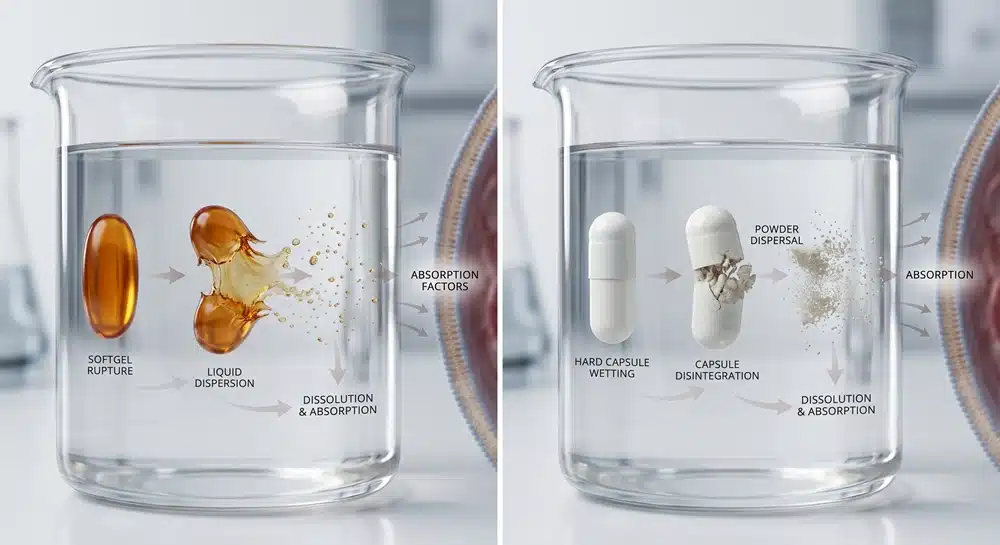
Softgels often release oil-based fills faster because the active ingredient is already dispersed in a liquid or lipid carrier. This is why softgels are commonly selected for fish oil, omega-3, Vitamin D, vitamin E, CoQ10, lutein, curcumin oil dispersions, and other lipophilic ingredients.
However, faster shell rupture does not automatically mean higher clinical effectiveness. Actual absorption depends on the active ingredient’s solubility, particle size, carrier oil, emulsifier system, meal timing, and whether the formula passes disintegration and dissolution testing under defined conditions. For B2B projects, absorption claims should be supported by product-specific data rather than generalized dosage-form assumptions.
Hard capsules may release more slowly than softgels when filled with dense powders, poorly wettable actives, or high-load blends. But they can still perform well when the powder is properly milled, blended with suitable excipients, and validated through disintegration testing. For dry botanicals, amino acids, minerals, probiotics, and multi-ingredient sports formulas, hard capsules often offer a better balance between stability, cost, and label flexibility.
III. Weichkapseln vs. Kapseln: Vorteile
Vorteile von Softgels:
- Strong fit for oil-based and fat-soluble ingredients.
- Smooth, flexible shell that many consumers find easy to swallow.
- Hermetic seal that can reduce odor exposure for fish oil and botanical oils.
- Useful for masking strong taste and odor.
- Premium visual appearance for beauty, omega, and specialty formulas.
Vorteile von Kapseln:
- Flexible for dry powders, granules, pellets, and multi-ingredient blends.
- Lower production complexity for many formulas.
- Easier capsule size and shell material selection.
- Suitable for vegetarian and vegan HPMC capsule positioning.
- Often better for lower MOQ and faster pilot-scale development.
For supplement brands, the practical benefit of softgels is formula protection for lipophilic actives such as fish oil, vitamin D, CoQ10, evening primrose oil, borage oil, and oil-soluble botanical extracts. The hermetic shell can reduce odor exposure and oxidation when paired with suitable antioxidants and barrier packaging. Hard capsules offer a different advantage: they are more flexible for dry powder blends, botanical extracts, amino acids, minerals, probiotics, and multi-ingredient sports nutrition formulas. Brands developing dry blends can review our Herstellung von Nahrungsergänzungsmitteln in Kapselform capabilities, while oil-based projects are better aligned with Herstellung von Softgel-Kapseln.
IV. Softgel-Kapseln: Wie man sie einnimmt
Softgel capsules should normally be swallowed whole with water. They should not be chewed, cut, crushed, or dissolved unless the product label specifically says so. Chewing a softgel can release oil or suspension early, creating an unpleasant taste, odor, leakage, and inconsistent intake.
For fat-soluble nutrients such as vitamin D, vitamin E, omega-3, CoQ10, or carotenoids, taking softgels with a meal that contains some dietary fat may support normal absorption. Hard capsules should also be taken according to label instructions. Some capsule products can be opened and mixed with food, but this should never be assumed for delayed-release, enteric, probiotic, or taste-sensitive formulas.
V. Wie lange dauert es, bis die Wirkung von Kapselpillen einsetzt?
The time required for a capsule product to “kick in” depends on the active ingredient, dose, meal status, disintegration time, and the biological endpoint being measured. A caffeine capsule may feel noticeable within the same day, while a vitamin, mineral, collagen, or probiotic product may require weeks of consistent intake before users evaluate results.
Softgels often release liquid fills faster than powder-filled hard capsules, but there is no universal time that applies to all formulas. The best practice for supplement brands is to validate disintegration and dissolution under defined test conditions and avoid unqualified label claims such as “works instantly” or “absorbs completely.
Wirken Weichkapseln schneller als Kapseln?
Softgels can work faster when the active ingredient is dissolved or dispersed in a liquid carrier and the product is designed for rapid release. But dosage form alone does not guarantee faster biological effect. Ingredient solubility, dose, carrier oil, digestive conditions, and product-specific testing determine the final release and absorption profile.
VI. Was sind die Nachteile von Weichkapseln?
Softgels are not ideal for every formula. Their main disadvantages include higher production complexity, longer drying time, higher tooling and MOQ requirements, more sensitivity to heat and humidity, and incompatibility with some moisture-sensitive or reactive ingredients.
Manufacturing Reality Check: Softgels require gelatin or vegetarian shell preparation, liquid-fill compatibility review, rotary-die encapsulation, tumble drying, tray drying, inspection, and leak testing. The drying stage and shell moisture balance are major reasons softgels can have longer production timelines and higher minimum order quantities than hard capsules. During summer shipping or high-humidity storage, softgels may also need stronger bottle, blister, desiccant, and carton specifications to reduce sticking, deformation, or leakage risk.
Hard capsules also have limitations. Very high-dose formulas may require multiple capsules per serving. Powders with poor flowability, high hygroscopicity, strong odor, or low bulk density may need excipient optimization, granulation, or a different dosage form. For high-dose powders, Herstellung von Nahrungsergänzungsmitteln in Pulverform may be more practical than either softgels or capsules.
VII. Sind Soft Gels gesund?
Softgels can be a healthy and appropriate supplement format when the formula, shell material, excipients, manufacturing controls, and testing program are well designed. The safety of a softgel depends on the active ingredient, dose, allergen profile, oxidation control, microbial testing, heavy metal limits, and compliance with dietary supplement cGMP requirements.
Brands should avoid implying that softgels are universally healthier than capsules. A more compliant statement is: softgels can be useful for delivering oil-based and fat-soluble nutrients, while hard capsules can be useful for dry powder formulas. The dosage form should match the ingredient and intended use.
VIII. Direkter Vergleich: Pro und Kontra Tabelle
Die folgende Tabelle fasst den Vergleich zusammen:
| Aspekt | Weichkapseln | Hartkapseln | B2B Decision Note |
|---|---|---|---|
| Struktur | One-piece flexible shell | Zweiteiliges Gehäuse aus Deckel und Korpus | Useful for definition queries: softgels are capsules, but not hard capsules. |
| Typische Füllmenge | Oil, lipid solution, suspension, semi-solid | Powder, granule, pellet, beadlet; some liquid-fill systems | Match dosage form to active ingredient state. |
| Best ingredient fit | Fish oil, vitamin D, vitamin E, CoQ10, oil-soluble botanicals | Botanicals, amino acids, minerals, probiotics, collagen peptides, dry blends | Avoid forcing dry hygroscopic powders into softgels. |
| Release pattern | Often faster for liquid fills | Depends on shell, powder wetting, excipients, disintegration | Do not claim universal faster absorption without formula data. |
| Herstellungsprozess | Gel mass preparation, rotary die encapsulation, drying, inspection | Powder blending, capsule filling, polishing, metal detection, packing | Softgels usually require more specialized process control. |
| Key QC tests | Fill weight, shell moisture, leak test, disintegration, peroxide/anisidine for oils | Weight variation, disintegration, microbial, heavy metals, assay | Use product-specific release specifications. |
| Packaging needs | Higher protection against heat, humidity, sticking, oxidation | Bottle/blister based on ingredient stability and moisture sensitivity | Softgels may need stronger climate and transport controls. |
| Cost / MOQ | Usually higher due to tooling, drying and specialized equipment | Often lower and more flexible for pilot launches | Capsules are often better for early-stage market tests. |
| Best brand scenario | Premium oil-based supplement with taste/odor masking needs | Dry multi-ingredient formula needing flexible dose and lower MOQ | Use a formulation review before deciding. |
IX. B2B Dosage Form Selection Matrix
X. Manufacturing and QC: What Brands Should Ask Before Choosing
Before confirming softgels or capsules, supplement brands should request a feasibility review that covers active ingredient form, dosage target, fill density, expected serving size, shell material, allergen positioning, oxidation risk, hygroscopicity, packaging, and market claims.
A robust release program may include identity testing, assay, microbial limits, heavy metals, disintegration, fill weight or capsule weight variation, stability monitoring, and packaging compatibility. For oil-based softgels, peroxide value, anisidine value, and oxidation controls may be important. For hard capsules, powder flowability, bulk density, moisture content, and capsule weight variation are often more relevant.
Manufacturing should follow dietary supplement cGMP requirements, including qualified personnel, batch production records, production controls, packaging controls, and documentation under applicable 21 CFR Part 111 expectations.
XI. Conclusion
Softgels and capsules are both useful supplement delivery formats, but they solve different formulation problems. Softgels are usually the better choice for oil-based, fat-soluble, odor-sensitive, and premium-positioned formulas. Hard capsules are usually the better choice for dry, multi-ingredient, lower-MOQ, and flexible private-label formulas.
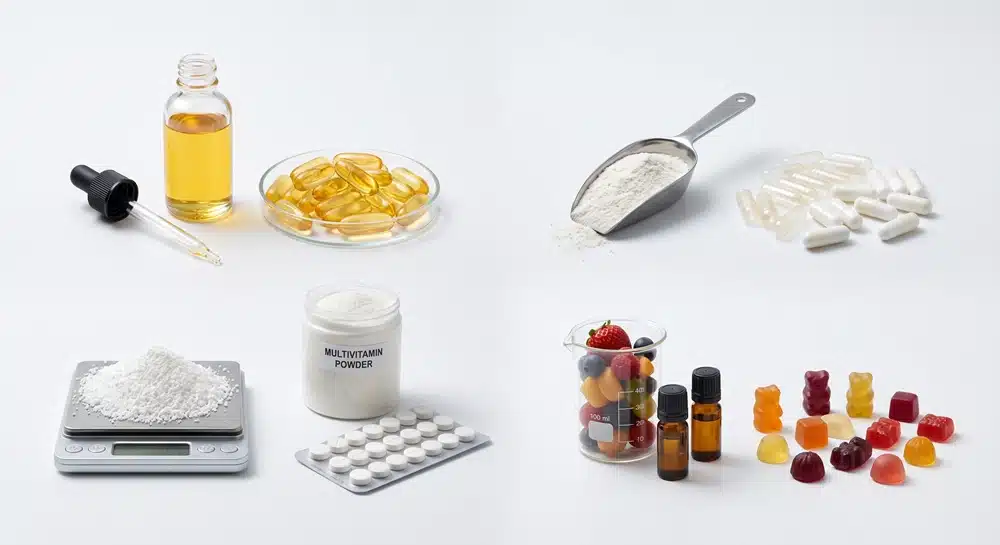
The best choice is not based on a universal claim that one dosage form is “better.” It depends on the ingredient chemistry, target dose, release profile, shell compatibility, stability requirements, packaging conditions, and commercial launch plan. Brands can use Gensei’s Unterstützung bei der Entwicklung kundenspezifischer Rezepturen to evaluate whether a formula should be developed as a softgel, hard capsule, tablet, gummy, liquid, or powder.
XII. Softgels vs Capsules FAQ
Referenzen
- Journal of Excipients and Food Chemicals. “Gelatin and Non-Gelatin Soft Gel Capsules: A Review.” Available at: https://jefc.scholasticahq.com/article/25162-gelatin-and-non-gelatin-soft-gel-capsules-a-review.pdf
- United States Pharmacopeia (USP). “General Chapter <2040> Disintegration and Dissolution of Dietary Supplements.” Available at: https://www.uspnf.com/sites/default/files/usp_pdf/EN/USPNF/revisions/genChapter2040.pdf
- Elektronisches Bundesgesetzbuch (eCFR). “21 CFR Part 111 – Current Good Manufacturing Practice in Manufacturing, Packaging, Labeling, or Holding Operations for Dietary Supplements.” Available at: https://www.ecfr.gov/current/title-21/chapter-I/subchapter-B/part-111
- US-amerikanische Lebensmittel- und Arzneimittelbehörde (FDA). “Aussagen zu Struktur und Funktion”. Abrufbar unter: https://www.fda.gov/food/nutrition-food-labeling-and-critical-foods/structurefunction-claims
- PubMed. Reference PMID: 22814927. Available at: https://pubmed.ncbi.nlm.nih.gov/22814927/

Warren Wan ist ein versierter Experte mit umfassender Erfahrung in der Lieferkette für Nahrungsergänzungsmittel und verfügt über fundierte praktische Kenntnisse in den Bereichen Forschung, Entwicklung, Prozesskontrolle und weltweite Beschaffung von Kerninhaltsstoffen wie Kollagenpeptiden, Knochenbrüheprotein und Keratin. Als Autor dieser Kolumne hat er es sich zur Aufgabe gemacht, den Marketing-Hype zu durchschauen und komplexe wissenschaftliche Erkenntnisse über Inhaltsstoffe sowie Standards der Produktionsqualitätskontrolle in leicht verständliche, fundierte Wissenschaftspopularisierung zu verwandeln, um den Lesern zu helfen, die Wahrheit hinter den Etiketten zu erkennen und rationalere Gesundheitsentscheidungen zu treffen.


