
En el ámbito de la nutricosmética, los productos para el cuidado del cabello y los suplementos proteicos funcionales, la elección entre la queratina hidrolizada y la proteína de trigo hidrolizada debe basarse en la distribución del peso molecular, el perfil de aminoácidos, el perfil alergénico, el posicionamiento en la etiqueta y el formato de administración. La queratina hidrolizada suele elegirse cuando una marca necesita una proteína estructural idéntica al cabello con un argumento de venta más centrado en la reparación, mientras que la proteína de trigo hidrolizada se elige cuando priman el posicionamiento como producto de origen vegetal, la capacidad de retención de agua y unas propiedades sensoriales cosméticas más ligeras.
Esta guía compara ambos ingredientes desde el punto de vista de la formulación y la fabricación, incluyendo la materia prima, la hidrólisis selectiva, el tamaño de los péptidos, los ensayos de control de calidad, el control de alérgenos y su idoneidad para proteínas en polvo, gominolas, cápsulas, champús, acondicionadores y suplementos de belleza de marca blanca.
Respuesta rápida: ¿Cuál deberían elegir las marcas?
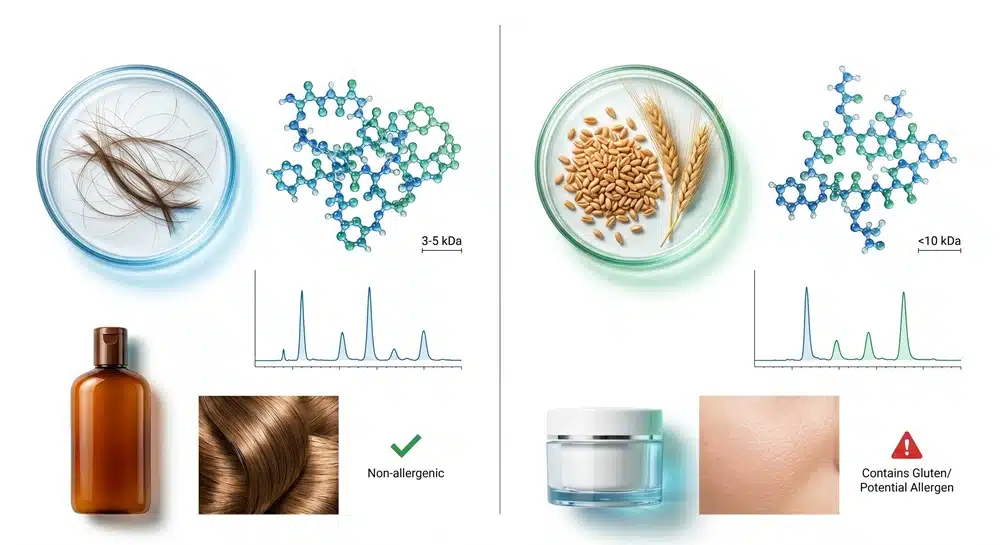
Elige la queratina hidrolizada cuando el concepto del producto se centre en la estructura del cabello, la piel y las uñas, en un posicionamiento de reparación intensiva, en proteínas de belleza de origen animal o en formulaciones nutricosméticas de alta gama. Elige la proteína de trigo hidrolizada cuando el concepto del producto requiera un posicionamiento de origen vegetal, un acondicionamiento ligero, una sensación de hidratación, productos para el cuidado capilar de uso diario o declaraciones aptas para veganos.
En el caso de los compradores B2B, la decisión no debe basarse únicamente en las afirmaciones sobre los beneficios dirigidas al consumidor. Debe basarse en el certificado de análisis (COA), la distribución del peso molecular, el perfil de aminoácidos, la declaración de alérgenos, la actividad del agua, el perfil olfativo, la solubilidad y la forma farmacéutica final.
¿Qué es la queratina hidrolizada?
La queratina hidrolizada es una proteína estructural de origen animal que se descompone en péptidos de menor peso molecular mediante una hidrólisis controlada. En la fabricación de productos para el cuidado del cabello y de suplementos proteicos, la queratina hidrolizada es muy apreciada por su perfil de aminoácidos similar al de la queratina, sus aminoácidos que contienen azufre y su capacidad para favorecer la formación de una película protectora, la resistencia a la tracción y el acondicionamiento de las fibras dañadas.
La queratina está presente de forma natural en el cabello, las uñas y la barrera cutánea externa. La queratina nativa es demasiado grande e insoluble para muchas aplicaciones cosméticas y de suplementos, por lo que los fabricantes recurren a la hidrólisis para descomponer la proteína en fracciones peptídicas más pequeñas. Dependiendo del proceso, la queratina hidrolizada puede actuar como un sistema peptídico penetrante, un agente formador de película que acondiciona la superficie o un ingrediente proteico que aporta belleza desde el interior.
Para los equipos de formulación, la especificación más importante no es solo el nombre del ingrediente, sino el perfil peptídico. Las fracciones de queratina de bajo peso molecular pueden mejorar el comportamiento de penetración, mientras que las fracciones de peso molecular medio a alto pueden mejorar la sustantividad superficial, la formación de película, la facilidad para peinar el cabello y la resistencia a la rotura. Una especificación de compra útil debería incluir información sobre la materia prima, el método de hidrólisis, el peso molecular medio, el nitrógeno total, el perfil de aminoácidos, el contenido de cenizas, la humedad, los límites microbianos, los metales pesados y la declaración de alérgenos.
¿Qué es la proteína de trigo hidrolizada?
La proteína de trigo hidrolizada es un hidrolizado proteico de origen vegetal que se obtiene mediante la descomposición de las proteínas del trigo en péptidos y fragmentos de aminoácidos más pequeños. En las fórmulas para el cuidado del cabello, se utiliza a menudo para retener la humedad, formar una película protectora, mejorar el tacto del cabello y destacar su origen vegetal; en la fabricación de complementos alimenticios, es fundamental controlar los alérgenos del trigo y revisar el etiquetado en relación con el gluten.
A diferencia de la queratina hidrolizada, la proteína de trigo hidrolizada no es idéntica al cabello. Su valor radica en su capacidad para retener el agua, su acción acondicionadora superficial, su carácter apto para veganos y su compatibilidad con formatos de productos que se aclaran o que no se aclaran. Sin embargo, los materiales derivados del trigo requieren una cualificación más rigurosa de los proveedores, ya que el método de hidrólisis, las fracciones residuales de alto peso molecular, la presencia de alérgenos y los controles de contaminación cruzada pueden afectar tanto a las propiedades declaradas del producto como al cumplimiento de la normativa de exportación.
Queratina hidrolizada frente a proteína de trigo hidrolizada: diferencias fundamentales
La queratina hidrolizada suele presentarse como un ingrediente reparador estructural. Resulta especialmente adecuada para el cabello dañado, los tratamientos intensivos, los complementos de belleza y aquellos productos en los que un perfil de aminoácidos similar al de la queratina refuerza el mensaje de la marca.
La proteína de trigo hidrolizada suele presentarse como un ingrediente acondicionador de origen vegetal. Puede resultar muy útil para productos de cuidado capilar de uso diario, formulaciones veganas, la mejora de la sensación de hidratación, la formación de una película ligera y productos en los que se gestiona adecuadamente el etiquetado de alérgenos.
La diferencia fundamental no es simplemente “animal frente a vegetal”. La verdadera diferencia radica en el perfil molecular, la distribución de aminoácidos, el carácter alergénico, las propiedades sensoriales y la compatibilidad con el producto final.
Mecanismo de acción: penetración, formación de una película y actuación específica sobre las fibras capilares
No todas las proteínas hidrolizadas se comportan de la misma manera en las fibras capilares. Su eficacia depende del peso molecular, la carga, la distribución de aminoácidos, la solubilidad y el formato del producto. Un péptido de bajo peso molecular puede penetrar más profundamente en las zonas dañadas de la fibra, mientras que una fracción peptídica de mayor tamaño puede permanecer más cerca de la superficie y mejorar la lubricidad, la facilidad de peinado y la sensación de suavidad.
En el caso de los productos para el cuidado del cabello dañado, la queratina hidrolizada puede reforzar el argumento de reparación, ya que su perfil de aminoácidos se asemeja más al de las proteínas estructurales que se encuentran de forma natural en el cabello. En cuanto a los productos de uso diario, la proteína de trigo hidrolizada puede ofrecer una sensación de acondicionamiento más ligera y una fórmula de origen vegetal más versátil.
| Atributo | Queratina hidrolizada | Proteína de trigo hidrolizada | Nota de control de calidad B2B |
|---|---|---|---|
| Perfil del peso molecular | Las fracciones de peso molecular bajo a medio pueden favorecer la penetración de la fibra o el refuerzo superficial, dependiendo del tamaño del péptido. | Se utiliza a menudo para crear una película ligera y mejorar la sensación de hidratación. | Solicita al proveedor el valor medio de MW, el método de distribución de MW y el certificado de análisis (COA) del lote. |
| Firma de aminoácidos | Mayor relevancia para la estructura del cabello debido a su composición de aminoácidos similar a la de la queratina y a la presencia de aminoácidos azufrados. | Perfil proteico vegetal; más adecuado para un posicionamiento vegano, pero no idéntico al del cabello. | Utiliza el perfil de aminoácidos en lugar de las afirmaciones genéricas sobre las “proteínas”. |
| Mejor narrativa funcional | Reparación, fortalecimiento, cabello dañado, fórmulas para la belleza de las uñas y la piel desde dentro. | Sensación de hidratación, elasticidad, volumen, sistemas de cuidado capilar de origen vegetal. | Distinguir las declaraciones sobre productos cosméticos de las declaraciones sobre la estructura y la función de los complementos alimenticios. |
| Riesgo de fabricación | Olor, trazabilidad de la materia prima, documentación sobre el origen animal. | Declaración sobre alérgenos del trigo y el gluten, contaminación cruzada, validación de la limpieza. | Utiliza el cuestionario para proveedores, la matriz de alérgenos y los procedimientos operativos estándar (SOP) de limpieza validados. |
Especificaciones de fabricación para propietarios de marcas
Para los compradores B2B, el mejor ingrediente no siempre es aquel que tiene el argumento de venta más convincente para el consumidor. La elección adecuada depende de la facilidad de fabricación, la documentación, el riesgo sensorial, la presencia de alérgenos, el formato de entrega y la uniformidad entre lotes. Una proteína en polvo, unas gominolas para el cabello, una cápsula o una base de champú pueden requerir un tamaño de péptido, un perfil de sabor, una estrategia de control de olores y un formato de envase diferentes.
Antes de aprobar una proteína hidrolizada para su producción comercial, las marcas deben solicitar la siguiente documentación: distribución del peso molecular, contenido total de nitrógeno o de proteína, perfil de aminoácidos, cenizas residuales, humedad, actividad del agua, límites microbianos, metales pesados, declaración de alérgenos, declaración de la materia prima y recomendaciones de envasado.
| Especificación | Por qué es importante | Solicitud del proveedor |
|---|---|---|
| Peso molecular medio y distribución | Regula la penetración, la formación de una película, la solubilidad y la textura. | Informe de MW elaborado por SEC/GPC o mediante un método validado de distribución de péptidos. |
| Nitrógeno total / contenido en proteínas | Evita que se promocione un ingrediente “proteico” con un contenido activo escaso. | Certificado de análisis (COA) con el método de nitrógeno/proteínas y los límites de especificación. |
| Perfil de aminoácidos | Permite diferenciar el perfil similar a la queratina del de las proteínas vegetales genéricas. | Informe de HPLC o del analizador de aminoácidos. |
| Humedad y actividad del agua | Ayuda a prevenir la formación de grumos, el riesgo microbiano y la inestabilidad en los productos en polvo y las gominolas. | Humedad %, actividad del agua o recomendaciones de envasado. |
| Declaración sobre alérgenos y origen | Es fundamental para el trigo, la queratina de origen animal, las etiquetas veganas y los documentos de exportación. | Tabla de alérgenos, certificado de origen y declaración de ausencia de OMG o de producto vegano, si procede. |
| Perfil sensorial | Las proteínas hidrolizadas pueden aportar olor, amargor, color o regusto. | Muestra sensorial, notas de enmascaramiento del sabor, aspecto del polvo. |
| Microbiología y metales pesados | Obligatorio para los complementos alimenticios y los productos de belleza desde dentro. | Se ha completado la información sobre el certificado de análisis (COA) y el laboratorio de ensayos. |
Consideraciones sobre alérgenos, fuentes y declaraciones
En el caso de los contenidos dirigidos al consumidor, evite dar a entender que las proteínas hidrolizadas pueden reparar de forma permanente las puntas abiertas, revertir la caída del cabello o tratar enfermedades del cuero cabelludo. Estos ingredientes pueden contribuir al acondicionamiento cosmético, al aspecto, a la manejabilidad y a la resistencia de la fibra capilar, pero deben eliminarse de los materiales de marketing de los complementos alimenticios y los cosméticos las afirmaciones relativas al tratamiento de enfermedades o que parezcan de carácter farmacológico.
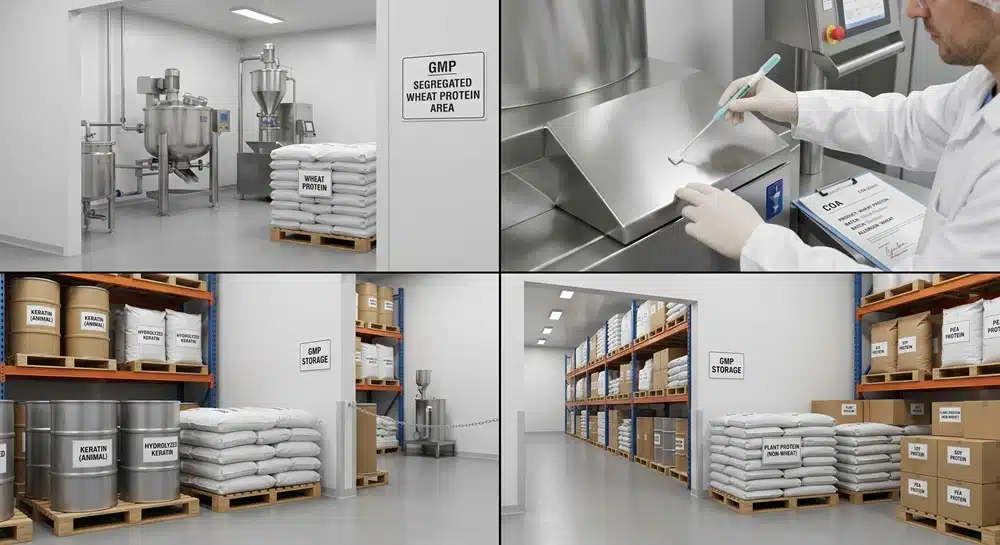
Para los propietarios de marcas, la principal diferencia en materia de cumplimiento normativo radica en la declaración de alérgenos y de origen. La queratina hidrolizada es de origen animal y puede entrar en conflicto con el posicionamiento vegano. La proteína de trigo hidrolizada respalda el posicionamiento de origen vegetal, pero requiere un análisis de alérgenos de trigo y gluten, documentación del proveedor y controles de contaminación cruzada.
Cuando en una misma instalación se procesen colágeno, queratina, proteína de trigo, proteína de soja, proteína de arroz y polvos de origen vegetal, la validación de la limpieza debe formar parte del expediente de cualificación del proveedor. En los proyectos de complementos alimenticios también deben tenerse en cuenta los requisitos de la norma 21 CFR, parte 111, de la FDA en lo que respecta a las operaciones de control de calidad, las especificaciones y los registros maestros de fabricación.
¿Qué ingrediente se adapta mejor a cada formato de producto?
La queratina hidrolizada es adecuada para mascarillas reparadoras intensivas, cápsulas para el cuidado del cabello, polvos de belleza de alta gama y fórmulas en las que se acepta la presencia de proteínas de origen animal. Puede requerir la neutralización del olor, documentación sobre el origen y una revisión minuciosa de las especificaciones de los péptidos.
La proteína de trigo hidrolizada es adecuada para champús, acondicionadores, productos sin aclarado, productos capilares veganos y polvos de belleza de uso diario. Puede ser necesario realizar un análisis más exhaustivo de los alérgenos, presentar documentación relacionada con el gluten y verificar que la fórmula final se ajuste al posicionamiento previsto en la etiqueta.
En las fórmulas mixtas, ambas proteínas pueden combinarse, pero la marca debe definir la función de cada ingrediente. La queratina hidrolizada puede reforzar el mensaje de reparación; la proteína de trigo hidrolizada, el de acondicionamiento de origen vegetal y la sensación de hidratación. La fórmula debe evitar una concentración excesiva de proteínas que provoque rigidez, pesadez, sabor amargo o una mala aceptación sensorial.
Recomendación final
| Parámetro | Queratina hidrolizada | Proteína de trigo hidrolizada | Interpretación B2B |
|---|---|---|---|
| Fuente | Materiales de queratina de origen animal, como las fracciones de queratina derivadas de la lana, las plumas o el pelo | Hidrolizado de proteínas derivado del trigo | Afecta directamente a la documentación relativa a productos veganos, alérgenos, halal/kosher y origen. |
| Posicionamiento principal | Proteína estructural idéntica a la del cabello / Relato sobre la reparación | Descripción de los productos hidratantes y acondicionadores de origen vegetal | No afirmes que se pueden reparar de forma definitiva las puntas abiertas ni que se puede tratar ninguna enfermedad. |
| Peso molecular objetivo habitual | Varía considerablemente; el proveedor debe especificar el rango objetivo | Varía según el método de hidrólisis; puede ser importante el análisis del peso molecular (MW) en relación con los alérgenos | Evita los certificados de análisis genéricos que no incluyan la distribución del peso molecular. |
| Enfoque en los aminoácidos | Perfil de aminoácidos similar al de la queratina; los aminoácidos azufrados tienen gran importancia comercial | Perfil de aminoácidos de las proteínas vegetales; menos similar al del cabello | Utiliza el perfil de aminoácidos para justificar el posicionamiento de gama alta. |
| Riesgo de alérgenos/fuentes | Origen animal, restricción vegana | Alerógeno del trigo/gluten y riesgo de contaminación cruzada | Exigir una declaración de alérgenos y una validación de la limpieza. |
| El producto más adecuado | Mascarillas reparadoras, tratamientos intensivos, proteínas en polvo para la belleza desde dentro, cápsulas | Champús, acondicionadores, productos sin aclarado, productos capilares veganos, polvos de belleza para el día a día | Elige en función del canal de destino y la promesa de la marca. |
| Reto de fabricación | Control de olores, trazabilidad de origen, solubilidad, consistencia de los péptidos | Segregación de alérgenos, análisis del gluten, efectos sobre la viscosidad y las propiedades sensoriales | Validar la fórmula antes de pasar a la escala comercial. |
La queratina hidrolizada es la mejor opción para productos de belleza de alta gama, centrados en la reparación y con queratina como ingrediente principal, en los que se acepta el uso de ingredientes de origen animal. La proteína de trigo hidrolizada es la mejor opción para productos de belleza y cuidado capilar de origen vegetal, de uso diario y centrados en la hidratación, en los que se pueda gestionar correctamente la documentación relativa a los alérgenos del trigo.
Para las marcas de complementos alimenticios y cosméticos, el ingrediente ideal es aquel que se adapta al formato del producto, al texto de las propiedades declaradas, al marco normativo del mercado, a la estrategia en materia de alérgenos, al perfil sensorial y a la documentación del proveedor. Una decisión acertada en materia de formulación B2B debe partir del certificado de análisis (COA), y no del argumento de venta.
Preguntas frecuentes
Referencias
- Evaluación de seguridad del CIR sobre la queratina y los ingredientes derivados de la queratina: https://www.cir-safety.org/sites/default/files/kerati062016FR.pdf
- Penetración de queratinas hidrolizadas de diferente peso molecular en las fibras capilares y sus efectos: https://pmc.ncbi.nlm.nih.gov/articles/PMC7820954/
- Modificación del gluten de trigo para mejorar las propiedades aglutinantes de un cosmético capilar a base de queratina: https://pmc.ncbi.nlm.nih.gov/articles/PMC5830729/
- Evaluación de seguridad del CIR sobre la proteína hidrolizada de trigo y el gluten hidrolizado de trigo: https://www.cir-safety.org/sites/default/files/wheatp062014final.pdf
- Norma cGMP de la FDA para suplementos dietéticos (21 CFR, parte 111): https://www.ecfr.gov/current/title-21/chapter-I/subchapter-B/part-111
- Guía de cumplimiento de la FDA para pequeñas empresas sobre las buenas prácticas de fabricación actuales (cGMP) de los complementos alimenticios: https://www.fda.gov/regulatory-information/search-fda-guidance-documents/small-entity-compliance-guide-current-good-manufacturing-practice-manufacturing-packaging-labeling

Warren Wan es un experto con una amplia trayectoria en la cadena de suministro de complementos alimenticios, que cuenta con una gran experiencia práctica en la investigación, el desarrollo, el control de procesos y el abastecimiento global de ingredientes clave como los péptidos de colágeno, la proteína de caldo de huesos y la queratina. Como autor de esta columna, se dedica a desmontar los argumentos de marketing, transformando la compleja ciencia de los ingredientes y las normas de control de calidad de la producción en divulgación científica rigurosa y fácil de entender, ayudando a los lectores a comprender la verdad que se esconde tras las etiquetas y a tomar decisiones más racionales en materia de salud.


