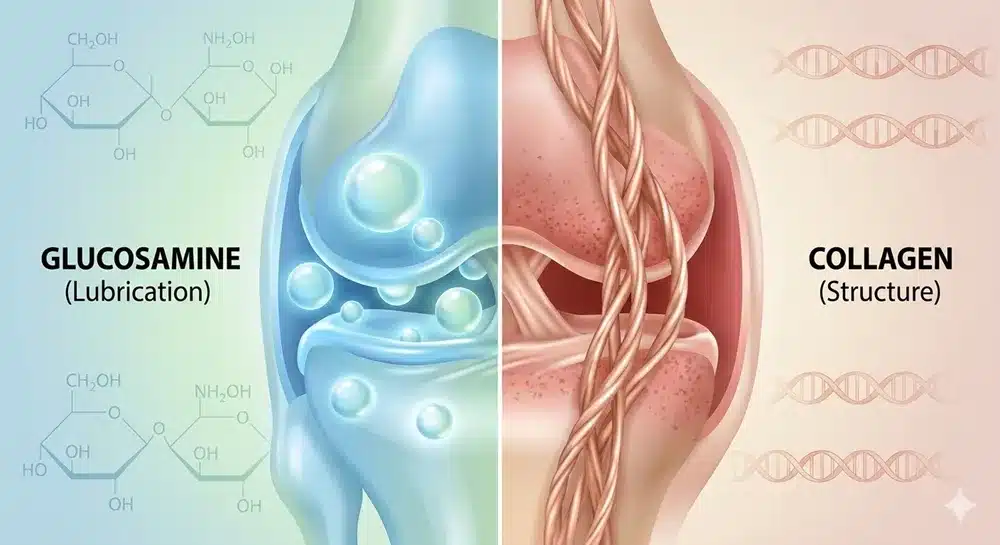
When comparing glucosamine vs. collagen, the fundamental difference lies in their biological function: glucosamine acts as a metabolic “maintenance worker” that stimulates the production of lubricating fluids and cartilage components, whereas collagen serves as the primary “structural scaffold” that provides the physical strength and durability of the joint matrix. To put it simply for those seeking an immediate answer: glucosamine focuses on improving joint environment and fluidity, while collagen focuses on repairing and maintaining the solid tissue architecture. While glucosamine is an amino sugar used to synthesize shock-absorbing molecules, collagen is a fibrous protein that builds the actual framework of your cartilage, tendons, and ligaments.
Molecular Origins: Sugar vs. Protein
To grasp the distinct roles of glucosamine vs. collagen, one must look at their disparate chemical identities. Despite their shared association with mobility, they belong to two entirely different classes of biological molecules.
Glucosamine: The Amino Sugar Building Block
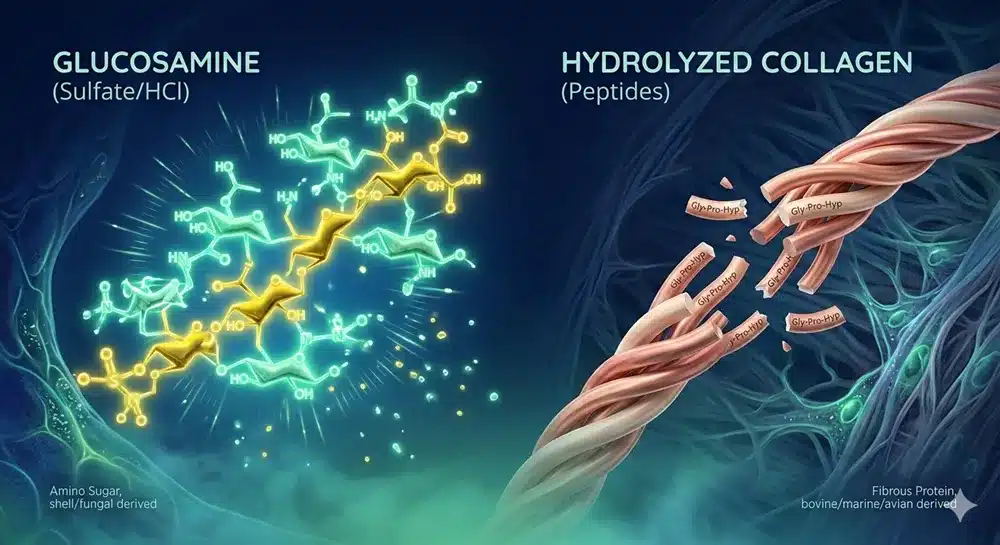
Glucosamine is an amino sugar, a small molecule that serves as a vital precursor for the synthesis of glycosaminoglycans (GAGs).
- The Source: It is naturally derived from the shells of shellfish (chitin) or produced via fungal fermentation.
- The Function: Once ingested, it acts as a substrate for proteoglycans, which are the “spongy” molecules in cartilage that trap water. This molecular sponges allow joints to handle compression, making glucosamine more of a “chemical catalyst” for joint hydration and metabolic health.
Collagen: The Triple Helix Fibrous Protein
Collagen, on the other hand, is a massive fibrous protein and the most abundant protein in the human body.
- The Source: Primarily harvested from bovine, marine, or avian connective tissues.
- The Function: It is built from a unique sequence of amino acids (Glycine, Proline, and Hydroxyproline) twisted into a Triple Helix. This structure functions like a high-tension cable. In the context of joints, Type II Collagen provides the actual tensile strength—the “netting” that prevents the cartilage from tearing under the stress of movement.
Comparison of Molecular Identity
| Feature | Glucosamine | Collagen |
| Molecule Class | Amino Sugar (Carbohydrate derivative) | Fibrous Protein |
| Primary Goal | Synthesis of lubricating “sponges” | Synthesis of structural “cables” |
| Active Focus | Synovial fluid and cartilage matrix | Cartilage, tendons, and ligaments |
| Core Components | Glucose + Glutamine | Amino Acid chains (Peptides) |
Mechanisms of Action: The Lubricant vs. The Frame
The distinct biological roles of glucosamine vs. collagen are most apparent when examining their unique mechanisms of action (MOA) within the joint environment. They work through entirely different physiological pathways to support mobility and comfort.
Glucosamine: The Biological Facilitator of Fluidity
Glucosamine functions primarily as a biochemical messenger and building block for the joint’s internal lubrication system.
- Stimulating Synovial Fluid: Its most crucial role is promoting the synthesis of glycosaminoglycans (GAGs) and hyaluronic acid, the key components of synovial fluid. This viscous fluid acts as the joint’s natural oil, reducing friction between cartilage surfaces during movement.
- Inhibiting Degradation: Glucosamine also exhibits mild anti-inflammatory properties by inhibiting certain enzymes (like matrix metalloproteinases) that break down existing cartilage. In this way, it works from a “bottom-up” approach, actively managing the joint’s environment and preserving its natural cushions.
Collagen: The Bio-Active Architect of Structure
Collagen operates through a “top-down” signaling approach, focusing on structural regeneration. When hydrolyzed collagen peptides are ingested, they are absorbed and enter the systemic circulation, where they act as powerful signals to the body’s repair cells.
- Fibroblast and Chondrocyte Activation: These peptides migrate to the joints, where they activate chondrocytes (cartilage cells) to increase the production of new, native collagen fibers. They don’t just provide raw materials; they provide the instruction to rebuild.
- Reinforcing the Matrix: By stimulating new collagen synthesis, they strengthen the “tensile net” of the extracellular matrix (ECM). This reinforces the cartilage’s durability and elasticity, ensuring it can withstand the mechanical stress and pressure of daily activities.
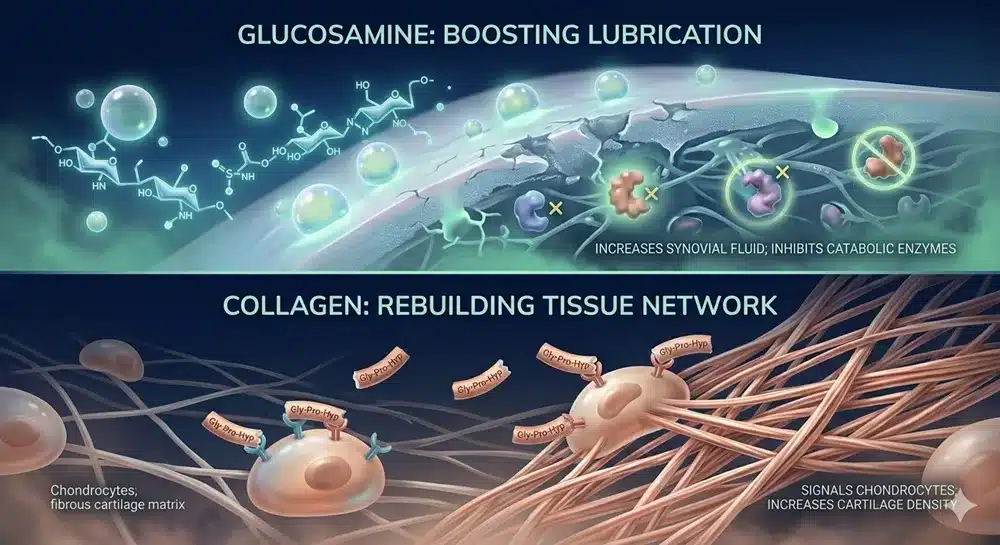
Comparison of Physiological Mechanisms
| Mechanism | Glucosamine (Lubrication & Protection) | Collagen (Structure & Synthesis) |
| Primary Pathway | Biochemical synthesis of GAGs and Proteoglycans | Cellular signaling to chondrocytes/fibroblasts |
| Key Action | Boosts synovial fluid; inhibits cartilage breakdown | Stimulates tissue regeneration; builds new fibers |
| Outcome | Improved joint fluidity and comfort (smoother glide) | Increased joint durability and elasticity (stronger frame) |
Specific Health Outcomes: Symptomatic Relief vs. Long-term Regeneration
When deciding between glucosamine vs. collagen, the choice often comes down to the specific problem you are trying to solve: immediate mechanical discomfort or long-term structural wear.
Glucosamine: The Specialist in Joint Comfort and Stiffness
Glucosamine is historically the “first responder” for joint health, particularly for those suffering from age-related wear or osteoarthritis.
- Reducing Friction-Related Pain: Because it boosts synovial fluid, it is highly effective at reducing the “grinding” sensation in joints. By improving lubrication, it often leads to a faster reduction in daily stiffness and localized discomfort.
- The “Maintenance” Effect: It serves as a preventative shield, slowing down the thinning of the cartilage “sponge” over time, making it ideal for individuals who feel their joints have become “dry” or less mobile.
Collagen: The Specialist in Tissue Durability and Resilience
Collagen’s outcomes are broader and focused on the “whole-body” structural network.
- Long-Term Tissue Repair: While it may not offer the immediate “lubricating” feel of glucosamine, collagen is superior for rebuilding the actual density of the cartilage. It addresses the root cause of structural thinning by stimulating new protein synthesis.
- Supporting the “Soft Tissue” Support System: Unlike glucosamine, which is mostly joint-specific, collagen strengthens the tendons and ligaments that hold the joint in place. This makes it a preferred choice for athletes or those recovering from soft-tissue injuries who need to improve the overall “elasticity” and strength of their movements.
Comparative Health Outcomes Table
| Desired Outcome | Glucosamine (The “Oil”) | Collagen (The “Steel”) |
| Immediate Benefit | Reduced joint stiffness and “grinding” | Improved joint stability and skin/nail health |
| Long-Term Goal | Preserving cartilage thickness | Rebuilding the structural matrix of tissues |
| Primary Target | Synovial joints (Knee, Hip, Fingers) | Cartilage, Tendons, Ligaments, and Dermis |
| Best For… | Daily comfort and osteoarthritis support | Injury prevention, recovery, and anti-aging |
Synergy and Final Verdict: The “1 + 1 = 3” Approach
In the debate of glucosamine vs. collagen, the most advanced approach to joint health doesn’t involve choosing one over the other, but rather utilizing their synergy. Because they target different biological systems—one managing the fluid environment and the other the physical framework—combining them can offer a comprehensive solution for total mobility.
The Power of the “Stack”
When taken together, these two ingredients create a holistic repair cycle:
- The Glucosamine Role: It ensures the joint stays “greased” and hydrated, reducing immediate inflammation and providing the chemical environment where repair can happen.
- The Collagen Role: It uses that healthy environment to lay down new structural fibers, rebuilding the cartilage “net” and strengthening the surrounding ligaments.
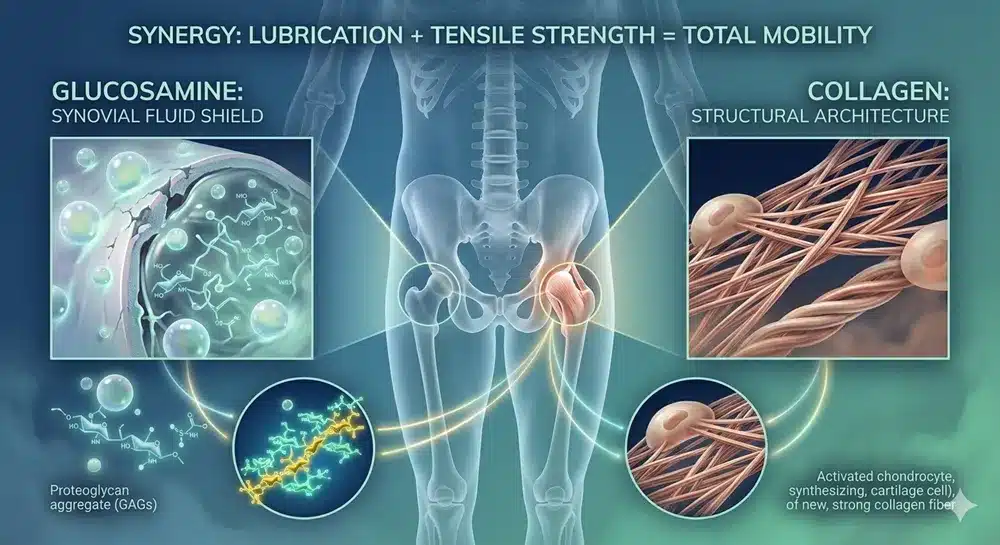
Final Buyer’s Guide: Which One is for You?
To make your final decision, identify your primary concern using the matrix below:
| If you feel… | Your Priority Should Be… | Why? |
| “Stiff and Grinding” | Glucosamine | You likely need better lubrication (synovial fluid) to reduce friction. |
| “Weak or Recovering” | Collagen | You need to rebuild the physical density and tensile strength of the tissue. |
| “Aging and Aching” | Both | You need to address both the loss of fluid (Glucosamine) and the thinning of structure (Collagen). |
| “Active and Preventive” | Collagen | Focus on reinforcing the tendons and cartilage to prevent future injury. |
Conclusion
Understanding the science of glucosamine vs. collagen allows you to move beyond generic “joint support” and start targeted bio-hacking. Use Glucosamine as your “oil” to keep things moving smoothly today, and use Collagen as your “steel” to ensure your body’s framework remains strong for years to come.
FAQs
References & Scientific Citations
1. On Glucosamine (Lubrication & Osteoarthritis)
- Clinical Trial on Joint Pain:“Glucosamine Sulfate in the Treatment of Knee Osteoarthritis Symptoms: A Randomized, Double-Blind, Placebo-Controlled Study.”
- Source: National Institutes of Health (PMC) / Archives of Internal Medicine.
- Key Insight: Evidence of glucosamine’s role in reducing joint space narrowing and improving synovial environment.
- Link: https://pubmed.ncbi.nlm.nih.gov/11204938/
- Mechanisms of Action:“Glucosamine and Chondroitin Sulfate: Is there any scientific evidence for their effectiveness?”
- Source: Cleveland Clinic Journal of Medicine.
- Key Insight: Explains how glucosamine serves as a precursor for glycosaminoglycan (GAG) synthesis.
- Link: https://www.ccjm.org/content/70/6/513
2. On Collagen (Structural Repair & Regeneration)
- Study on Cartilage Regeneration:“Effect of specific collagen peptides on knee joint discomfort: A 3-month randomized controlled trial.”
- Source: Nutrients (MDPI).
- Key Insight: Clinical data showing that collagen peptides stimulate chondrocytes to increase cartilage matrix production.
- Link: https://www.ncbi.nlm.nih.gov/pmc/articles/PMC8541399/
- Soft Tissue & Injury Recovery:“Collagen supplementation as a complementary therapy for the prevention and treatment of osteoporosis and osteoarthritis.”
- Source: Journal of Medicinal Food.
- Key Insight: Discusses the structural benefits of Type II collagen in reinforcing the extracellular matrix.
- Link: https://pubmed.ncbi.nlm.nih.gov/11071580/
3. Synergistic Research (The Combined Effect)
- Comparative Review:“Role of glucosamine and collagen in joint health: A systemic review of complementary mechanisms.”
- Source: International Journal of Rheumatic Diseases.
- Key Insight: Validates the combined use of lubrication-focused and structure-focused ingredients.
- Link: https://onlinelibrary.wiley.com/journal/1756185x