
Sea moss gel and sea moss capsules usually start from the same red algae source, but they solve different formulation problems. Gel is a hydrated, short-shelf-life matrix suited for smoothies and topical use; capsules are dried, dose-controlled, shelf-stable powders designed for portability, GMP production, and batch-to-batch consistency.
For consumers, the better choice depends on lifestyle. For supplement brand owners, the better choice depends on iodine standardization, heavy-metal testing, microbial risk, packaging, logistics, and target dosage form.
- Sea moss gel: Best for users who want a hydrated food-style ingredient for smoothies, skincare masks, and short-term refrigerated use.
- Sea moss capsules: Best for precise serving size, travel convenience, longer shelf life, and scalable private-label supplement programs.
- Buying criteria: The most important factor is not “freshness” but verified quality: species identity, iodine assay, heavy-metal testing, microbiology, and documented GMP manufacturing.
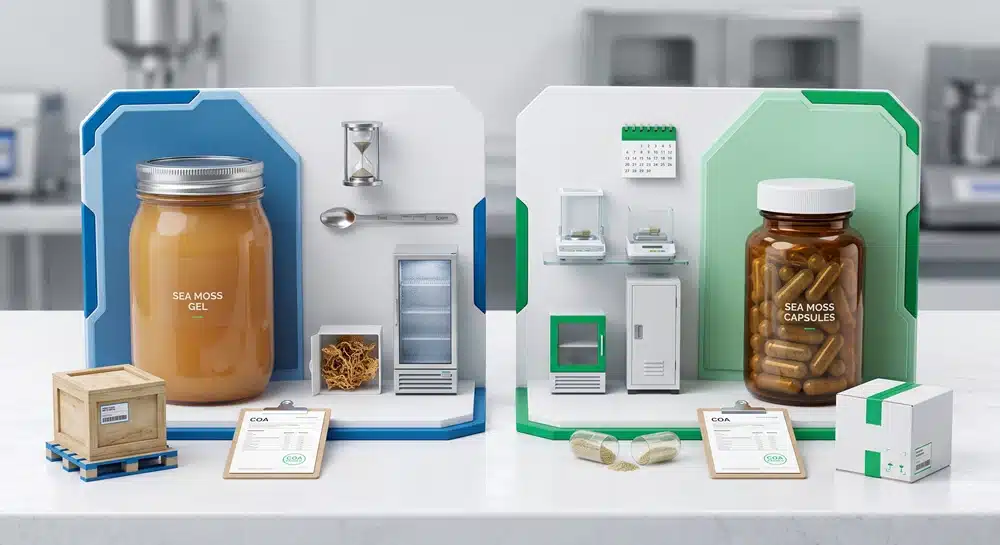
What Is Sea Moss?
Sea moss, commonly associated with Chondrus crispus and related red seaweed species, is valued for its naturally occurring polysaccharides, iodine, potassium, magnesium, calcium, and trace minerals. However, the nutrient profile is not fixed. Species, harvest location, seawater quality, season, washing, drying, and milling can all change the final mineral content.
The popular “92 minerals” claim should not be used as a finished-product specification unless supported by batch-specific testing. For commercial supplement development, a sea moss ingredient should be backed by a Certificate of Analysis covering identity, iodine, heavy metals, microbiology, and moisture. NIH ODS notes that iodine amounts in seaweed can vary greatly by seaweed species, which makes standardized testing especially important for sea moss products.
Sea Moss Gel: Hydrated, Versatile, but Harder to Standardize
Sea moss gel is produced by soaking dried sea moss, cleaning it, and blending it with water until it forms a thick gel. Consumers like gel because it can be added to smoothies, soups, masks, or haircare routines. It feels closer to a fresh food than a supplement capsule.
From a manufacturing viewpoint, sea moss gel is a high-water botanical matrix. Its key risks are water activity, refrigeration, pH drift, microbial growth, container compatibility, and cold-chain shipping. Gel can be attractive for local fresh wellness channels, but it is harder to standardize for Supplement Facts labeling because each serving can vary in water content and solids concentration.
Gel is generally a lifestyle product. It performs well when the customer values freshness, texture, and versatility, but it demands strict storage and shorter inventory cycles.
Sea Moss Capsules: Dose-Controlled and Better for Scalable Supplements
Sea moss capsules contain dehydrated and milled sea moss powder filled into a capsule shell, often HPMC vegetable capsules for vegan positioning. Capsules remove the taste, texture, and refrigeration problems of gel while improving serving-size consistency.
A reliable sea moss capsule project should define the dehydration temperature window, final loss on drying, particle size or mesh range, bulk density, flowability, and target fill weight per capsule. The factory should validate uniform fill weight, finished-product disintegration, microbial limits, iodine content, and heavy-metal release specifications.
For B2B brands, capsules usually provide the strongest balance of convenience, shelf stability, e-commerce suitability, and label-control. To evaluate technical feasibility, work with a professional カプセル・サプリメント製造 team before finalizing capsule size, fill weight, and packaging.
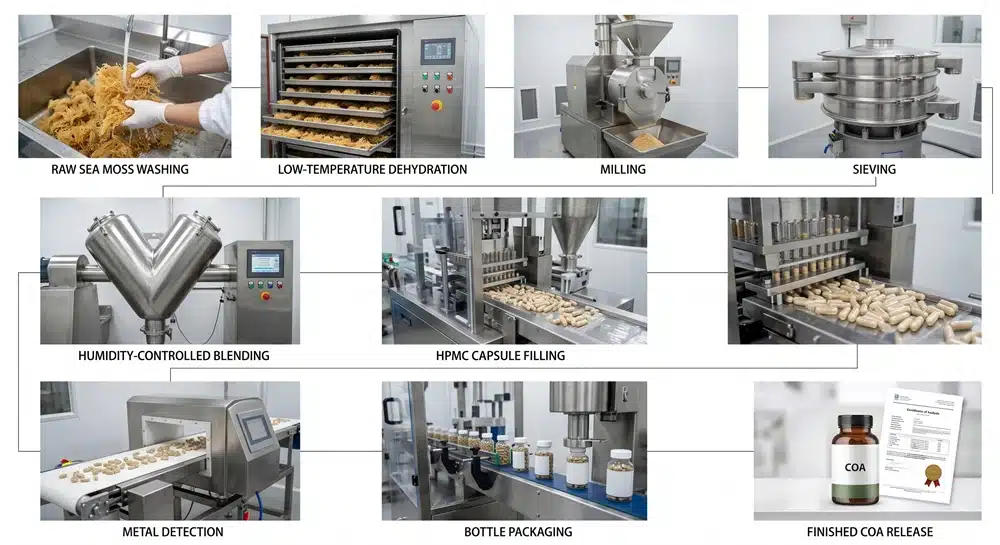
Head-to-Head Comparison: Gel vs Capsules
Sea moss gel offers faster dispersion because it is already hydrated, but capsules offer stronger dosage control and logistical stability. Gel works best for smoothie users, topical rituals, and fresh wellness positioning. Capsules work best for supplement retail, travel, subscription models, and combination formulas.
For a consumer, gel may feel more natural. For a brand owner, capsules are generally easier to control, test, label, ship, and scale.
| 特徴 | シーモスジェル | シーモスカプセル |
|---|---|---|
| バイオアベイラビリティ | 即座に。. すでに水分を含んでいるため、体内で即座に吸収されます。. | 遅延。. カプセルの殻が溶けるまで約20~30分かかります。. |
| 賞味期限 | 短い。. 3~4週間で期限切れ。冷蔵保存必須。. | 長い。. 1~2年保存可能。常温で保存可能。. |
| 味と食感 | 強い。. 土や海の風味で、ゼリーのような食感。. | なし。. 味も匂いもない(飲み込んで終わり)。. |
| 利便性 | 低い。. 下準備、冷蔵、計量が必要です。. | 高い。. 携帯に便利で、あらかじめ計量された分量。. |
| 汎用性 | 高い。. 食べたり身につけたり(フェイスマスク/ヘア). | 低い。. 内部利用のみに限定します。. |
B2B仕様マトリックス
When choosing between sea moss gel and capsules, brand owners should compare specifications rather than slogans. The most important criteria are active matrix, shelf-life driver, dosage precision, quality tests, packaging, and channel fit.
Sea moss gel should be evaluated through water activity, pH, microbial shelf-life, refrigerated logistics, and serving-size variability. Sea moss capsules should be evaluated through moisture, mesh size, fill weight, capsule shell, disintegration, heavy-metal testing, iodine assay, and finished-product stability.
| 仕様 | シーモスジェル | シーモスカプセル | なぜ重要なのか |
|---|---|---|---|
| Active matrix | Hydrated gel with variable solids | Dried powder in HPMC or gelatin shell | Determines dosage precision and label claims |
| Shelf-life driver | Water activity, pH, refrigeration, microbial control | Moisture, oxygen exposure, powder flow, shell stability | Drives packaging, logistics, and returns risk |
| 投与量の精度 | Spoon-size dependent | Fixed fill weight, often 500–1,000 mg/capsule | Capsules are easier for Supplement Facts standardization |
| Quality tests | Microbiology, pH, preservative strategy, heavy metals | Identity, iodine, heavy metals, LOD/moisture, microbiology, disintegration | Defines batch release requirements |
| パッケージング | Refrigerated jars or pouches | HDPE/PET bottles, desiccants, blister packs | Impacts freight cost and shelf placement |
| Best-fit channel | Fresh wellness, smoothie bars, topical use | E-commerce, travel, retail supplements, private label | Supports channel-specific product design |
Quality Control and Safety: The Real Differentiator
Because sea moss grows in marine environments, “wild-crafted” is not enough. Sea moss can absorb both nutrients and contaminants from the water where it grows. A commercial project should require written specifications and batch release testing.

Recommended release tests include identity/species verification, iodine assay, heavy metals by ICP-MS, total plate count, yeast and mold, E. coli, Salmonella, loss on drying, and finished-product disintegration for capsules. For U.S. dietary supplements, these controls should be integrated into master manufacturing records, batch records, and quality-control procedures under 21 CFR Part 111 cGMP principles.
Who Should Choose Sea Moss Gel?
Choose sea moss gel if the consumer values texture, smoothie use, fresh preparation, and topical versatility. Gel works well when the product is sold locally, consumed quickly, and supported with refrigeration instructions. It is less ideal for long-distance e-commerce, high inventory turnover risk, or precise Supplement Facts standardization.
Who Should Choose Sea Moss Capsules?
Choose sea moss capsules if the brand needs precise dosing, shelf stability, travel convenience, strong e-commerce logistics, and lower spoilage risk. Capsules are also better for combination formulas such as sea moss with bladderwrack, burdock root, trace minerals, or other functional ingredients. For launch planning, a プライベートブランドサプリメント製造 partner can help compare capsule size, fill weight, desiccant packaging, and MOQ before commercialization.
What About Powder, Gummies, and Drops?
Sea moss powder, gummies, and drops deserve separate format analysis. Powder provides flexibility but can be hygroscopic and taste-sensitive. Gummies improve consumer compliance but require heat-stable formulation and careful texture control. Drops can be convenient but may need preservative and liquid stability validation.
For the best topical architecture, this page should link to separate spoke articles on Sea Moss Powder vs Gel vs Capsules, Sea Moss Gummies vs Gel, and Best Sea Moss Capsules COA Checklist. A sea moss gummy article should connect to グミサプリ OEM and explain pectin, gelatin, agar, carrageenan, texture, heat exposure, and active-dose limitations.
よくあるご質問
結論
Sea moss gel vs capsules is not a simple “natural vs processed” decision. Gel is hydrated, versatile, and emotionally appealing, but it is harder to standardize and ship. Capsules are less experiential but more practical for precise dosing, shelf stability, retail distribution, and private-label supplement manufacturing.
For consumers, choose the form that matches daily habits. For brands, choose the form that can be tested, labeled, packaged, and scaled with consistent quality.
サプリメントブランドを立ち上げたいとお考えですか?
高品質な海苔とミネラルサプリメントに対する市場の需要はかつてないほど高まっています。しかし新規ブランドにとって、クリーンな原料の調達と信頼できる製造パートナーの確保が成功への最大の障壁となっています。.
ゲンセイ 一流の 栄養 補助 食品 メーカー 複雑な業界をブランドが乗り切るお手伝いを専門としています。カスタムのセファカモスカプセル、複雑なミネラルブレンド、あるいは美味しい機能性グミの開発をお考えの場合でも、お客様のコンセプトを店頭販売可能な製品へと形にする基盤を提供します。.
私たちの OEM製造サービス 以下を含める:
- 多様な形式: カプセル、錠剤、粉末、グミ、液体の専門知識。.
- 研究開発・処方設計: 当社のチームは、競争の激しい市場で際立つ、ユニークで効果的な処方箋の創出を支援します。.
- スケーラビリティ: 当社は最小発注数量(MOQ)の低いサプリメントメーカーであり、市場調査中のスタートアップ企業から事業拡大を目指す既存ブランドまで、あらゆる規模の企業にとって最適なパートナーです。.
- フルサービス: 原材料調達からカスタム包装デザインまで。.
科学と市場を理解するパートナーと共に高品質なサプリメントブランドを構築する準備が整っているなら、ぜひ当社との協業をご検討ください。.
本日、ゲンセイに連絡してください プロジェクトについて話し合い、カスタマイズされた見積もりを入手する。.
参考文献
- NIH ODS — Iodine Fact Sheet for Health Professionals: https://ods.od.nih.gov/factsheets/Iodine-HealthProfessional/
- FDA — Dietary Supplement cGMP Backgrounder: https://www.fda.gov/food/dietary-supplements-guidance-documents-regulatory-information/backgrounder-final-rule-current-good-manufacturing-practices-cgmps-dietary-supplements
- eCFR — 21 CFR Part 111 Current Good Manufacturing Practice in Manufacturing, Packaging, Labeling, or Holding Operations for Dietary Supplements: https://www.ecfr.gov/current/title-21/chapter-I/subchapter-B/part-111
- NCBI LactMed — Sea Moss: https://www.ncbi.nlm.nih.gov/books/NBK621050/
- PMC — Dietary exposure to heavy metals and iodine intake via consumption of seaweeds and halophytes in the European population: https://pmc.ncbi.nlm.nih.gov/articles/PMC9887633/

ウォーレン・ワン氏は、栄養補助食品のサプライチェーンにおいて豊富な経験を持つベテランの専門家であり、コラーゲンペプチド、骨スープ由来タンパク質、ケラチンといった主要成分の研究、開発、工程管理、およびグローバルな調達において、豊富な実務経験を有しています。 本コラムの執筆者として、彼はマーケティング的な装いを剥ぎ取り、難解な成分科学や製造品質管理基準を、分かりやすい本格的な科学普及記事へと変換することに尽力しています。これにより、読者がラベルの裏にある真実を理解し、より合理的な健康に関する選択を行えるよう支援しています。.


