
El gel de algas marinas y las cápsulas de algas marinas suelen proceder de la misma fuente de algas rojas, pero resuelven problemas de formulación distintos. El gel es una matriz hidratada, con una vida útil corta, adecuada para batidos y para uso tópico; las cápsulas son polvos deshidratados, con dosis controladas y de larga conservación, diseñadas para facilitar su transporte, la producción conforme a las buenas prácticas de fabricación (GMP) y la uniformidad entre lotes.
Para los consumidores, la mejor opción depende del estilo de vida. Para los propietarios de marcas de complementos alimenticios, la mejor opción depende de la estandarización del yodo, los análisis de metales pesados, el riesgo microbiano, el envasado, la logística y la forma farmacéutica deseada.
- Gel de algas marinas: Ideal para usuarios que buscan un ingrediente hidratado, similar a un alimento, para batidos, mascarillas faciales y uso refrigerado a corto plazo.
- Cápsulas de musgo marino: Ideal para dosificaciones precisas, comodidad a la hora de viajar, mayor vida útil y programas de suplementos de marca propia adaptables.
- Criterios de compra: El factor más importante no es la “frescura”, sino la calidad verificada: identidad de la especie, análisis de yodo, análisis de metales pesados, análisis microbiológicos y fabricación conforme a las buenas prácticas de fabricación (GMP) documentadas.

¿Qué es el musgo marino?
Las algas marinas, que suelen asociarse con el Chondrus crispus y otras especies de algas rojas relacionadas, son apreciadas por sus polisacáridos naturales, yodo, potasio, magnesio, calcio y oligoelementos. Sin embargo, su perfil nutricional no es fijo. La especie, el lugar de recolección, la calidad del agua de mar, la estación del año, el lavado, el secado y la molienda pueden alterar el contenido mineral final.
La popular afirmación de los “92 minerales” no debe utilizarse como especificación del producto final a menos que esté respaldada por análisis específicos de cada lote. Para el desarrollo comercial de complementos alimenticios, un ingrediente a base de musgo marino debe ir acompañado de un certificado de análisis que incluya la identidad, el yodo, los metales pesados, los parámetros microbiológicos y la humedad. La Oficina de Suplementos Dietéticos (ODS) de los NIH señala que las cantidades de yodo en las algas pueden variar considerablemente según la especie, lo que hace que los análisis estandarizados sean especialmente importantes para los productos a base de musgo marino.
Gel de musgo marino: hidratante, versátil, pero más difícil de estandarizar
El gel de musgo marino se elabora remojando musgo marino seco, limpiándolo y mezclándolo con agua hasta que se forma un gel espeso. A los consumidores les gusta este gel porque se puede añadir a batidos, sopas, mascarillas o rutinas de cuidado capilar. Da la sensación de ser más parecido a un alimento fresco que a una cápsula de suplemento.
Desde el punto de vista de la fabricación, el gel de musgo marino es una matriz botánica con un alto contenido en agua. Sus principales riesgos son la actividad del agua, la refrigeración, la variación del pH, el crecimiento microbiano, la compatibilidad del envase y el transporte en cadena de frío. El gel puede resultar atractivo para los canales locales de productos frescos para el bienestar, pero resulta más difícil de estandarizar a la hora de elaborar el etiquetado nutricional, ya que cada ración puede variar en cuanto a contenido de agua y concentración de sólidos.
El gel es, por lo general, un producto relacionado con el estilo de vida. Ofrece buenos resultados cuando el cliente valora la frescura, la textura y la versatilidad, pero exige unas condiciones de almacenamiento estrictas y ciclos de inventario más cortos.
Cápsulas de musgo marino: con dosis controladas y más adecuadas para suplementos a gran escala
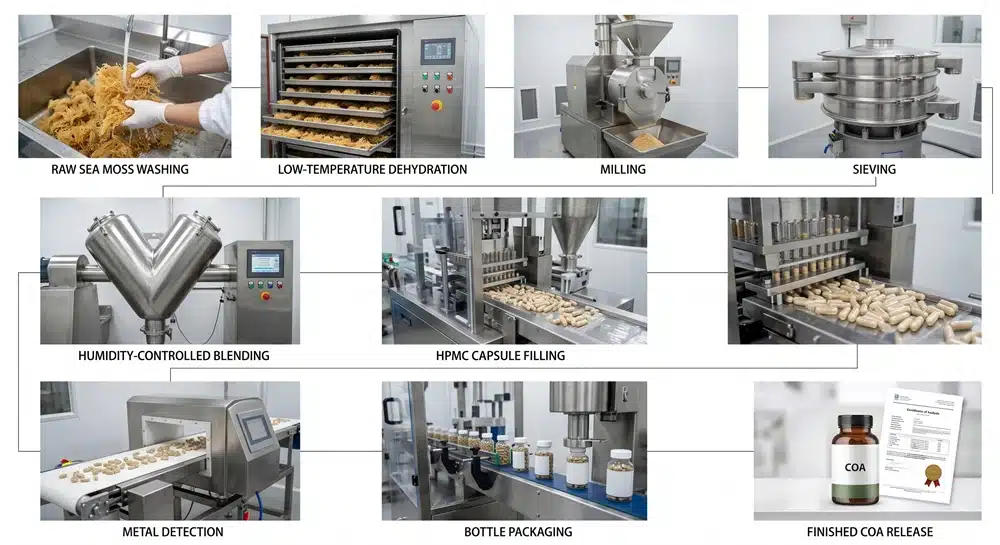
Las cápsulas de musgo marino contienen polvo de musgo marino deshidratado y molido introducido en una cápsula, a menudo cápsulas vegetales de HPMC para posicionarlas como producto vegano. Las cápsulas eliminan los problemas de sabor, textura y conservación en frío del gel, al tiempo que mejoran la uniformidad de la ración.
Un proyecto fiable de cápsulas de algas marinas debe definir el intervalo de temperaturas de deshidratación, la pérdida final por secado, el tamaño de las partículas o el rango de malla, la densidad aparente, la fluidez y el peso de llenado objetivo por cápsula. La fábrica debe validar la uniformidad del peso de llenado, la desintegración del producto acabado, los límites microbianos, el contenido de yodo y las especificaciones relativas a la liberación de metales pesados.
Para las marcas B2B, las cápsulas suelen ofrecer el mejor equilibrio entre comodidad, estabilidad de almacenamiento, idoneidad para el comercio electrónico y control del etiquetado. Para evaluar la viabilidad técnica, consulta con un profesional Fabricación de suplementos en cápsulas equipo antes de determinar el tamaño de la cápsula, el peso del contenido y el embalaje.
Comparación directa: gel frente a cápsulas
El gel de musgo marino se dispersa más rápidamente porque ya está hidratado, pero las cápsulas permiten un mayor control de la dosis y ofrecen mayor estabilidad logística. El gel es ideal para quienes lo añaden a batidos, para rituales de aplicación tópica y para un posicionamiento orientado al bienestar natural. Las cápsulas son ideales para la venta al por menor de suplementos, para viajes, para modelos de suscripción y para fórmulas combinadas.
Para el consumidor, el gel puede resultar más natural. Para el propietario de una marca, las cápsulas suelen ser más fáciles de controlar, analizar, etiquetar, enviar y producir a gran escala.
| Característica | Gel de musgo marino | Cápsulas de musgo marino |
|---|---|---|
| Biodisponibilidad | Inmediato. Como ya está hidratado, el cuerpo lo absorbe inmediatamente. | Retrasado. La cápsula tarda aproximadamente entre 20 y 30 minutos en disolverse. |
| Vida útil | Corto. Caduca en 3-4 semanas. Debe conservarse refrigerado. | Largo. Dura entre 1 y 2 años. Se conserva a temperatura ambiente. |
| Sabor y textura | Fuerte. Sabor terroso/marino con una textura gelatinosa. | Ninguno. Sin sabor ni olor (tragar y listo). |
| Conveniencia | Bajo. Requiere preparación, refrigeración y medición. | Alto. Fácil de llevar de viaje y con dosis premedidas. |
| Versatilidad | Alto. Cómelo o póntelo (mascarillas faciales/cabello). | Bajo. Estrictamente para consumo interno. |
Matriz de especificaciones B2B
A la hora de elegir entre el gel de musgo marino y las cápsulas, los propietarios de marcas deberían comparar las especificaciones en lugar de los eslóganes. Los criterios más importantes son la matriz activa, el factor que determina la vida útil, la precisión de la dosificación, los controles de calidad, el envase y la adecuación al canal de distribución.
El gel de musgo marino debe evaluarse en función de la actividad del agua, el pH, la vida útil microbiana, la logística de refrigeración y la variabilidad del tamaño de las raciones. Las cápsulas de musgo marino deben evaluarse en función del contenido de humedad, el tamaño de malla, el peso de llenado, la cubierta de la cápsula, la desintegración, los análisis de metales pesados, el ensayo de yodo y la estabilidad del producto acabado.
| Especificación | Gel de musgo marino | Cápsulas de musgo marino | Por qué es importante |
|---|---|---|---|
| Matriz activa | Gel hidratado con contenido variable en sólidos | Polvo desecado recubierto de HPMC o gelatina | Determina la precisión de la dosificación y las indicaciones que figuran en la etiqueta |
| Factor determinante de la vida útil | Actividad del agua, pH, refrigeración, control microbiano | Humedad, exposición al oxígeno, flujo del polvo, estabilidad de la capa exterior | Influye en los riesgos relacionados con el embalaje, la logística y las devoluciones |
| Precisión en la dosificación | Depende del tamaño de la cuchara | Peso fijo del contenido, normalmente entre 500 y 1.000 mg por cápsula | Las cápsulas facilitan la estandarización de la información nutricional |
| Pruebas de calidad | Microbiología, pH, estrategia de conservación, metales pesados | Identidad, yodo, metales pesados, límite de detección/humedad, microbiología, desintegración | Define los requisitos para la liberación de lotes |
| Embalaje | Tarro o bolsita refrigerados | Botellas de HDPE/PET, desecantes, envases blíster | Influye en el coste del transporte y en la ubicación en los estantes |
| Canal de mejor ajuste | Bienestar natural, bares de batidos, uso tópico | Comercio electrónico, viajes, complementos para el comercio minorista, marcas propias | Permite el diseño de productos específicos para cada canal |
Control de calidad y seguridad: el verdadero factor diferenciador
Dado que el musgo marino crece en entornos marinos, la simple indicación de que es “de recolección silvestre” no es suficiente. El musgo marino puede absorber tanto nutrientes como contaminantes del agua en la que crece. Un proyecto comercial debería exigir especificaciones por escrito y pruebas de liberación de lotes.

Las pruebas de liberación recomendadas incluyen la verificación de la identidad y la especie, el ensayo de yodo, el análisis de metales pesados mediante ICP-MS, el recuento total de gérmenes, la presencia de levaduras y mohos, E. coli, Salmonella, la pérdida por secado y la desintegración del producto terminado en el caso de las cápsulas. En el caso de los complementos alimenticios de EE. UU., estos controles deben integrarse en los registros maestros de fabricación, los registros de lotes y los procedimientos de control de calidad, de conformidad con los principios de las buenas prácticas de fabricación actuales (cGMP) establecidos en el título 21 del CFR, parte 111.
¿Quién debería optar por el gel de musgo marino?
Elige el gel de musgo marino si el consumidor valora la textura, su uso en batidos, la preparación al momento y la versatilidad de aplicación tópica. El gel funciona bien cuando el producto se vende a nivel local, se consume rápidamente y se acompañan las instrucciones de refrigeración. No es la opción más adecuada para el comercio electrónico a larga distancia, en casos de alto riesgo de rotación de existencias o cuando se requiere una estandarización precisa de la información nutricional.
¿Quién debería optar por las cápsulas de musgo marino?
Opta por las cápsulas de musgo marino si la marca necesita una dosificación precisa, estabilidad de conservación, comodidad para viajar, una sólida logística de comercio electrónico y un menor riesgo de deterioro. Las cápsulas también son más adecuadas para fórmulas combinadas, como el musgo marino con fucus, raíz de bardana, oligoelementos u otros ingredientes funcionales. Para la planificación del lanzamiento, un Fabricación de suplementos de marca blanca El socio puede ayudar a comparar el tamaño de las cápsulas, el peso de llenado, el envase del desecante y la cantidad mínima de pedido (MOQ) antes de la comercialización.
¿Y qué hay de los productos en polvo, las gominolas y las gotas?
El polvo de musgo marino, las gominolas y las gotas merecen un análisis específico en función de su formato. El polvo ofrece flexibilidad, pero puede ser higroscópico y sensible al sabor. Las gominolas mejoran la adherencia del consumidor al tratamiento, pero requieren una formulación resistente al calor y un control minucioso de la textura. Las gotas pueden resultar prácticas, pero es posible que sea necesario validar la estabilidad de los conservantes y del líquido.
Para ofrecer la mejor información específica sobre este tema, esta página debería incluir enlaces a artículos independientes sobre «Polvo de musgo marino frente a gel frente a cápsulas», «Gominolas de musgo marino frente a gel» y «Lista de verificación del certificado de análisis (COA) de las mejores cápsulas de musgo marino». El artículo sobre las gominolas de musgo marino debería enlazar con Fabricación de suplementos de gominola y explicar qué son la pectina, la gelatina, el agar, el carragenano, la textura, la exposición al calor y las limitaciones de la dosis activa.
Preguntas frecuentes
Conclusión
La elección entre el gel de musgo marino y las cápsulas no es una simple cuestión de “natural frente a procesado”. El gel es hidratante, versátil y resulta atractivo a nivel emocional, pero es más difícil de estandarizar y transportar. Las cápsulas ofrecen una experiencia menos sensorial, pero son más prácticas en cuanto a la dosificación precisa, la estabilidad de conservación, la distribución minorista y la fabricación de suplementos de marca blanca.
Los consumidores deben elegir el formato que mejor se adapte a sus hábitos diarios. Las marcas deben elegir el formato que permita realizar pruebas, etiquetarlo, envasarlo y producirlo a gran escala con una calidad constante.
¿Quieres lanzar tu propia marca de suplementos?
La demanda del mercado de musgo marino y suplementos minerales de alta calidad es más alta que nunca. Sin embargo, para las nuevas marcas, obtener ingredientes limpios y encontrar un socio fabricante fiable es el mayor obstáculo para alcanzar el éxito.
Gensei es un primer Fabricante por contrato de suplemento dietético Dedicados a ayudar a las marcas a navegar por esta compleja industria. Ya sea que desee crear una cápsula personalizada de musgo sefaqa, una mezcla mineral compleja o una deliciosa gominola funcional, le proporcionamos la infraestructura necesaria para convertir su concepto en un producto listo para salir al mercado.
Nuestra Servicios de fabricación OEM Incluir:
- Formatos diversos: Experiencia en cápsulas, comprimidos, polvos, gominolas y líquidos.
- I+D y formulación: Nuestro equipo te ayuda a crear fórmulas únicas y eficaces que destaquen en un mercado saturado.
- Escalabilidad: Somos un fabricante de suplementos con un MOQ bajo, lo que nos convierte en el socio perfecto tanto para las empresas emergentes que están probando suerte como para las marcas consolidadas que buscan expandirse.
- Servicio completo: Desde el abastecimiento de materias primas hasta el diseño de envases personalizados.
Si está listo para crear una marca de suplementos de alta calidad con un socio que entiende la ciencia y el mercado, le invitamos a colaborar con nosotros.
Póngase en contacto con Gensei hoy mismo. para hablar sobre su proyecto y obtener un presupuesto personalizado.
referencias
- ODS de los NIH — Ficha informativa sobre el yodo para profesionales sanitarios: https://ods.od.nih.gov/factsheets/Iodine-HealthProfessional/
- FDA — Documento informativo sobre las buenas prácticas de fabricación actuales (cGMP) de los complementos alimenticios: https://www.fda.gov/food/dietary-supplements-guidance-documents-regulatory-information/backgrounder-final-rule-current-good-manufacturing-practices-cgmps-dietary-supplements
- eCFR — 21 CFR, parte 111: Buenas prácticas de fabricación vigentes en las operaciones de fabricación, envasado, etiquetado o almacenamiento de complementos alimenticios: https://www.ecfr.gov/current/title-21/chapter-I/subchapter-B/part-111
- NCBI LactMed — Alga marina: https://www.ncbi.nlm.nih.gov/books/NBK621050/
- PMC — Exposición alimentaria a metales pesados e ingesta de yodo a través del consumo de algas marinas y halófitas en la población europea: https://pmc.ncbi.nlm.nih.gov/articles/PMC9887633/

Warren Wan es un experto con una amplia trayectoria en la cadena de suministro de complementos alimenticios, que cuenta con una gran experiencia práctica en la investigación, el desarrollo, el control de procesos y el abastecimiento global de ingredientes clave como los péptidos de colágeno, la proteína de caldo de huesos y la queratina. Como autor de esta columna, se dedica a desmontar los argumentos de marketing, transformando la compleja ciencia de los ingredientes y las normas de control de calidad de la producción en divulgación científica rigurosa y fácil de entender, ayudando a los lectores a comprender la verdad que se esconde tras las etiquetas y a tomar decisiones más racionales en materia de salud.


