
Sea moss gel and sea moss capsules usually start from the same red algae source, but they solve different formulation problems. Gel is a hydrated, short-shelf-life matrix suited for smoothies and topical use; capsules are dried, dose-controlled, shelf-stable powders designed for portability, GMP production, and batch-to-batch consistency.
For consumers, the better choice depends on lifestyle. For supplement brand owners, the better choice depends on iodine standardization, heavy-metal testing, microbial risk, packaging, logistics, and target dosage form.
- Sea moss gel: Best for users who want a hydrated food-style ingredient for smoothies, skincare masks, and short-term refrigerated use.
- Sea moss capsules: Best for precise serving size, travel convenience, longer shelf life, and scalable private-label supplement programs.
- Buying criteria: The most important factor is not “freshness” but verified quality: species identity, iodine assay, heavy-metal testing, microbiology, and documented GMP manufacturing.

What Is Sea Moss?
Sea moss, commonly associated with Chondrus crispus and related red seaweed species, is valued for its naturally occurring polysaccharides, iodine, potassium, magnesium, calcium, and trace minerals. However, the nutrient profile is not fixed. Species, harvest location, seawater quality, season, washing, drying, and milling can all change the final mineral content.
The popular “92 minerals” claim should not be used as a finished-product specification unless supported by batch-specific testing. For commercial supplement development, a sea moss ingredient should be backed by a Certificate of Analysis covering identity, iodine, heavy metals, microbiology, and moisture. NIH ODS notes that iodine amounts in seaweed can vary greatly by seaweed species, which makes standardized testing especially important for sea moss products.
Sea Moss Gel: Hydrated, Versatile, but Harder to Standardize
Sea moss gel is produced by soaking dried sea moss, cleaning it, and blending it with water until it forms a thick gel. Consumers like gel because it can be added to smoothies, soups, masks, or haircare routines. It feels closer to a fresh food than a supplement capsule.
From a manufacturing viewpoint, sea moss gel is a high-water botanical matrix. Its key risks are water activity, refrigeration, pH drift, microbial growth, container compatibility, and cold-chain shipping. Gel can be attractive for local fresh wellness channels, but it is harder to standardize for Supplement Facts labeling because each serving can vary in water content and solids concentration.
Gel is generally a lifestyle product. It performs well when the customer values freshness, texture, and versatility, but it demands strict storage and shorter inventory cycles.
Sea Moss Capsules: Dose-Controlled and Better for Scalable Supplements
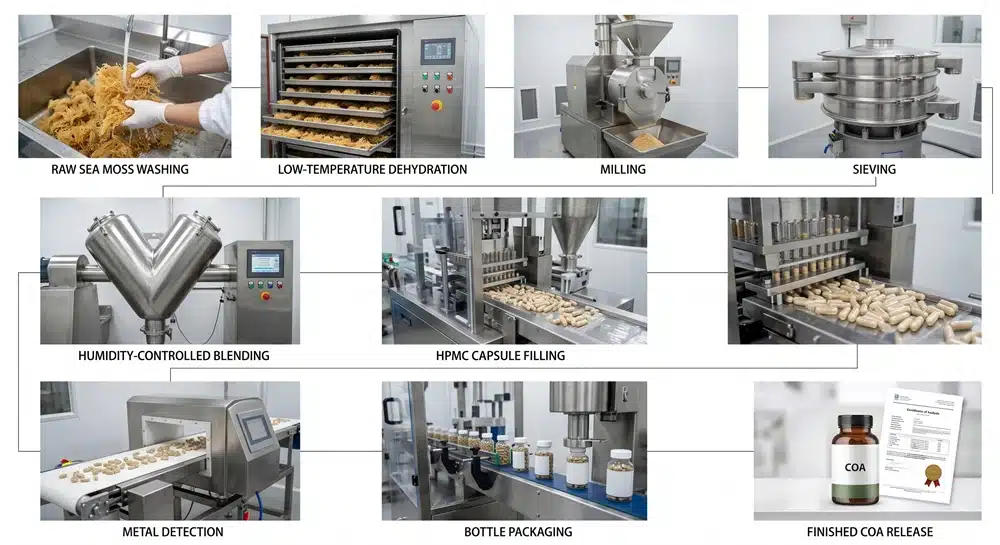
Sea moss capsules contain dehydrated and milled sea moss powder filled into a capsule shell, often HPMC vegetable capsules for vegan positioning. Capsules remove the taste, texture, and refrigeration problems of gel while improving serving-size consistency.
A reliable sea moss capsule project should define the dehydration temperature window, final loss on drying, particle size or mesh range, bulk density, flowability, and target fill weight per capsule. The factory should validate uniform fill weight, finished-product disintegration, microbial limits, iodine content, and heavy-metal release specifications.
For B2B brands, capsules usually provide the strongest balance of convenience, shelf stability, e-commerce suitability, and label-control. To evaluate technical feasibility, work with a professional Produzione di integratori in capsule team before finalizing capsule size, fill weight, and packaging.
Head-to-Head Comparison: Gel vs Capsules
Sea moss gel offers faster dispersion because it is already hydrated, but capsules offer stronger dosage control and logistical stability. Gel works best for smoothie users, topical rituals, and fresh wellness positioning. Capsules work best for supplement retail, travel, subscription models, and combination formulas.
For a consumer, gel may feel more natural. For a brand owner, capsules are generally easier to control, test, label, ship, and scale.
| Caratteristica | Gel di muschio marino | Capsule di muschio marino |
|---|---|---|
| Biodisponibilità | Immediato. Poiché è già idratato, il corpo lo assorbe immediatamente. | Ritardato. Ci vogliono circa 20-30 minuti perché l'involucro della capsula si dissolva. |
| Durata di conservazione | Breve. Scade tra 3-4 settimane. Deve essere conservato in frigorifero. | Lungo. Dura 1-2 anni. Si conserva a temperatura ambiente. |
| Sapore e consistenza | Forte. Sapore terroso/marino con consistenza gelatinosa. | Nessuno. Insapore e inodore (basta ingerirlo e il gioco è fatto). |
| Convenienza | Basso. Richiede preparazione, refrigerazione e misurazione. | Alto. Facile da trasportare e dosaggio preconfezionato. |
| Versatilità | Alto. Mangiarlo o indossarlo (mascherine/capelli). | Basso. Esclusivamente per uso interno. |
Matrice delle specifiche B2B
When choosing between sea moss gel and capsules, brand owners should compare specifications rather than slogans. The most important criteria are active matrix, shelf-life driver, dosage precision, quality tests, packaging, and channel fit.
Sea moss gel should be evaluated through water activity, pH, microbial shelf-life, refrigerated logistics, and serving-size variability. Sea moss capsules should be evaluated through moisture, mesh size, fill weight, capsule shell, disintegration, heavy-metal testing, iodine assay, and finished-product stability.
| Specifiche | Gel di muschio marino | Capsule di muschio marino | Perché è importante |
|---|---|---|---|
| Active matrix | Hydrated gel with variable solids | Dried powder in HPMC or gelatin shell | Determines dosage precision and label claims |
| Shelf-life driver | Water activity, pH, refrigeration, microbial control | Moisture, oxygen exposure, powder flow, shell stability | Drives packaging, logistics, and returns risk |
| Precisione della dose | Spoon-size dependent | Fixed fill weight, often 500–1,000 mg/capsule | Capsules are easier for Supplement Facts standardization |
| Quality tests | Microbiology, pH, preservative strategy, heavy metals | Identity, iodine, heavy metals, LOD/moisture, microbiology, disintegration | Defines batch release requirements |
| Imballaggio | Refrigerated jars or pouches | HDPE/PET bottles, desiccants, blister packs | Impacts freight cost and shelf placement |
| Best-fit channel | Fresh wellness, smoothie bars, topical use | E-commerce, travel, retail supplements, private label | Supports channel-specific product design |
Quality Control and Safety: The Real Differentiator
Because sea moss grows in marine environments, “wild-crafted” is not enough. Sea moss can absorb both nutrients and contaminants from the water where it grows. A commercial project should require written specifications and batch release testing.

Recommended release tests include identity/species verification, iodine assay, heavy metals by ICP-MS, total plate count, yeast and mold, E. coli, Salmonella, loss on drying, and finished-product disintegration for capsules. For U.S. dietary supplements, these controls should be integrated into master manufacturing records, batch records, and quality-control procedures under 21 CFR Part 111 cGMP principles.
Who Should Choose Sea Moss Gel?
Choose sea moss gel if the consumer values texture, smoothie use, fresh preparation, and topical versatility. Gel works well when the product is sold locally, consumed quickly, and supported with refrigeration instructions. It is less ideal for long-distance e-commerce, high inventory turnover risk, or precise Supplement Facts standardization.
Who Should Choose Sea Moss Capsules?
Choose sea moss capsules if the brand needs precise dosing, shelf stability, travel convenience, strong e-commerce logistics, and lower spoilage risk. Capsules are also better for combination formulas such as sea moss with bladderwrack, burdock root, trace minerals, or other functional ingredients. For launch planning, a Produzione di integratori a marchio privato partner can help compare capsule size, fill weight, desiccant packaging, and MOQ before commercialization.
What About Powder, Gummies, and Drops?
Sea moss powder, gummies, and drops deserve separate format analysis. Powder provides flexibility but can be hygroscopic and taste-sensitive. Gummies improve consumer compliance but require heat-stable formulation and careful texture control. Drops can be convenient but may need preservative and liquid stability validation.
For the best topical architecture, this page should link to separate spoke articles on Sea Moss Powder vs Gel vs Capsules, Sea Moss Gummies vs Gel, and Best Sea Moss Capsules COA Checklist. A sea moss gummy article should connect to Produzione di integratori gommosi and explain pectin, gelatin, agar, carrageenan, texture, heat exposure, and active-dose limitations.
Domande frequenti
Conclusione
Sea moss gel vs capsules is not a simple “natural vs processed” decision. Gel is hydrated, versatile, and emotionally appealing, but it is harder to standardize and ship. Capsules are less experiential but more practical for precise dosing, shelf stability, retail distribution, and private-label supplement manufacturing.
For consumers, choose the form that matches daily habits. For brands, choose the form that can be tested, labeled, packaged, and scaled with consistent quality.
Vuoi lanciare il tuo marchio di integratori alimentari?
La domanda di mercato di muschio marino e integratori minerali di alta qualità è più alta che mai. Tuttavia, per i nuovi marchi, reperire ingredienti puliti e trovare un partner di produzione affidabile è l'ostacolo più grande al successo.
Gensei è un premier integratori alimentari produttori dedicata ad aiutare i marchi a orientarsi in questo settore complesso. Che tu stia cercando di creare una capsula personalizzata al muschio sefaqa, una miscela minerale complessa o una deliziosa caramella gommosa funzionale, ti forniamo l'infrastruttura necessaria per trasformare la tua idea in un prodotto pronto per essere messo in vendita.
Il nostro Servizi di produzione OEM Includere:
- Formati diversi: Competenza in capsule, compresse, polveri, caramelle gommose e liquidi.
- Ricerca e sviluppo e formulazione: Il nostro team ti aiuta a creare formule uniche ed efficaci che si distinguono in un mercato affollato.
- Scalabilità: Siamo un produttore di integratori con MOQ basso, il che ci rende il partner perfetto sia per le startup che stanno muovendo i primi passi nel settore sia per i marchi affermati che desiderano espandersi.
- Servizio completo: Dall'approvvigionamento delle materie prime alla progettazione di imballaggi personalizzati.
Se sei pronto a creare un marchio di integratori di alta qualità con un partner che conosce bene la scienza e il mercato, ti invitiamo a collaborare con noi.
Contatta Gensei oggi stesso per discutere del tuo progetto e ottenere un preventivo personalizzato.
riferimenti
- NIH ODS — Iodine Fact Sheet for Health Professionals: https://ods.od.nih.gov/factsheets/Iodine-HealthProfessional/
- FDA — Dietary Supplement cGMP Backgrounder: https://www.fda.gov/food/dietary-supplements-guidance-documents-regulatory-information/backgrounder-final-rule-current-good-manufacturing-practices-cgmps-dietary-supplements
- eCFR — 21 CFR Part 111 Current Good Manufacturing Practice in Manufacturing, Packaging, Labeling, or Holding Operations for Dietary Supplements: https://www.ecfr.gov/current/title-21/chapter-I/subchapter-B/part-111
- NCBI LactMed — Sea Moss: https://www.ncbi.nlm.nih.gov/books/NBK621050/
- PMC — Dietary exposure to heavy metals and iodine intake via consumption of seaweeds and halophytes in the European population: https://pmc.ncbi.nlm.nih.gov/articles/PMC9887633/

Warren Wan è un esperto di grande esperienza nel settore della filiera degli integratori alimentari, con una vasta esperienza pratica nella ricerca, nello sviluppo, nel controllo dei processi e nell’approvvigionamento globale di ingredienti fondamentali quali i peptidi di collagene, le proteine del brodo d’ossa e la cheratina. In qualità di autore di questa rubrica, si impegna a smascherare le strategie di marketing, trasformando la complessa scienza degli ingredienti e gli standard di controllo della qualità della produzione in una divulgazione scientifica approfondita e di facile comprensione, aiutando i lettori a comprendere la verità che si cela dietro le etichette e a compiere scelte più razionali in materia di salute.


