
Sea moss gel and sea moss capsules usually start from the same red algae source, but they solve different formulation problems. Gel is a hydrated, short-shelf-life matrix suited for smoothies and topical use; capsules are dried, dose-controlled, shelf-stable powders designed for portability, GMP production, and batch-to-batch consistency.
For consumers, the better choice depends on lifestyle. For supplement brand owners, the better choice depends on iodine standardization, heavy-metal testing, microbial risk, packaging, logistics, and target dosage form.
- Sea moss gel: Best for users who want a hydrated food-style ingredient for smoothies, skincare masks, and short-term refrigerated use.
- Sea moss capsules: Best for precise serving size, travel convenience, longer shelf life, and scalable private-label supplement programs.
- Buying criteria: The most important factor is not “freshness” but verified quality: species identity, iodine assay, heavy-metal testing, microbiology, and documented GMP manufacturing.
What Is Sea Moss?
Sea moss, commonly associated with Chondrus crispus and related red seaweed species, is valued for its naturally occurring polysaccharides, iodine, potassium, magnesium, calcium, and trace minerals. However, the nutrient profile is not fixed. Species, harvest location, seawater quality, season, washing, drying, and milling can all change the final mineral content.
The popular “92 minerals” claim should not be used as a finished-product specification unless supported by batch-specific testing. For commercial supplement development, a sea moss ingredient should be backed by a Certificate of Analysis covering identity, iodine, heavy metals, microbiology, and moisture. NIH ODS notes that iodine amounts in seaweed can vary greatly by seaweed species, which makes standardized testing especially important for sea moss products.
Sea Moss Gel: Hydrated, Versatile, but Harder to Standardize
Sea moss gel is produced by soaking dried sea moss, cleaning it, and blending it with water until it forms a thick gel. Consumers like gel because it can be added to smoothies, soups, masks, or haircare routines. It feels closer to a fresh food than a supplement capsule.
From a manufacturing viewpoint, sea moss gel is a high-water botanical matrix. Its key risks are water activity, refrigeration, pH drift, microbial growth, container compatibility, and cold-chain shipping. Gel can be attractive for local fresh wellness channels, but it is harder to standardize for Supplement Facts labeling because each serving can vary in water content and solids concentration.
Gel is generally a lifestyle product. It performs well when the customer values freshness, texture, and versatility, but it demands strict storage and shorter inventory cycles.
Sea Moss Capsules: Dose-Controlled and Better for Scalable Supplements
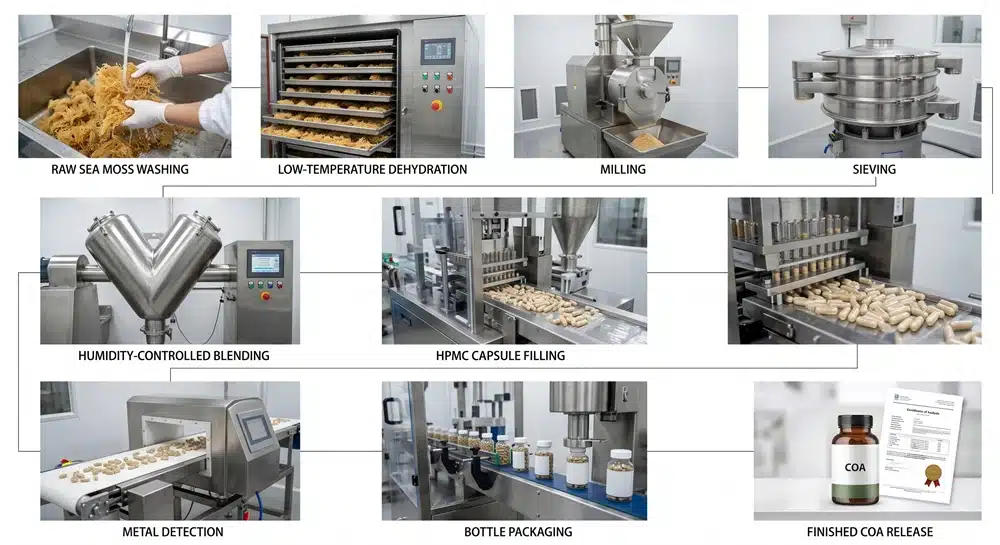
Sea moss capsules contain dehydrated and milled sea moss powder filled into a capsule shell, often HPMC vegetable capsules for vegan positioning. Capsules remove the taste, texture, and refrigeration problems of gel while improving serving-size consistency.
A reliable sea moss capsule project should define the dehydration temperature window, final loss on drying, particle size or mesh range, bulk density, flowability, and target fill weight per capsule. The factory should validate uniform fill weight, finished-product disintegration, microbial limits, iodine content, and heavy-metal release specifications.
For B2B brands, capsules usually provide the strongest balance of convenience, shelf stability, e-commerce suitability, and label-control. To evaluate technical feasibility, work with a professional Capsule Supplement Manufacturing team before finalizing capsule size, fill weight, and packaging.
Head-to-Head Comparison: Gel vs Capsules
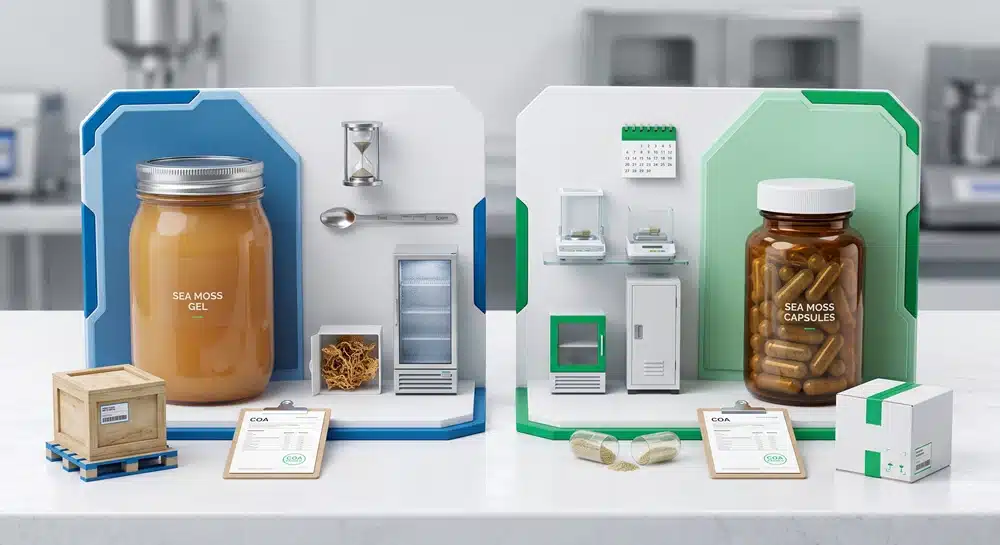
Sea moss gel offers faster dispersion because it is already hydrated, but capsules offer stronger dosage control and logistical stability. Gel works best for smoothie users, topical rituals, and fresh wellness positioning. Capsules work best for supplement retail, travel, subscription models, and combination formulas.
For a consumer, gel may feel more natural. For a brand owner, capsules are generally easier to control, test, label, ship, and scale.
| Feature | Sea Moss Gel | Sea Moss Capsules |
|---|---|---|
| Bioavailability | Instant. Since it is already hydrated, the body absorbs it immediately. | Delayed. Takes approx. 20-30 mins for the capsule shell to dissolve. |
| Shelf Life | Short. Expires in 3–4 weeks. Must be refrigerated. | Long. Lasts 1–2 years. Shelf-stable at room temperature. |
| Taste & Texture | Strong. Earthy/Ocean taste with a jelly-like texture. | None. Tasteless and odorless (swallow and go). |
| Convenience | Low. Requires prep, refrigeration, and measuring. | High. Travel-friendly and pre-measured dosage. |
| Versatility | High. Eat it or wear it (Face masks/Hair). | Low. Strictly for internal consumption. |
B2B Specification Matrix
When choosing between sea moss gel and capsules, brand owners should compare specifications rather than slogans. The most important criteria are active matrix, shelf-life driver, dosage precision, quality tests, packaging, and channel fit.
Sea moss gel should be evaluated through water activity, pH, microbial shelf-life, refrigerated logistics, and serving-size variability. Sea moss capsules should be evaluated through moisture, mesh size, fill weight, capsule shell, disintegration, heavy-metal testing, iodine assay, and finished-product stability.
| Specification | Sea Moss Gel | Sea Moss Capsules | Why It Matters |
|---|---|---|---|
| Active matrix | Hydrated gel with variable solids | Dried powder in HPMC or gelatin shell | Determines dosage precision and label claims |
| Shelf-life driver | Water activity, pH, refrigeration, microbial control | Moisture, oxygen exposure, powder flow, shell stability | Drives packaging, logistics, and returns risk |
| Dose precision | Spoon-size dependent | Fixed fill weight, often 500–1,000 mg/capsule | Capsules are easier for Supplement Facts standardization |
| Quality tests | Microbiology, pH, preservative strategy, heavy metals | Identity, iodine, heavy metals, LOD/moisture, microbiology, disintegration | Defines batch release requirements |
| Packaging | Refrigerated jars or pouches | HDPE/PET bottles, desiccants, blister packs | Impacts freight cost and shelf placement |
| Best-fit channel | Fresh wellness, smoothie bars, topical use | E-commerce, travel, retail supplements, private label | Supports channel-specific product design |
Quality Control and Safety: The Real Differentiator
Because sea moss grows in marine environments, “wild-crafted” is not enough. Sea moss can absorb both nutrients and contaminants from the water where it grows. A commercial project should require written specifications and batch release testing.

Recommended release tests include identity/species verification, iodine assay, heavy metals by ICP-MS, total plate count, yeast and mold, E. coli, Salmonella, loss on drying, and finished-product disintegration for capsules. For U.S. dietary supplements, these controls should be integrated into master manufacturing records, batch records, and quality-control procedures under 21 CFR Part 111 cGMP principles.
Who Should Choose Sea Moss Gel?
Choose sea moss gel if the consumer values texture, smoothie use, fresh preparation, and topical versatility. Gel works well when the product is sold locally, consumed quickly, and supported with refrigeration instructions. It is less ideal for long-distance e-commerce, high inventory turnover risk, or precise Supplement Facts standardization.
Who Should Choose Sea Moss Capsules?
Choose sea moss capsules if the brand needs precise dosing, shelf stability, travel convenience, strong e-commerce logistics, and lower spoilage risk. Capsules are also better for combination formulas such as sea moss with bladderwrack, burdock root, trace minerals, or other functional ingredients. For launch planning, a Private Label Supplement Manufacturing partner can help compare capsule size, fill weight, desiccant packaging, and MOQ before commercialization.
What About Powder, Gummies, and Drops?
Sea moss powder, gummies, and drops deserve separate format analysis. Powder provides flexibility but can be hygroscopic and taste-sensitive. Gummies improve consumer compliance but require heat-stable formulation and careful texture control. Drops can be convenient but may need preservative and liquid stability validation.
For the best topical architecture, this page should link to separate spoke articles on Sea Moss Powder vs Gel vs Capsules, Sea Moss Gummies vs Gel, and Best Sea Moss Capsules COA Checklist. A sea moss gummy article should connect to Gummy Supplement Manufacturing and explain pectin, gelatin, agar, carrageenan, texture, heat exposure, and active-dose limitations.
FAQs
Conclusion
Sea moss gel vs capsules is not a simple “natural vs processed” decision. Gel is hydrated, versatile, and emotionally appealing, but it is harder to standardize and ship. Capsules are less experiential but more practical for precise dosing, shelf stability, retail distribution, and private-label supplement manufacturing.
For consumers, choose the form that matches daily habits. For brands, choose the form that can be tested, labeled, packaged, and scaled with consistent quality.
Looking to Launch Your Own Supplement Brand?
The market demand for high-quality sea moss and mineral supplements is higher than ever. However, for new brands, sourcing clean ingredients and finding a reliable manufacturing partner is the biggest hurdle to success.
Gensei is a premier Dietary Supplement Contract Manufacturer dedicated to helping brands navigate this complex industry. Whether you are looking to create a custom sefaqa moss capsule, a complex mineral blend, or a delicious functional gummy, we provide the infrastructure to turn your concept into a shelf-ready product.
Our OEM Manufacturing Services Include:
- Diverse Formats: Expertise in Capsules, Tablets, Powders, Gummies, and Liquids.
- R&D & Formulation: Our team helps you create unique, effective formulas that stand out in a crowded market.
- Scalability: We are a Low MOQ Supplement Manufacturer, making us the perfect partner for both startups testing the waters and established brands looking to scale.
- Full Service: From raw material sourcing to custom packaging design.
If you are ready to build a high-quality supplement brand with a partner who understands the science and the market, we invite you to collaborate with us.
Contact Gensei today to discuss your project and get a custom quote.
references
- NIH ODS — Iodine Fact Sheet for Health Professionals: https://ods.od.nih.gov/factsheets/Iodine-HealthProfessional/
- FDA — Dietary Supplement cGMP Backgrounder: https://www.fda.gov/food/dietary-supplements-guidance-documents-regulatory-information/backgrounder-final-rule-current-good-manufacturing-practices-cgmps-dietary-supplements
- eCFR — 21 CFR Part 111 Current Good Manufacturing Practice in Manufacturing, Packaging, Labeling, or Holding Operations for Dietary Supplements: https://www.ecfr.gov/current/title-21/chapter-I/subchapter-B/part-111
- NCBI LactMed — Sea Moss: https://www.ncbi.nlm.nih.gov/books/NBK621050/
- PMC — Dietary exposure to heavy metals and iodine intake via consumption of seaweeds and halophytes in the European population: https://pmc.ncbi.nlm.nih.gov/articles/PMC9887633/

Warren Wan is a seasoned expert with extensive experience in the dietary supplement supply chain, possessing rich practical experience in the research, development, process control, and global sourcing of core ingredients such as collagen peptides, bone broth protein, and keratin. As the author of this column, he is dedicated to stripping away the marketing packaging, transforming obscure ingredient science and production quality control standards into easy-to-understand, hardcore science popularization, helping readers understand the truth behind the labels and make more rational health choices.


