This guide is written for consumers who are comparing labels and for supplement brands, formulators and purchasing teams evaluating raw materials. It separates medical uses from supplement claims, explains common naming errors and provides practical quality-control questions for NAC and NAG projects.
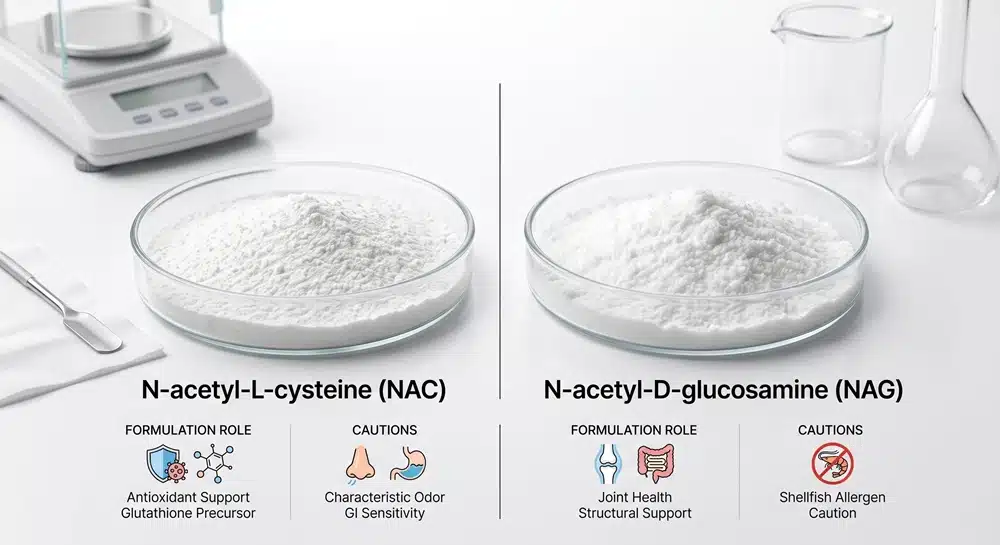
NAC vs NAG: Key Differences
| Yếu tố | NAC | NAG / GlcNAc |
|---|---|---|
| Full name | N-acetyl-L-cysteine | N-acetyl-D-glucosamine |
| Common abbreviations | NAC; sometimes NALC in technical contexts | NAG, GlcNAc, N-acetylglucosamine |
| Chemical family | Acetylated sulfur-containing amino-acid derivative | Acetylated amino sugar |
| Common formula-development role | Glutathione-related antioxidant-support positioning, subject to evidence and market rules | Joint, connective-tissue or specialty matrix-support positioning, subject to evidence and claim review |
| Typical sourcing questions | Assay, related substances, odor, residual solvents, particle size and target-market regulatory status | Shellfish or fermentation source, allergen documentation, D-isomer identity, assay and residual proteins |
| Are they interchangeable? | No. They have different structures, specifications, evidence bases and regulatory considerations. | |
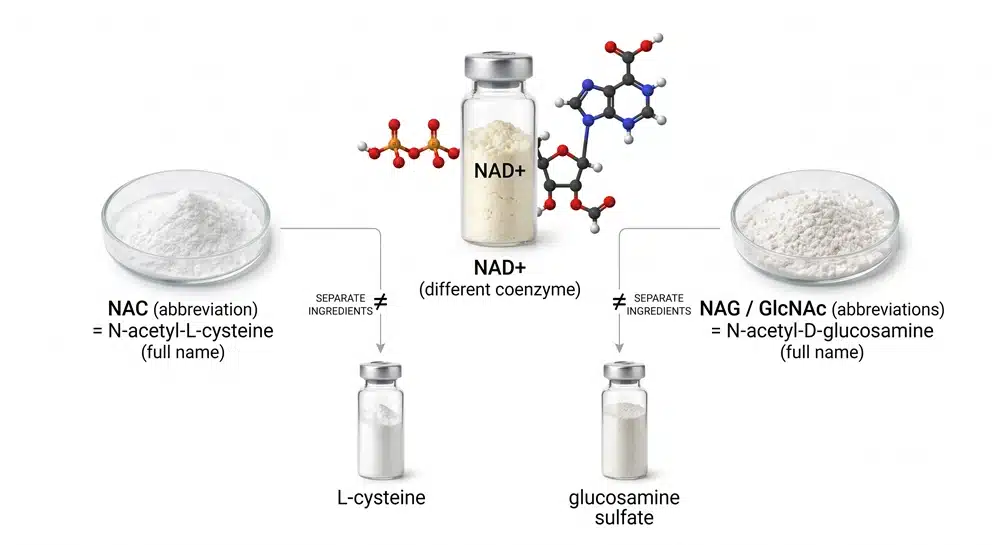
Names That Are Commonly Confused
| Term | What it means | Do not confuse it with |
|---|---|---|
| NAC | N-acetyl-L-cysteine | NAG, NAD+, L-cysteine or glutamine |
| NAG / GlcNAc | N-acetyl-D-glucosamine; “N-acetylglucosamine” usually refers to the same D-form in biological and supplement contexts | NAC, glucosamine sulfate, glucosamine HCl or GalNAc |
| NAD+ | Nicotinamide adenine dinucleotide | NAC or NAG |
| L-cysteine | An amino acid and the non-acetylated parent compound related to NAC | NAC |
| Glucosamine sulfate / HCl | Different glucosamine ingredient forms with different identities and label declarations | NAG / GlcNAc |
What Is N-Acetyl-L-Cysteine?
N-acetyl-L-cysteine is an acetylated form of L-cysteine with a free thiol group. In research and clinical medicine, acetylcysteine has established drug uses, including specific medical use as an antidote for acetaminophen overdose. Those drug indications do not automatically authorize the same treatment language for a dietary supplement.
For ingredient sourcing, buyers should evaluate bulk N-acetyl-L-cysteine powder by identity, assay, related substances, moisture, residual solvents where relevant, heavy metals, microbiology, particle size, odor profile, storage and destination-market requirements.
NAC supplement evidence: what can be said carefully?
NAC is widely studied, but the evidence depends on the population, dose, route, outcome and product. A supplement article should distinguish between biochemical rationale, clinical research and approved medical use. Phrases such as “supports normal antioxidant defenses” may be considered only when substantiated for the finished product and target market. Claims that NAC treats lung disease, psychiatric disorders, infections, cancer or liver injury are drug or disease claims and should not appear in ordinary supplement marketing.
United States regulatory note for NAC
In the United States, NAC has a special regulatory history. FDA has stated that NAC is excluded from the statutory definition of a dietary supplement because it was approved as a drug before being marketed as a supplement or food. FDA has also issued a policy describing enforcement discretion for certain NAC products while considering rulemaking. Brands should obtain current regulatory advice before launching or relabeling an NAC product in the United States.
What Is N-Acetyl-D-Glucosamine?
N-acetyl-D-glucosamine is an amino sugar commonly abbreviated NAG or GlcNAc. It is structurally different from NAC and from glucosamine sulfate or glucosamine hydrochloride. NAG is also a building block found in biological glycoconjugates and chitin-related materials, but a biological role does not by itself prove that an oral supplement produces a specific clinical outcome.
For B2B projects, brands should review the exact N-acetyl-D-glucosamine ingredient specification, including source route, allergen statements, identity method, assay, residual proteins, heavy metals, microbiology, particle size, solubility and batch documentation.
What are the potential N-acetyl-D-glucosamine benefits?
Small human studies and biomarker research have examined oral NAG in joint and connective-tissue contexts. However, the evidence is much smaller and less standardized than many commercial pages imply. Results from a specific source, dose or study population should not be generalized to every NAG powder, capsule or finished formula. Claims about treating osteoarthritis, repairing the gut lining, reducing inflammatory bowel disease, regulating immunity or reversing skin aging require a level of evidence and regulatory status that ordinary supplement marketing usually does not have.
Is NAG the same as glucosamine?
No. NAG is an acetylated glucosamine form. Glucosamine sulfate and glucosamine hydrochloride are separate ingredient forms. They have different chemical identities, molecular weights, specifications, research histories and label declarations. A supplier or formulator should never substitute one for another without revisiting the formula, dose, evidence, label and regulatory assessment.
Which Is Better: NAC or NAG?
Neither is universally better. They solve different formulation problems.
| Project goal | More relevant ingredient to evaluate | Required caution |
|---|---|---|
| Glutathione-related antioxidant-support concept | NAC | Confirm evidence, claims and NAC’s destination-market regulatory status. |
| Joint or connective-tissue ingredient concept | NAG | Do not treat NAG as interchangeable with glucosamine sulfate/HCl or claim disease treatment. |
| Shellfish-free positioning | Potentially fermentation-sourced NAG | “Shellfish-free” is not automatic; verify source, residual protein, cross-contact and allergen documents. |
| Low-odor consumer format | Often easier with NAG than NAC | Evaluate the actual batch and finished product; NAC’s sulfur odor can affect capsules, powders and flavored products. |
| Combined NAC + NAG formula | Possible only with a clear rationale | Do not claim automatic synergy. Check capsule payload, compatibility, stability, claims and market rules. |
Can NAC and NAG Be Used Together?
They may appear in the same formulation, but the shared “N-acetyl” wording does not create a scientific synergy. A combined formula should have two independently justified ingredient roles, a clear audience, an evidence-based claim strategy and a realistic dosage-form plan.
Payload is a practical constraint. For example, a formula containing a total of 1,000 mg of NAC and NAG actives will exceed 1,000 mg once flow agents and other excipients are added. Depending on bulk density and capsule size, the project may require multiple capsules, a tablet, a sachet or a powder format. Prototype testing should confirm flow, compression or fill behavior, odor, taste, disintegration and stability.
Safety and Label-Claim Considerations
NAC safety considerations
- Oral NAC can cause gastrointestinal effects in some users, including nausea, abdominal discomfort or diarrhea.
- The sulfur odor and taste are product-development issues and should not be masked by inaccurate “odorless” claims without finished-product verification.
- Consumers using medicines or managing chronic conditions should seek professional advice before use.
- Clinical acetylcysteine drug uses must remain clearly separate from supplement claims.
- For U.S. projects, review FDA’s current NAC policy before commercialization.
NAG safety considerations
- NAG may be shellfish-derived or produced by another route. Source and allergen status must be documented, not assumed.
- Do not automatically transfer every warning or efficacy claim from glucosamine sulfate or glucosamine HCl to NAG; they are different ingredient forms.
- People who are pregnant, breastfeeding, under 18, using anticoagulants or glucose-management medicines, or managing a medical condition should consult a qualified healthcare professional.
- Human evidence for long-term use, special populations and many promoted outcomes remains limited.
General note: Dietary supplements are not approved by FDA before marketing in the same manner as drugs. Product identity, safety, claims, labeling and regulatory status remain the responsibility of the responsible company.
Các tiêu chuẩn chất lượng cần kiểm tra
| Quality item | NAC questions | NAG questions |
|---|---|---|
| Bản sắc | Which compendial or validated method confirms N-acetyl-L-cysteine and L-configuration? | Which method confirms N-acetyl-D-glucosamine / GlcNAc and distinguishes it from other glucosamine forms? |
| Phương pháp định lượng | What is the assay range, method and calculation basis? | What is the assay range, method and calculation basis? |
| Nguồn | What synthesis or manufacturing route is used, and what residual-solvent controls apply? | Shellfish chitin, fungal or microbial fermentation, or another route? What allergen and GMO documents are available? |
| Các chất có liên quan | Which cysteine-related or process-related impurities are controlled? | Which related sugars, residual proteins or process impurities are controlled? |
| Tính chất vật lý | Particle size, flow, bulk density, color and odor profile | Particle size, flow, bulk density, color and solubility |
| Các chất gây ô nhiễm | Kim loại nặng, vi sinh vật và dung môi dư (nếu có) | Heavy metals, microbiology, residual solvents and source-related allergens as applicable |
| Sự ổn định | Moisture protection, oxidation control, packaging and shelf-life data | Moisture, packaging, compatibility and shelf-life data |
| Regulatory file | Target-market NAC assessment and permitted claim review | Ingredient status, source declaration, allergen review and permitted claim review |
Raw-material COAs should be reviewed within a broader supplement quality-control program that includes supplier qualification, incoming identity testing, master specifications, batch records, in-process controls and finished-product release testing.
RFP Questions for NAC or NAG Suppliers
- What is the exact chemical name, CAS number, molecular formula and grade?
- Which identity and assay methods are used, and are chromatograms available?
- What are the assay range and related-substance limits?
- What is the source and manufacturing route?
- For NAG, is the source shellfish-derived or fermentation-derived?
- Which allergen, cross-contact, GMO and vegan/vegetarian statements can be supported?
- Which residual solvents, heavy metals and microbiological limits are tested?
- What particle-size, bulk-density and solubility data are available?
- For NAC, how are sulfur odor, moisture and oxidation managed?
- What packaging, storage conditions, shelf life and stability data are available?
- Can the supplier provide COA, specification, SDS, TDS, traceability and change-control documents?
- Has the ingredient and proposed claim language been reviewed for the destination market?
Các thương hiệu thực phẩm bổ sung nên lựa chọn như thế nào
- Define the consumer and product goal. Avoid choosing an ingredient because its abbreviation is trending.
- Confirm exact identity. NAC, NAG, NAD+, L-cysteine and glucosamine salts are different.
- Map the evidence to the exact ingredient. Do not borrow clinical evidence from another glucosamine form or from prescription acetylcysteine.
- Review target-market status before finalizing the formula. This is especially important for NAC in the United States.
- Build the format around payload and sensory constraints. Consider capsule count, tablet size, powder taste and sulfur odor.
- Verify the finished product. Raw-material quality does not replace finished-product potency, uniformity, disintegration and stability testing.
For ingredient samples, COA review or a custom NAC/NAG formulation discussion, liên hệ với GENSEI with the target market, dosage form, serving size, source requirements and planned label claims.
Câu hỏi thường gặp
What is the difference between NAC and NAG?
NAC is N-acetyl-L-cysteine, a sulfur-containing cysteine derivative. NAG is N-acetyl-D-glucosamine, an amino sugar also called GlcNAc. They have different structures, evidence bases, specifications and regulatory considerations.
What is N-acetyl-D-glucosamine?
N-acetyl-D-glucosamine is an acetylated amino sugar. In supplement sourcing it may be called NAG, GlcNAc or N-acetylglucosamine. Buyers should verify the D-form, CAS number, source, assay and allergen documentation.
Is N-acetylglucosamine the same as N-acetyl-D-glucosamine?
In most biological and supplement contexts, yes: N-acetylglucosamine commonly refers to the naturally relevant D-form, N-acetyl-D-glucosamine. Specifications and labels should still state the exact identity.
Is NAG the same as glucosamine sulfate?
No. NAG, glucosamine sulfate and glucosamine hydrochloride are different ingredient forms. They should not be substituted without reviewing identity, dose, evidence, label and product specifications.
What are the benefits of an NAG supplement?
NAG has been studied in limited human and mechanistic research related to joint and connective-tissue biology. The evidence does not support broad treatment promises, and results from one source or dose should not be generalized to every product.
What are common NAG side effects?
Reported oral tolerance is generally acceptable in small studies, but gastrointestinal discomfort or source-related allergy concerns may occur. Long-term and special-population evidence is limited, so users with medical conditions or medications should seek professional advice.
Is NAC the same as L-cysteine?
No. NAC is an acetylated derivative of L-cysteine. The two ingredients have different identities, properties and product-development considerations.
Can NAC and NAG be taken together?
A combined product is possible, but there is no automatic synergy simply because both names begin with “N-acetyl.” Safety, medications, total serving size, target-market status and finished-product evidence should be reviewed.
Tài liệu tham khảo
- FDA: Policy Regarding N-acetyl-L-cysteine
- FDA: Select Dietary Supplement Ingredients and Other Substances
- FDA Prescribing Information: Acetylcysteine Injection
- Safety of N-Acetylcysteine at High Doses in Chronic Respiratory Diseases
- Health Canada Natural Health Products Ingredients Database: N-Acetylglucosamine
- Pilot Study of Oral N-Acetyl-D-Glucosamine Absorption
- Evaluation of N-Acetyl-Glucosamine Administration in Healthy Subjects
- Safety Evaluation of Fermentation-Produced N-Acetylglucosamine
- FDA: Các tuyên bố về cấu trúc/chức năng
- FTC: Hướng dẫn tuân thủ đối với các sản phẩm chăm sóc sức khỏe
- FDA: Dietary Supplement CGMP Small Entity Compliance Guide

Warren Wan là một chuyên gia dày dạn với kinh nghiệm phong phú trong chuỗi cung ứng thực phẩm bổ sung, sở hữu kinh nghiệm thực tiễn sâu rộng trong nghiên cứu, phát triển, kiểm soát quy trình và tìm nguồn cung ứng toàn cầu các thành phần cốt lõi như peptit collagen, protein từ nước hầm xương và keratin. Với tư cách là tác giả của chuyên mục này, ông cam kết loại bỏ những lớp bao bọc tiếp thị, biến những kiến thức khoa học phức tạp về thành phần và các tiêu chuẩn kiểm soát chất lượng sản xuất thành những nội dung phổ biến khoa học dễ hiểu nhưng sâu sắc, giúp độc giả hiểu rõ sự thật đằng sau các nhãn mác và đưa ra những lựa chọn sức khỏe hợp lý hơn.