
Câu trả lời nhanh
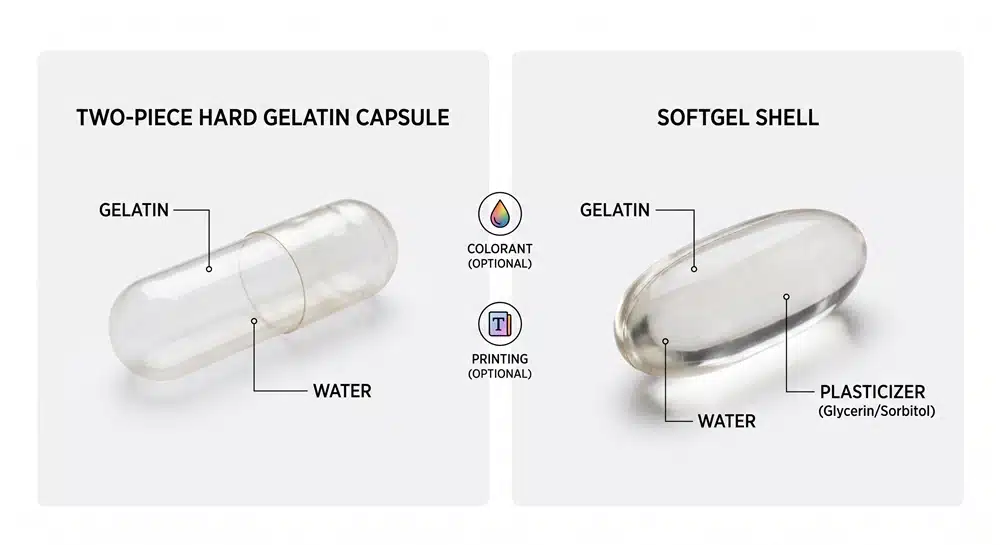
A hard gelatin capsule shell is usually made from gelatin and water, with optional colorants, opacifiers and printing inks. A softgel shell usually contains gelatin, water and a plasticizer such as glycerin or sorbitol, plus optional colors or other processing ingredients. The exact formula, animal source and specifications vary by supplier and product.The shell should be evaluated separately from the capsule fill. Consumers may care about animal source and dietary suitability, while supplement brands also need identity, microbiological, contaminant, dissolution, stability and labeling documentation before production.
Gelatin là gì?
Gelatin is a protein ingredient produced by partial hydrolysis of collagen-rich animal tissues. Commercial gelatin may be derived from bovine, porcine or fish sources. Its source, tissue, pretreatment and manufacturing process affect characteristics such as gel strength, viscosity, color, odor and capsule performance.
A capsule specification should not rely on the word “gelatin” alone. Procurement teams should verify the species, tissue source, country of origin, Type A or Type B designation when relevant, and the supplier’s quality documentation. For a deeper production overview, see how gelatin is made.
What Is a Hard Gelatin Capsule Made Of?
A hard gelatin capsule is a two-piece shell consisting of a cap and body. The shell formula is commonly based on gelatin and purified water. Depending on the product and market, it may also contain approved colorants, opacifying agents and printing inks.
Hard capsule manufacturers control solution viscosity, dipping conditions, drying, shell dimensions, moisture, mechanical strength and dissolution. The final shell composition and residual moisture are supplier- and process-specific, so universal percentages should not be presented as fixed values for every capsule.
What Is a Soft Gelatin Capsule Made Of?
A soft gelatin capsule, or softgel, is a one-piece hermetically sealed shell. Its shell system generally contains gelatin, purified water and a plasticizer. Glycerin and sorbitol are common plasticizer options because they help create a flexible shell. The formula may also use approved colors, opacifiers, flavors or other processing ingredients when technically justified and legally permitted.
The correct plasticizer system depends on the fill composition, shell-to-fill compatibility, target hardness, storage conditions and package. Softgel development therefore requires pilot work and stability testing rather than a universal gelatin-to-plasticizer ratio.
Hard vs Soft Gelatin Capsule Ingredients
| Yếu tố | Viên nang gelatin cứng | Soft Gelatin Capsule |
|---|---|---|
| Shell design | Two-piece cap and body | One-piece sealed shell |
| Core shell ingredients | Gelatin and water | Gelatin, water and plasticizer |
| Common optional ingredients | Colorants, opacifiers and printing inks | Colorants, opacifiers, flavors or other approved processing ingredients |
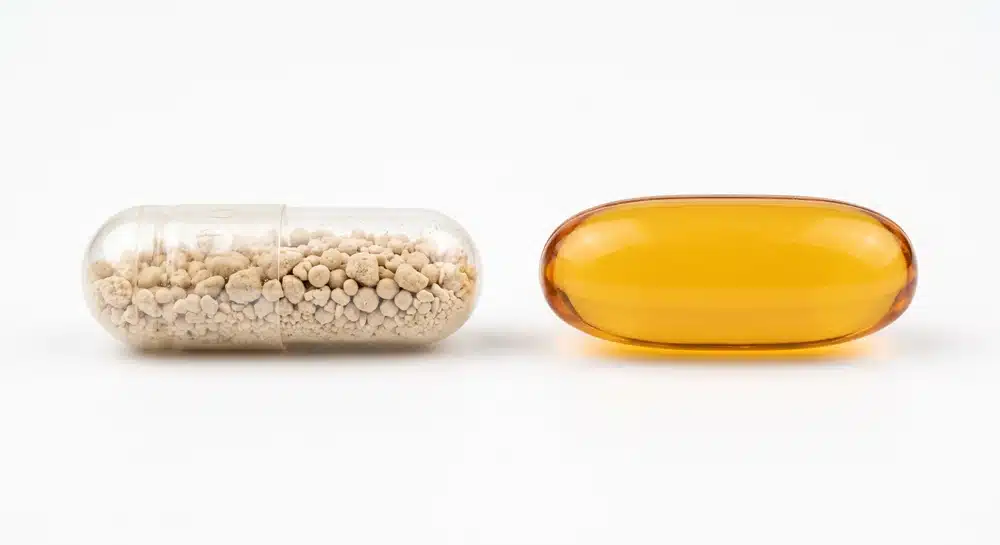
| Hình thức điền thông thường | Powders, granules, pellets or selected non-aqueous fills | Oils, suspensions, pastes and selected solutions |
| Critical development checks | Shell dimensions, brittleness, moisture, fill compatibility and dissolution | Plasticizer balance, seam integrity, leakage, migration, oxidation and dissolution |
Where Does Capsule Gelatin Come From?
Gelatin bò
Bovine gelatin is commonly made from cattle hides, skin or bones. Buyers should request species and tissue documentation, country of origin, traceability and applicable BSE/TSE statements. “BSE-free” should not be used as a vague absolute claim; documentation should describe the source materials and controls that apply to the exact ingredient.
Gelatin heo
Porcine gelatin is derived from pig skin or other porcine tissues. It is widely used in food and pharmaceutical applications but is not acceptable for halal products and may not meet kosher requirements. Certification depends on the exact source, process, facility and certifying body.
Gelatin cá
Fish gelatin may be selected for certain religious, cultural or market-positioning needs. Its gel properties can differ from mammalian gelatin, and fish species, allergen assessment, supply consistency and certification should be verified. Fish origin alone does not automatically establish halal or kosher status.
What Optional Ingredients May Be in the Capsule Shell?
Colorants and Opacifiers
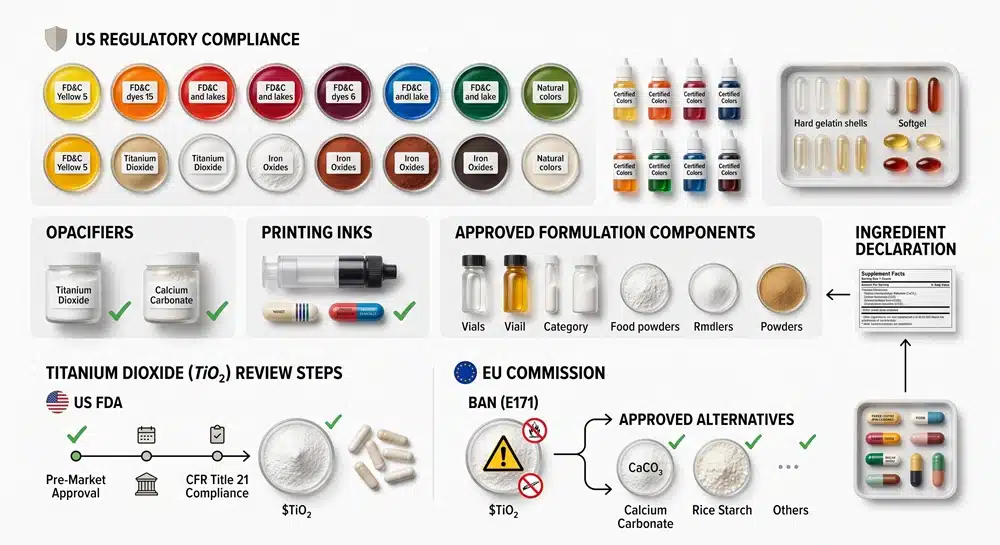
Capsules may be transparent, colored or opaque. Any color additive must be permitted for the intended use and target market. Titanium dioxide requirements differ by market: it remains permitted for specified food uses in the United States under current FDA conditions, while E171 is no longer authorized as a food additive in the European Union. Brands selling food supplements in multiple markets should qualify a market-appropriate color system.
Printing Inks
Capsules may be printed with product codes, logos or other identifiers. Ink components, migration controls, legibility and regulatory suitability should be included in the capsule specification and supplier documentation.
Preservatives and Processing Aids
Not every gelatin capsule requires a preservative. The need depends on water activity, manufacturing controls, shell formulation and storage. Brands should request the complete shell ingredient declaration and should not assume that all processing materials are identical across suppliers.
How Are Hard Gelatin Capsules Made?
- Gelatin is hydrated and dissolved under controlled conditions.
- Approved colors or other shell ingredients are added when required.
- Metal pins are dipped into the gelatin solution to form the cap and body films.
- The shells are dried under controlled temperature and humidity.
- The dried shells are stripped, trimmed and joined.
- Capsules are inspected for dimensions, defects, moisture and performance before release.
During Sản xuất thực phẩm bổ sung dạng viên nang, the shell must also be qualified against the proposed fill, packaging and shelf-life conditions.
How Are Softgels Made?
- A gelatin mass is prepared with water, plasticizer and approved optional ingredients.
- The fill material is prepared separately and checked for compatibility with the shell.
- Two gelatin ribbons are formed and brought together in a rotary-die encapsulation process.
- The fill is metered between the ribbons as the capsule is formed and sealed.
- Softgels are dried, sorted, inspected and tested.
- The final product is packaged to control moisture, oxygen, light and temperature as required.
Reactive aldehydes, unsuitable solvents, excessive water migration or poor storage conditions can affect gelatin cross-linking and dissolution. Finished-product testing is therefore necessary even when the empty shell meets its incoming specification.
Gelatin vs HPMC and Other Plant-Based Shells
HPMC, pullulan and other non-gelatin materials are separate capsule-shell systems. HPMC is not a type of gelatin. A plant-derived shell may suit vegetarian positioning, but material name alone does not prove vegan, halal, kosher, non-GMO or allergen status. The exact formula, processing aids, facility and certificates still need review.
For a technical comparison of shell behavior and formulation tradeoffs, review gelatin vs HPMC capsules.
Labeling and Dietary Suitability
- Distinguish capsule shell ingredients from the ingredients contained inside the capsule.
- List the shell ingredients required by the target market; a phrase such as “vegetarian capsule” is not a complete ingredient declaration.
- Declare added water, glycerin, colors and other ingredients when applicable under the relevant labeling rules.
- Do not describe bovine gelatin as automatically halal or kosher.
- Do not use “allergen-free” unless the claim has been reviewed against the formula, facility, supply chain and applicable law.
- Confirm that color additives and printing inks are permitted in every market where the product will be sold.
Các tiêu chuẩn chất lượng cần kiểm tra
| Quality Attribute | Những điều cần kiểm tra | Tại sao điều này lại quan trọng |
|---|---|---|
| Bản sắc và nguồn gốc | Gelatin identity, animal species, tissue, country of origin and traceability | Supports correct labeling, dietary suitability and source-risk review |
| Functional properties | Gel strength, viscosity and supplier-defined capsule performance specifications | Affects shell formation, mechanical properties and process consistency |
| Dimensions and appearance | Capsule size, cap/body fit, color, print and visual defect limits | Supports filling-line performance and finished-product presentation |
| Moisture and mechanical behavior | Supplier moisture range, brittleness, elasticity and storage conditions | Reduces cracking, deformation and leakage risk |
| Vi sinh học | Total counts and specified organism limits | Supports ingredient and finished-product release |
| Các chất gây ô nhiễm | Heavy metals and other risk-based tests | Supports market and product safety requirements |
| Dissolution or disintegration | Compendial or product-appropriate method and acceptance criteria | Confirms the finished dosage form performs as intended |
| Compatibility and stability | Fill interaction, cross-linking risk, package compatibility and shelf-life data | Incoming shell compliance does not guarantee finished-product performance |
| Tài liệu | Specification, lot COA, TDS, SDS, origin statement and relevant certificates | Hỗ trợ việc đánh giá năng lực nhà cung cấp và chuẩn bị cho hoạt động kiểm toán |
Các thương hiệu thực phẩm chức năng nên lựa chọn vỏ viên nang như thế nào
The best shell is the one that meets the product’s fill, market, dietary, processing and stability requirements. A transparent hard gelatin capsule may be suitable for a dry powder, while an opaque or printed shell may be chosen for light protection or brand identification. A softgel requires a compatible plasticizer system and fill that will not destabilize the shell.
Brands should define the target markets, fill type, serving size, certification requirements, color system, package and shelf life before requesting quotations. The shell supplier and contract manufacturer should then document how the selected material is qualified for the finished product.
RFP Questions for a Gelatin Capsule Manufacturer
- Is the shell hard gelatin or soft gelatin, and what is the complete shell formula?
- What animal species, tissue and country of origin apply to the gelatin?
- Which Type A or Type B designation and functional specifications apply?
- Which colors, opacifiers, printing inks, plasticizers or preservatives are used?
- Are all shell ingredients permitted in the target markets?
- What halal, kosher or other certificates apply to the exact shell and manufacturing site?
- What BSE/TSE and source-traceability documentation is available for bovine gelatin?
- Which incoming and finished-product tests are included?
- How is shell-to-fill compatibility evaluated?
- How are cross-linking, dissolution, brittleness, leakage and moisture migration controlled?
- What are the MOQ, sample quantity, tooling cost and lead time?
- Can you provide recent lot COAs, specifications, batch records and stability options?
Vị trí của GENSEI
GENSEI supports hard-capsule and softgel projects, including shell selection, formulation review, pilot development, filling, packaging and quality planning. Brands can liên hệ với GENSEI with the target shell material, fill type, capsule size, market, certification needs and order quantity.
Câu hỏi thường gặp
What are gelatin capsules made of?
Hard gelatin capsule shells are generally made from gelatin and water, with optional colors, opacifiers and printing inks. Softgel shells usually also contain a plasticizer such as glycerin or sorbitol.
Are gelatin capsules made from pork?
Some are. Gelatin capsules may use porcine, bovine or fish gelatin. The species should be verified from the product label or supplier documentation rather than assumed from the word “gelatin.”
Are gelatin capsules vegetarian?
No. Gelatin is animal-derived. Vegetarian shell alternatives may use HPMC, pullulan or other non-gelatin materials, subject to formula and certification review.
What is the difference between a hard gelatin capsule and a softgel?
A hard capsule is a two-piece shell commonly filled with powders or granules. A softgel is a one-piece sealed shell that includes a plasticizer and is commonly used for oils, suspensions or pastes.
Do gelatin capsules contain glycerin?
Softgel shells commonly use glycerin, sorbitol or another plasticizer. Hard gelatin capsule shells are not normally defined by a plasticizer, although the exact supplier formula should be reviewed.
Are bovine gelatin capsules halal?
Not automatically. Halal status depends on the cattle source, slaughter, processing, facility and valid certification for the exact capsule shell.
Do capsule shell ingredients need to appear on the label?
Applicable shell ingredients should be included in the ingredient declaration according to the target market’s labeling rules. A general phrase such as “vegetarian capsule” does not replace a complete ingredient declaration.
Điểm chính cần ghi nhớ
A gelatin capsule shell is not just “gelatin.” Hard shells generally contain gelatin and water, while softgels also use a plasticizer. Animal source, optional colors, printing inks, certifications, contaminant controls, dissolution, fill compatibility and labeling all matter. Consumers should check source and dietary suitability; brands should qualify the exact shell with lot documentation and finished-product testing.
Tài liệu tham khảo
- FDA: Câu hỏi và câu trả lời về thực phẩm chức năng
- FDA: Dietary Supplement Labeling Guide, Chapter V – Ingredient Labeling
- FDA Warning Letter: Capsule Shell Ingredient Labeling
- FDA: Final Rule on Bovine Spongiform Encephalopathy
- 21 CFR Part 111, Subpart E: Requirements for Components and Specifications
- FDA: Titanium Dioxide as a Color Additive in Foods
- Commission Regulation (EU) 2022/63 on Titanium Dioxide (E171)
- Gelatin Manufacturers Institute of America: Gelatin Handbook
- Softgel Shell Formulation and Manufacturing Review
- Gelatin Structure, Cross-Linking and Hard Capsule Dissolution

Warren Wan là một chuyên gia dày dạn với kinh nghiệm phong phú trong chuỗi cung ứng thực phẩm bổ sung, sở hữu kinh nghiệm thực tiễn sâu rộng trong nghiên cứu, phát triển, kiểm soát quy trình và tìm nguồn cung ứng toàn cầu các thành phần cốt lõi như peptit collagen, protein từ nước hầm xương và keratin. Với tư cách là tác giả của chuyên mục này, ông cam kết loại bỏ những lớp bao bọc tiếp thị, biến những kiến thức khoa học phức tạp về thành phần và các tiêu chuẩn kiểm soát chất lượng sản xuất thành những nội dung phổ biến khoa học dễ hiểu nhưng sâu sắc, giúp độc giả hiểu rõ sự thật đằng sau các nhãn mác và đưa ra những lựa chọn sức khỏe hợp lý hơn.


