Gelatin and L-glutamine are not substitutes. Gelatin is a collagen-derived protein mixture with functional gelling properties, while L-glutamine is a single free-form amino acid used when a formula needs a defined glutamine ingredient. Gelatin can contain glutamine and/or glutamic-acid residues as part of its protein structure, but it should not be treated as a standardized source of free L-glutamine.
For supplement brands, choose gelatin when texture, gel strength, capsule-shell performance, or collagen-derived protein functionality is required. Choose L-glutamine when the formula calls for a measured amount of free-form L-glutamine. If the product is positioned for gut or sports nutrition, claims should be matched to the actual ingredient form, dose, evidence, and destination-market requirements.
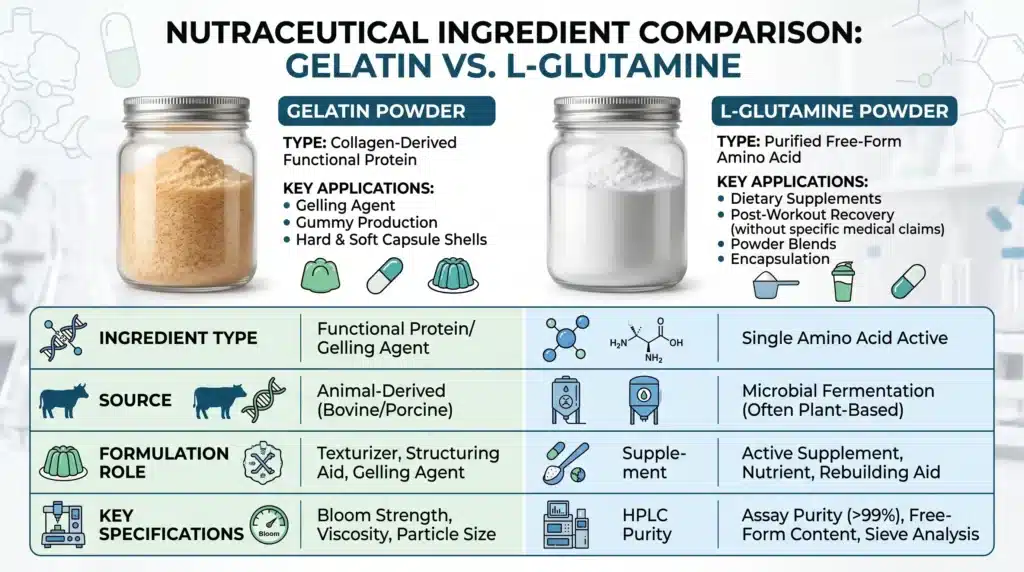
Gelatin vs L-Glutamine: Quick Comparison
|
Yếu tố |
Gelatin |
L-Glutamine |
Điểm chính về công thức |
|
Loại nguyên liệu |
Collagen-derived protein/polypeptide mixture |
Single free-form amino acid |
They are chemically and functionally different ingredients. |
|
Nguồn điển hình |
Bovine, porcine, fish, or other approved collagen-rich animal sources |
Usually produced as purified L-glutamine for food or supplement use |
Source and grade documentation should be reviewed separately. |
|
Main formulation role |
Gelling, thickening, film formation, capsule shells, gummies, selected protein applications |
Defined amino-acid addition in powders, capsules, tablets, gummies, sports or wellness formulas |
Choose the ingredient based on the job it must perform. |
|
Key composition |
Rich in glycine, proline, hydroxyproline, and other amino-acid residues |
L-glutamine (Gln) as a defined free amino acid |
Protein-bound amino acids in gelatin are not equivalent to a free amino-acid dose. |
|
Các thông số kỹ thuật chính |
Source, Type A/B, Bloom, viscosity, gel clarity, moisture, microbiology, heavy metals |
Identity, assay, specific rotation, loss on drying, particle size, solubility, heavy metals, microbiology |
Supplier qualification uses different specifications. |
|
Gut-health positioning |
Do not market generic gelatin as a treatment for intestinal disease or “leaky gut” |
Has been studied directly in intestinal-permeability settings, but results vary by population and protocol. |
Avoid universal benefit claims for either ingredient. |
Gelatin là gì?
Gelatin is a collagen-derived protein produced by partial hydrolysis of collagen-rich animal tissues. Unlike collagen peptides, gelatin retains strong functional gelling and viscosity properties: it dissolves under suitable heat and hydration conditions and can form a gel as the system cools.
In supplement manufacturing, gelatin may be used as a softgel or hard-capsule shell material, a gummy gelling system, a binder, a texture modifier, or a collagen-derived protein ingredient in selected applications. Brands sourcing supplement-grade gelatin raw material should confirm the source species, Bloom strength, viscosity, gel clarity, microbiological limits, heavy-metal limits, and supporting documentation before production.
What Is L-Glutamine?
L-glutamine is the L-isomer of glutamine and is commonly described as a conditionally essential amino acid. The human body can synthesize glutamine, but glutamine metabolism changes substantially during certain forms of physiological stress. In dietary supplements, L-glutamine is typically supplied as a purified free-form amino acid powder rather than as part of a larger protein.
For B2B sourcing, bulk L-glutamine powder should be evaluated by identity, assay, specific rotation, grade, solubility, particle size, loss on drying, heavy metals, microbial limits, packaging, and the actual batch COA.
Does Gelatin Contain Glutamine?
Yes, gelatin can contain glutamine-related amino-acid residues, but this requires careful wording. Gelatin is a protein, so its amino acids are predominantly bound within peptide chains rather than present as a standardized amount of free L-glutamine. Published gelatin amino-acid profiles may report glutamine separately, glutamic acid separately, or combine glutamine and glutamic acid as a single “Glx” value depending on the analytical method.
Processing also matters. Acid, alkaline, thermal, and enzymatic treatments can change how amide-containing amino acids are represented. In particular, alkaline processing can deamidate glutamine to glutamic acid. Therefore, a gelatin COA or amino-acid profile showing glutamic acid does not mean the ingredient provides an equivalent gram-for-gram dose of free L-glutamine.
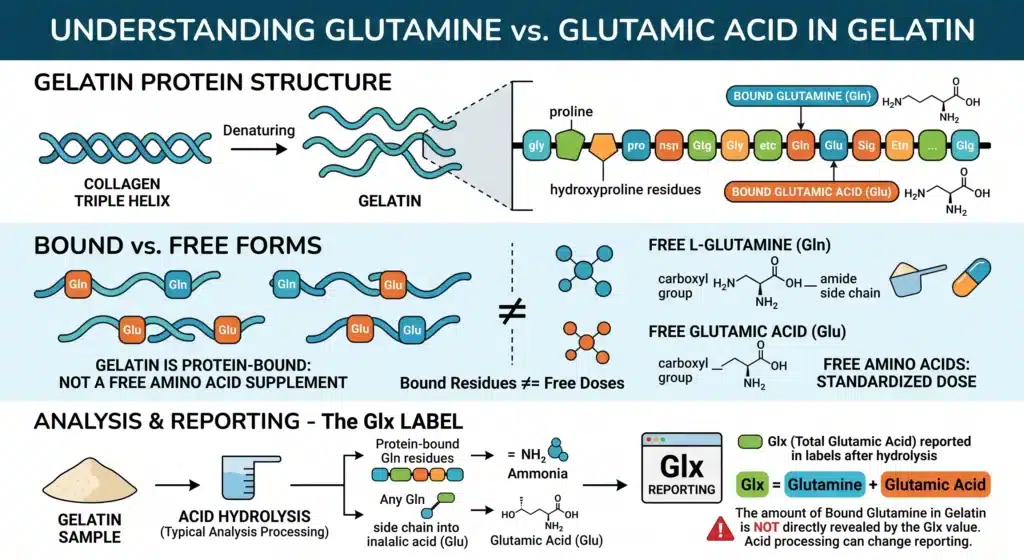
Glutamine vs Glutamic Acid in Gelatin
|
Term |
Ý nghĩa của điều đó là gì |
Why It Matters in This Comparison |
|
L-Glutamine (Gln) |
A specific amino acid with an amide side chain; sold as a free-form supplement ingredient |
A defined L-glutamine supplement can be assayed and dosed as L-glutamine. |
|
Glutamic acid/glutamate (Glu) |
A related amino acid with a carboxyl side chain |
Gelatin analyses often report a measurable glutamic-acid fraction. |
|
Glx |
An analytical reporting convention that may combine glutamine + glutamic acid |
Do not interpret Glx as free L-glutamine content. |
|
Protein-bound glutamine residues |
Glutamine incorporated within gelatin peptide chains |
Not interchangeable with adding purified free-form L-glutamine to a formula. |
Gelatin vs L-Glutamine for Gut-Health Formulas
There is no universal “better” ingredient for gut health because the ingredients serve different roles and the clinical evidence is not interchangeable. L-glutamine has been studied directly in trials measuring intestinal permeability. A 2024 systematic review and meta-analysis found no significant overall effect across included adult trials, although subgroup findings varied by dose, duration, and participant population. This is a reason to avoid presenting L-glutamine as a guaranteed solution for digestive disorders.
Generic gelatin has a different evidence profile. It supplies collagen-derived amino acids and can serve as a functional protein, but broad claims that gelatin “heals and seals the gut” or treats digestive disease should not be used without product-specific substantiation. Brands developing digestive-wellness concepts can connect ingredient selection with sản xuất thực phẩm chức năng hỗ trợ sức khỏe đường ruột support for dosage form, serving size, ingredient compatibility, flavor, stability, packaging, and finished-product testing.
Gelatin vs L-Glutamine for Sports Nutrition
L-glutamine is common in sports-nutrition formulas, but the evidence does not support treating it as a universal performance enhancer. A systematic review and meta-analysis of clinical trials in athletes reported no overall effect on most investigated outcomes, including aerobic performance, immune measures, and body composition. Individual studies may examine narrower endpoints, but those findings should not be converted into broad “faster recovery” or “better performance” claims for every product.
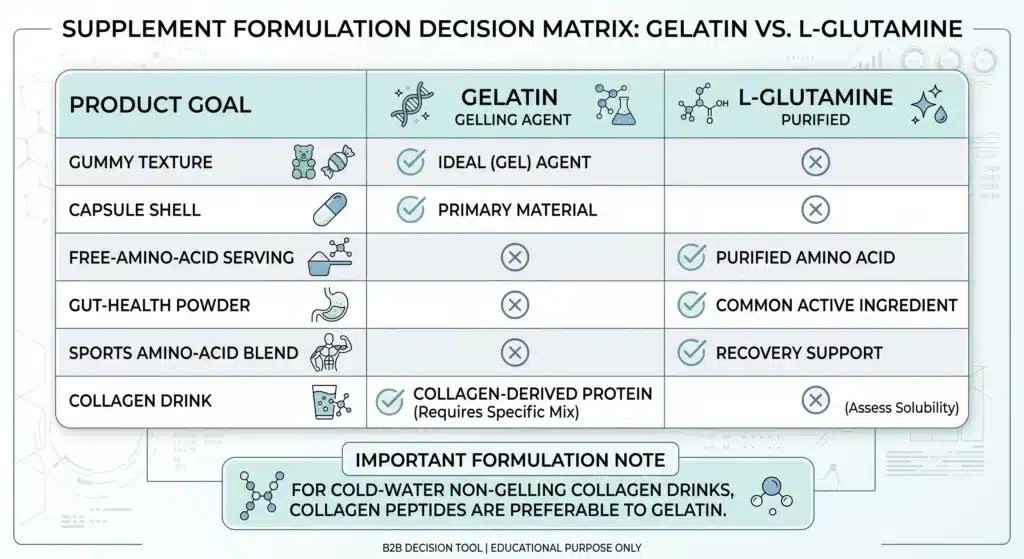
Gelatin is also not a direct substitute for a free amino acid or a complete sports protein. Its stronger use case is functional: texture, gelling, capsule shells, gummies, or collagen-derived protein positioning. If the product goal is a cold-water, non-gelling collagen drink, review Peptide collagen so với gelatin before selecting the protein format.
L-Glutamine vs Collagen vs Gelatin: Do Not Treat Them as the Same Ingredient
|
Thành phần |
What It Is |
Typical Product Role |
Key Formulation Question |
|
L-Glutamine |
Single free-form amino acid |
Amino-acid blends, sports/wellness powders, capsules, tablets, selected gut-health concepts |
What verified L-glutamine dose and evidence support the finished-product positioning? |
|
Gelatin |
Partially hydrolyzed collagen-derived protein that can gel |
Gummies, capsule shells, texture systems, selected protein applications |
What source, Bloom, viscosity, gel clarity, and process behavior are required? |
|
Peptide collagen |
Further hydrolyzed collagen fragments, typically non-gelling |
Powders, stick packs, beverages, capsules, beauty or joint concepts |
What source, molecular-weight distribution, solubility, sensory profile, and evidence are required? |
Which Ingredient Should a Supplement Brand Choose?
|
Mục tiêu sản phẩm |
Điểm khởi đầu tốt hơn |
Execution Note |
|
Gummy texture or gelatin-based capsule shell |
Gelatin |
Select source, Bloom, viscosity, plasticizer compatibility, gel clarity, and process conditions. |
|
Defined free-amino-acid serving |
L-Glutamine |
Specify identity, assay, grade, serving size, and label claim strategy. |
|
Cold-water collagen drink or non-gelling collagen powder |
Collagen peptides rather than gelatin |
Gelatin may thicken or gel; use a peptide format when low viscosity and cold-water mixing are priorities. |
|
Gut-health powder |
Depends on formula objective |
Do not choose solely from marketing claims; review evidence, serving size, taste, solubility, and finished-product positioning. |
|
Sports amino-acid blend |
L-Glutamine if specifically required by the concept |
Avoid implying guaranteed performance or recovery benefits. |
|
Functional protein / gel-based food format |
Gelatin |
Confirm the protein and texture function needed in the finished product. |
Can Gelatin and L-Glutamine Be Used Together?
They can be formulated in the same product when there is a clear product rationale, and the dosage form can accommodate both ingredients. However, there is no established general rule that the combination creates a synergistic health benefit. The formula should be evaluated based on serving size, texture, solubility, flavor, stability, process temperature, packaging, and the evidence supporting any finished-product claims.
A powder containing gelatin may thicken or behave differently from a simple amino-acid drink mix. A gummy or gel product may benefit from gelatin functionality, while free L-glutamine can be added only if the intended dose remains stable and practical under the manufacturing process.
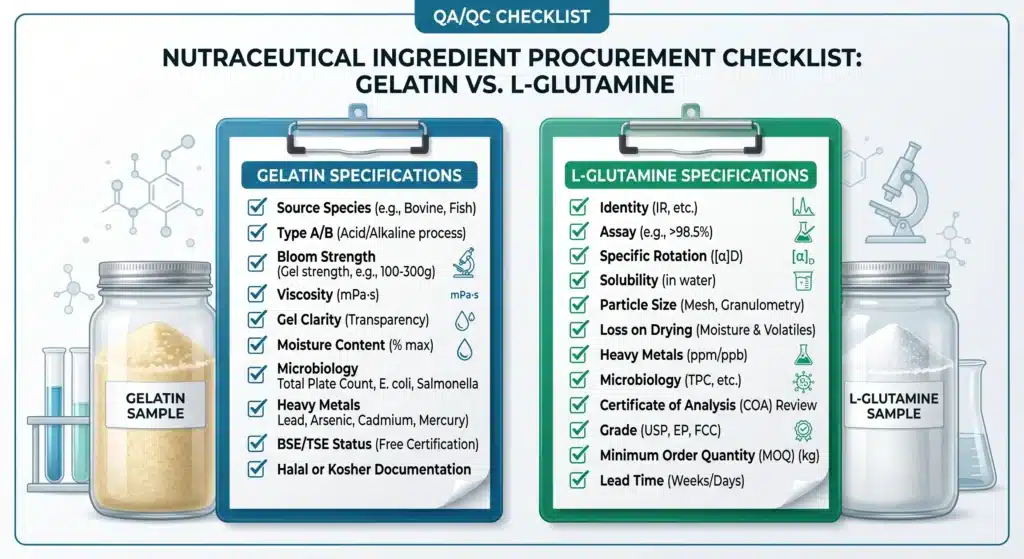
B2B Quality Specifications to Check Before Buying
|
Thông số kỹ thuật |
Gelatin |
L-Glutamine |
|
Identity/grade |
Gelatin type, source species, supplement/food/capsule application |
L-Glutamine identity, grade, CAS, specification |
|
Assay/protein |
Protein content as applicable; gelatin specification |
L-Glutamine assay and identity test |
|
Functional metric |
Bloom strength, viscosity, gel clarity, setting behavior |
Solubility, particle size, bulk behavior |
|
Chemistry |
pH, moisture, ash, sulfur dioxide or other relevant specification items |
Specific rotation, loss on drying, residue on ignition, chloride/sulfate where specified |
|
Các chất gây ô nhiễm |
Heavy metals and other market-required contaminants |
Heavy metals and other market-required contaminants |
|
Vi sinh học |
Total plate count, yeast/mold, pathogen limits |
Total plate count, yeast/mold, pathogen limits |
|
Source/certifications |
Bovine/porcine/fish source, BSE/TSE, halal/kosher if required |
Non-GMO/allergen/grade declarations as required by project |
|
Tài liệu |
COA, specification, SDS/TDS, source statement, certificates |
COA, specification, SDS/TDS, allergen/non-GMO and technical documents |
|
Commercial |
MOQ, sample, packaging, lead time, change control |
MOQ, sample, packaging, lead time, change control |
Safety and Claim Considerations
- Do not use disease-treatment language. Avoid claims that gelatin or L-glutamine treats IBS, IBD, “leaky gut,” infections, arthritis, or other diseases.
- Do not promise guaranteed recovery or performance. Human evidence for L-glutamine in sports settings is mixed and outcome-specific.
- Do not equate gelatin amino-acid composition with a free L-glutamine dose. Protein-bound residues and free-form amino acids are different formulation inputs.
- Review source and dietary restrictions. Gelatin is animal-derived; source species can affect halal, kosher, allergen, ethical, and market-positioning requirements.
- Use product-specific substantiation.Structure/function claims in U.S. dietary supplements must be truthful, non-misleading, and supported by appropriate evidence.
- Escalate individual safety questions. Pregnancy, breastfeeding, pediatric use, chronic disease, and medication-related questions should be reviewed by an appropriate healthcare professional and the brand’s regulatory team.
Câu hỏi thường gặp
Does gelatin contain L-glutamine?
Gelatin can contain glutamine-related residues as part of its protein structure, but it is not a standardized source of free L-glutamine. Depending on processing and analytical methods, amino acid reports may show glutamine, glutamic acid, or a combined Glx value.
Does gelatin contain glutamic acid?
Yes. Published gelatin amino acid profiles commonly report glutamic acid. The exact amount varies by source and processing, and some analytical methods combine glutamic acid and glutamine. This value should not be interpreted as free L-glutamine content.
Is gelatin the same as L-glutamine?
No. Gelatin is a collagen-derived mixture of protein chains and peptides. L-glutamine is a single amino acid that can be supplied as a purified free-form ingredient.
Is L-glutamine the same as collagen?
No. L-glutamine is one amino acid. Collagen is a structural protein made from many amino acids. Gelatin is made from partially hydrolyzed collagen, while collagen peptides are further hydrolyzed collagen fragments.
Which is better for gut health: gelatin or L-glutamine?
There is no universal winner. L-glutamine has more direct clinical research on intestinal permeability, but study results vary by population, dose, and duration. Generic gelatin should not be promoted as a treatment for gut disorders. Product positioning should follow the evidence for the exact ingredient and formula.
Can gelatin replace L-glutamine in a supplement formula?
Not when the formula requires a defined free L-glutamine dose. Gelatin can contribute protein-bound amino acids, but it cannot be treated as an equivalent substitute for purified L-glutamine.
Can L-glutamine replace gelatin in gummies or capsule shells?
No. L-glutamine does not provide gelatin’s gelling, film-forming, viscosity, and shell-forming functions.
What should B2B buyers request before sourcing either ingredient?
Request a current COA and specification sheet, confirm intended grade and application, review heavy metals and microbiology, verify source and certifications, check formulation-specific properties, and confirm MOQ, sample availability, packaging, lead time, and destination-market requirements.
Final Formulation Takeaway
Gelatin and L-glutamine solve different formulation problems. Use gelatin when you need collagen-derived protein functionality, gelling, texture, or capsule-shell performance. Use L-glutamine when you need a defined free-form amino acid in the finished formula. If a product needs both, formulate them as separate inputs and substantiate the finished-product claims rather than assuming gelatin provides an equivalent L-glutamine dose.
For ingredient qualification or a finished supplement project, request a COA, sample, MOQ, or formulation review trước khi đưa vào sản xuất thương mại.
Tài liệu tham khảo
- S. Food and Drug Administration — Structure/Function Claims
- Federal Trade Commission — Health Products Compliance Guidance
- Abbasi F, et al. A systematic review and meta-analysis of clinical trials on the effects of glutamine supplementation on gut permeability in adults. Amino Acids. 2024.
- Ramezani Ahmadi A, et al. The effect of glutamine supplementation on athletic performance, body composition, and immune function: a systematic review and meta-analysis. Clinical Nutrition. 2019.
- Samatra MY, et al. Bovidae-based gelatin: extraction methods, physicochemical and functional properties, applications, and future trends. Comprehensive Reviews in Food Science and Food Safety. 2022.
- Rafieian F, et al. Characterization and functional properties of gelatin from goat bone through alcalase and neutrase enzymatic extraction. Veterinary World. 2021.

Warren Wan là một chuyên gia dày dạn với kinh nghiệm phong phú trong chuỗi cung ứng thực phẩm bổ sung, sở hữu kinh nghiệm thực tiễn sâu rộng trong nghiên cứu, phát triển, kiểm soát quy trình và tìm nguồn cung ứng toàn cầu các thành phần cốt lõi như peptit collagen, protein từ nước hầm xương và keratin. Với tư cách là tác giả của chuyên mục này, ông cam kết loại bỏ những lớp bao bọc tiếp thị, biến những kiến thức khoa học phức tạp về thành phần và các tiêu chuẩn kiểm soát chất lượng sản xuất thành những nội dung phổ biến khoa học dễ hiểu nhưng sâu sắc, giúp độc giả hiểu rõ sự thật đằng sau các nhãn mác và đưa ra những lựa chọn sức khỏe hợp lý hơn.