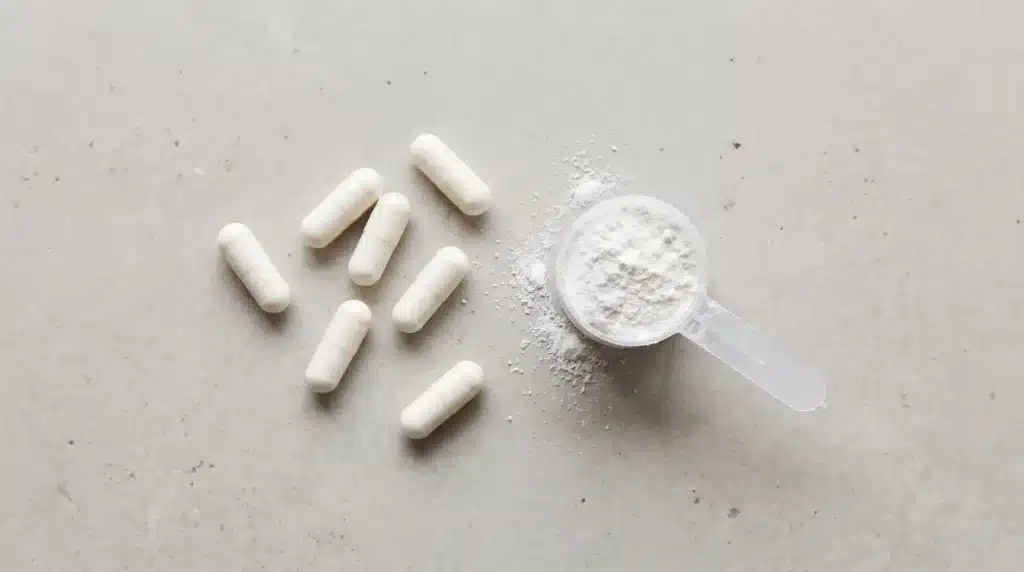
Creatine pills and powder can both provide creatine monohydrate, so you don’t need to choose one because you think it contains “better” creatine.
What changes is the experience of taking it every day.
Powder is simple: measure a scoop, mix it into a drink, and you’re done. Viên nang skip the measuring and mixing, but you may need several of them to get the same amount of creatine.
For example, if a powder provides 5 grams per scoop and your capsules contain 750 mg each, getting close to 5 grams would take about seven capsules.
That may be a great trade if you travel often or hate drinking powder. If you already throw creatine into a morning shake, seven capsules may feel like more work than one scoop.
There’s also the size of the capsules to consider. Putting more creatine into each capsule can reduce the number you need, but those capsules may be larger.
So before choosing, look at the actual product in front of you: how much creatine does it provide, how many capsules will you need, how easy will they be to take, and how much will you pay for the amount you use every day?

Creatine pills vs powder at a glance
| Bột Creatine | Creatine Pills or Capsules | |
| Thành phần | Usually creatine monohydrat | Usually creatine monohydrate |
| Hiệu quả | Effective when taken consistently | Can work just as well at an equivalent dose |
| Daily use | Measure, mix, and drink | Swallow capsules |
| Getting several grams | Easy with one scoop | May require several capsules |
| Adjusting the amount | Easy to adjust | Limited to whole capsules |
| Hương vị và kết cấu | You have to drink it | No powder taste or texture |
| Travel | Less convenient to carry and mix | Easy to pack and portion |
| Loading | Easy to take larger amounts | Can require many capsules |
| Chi phí | Usually lower per gram | Usually higher per gram |
This comparison assumes both products contain creatine monohydrate. If you’re looking at different forms of creatine, such as creatine nitrate rather than monohydrate, the ingredient itself has changed and the comparison is different.
Do creatine pills work as well as powder?
Yes, they can.
If your capsules contain creatine monohydrate, the creatine inside isn’t fundamentally different from the creatine monohydrate sold as loose powder.
The first thing to check is the dose.
Imagine your powder gives you 5 grams per scoop, while your capsule label says:
Serving Size: 4 capsules
Creatine Monohydrate: 3,000 mg
Four capsules give you 3 grams of creatine.
One scoop of the powder gives you 5 grams.
If you take one labeled serving of each, you’re taking different amounts even though both packages call it “one serving.”
That’s easy to miss because serving sizes aren’t standardized across creatine products. One company may use 3 grams as a serving, while another uses 5 grams.
The Supplement Facts panel clears this up quickly. Look for the amount of creatine monohydrate in the serving and the number of capsules that make up that serving.
Research directly comparing modern commercial creatine capsules with loose powder over long periods is limited. We do have human evidence showing that creatine is absorbed when taken in solid form. A capsule shell changes how the product is delivered, but it doesn’t turn creatine monohydrate into a different ingredient.
If two products give you an equivalent amount of creatine monohydrate, there’s no good evidence that you should expect dramatically different results simply because one came from a scoop and the other came from capsules.
How many creatine capsules equal 5 grams?
It depends on how much creatine is in each capsule.
If four capsules contain 3,000 mg in total, each capsule contains:
3,000 mg ÷ 4 = 750 mg
That’s 0.75 grams per capsule.
To get close to 5 grams:
5 g ÷ 0.75 g = 6.67 capsules
In practice:
6 capsules = 4.5 g
7 capsules = 5.25 g
You don’t need to worry about hitting exactly 5.00 grams. The calculation is mainly useful because it tells you what taking the product will look like every day.
If seven capsules sounds fine, there’s no problem.
If you already take several other pills or supplements in the morning, adding another seven may be less appealing.
And don’t assume every creatine capsule contains 750 mg. That’s only an example. Some contain more and some contain less.
Also check whether the amount on the label is listed per capsule or per serving.
Serving Size: 4 capsules
Creatine Monohydrate: 3,000 mg
means all four capsules together provide 3,000 mg. It does not mean each capsule contains 3,000 mg.
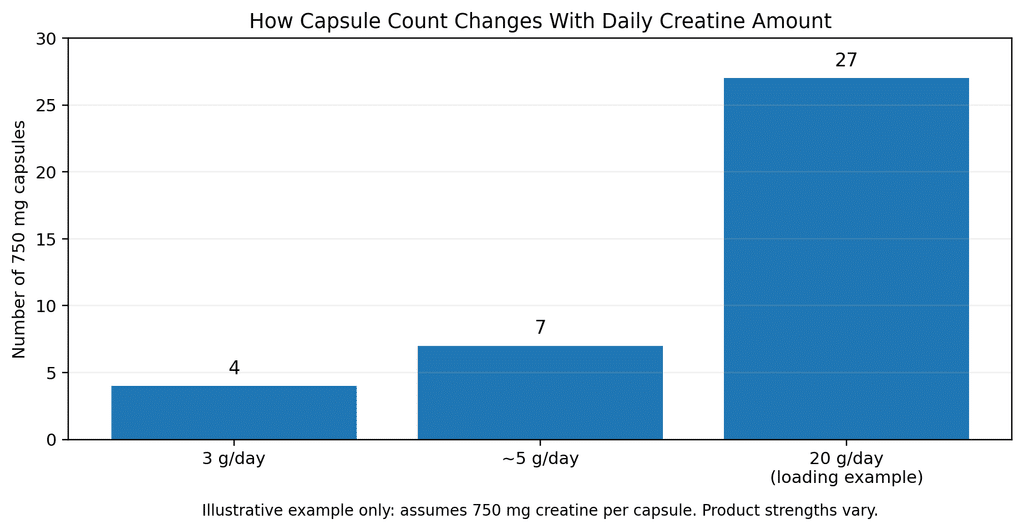
Figure 1. Illustrative capsule-count example using 750 mg creatine per capsule. Product strengths vary.
Fewer capsules may be larger
A product that puts more creatine into each capsule can reduce the number you need to swallow.
But creatine takes up space. More material has to fit inside each capsule, so reducing the pill count can mean using larger capsules.
That matters if swallowing large pills is difficult for you.
You might prefer seven smaller capsules to four large ones. Someone else may want the fewest capsules possible and not care about their size.
And if neither sounds appealing, powder starts to look pretty simple.
You don’t need to know the exact capsule dimensions before buying. If capsule size is listed, though, or reviews repeatedly mention that the pills are unusually large, it’s worth paying attention—especially if easy swallowing is the reason you’re considering capsules in the first place.
A 120-capsule bottle may not last very long
The number of capsules in the bottle can also be deceptive until you know your daily amount.
Take a bottle with 120 capsules.
If you take four per day, it lasts 30 days.
If you take six per day, it lasts 20 days.
If you take seven per day, it lasts a little over 17 days.
A bottle containing 120 capsules sounds substantial, but seven capsules a day goes through it quickly.
This becomes especially useful when you’re comparing prices. A cheaper bottle isn’t necessarily cheaper to use if you need more capsules each day.
Are creatine capsules more convenient than powder?
They can be, particularly when you’re away from home.
Capsules are easy to put in a bag, take to work, or bring on a trip. You don’t need a scoop or shaker, and there’s no loose powder to deal with.
You also avoid the taste and texture completely.
At home, powder may be just as easy.
If you already make a protein shake every morning, adding a scoop of creatine takes very little effort. Even mixing it into a glass of water may only add a few seconds to your routine.
Now compare that with counting out six or seven capsules and swallowing them one by one.
For some people, the capsules still win. They would rather swallow pills than drink creatine powder.
For others, the scoop is easier.
Think about where you’ll actually take your creatine. A frequent traveler may get much more value from capsules than someone whose creatine tub never leaves the kitchen.
Powder is easier to adjust
Capsules give you fixed amounts.
If each capsule contains 750 mg:
4 capsules = 3 g
5 capsules = 3.75 g
6 capsules = 4.5 g
7 capsules = 5.25 g
Powder lets you measure the amount more freely.
That doesn’t mean you need to obsess over tiny differences in your daily creatine intake. Creatine isn’t something most people need to measure to the nearest milligram.
It simply means powder is easier when you want to change the amount.
If you normally take 5 grams but decide to take 3 grams, you can measure 3 grams of powder. With capsules, the available amounts depend on how much is inside each capsule.
For someone taking the same number every day, that may never be a problem.
It becomes more noticeable if you use a loading phase.
Loading creatine with capsules can mean a lot of pills
A traditional creatine loading phase uses about 20 grams per day for several days, usually divided into smaller doses throughout the day.
Loading isn’t required. Taking a lower daily amount can still increase muscle creatine stores; it just does so more gradually.
But 20 grams is a lot to fit into capsules.
At 750 mg per capsule:
20 g ÷ 0.75 g = about 27 capsules per day
Those capsules would normally be spread across the day rather than swallowed all at once, but 27 is still a lot of pills.
With powder, the same daily amount can be divided into several measured servings without dealing with dozens of capsules.
If you don’t plan to load creatine, this may never matter to you.
Is creatine powder cheaper than pills?
Usually, yes.
Powder is a relatively simple finished product. Capsules add the capsule shell and additional filling and processing, which generally makes them more expensive per gram of creatine.
The easiest mistake is comparing the price per serving without checking how much creatine is in each serving.
Imagine a bottle contains 120 capsules, each with 750 mg of creatine.
The whole bottle contains:
120 × 0.75 g = 90 g of creatine
At six capsules per day, you’re taking 4.5 grams and the bottle lasts 20 days.
Now imagine a tub of powder contains 500 grams of creatine. Even if the tub costs more upfront, it may provide far more days of use.
You can calculate the exact cost per gram if you want:
Product price ÷ total grams of creatine = cost per gram
But you don’t necessarily need to.
A quick check of the total creatine in the container and how many days it will last at your usual amount is often enough to tell which one is the better value.
Powder usually comes out ahead.
That doesn’t automatically make capsules a bad purchase. If capsules make it much easier for you to take creatine consistently—especially when traveling or away from home—the extra cost may be worth it.
Does creatine powder absorb faster than capsules?
The earliest part of absorption can be different.
Loose powder doesn’t have a capsule shell that needs to break down before the creatine is released. Human research has also found differences in plasma creatine concentrations over time when creatine was consumed in solution versus solid forms.
Solid creatine was still absorbed.
What we don’t have is evidence showing that choosing powder because it appears in the bloodstream sooner will give you more muscle, greater strength, or meaningfully higher muscle creatine stores than an equivalent amount taken in capsules.
Creatine isn’t normally used for an immediate effect.
You take it consistently, muscle creatine stores increase over time, and regular intake helps keep those stores elevated.
Whether one format begins appearing in the bloodstream a little sooner is much less important than taking enough creatine and taking it consistently.
So if the only reason you’re leaning toward powder is because you’ve heard it “absorbs faster,” I wouldn’t put much weight on that.
What about taste and mixing?
Capsules are the easy choice if you really dislike the taste or texture of creatine powder.
You swallow them with water and move on.
Powder has to be mixed into something. Depending on the product and the drink, some may settle at the bottom or leave a slightly gritty texture.
That bothers some people much more than others.
If you already add creatine to a shake, you may barely notice it. If you mix it with plain water and dislike the texture every time, capsules become much more attractive.
Different powders can also behave differently in liquid. Particle size is one reason creatine dạng vi hạt comes up when people talk about how easily creatine mixes and how it feels to drink.
If mixing is your main complaint, that difference may be worth understanding before giving up on powder entirely.
Are creatine capsules easier on the stomach?
Không hẳn.
If both products contain creatine monohydrate, the active ingredient is still the same.
The amount you take at one time may make more difference than whether it came from a scoop or a capsule. Larger single doses can be harder for some people to tolerate, which is one reason larger daily amounts are often divided.
The other ingredients can differ too.
A plain creatine powder may contain only creatine monohydrate. A capsule also needs a shell and may contain additional inactive ingredients used in manufacturing.
Then there’s the simple physical issue of swallowing several capsules.
Some people prefer that to drinking powder. Others find a large handful of pills uncomfortable even when their stomach handles the creatine itself perfectly well.
If one product consistently gives you trouble, compare the dose and the full ingredient list rather than assuming every capsule or every powder will behave the same way.
If you have a medical condition, take medication, are pregnant or breastfeeding, or have been advised to limit supplement use, speak with an appropriate healthcare professional before using creatine.
Creatine pills or powder: which should you choose?
If you take creatine at home, don’t mind mixing it, and want the lowest cost per gram, powder is usually the easier choice.
It’s also easier if you want to adjust the amount or take larger daily doses.
Capsules become more attractive when portability matters or when you simply don’t like drinking creatine powder.
If you travel several times a month, keeping capsules in your bag may be much easier than carrying powder and a scoop.
If you hate swallowing pills, the opposite is true.
Before buying capsules, check two things that can change the experience quite a bit:
How many will you need each day?
How large are they?
Three or four capsules that are easy for you to swallow may fit your routine perfectly.
Seven capsules may still be fine if avoiding powder matters more to you.
And a smaller number of very large capsules may be worse than either option if large pills are difficult for you.
There’s no need for everyone to reach the same answer.
Someone taking 5 grams at home every morning may prefer one scoop.
Someone who lives out of a suitcase may gladly pay more for capsules.
Someone who cannot stand the texture of creatine powder may choose capsules even if it means swallowing several of them.
Choose the version that makes taking creatine feel like the smallest part of your day.
Câu hỏi thường gặp
Can I switch between creatine powder and capsules?
Yes. If both products contain creatine monohydrate, you can switch between them. Check how much creatine each product provides and adjust accordingly rather than treating one scoop and one capsule as equivalent.
Should I take creatine capsules on rest days?
Generally, yes. The capsule format doesn’t change the usual approach to creatine. Creatine is normally taken consistently, including on rest days, rather than only around workouts.
Are creatine tablets the same as capsules?
Not exactly. Tablets are compressed solid dosage forms. Capsules contain the ingredient inside a shell. Both let you take creatine without mixing powder, so the same questions are useful when comparing creatine tablets vs powder: how much creatine is in each tablet, how many you need each day, and whether you find them easier to take.
Is 750 mg of Creatine a Lot?
750 mg is 0.75 grams. If that’s the amount in one capsule, four capsules provide 3 grams and seven provide 5.25 grams. If 750 mg is listed for an entire serving rather than one capsule, the calculation is different. Check the serving size on the Supplement Facts panel before deciding how much creatine the product provides.
Kết luận
Creatine powder is usually cheaper, easier to adjust, and simpler when you want several grams at once.
Capsules are easier to carry and avoid the taste, texture, measuring, and mixing that come with powder.
If you’re leaning toward capsules, check the amount of creatine in each one before buying. A serving that looks simple on the front of the bottle may turn into six or seven capsules once you match the amount you normally take. Products that fit more creatine into fewer capsules may also use larger capsules.
For someone who mixes creatine at home every morning, one scoop may be the easiest option.
For someone who travels often or really dislikes drinking creatine powder, capsules may be worth the extra cost.
Tài liệu tham khảo
- International Society of Sports Nutrition position stand: safety and efficacy of creatine supplementation in exercise, sport, and medicine
- Absorption of creatine supplied as a drink, in meat or in solid form
- Pharmacokinetics of the Dietary Supplement Creatine
- Single- and multiple-dose pharmacokinetics of oral creatine
- A buffered form of creatine does not promote greater changes in muscle creatine content, body composition, or training adaptations than creatine monohydrate

Warren Wan là một chuyên gia dày dạn với kinh nghiệm phong phú trong chuỗi cung ứng thực phẩm bổ sung, sở hữu kinh nghiệm thực tiễn sâu rộng trong nghiên cứu, phát triển, kiểm soát quy trình và tìm nguồn cung ứng toàn cầu các thành phần cốt lõi như peptit collagen, protein từ nước hầm xương và keratin. Với tư cách là tác giả của chuyên mục này, ông cam kết loại bỏ những lớp bao bọc tiếp thị, biến những kiến thức khoa học phức tạp về thành phần và các tiêu chuẩn kiểm soát chất lượng sản xuất thành những nội dung phổ biến khoa học dễ hiểu nhưng sâu sắc, giúp độc giả hiểu rõ sự thật đằng sau các nhãn mác và đưa ra những lựa chọn sức khỏe hợp lý hơn.