

Quick answer: Yes, most adults can consume vitamin A and vitamin E together through food or standard multivitamin amounts. However, taking high-dose supplements does not automatically provide additional health benefits. Because both nutrients are fat-soluble, excessive intake—especially of preformed vitamin A or high-dose supplemental vitamin E—can cause harm. People who are pregnant or may become pregnant, current or former smokers, and people taking anticoagulant or retinoid medications should seek professional advice before using high-dose supplements.
Vitamin A and vitamin E are essential fat-soluble nutrients, but they perform different functions in the body. Vitamin A is required for normal vision, immune function, reproduction, and cellular growth. Vitamin E acts as an antioxidant and also contributes to normal immune and cellular function.
A vitamin A and E supplement may be useful when dietary intake is inadequate or when a healthcare professional identifies a specific need. It should not, however, be assumed that taking more than the recommended amount will improve immunity, prevent disease, or produce visible anti-aging results.
This guide explains the differences between vitamin A and vitamin E, whether they can be taken together, their food sources, daily requirements, safety limits, interactions, and how to evaluate a supplement label.
Vitamin A vs. Vitamin E at a Glance
Although vitamin A and vitamin E are both fat-soluble vitamins, they are not interchangeable.
| Feature | Vitamin A | Vitamin E |
|---|---|---|
| Main nutritional functions | Normal vision, immune function, reproduction, growth and cellular differentiation | Antioxidant protection, immune function and cellular communication |
| Common dietary forms | Preformed vitamin A and provitamin A carotenoids | Alpha-tocopherol and other tocopherols and tocotrienols |
| Common supplement forms | Retinyl acetate, retinyl palmitate and beta-carotene | d-alpha-tocopherol, dl-alpha-tocopherol and mixed tocopherols |
| Recommended amount for adults | 900 mcg RAE for men and 700 mcg RAE for women | 15 mg alpha-tocopherol |
| Adult upper limit | 3,000 mcg RAE of preformed vitamin A | 1,000 mg from supplements |
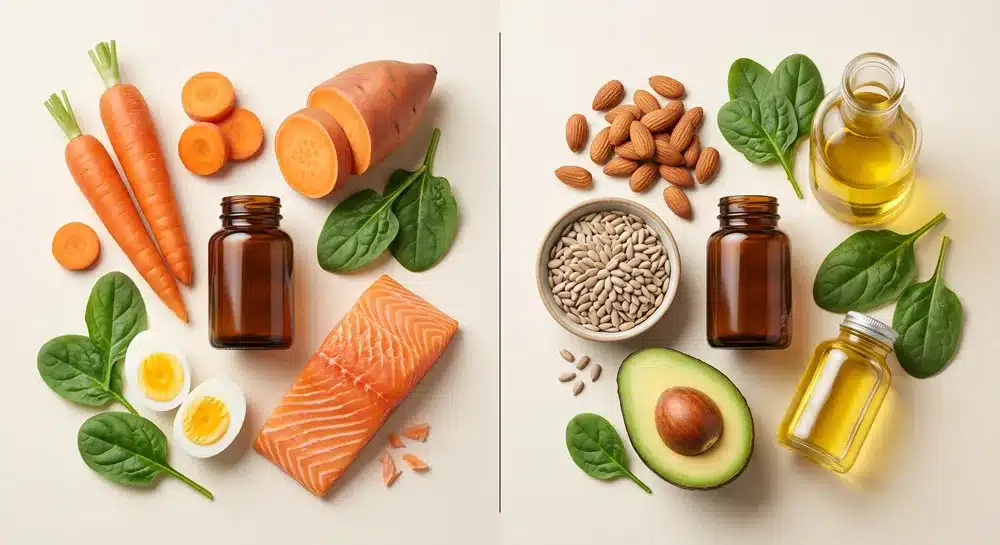
| Major food sources | Liver, eggs, dairy products, fish, carrots, sweet potatoes and leafy vegetables | Vegetable oils, almonds, sunflower seeds, peanuts, spinach and broccoli |
| Main high-dose concern | Liver toxicity, birth-defect risk and medication interactions | Increased bleeding risk and medication interactions |
The upper limit for vitamin A applies to preformed vitamin A, not to beta-carotene naturally present in food. However, high-dose beta-carotene supplements are not considered appropriate for everyone, particularly current or former smokers and people exposed to asbestos.
What Are the Benefits of Vitamin A and E?
Established functions of vitamin A
Vitamin A is necessary for normal vision, particularly the ability to see in low-light conditions. It also supports immune function and helps maintain tissues in the eyes, lungs, intestines and other organs.
The body obtains vitamin A from two main sources:
- Preformed vitamin A, including retinol and retinyl esters, is found in animal-derived foods and some supplements.
- Provitamin A carotenoids, including beta-carotene, are found in colorful fruits and vegetables and can be converted into vitamin A by the body.
Vitamin A deficiency is uncommon in the United States but can occur in people with certain digestive or absorption disorders. A significant deficiency can affect vision and immune function.
Established functions of vitamin E
Vitamin E is a group of fat-soluble compounds. Alpha-tocopherol is the form used to establish human vitamin E requirements.
Its best-established nutritional role is antioxidant protection. Vitamin E helps protect cell membranes from oxidative damage and is also involved in immune function and cellular communication.
Vitamin E deficiency is rare in otherwise healthy people. It is more commonly associated with conditions that interfere with fat digestion or absorption.
Do vitamin A and vitamin E provide additional benefits when combined?
Vitamin A and vitamin E can be consumed as part of the same diet or supplement. However, this does not mean that combining high doses creates a special or clinically proven “synergy.”
Each nutrient supports established biological functions, but evidence is limited that healthy adults with adequate nutritional intake gain additional benefits simply by taking both as high-dose supplements.
The goal should be to meet nutritional requirements without exceeding safe levels, rather than to maximize the dose of either vitamin.
Are vitamin A and E good for the skin?
Vitamin A contributes to normal cellular growth and differentiation, including processes involved in maintaining healthy skin. Vitamin E helps protect cell membranes from oxidative damage.
These normal nutrient functions should not be interpreted as proof that an oral vitamin A and E supplement will remove wrinkles, increase collagen production or visibly reverse skin aging.
Evidence from topical retinoids or topical skincare products should not be automatically applied to oral dietary supplements. People considering supplements specifically for a skin concern should first evaluate diet, sun protection, skincare practices and any underlying medical condition.
Can Vitamin A and E Be Taken Together?
For most adults, vitamin A and vitamin E can be consumed together in food or in the amounts commonly found in standard multivitamin products.
There is no general requirement to separate them into different times of day.
Because both are fat-soluble, they are commonly taken with a meal that contains some dietary fat. Always follow the product directions unless a healthcare professional recommends a different schedule.
Before combining supplements, check the total amount
The main risk is often not the combination itself but accidentally consuming the same nutrients from several products.
For example, vitamin A or vitamin E might be present in:
- A multivitamin
- A vitamin A and E capsule
- A skin, hair or beauty supplement
- Cod liver oil
- An eye-health supplement
- A fortified food or nutrition drink
- A separate antioxidant formula
Add the amounts from all supplements before deciding whether an additional product is appropriate.
High doses are different from normal dietary intake
Normal food intake and high-dose supplementation should not be treated as the same exposure.
Food sources generally provide nutrients within a broader dietary pattern. Supplements can deliver concentrated doses that may approach or exceed the upper intake level.
A healthcare professional should supervise high-dose use, especially when it is intended to correct a deficiency or support the treatment of a medical condition.
Vitamin A and E Foods: Where to Get Both Nutrients
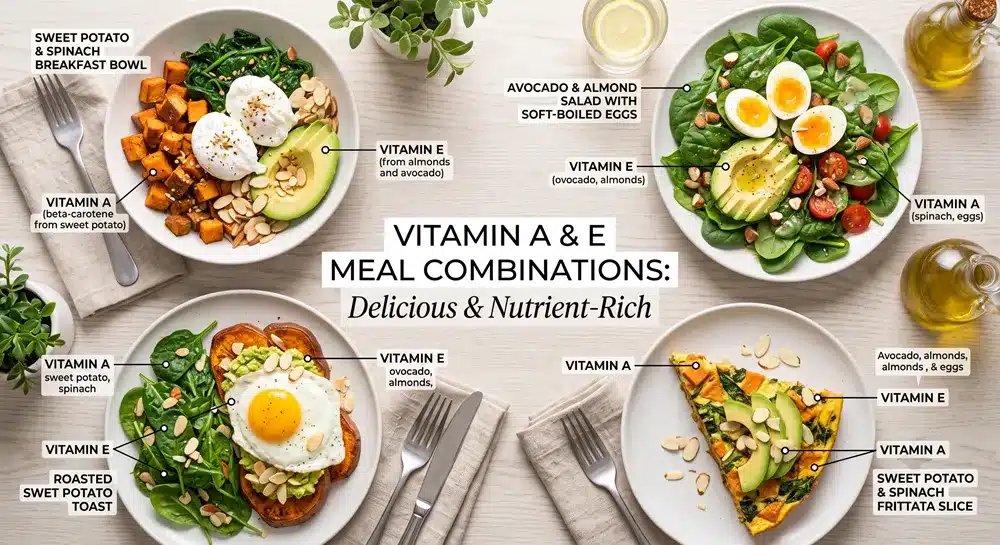
Most people do not need to find one food that contains large amounts of both vitamins. A varied meal can combine a vitamin A source with a vitamin E source.
| Meal combination | Main vitamin A contribution | Main vitamin E contribution |
|---|---|---|
| Sweet potato with almonds or sunflower seeds | Beta-carotene from sweet potato | Vitamin E from nuts or seeds |
| Spinach salad with avocado and sunflower seeds | Beta-carotene from spinach | Vitamin E from avocado and seeds |
| Eggs with spinach and avocado | Preformed vitamin A from eggs and carotenoids from spinach | Vitamin E from avocado |
| Broccoli with a vegetable-oil dressing | Carotenoids from broccoli | Vitamin E from vegetable oil |
| Fortified cereal with fruit and nuts | Added vitamin A, depending on the label | Added vitamin E and vitamin E from nuts |
Good food sources of vitamin A
Common vitamin A sources include:
- Beef liver and other organ meats
- Eggs
- Dairy products
- Fish such as salmon and herring
- Sweet potatoes
- Carrots
- Spinach
- Broccoli
- Winter squash
- Mangoes
- Apricots
- Fortified breakfast cereals
Liver contains a particularly concentrated amount of preformed vitamin A, so it should not be treated as an unlimited everyday source.
Good food sources of vitamin E
Common vitamin E sources include:
- Wheat germ oil
- Sunflower oil
- Safflower oil
- Almonds
- Sunflower seeds
- Peanuts and peanut butter
- Hazelnuts
- Spinach
- Broccoli
- Some fortified cereals and spreads
Nutrient amounts vary by food, serving size, processing method and product formulation. Check nutrition labels or a verified food-composition database when exact values are needed.
Dosage, Daily Needs and Upper Limits
Recommended daily amounts
| Life stage | Vitamin A | Vitamin E |
|---|---|---|
| Adult men | 900 mcg RAE | 15 mg |
| Adult women | 700 mcg RAE | 15 mg |
| Pregnant women | 770 mcg RAE | 15 mg |
| Breastfeeding women | 1,300 mcg RAE | 19 mg |
These values represent recommended total daily intake from food, beverages and supplements. They are not recommended supplement doses.
A person who already obtains enough from food may not need a supplement that provides 100% or more of the Daily Value.
What do RAE, mg, IU and %DV mean?
- mcg RAE means micrograms of retinol activity equivalents. It accounts for differences between preformed vitamin A and provitamin A carotenoids.
- mg means milligrams and is the standard unit used for vitamin E on current U.S. labels.
- IU means International Units. Older vitamin E products may still display IU, but the conversion depends on whether the vitamin E is natural or synthetic.
- %DV shows how much one serving contributes to the Daily Value used on U.S. food and supplement labels.
The FDA Daily Value is 900 mcg RAE for vitamin A and 15 mg alpha-tocopherol for vitamin E.
Daily Values are designed for label comparison and are not personalized recommendations for every age, sex or life stage.
Tolerable upper intake levels
| Nutrient | Adult upper limit | What the limit applies to |
|---|---|---|
| Vitamin A | 3,000 mcg RAE per day | Preformed vitamin A from food, beverages and supplements |
| Vitamin E | 1,000 mg per day | Vitamin E from supplements |
An upper limit is not a target. It is the highest average daily intake considered unlikely to cause harm for most people in the applicable group.
Potential adverse effects can occur below an upper limit in some individuals, particularly when medications, health conditions or prolonged high-dose use are involved.
Side Effects, Risks and Interactions
Pregnancy and preformed vitamin A
High intakes of preformed vitamin A during pregnancy can cause birth defects.
People who are pregnant, may become pregnant or are breastfeeding should not use high-dose preformed vitamin A supplements unless specifically directed by an appropriate healthcare professional.
Prenatal products should be evaluated according to their complete formulation rather than by comparing only the front-label vitamin A number.
Beta-carotene and smoking history
Beta-carotene from food is not the same as a high-dose beta-carotene supplement.
Studies have associated high-dose beta-carotene supplementation with an increased risk of lung cancer and death in current smokers, former smokers and people exposed to asbestos.
People in these groups should avoid high-dose beta-carotene supplements unless a qualified healthcare professional has recommended them for a specific reason.
Vitamin E and bleeding risk
High-dose vitamin E supplements may reduce the blood’s ability to clot and increase bleeding risk.
Extra caution is needed for people who take anticoagulant or antiplatelet medicines, including warfarin, or who have a bleeding disorder.
People preparing for a medical procedure should tell their healthcare team about every supplement they use.
Prescription retinoids and vitamin A
Some prescription medicines are chemically related to vitamin A. Taking additional vitamin A with retinoid medicines can lead to excessive exposure.
People taking medicines such as acitretin or bexarotene should not add a vitamin A supplement without approval from the prescribing clinician.
Orlistat and nutrient absorption
Orlistat can reduce the absorption of fat-soluble vitamins, including vitamin A. People using orlistat should follow the timing and supplementation instructions provided by their healthcare professional.
Cancer treatment
Antioxidant supplements may interact with some chemotherapy or radiation treatments. Anyone receiving cancer treatment should discuss vitamin E and other antioxidant supplements with their oncology team before use.
Possible signs of excessive intake
Excessive preformed vitamin A can cause symptoms such as:
- Headache
- Nausea
- Dizziness
- Blurred vision
- Muscle aches
- Coordination problems
High-dose vitamin E may increase bruising or bleeding risk.
These symptoms are not specific enough for self-diagnosis. Seek medical advice when an adverse effect or excessive intake is suspected.
How to Choose a Vitamin A and E Supplement
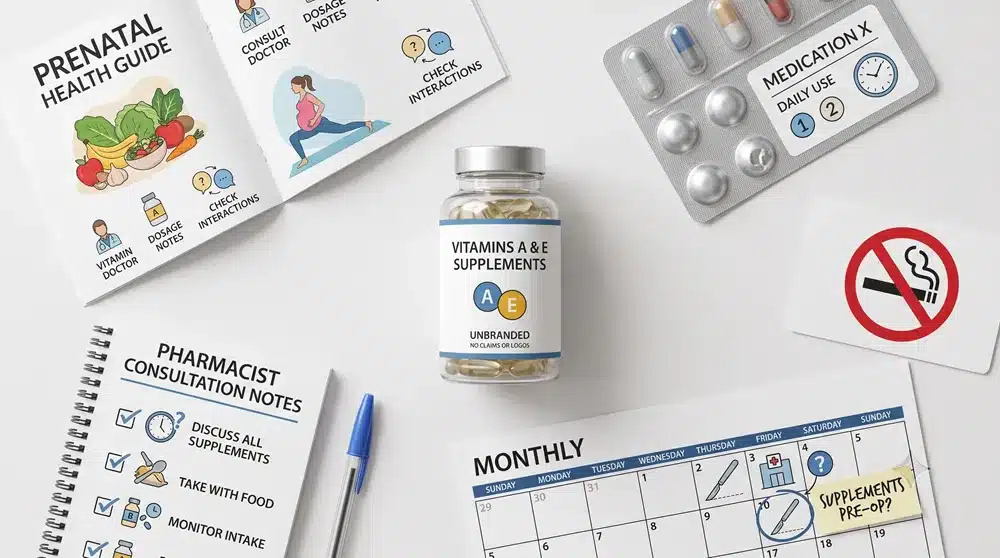
There is no single “best vitamin A and E supplement” for every person. The most appropriate product depends on nutritional intake, age, pregnancy status, medication use, health conditions and the reason for supplementing.
Use the following checklist when evaluating a product.
1. Decide whether both nutrients are necessary
A combination product is not automatically more appropriate than a single-nutrient product or a standard multivitamin.
Review your diet and all existing supplements before adding another source.
2. Compare the dose with the Daily Value
Check the amount per serving and the serving size.
A bottle may list one capsule on the front while defining two or more capsules as a full serving on the Supplement Facts panel.
A higher percentage is not necessarily better.
3. Identify the form of vitamin A
Common forms include:
- Retinyl acetate
- Retinyl palmitate
- Beta-carotene
- A combination of preformed vitamin A and beta-carotene
Preformed vitamin A requires greater attention to total intake because it is covered by the adult upper limit.
4. Identify the form of vitamin E
Natural-source vitamin E is commonly listed as d-alpha-tocopherol, while synthetic vitamin E is commonly listed as dl-alpha-tocopherol.
For a more detailed comparison of label terminology, biological activity and formulation differences, read our guide to natural vs. synthetic vitamin E.
Natural vitamin E has greater biological potency per milligram, but this does not prove that every natural-source product produces better health outcomes than every synthetic product.
Some formulas also contain mixed tocopherols or tocotrienols. Current evidence does not establish that these forms are universally superior to alpha-tocopherol in dietary supplements.
5. Check for duplicate ingredients
Compare the product with multivitamins, beauty supplements, eye formulas, cod liver oil and fortified drinks already in use.
Duplicate intake is one of the easiest ways to unintentionally reach a high dose.
6. Look for meaningful quality information
Useful information can include:
- Clear ingredient forms and amounts
- Lot or batch identification
- Expiration or best-before date
- Storage instructions
- Allergen information
- Manufacturer contact details
- Independent certification or verification, where applicable
- Accessible quality or testing documentation
Brands, buyers and product developers who need more detail on raw-material checks, batch documentation, potency verification and finished-product testing can review our supplement quality control process.
Third-party certification can be helpful, but the exact scope varies by program. A seal should not be interpreted as proof that a supplement is clinically effective for a particular health outcome.
7. Avoid disease-treatment claims
A dietary supplement should not be selected because it claims to cure, treat or prevent a disease.
Be cautious with products that promise rapid anti-aging effects, disease prevention, guaranteed immune enhancement or dramatic skin transformation.
Formulation Notes for Supplement Brands
For brands developing a vitamin A and E supplement, the ingredient form should be selected according to dosage form, target dose, stability requirements, processing conditions, intended market and regulatory strategy. Our vitamin contract manufacturing service supports formula review, dosage-form selection, production planning, packaging and finished-product quality control.
| Product format | Common formulation considerations |
|---|---|
| Softgels | Oil compatibility, oxidation control, fill-material compatibility, light exposure and packaging |
| Hard capsules | Powder flow, particle-size distribution, blend uniformity, potency and stability |
| Tablets | Compressibility, content uniformity, ingredient interactions and assay retention |
| Gummies | Heat exposure, oxygen, dispersibility, flavor, appearance and nutrient loss during processing |
| Powders | Dispersibility, carrier selection, moisture control, oxidation and serving-size accuracy |
| Premixes and fortified foods | Particle size, segregation, processing loss, validated overage and shelf-life stability |
For vitamin A projects, formulators can compare retinyl acetate, retinyl palmitate, powder, beadlet, oil dispersion and customized potency options in our vitamin A raw material guide.
Because vitamins A and E can be sensitive to processing and storage conditions, finished-product specifications should be supported by validated analytical testing and stability data.
Any formulation overage should be justified by actual manufacturing and shelf-life data rather than added as an arbitrary percentage.
Developing a vitamin A and E product?
Gensei supports supplement brands with ingredient sourcing, custom formulation, dosage-form evaluation, pilot production, quality documentation, packaging and scalable manufacturing.
Before requesting a quotation, prepare the following information:
- Target market
- Intended serving size
- Target vitamin A and vitamin E amounts
- Preferred ingredient forms
- Capsule, softgel, tablet, gummy, powder or liquid format
- Certification requirements
- Allergen and dietary requirements
- Packaging format
- Expected order volume
Frequently Asked Questions
Can I take vitamin A and vitamin E together?
Yes. Most adults can consume vitamin A and vitamin E together through food or standard multivitamin amounts. The main concern is excessive total intake, not an inherent incompatibility between the two nutrients.
What are vitamin A and E good for?
Vitamin A supports normal vision, immune function, reproduction, growth and cellular differentiation. Vitamin E acts as an antioxidant and also supports immune and cellular function.
What is the best time to take vitamin A and vitamin E?
There is no universally required time of day. Because both are fat-soluble, they are commonly taken with a meal containing some dietary fat. Follow the directions on the product label.
Can vitamin A and E improve the skin?
Both nutrients contribute to normal cellular and skin-related functions, but an oral supplement should not be expected to remove wrinkles or produce guaranteed cosmetic changes. Evidence from topical skincare ingredients cannot automatically be applied to oral supplements.
Which foods contain vitamin A and vitamin E?
Spinach and broccoli contribute both nutrients. A practical approach is to combine vitamin A-rich foods such as sweet potatoes or carrots with vitamin E-rich foods such as almonds, sunflower seeds or vegetable oils.
How much vitamin A and vitamin E do adults need?
Adult men generally need 900 mcg RAE of vitamin A per day, and adult women need 700 mcg RAE. Most adults need 15 mg of vitamin E per day. These amounts include intake from food and supplements.
Can pregnant women take vitamin A and vitamin E supplements?
Pregnancy changes nutritional requirements, but high-dose preformed vitamin A can cause birth defects. Pregnant people should evaluate supplements with a qualified healthcare professional and should not independently add a high-dose vitamin A product.
Is beta-carotene safer than retinol?
Beta-carotene does not cause the same type of vitamin A toxicity as excessive preformed vitamin A. However, high-dose beta-carotene supplements have been associated with increased lung-cancer risk in current smokers, former smokers and people exposed to asbestos.
Is natural vitamin E better than synthetic vitamin E?
Natural vitamin E is more potent per milligram and is usually labeled d-alpha-tocopherol. Synthetic vitamin E is usually labeled dl-alpha-tocopherol. The label form and dose matter, but “natural” does not automatically mean that a product will provide superior clinical results.
Can vitamin E be taken with blood thinners?
High-dose vitamin E can increase bleeding risk in people taking anticoagulant or antiplatelet medicines. People using warfarin or similar medication should consult their healthcare professional before taking a vitamin E supplement.
Can I take a vitamin A and E supplement with a multivitamin?
Possibly, but first compare the Supplement Facts panels. Using both products may duplicate vitamin A or vitamin E and result in a much higher total dose than intended.
Conclusion
Vitamin A and vitamin E can generally be consumed together, but more is not necessarily better.
Vitamin A supports normal vision, immune function and cellular growth, while vitamin E provides antioxidant protection and contributes to normal immune and cellular function. Most people should prioritize a varied diet and use supplements only when they help address a genuine nutritional need.
Before choosing a vitamin A and E supplement, check the ingredient forms, serving size, percentage Daily Value, total intake from other products and relevant medication interactions.
High-dose products require particular caution during pregnancy, in current or former smokers, and in people taking anticoagulant or retinoid medicines.
Medical disclaimer: This article is for educational purposes and is not a substitute for medical diagnosis or individualized advice. Discuss supplements with a physician, registered dietitian or pharmacist when you have a health condition, take medication, are pregnant or are considering a high-dose product.
References
- National Institutes of Health, Office of Dietary Supplements. Vitamin A and Carotenoids: Fact Sheet for Consumers. Updated March 10, 2025.
- National Institutes of Health, Office of Dietary Supplements. Vitamin A and Carotenoids: Fact Sheet for Health Professionals.
- National Institutes of Health, Office of Dietary Supplements. Vitamin E: Fact Sheet for Consumers.
- National Institutes of Health, Office of Dietary Supplements. Vitamin E: Fact Sheet for Health Professionals.
- U.S. Food and Drug Administration. Daily Value on the Nutrition and Supplement Facts Labels.
- U.S. Department of Agriculture. FoodData Central.

Warren Wan is a seasoned expert with extensive experience in the dietary supplement supply chain, possessing rich practical experience in the research, development, process control, and global sourcing of core ingredients such as collagen peptides, bone broth protein, and keratin. As the author of this column, he is dedicated to stripping away the marketing packaging, transforming obscure ingredient science and production quality control standards into easy-to-understand, hardcore science popularization, helping readers understand the truth behind the labels and make more rational health choices.