
Bone broth is not a proven treatment for acid reflux or gastroesophageal reflux disease (GERD). A simple, lower-fat broth may fit some people’s reflux-conscious eating pattern, but tolerance varies. Fat content, portion size, meal timing, acidic ingredients, spices, and personal trigger foods matter more than the words “bone broth” on the label.
The strongest evidence-based use of bone broth in this context is as a food choice, not as a therapy. It should not be described as sealing a “leaky gut,” coating the esophagus like a bandage, repairing the lower esophageal sphincter (LES), neutralizing stomach acid, or treating GERD.
What Acid Reflux and GERD Actually Are
Gastroesophageal reflux happens when stomach contents move back into the esophagus. GERD is a more persistent condition in which reflux repeatedly causes symptoms or complications. The lower esophageal sphincter and diaphragm normally help form an anti-reflux barrier; GERD can develop when that barrier does not function effectively.
Heartburn and regurgitation are common symptoms, but GERD can also involve chest discomfort, chronic cough, hoarseness, nausea, or difficulty swallowing. Bone broth does not correct the mechanical causes of GERD and should not be positioned as a way to strengthen or repair the LES.
Does Bone Broth Help Acid Reflux? Direct Evidence vs Indirect Evidence
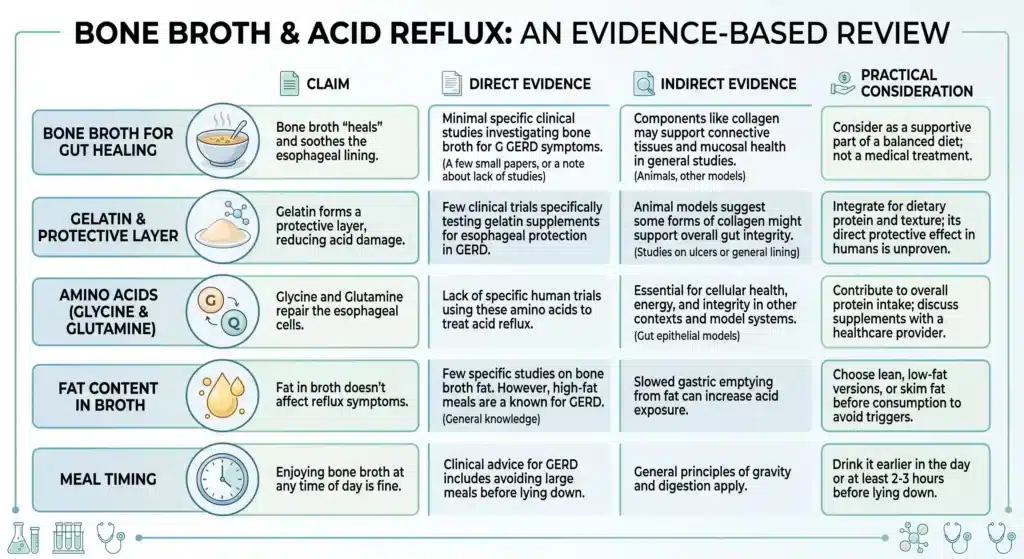
There are no high-quality clinical trials showing that bone broth itself treats GERD, heals reflux-related esophagitis, repairs the LES, or prevents reflux episodes. Most positive arguments for bone broth rely on indirect evidence about collagen, gelatin, glycine, glutamine, warm liquids, or lighter meals.
| Claim | Direct Evidence for Bone Broth + GERD | What the Evidence Supports | Recommended Conclusion |
| Bone broth treats GERD | No direct clinical evidence identified | Lifestyle measures and medical therapy have GERD evidence | Do not claim treatment |
| Gelatin protects the esophagus | No direct GERD trial showing a coating effect | Gelatin is a collagen-derived food protein | Do not call it a biological bandage |
| Glycine balances stomach acid | No bone-broth GERD evidence | Glycine has normal biochemical roles; amounts vary | Do not claim acid normalization |
| Glutamine seals leaky gut and improves reflux | No direct bone-broth GERD evidence | Barrier research exists in other contexts | Do not extrapolate to GERD |
| Lower-fat broth may be easier to tolerate | Not bone-broth-specific | High-fat foods are common personal GERD triggers | Reasonable practical guidance |
| Late-night broth may worsen reflux | Not bone-broth-specific | GERD guidance advises avoiding meals close to lying down | Reasonable practical guidance |
GERD Is Not the Same as “Leaky Gut”
GERD concerns reflux of gastric contents into the esophagus. Increased intestinal permeability concerns barrier function mainly within the intestine. They are not interchangeable diagnoses, and evidence about intestinal tight junctions should not automatically be used as proof that a food treats GERD.
This distinction matters because many bone-broth articles move from “gut barrier” research directly to GERD treatment claims. Current clinical evidence does not justify that leap.
Can Bone Broth Cause Acid Reflux?
Yes, it can in some people. Bone broth is not automatically reflux-friendly. The finished recipe matters.
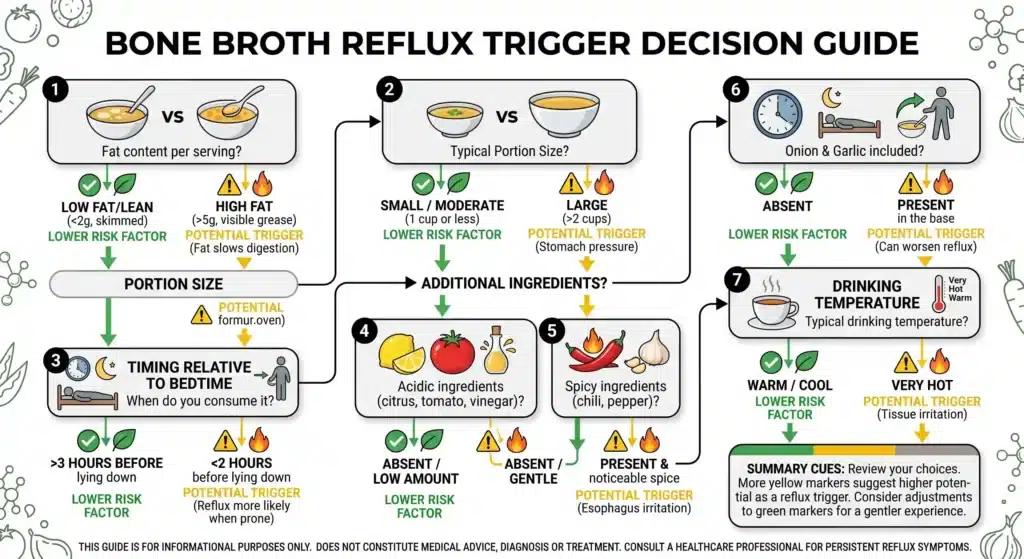
| Variable | Why It Matters | What to Check |
| Fat per serving | High-fat foods are common reflux triggers for some people | Nutrition label, visible fat, recipe |
| Portion size | Larger meals or drinks increase stomach volume | Start with a modest serving |
| Timing | Eating close to lying down may worsen nighttime reflux | Leave about 2–3 hours before bedtime when possible |
| Acidic ingredients | Tomato, citrus, vinegar, and similar ingredients can be personal triggers | Ingredient list and recipe |
| Spicy ingredients | Chili and strong spices can trigger symptoms in some people | Seasoning system |
| Onion, garlic, flavors | Tolerance is individual | Track your own symptom pattern |
| Temperature | Very hot drinks may feel irritating | Choose a comfortable drinking temperature |
Is Bone Broth Acidic?
Bone broth has no universal pH. Acidity depends on the raw materials, water ratio, cooking method, concentration, and added ingredients. Many recipes use vinegar, and commercial broths may contain tomato, citrus-derived acids, flavor systems, or other acidulants.
For reflux, pH alone does not predict tolerance. A lower-pH broth is not automatically a problem for every person, and a higher-pH broth is not automatically reflux-safe. Fat, portion size, timing, and personal triggers also matter.
What Is the Best Bone Broth for GERD?
There is no clinically proven “best” brand, animal source, or formula for GERD. A more useful approach is to select the simplest product you can evaluate.
- Choose a lower-fat broth if fat commonly worsens your reflux.
- Start with a smaller serving rather than a large mug or bowl.
- Avoid tomato, citrus, vinegar, chili, or other ingredients that are known personal triggers.
- Review the nutrition label for sodium and serving size.
- Avoid consuming a full serving immediately before lying down.
- If a specific product consistently worsens symptoms, stop using it rather than assuming bone broth must be beneficial.
Chicken vs Beef Bone Broth for Reflux
Species alone cannot predict GERD tolerance. Chicken broth may taste lighter and beef broth may taste richer, but either can be high or low in fat, acidic or non-acidic, simply seasoned or heavily flavored.
| Factor | Chicken Bone Broth | Beef Bone Broth | What Matters More |
| Flavor | Often lighter | Often richer | Finished recipe |
| Fat | Can vary widely | Can vary widely | Fat per serving and visible fat |
| Acidity | Recipe-dependent | Recipe-dependent | Added acids and individual tolerance |
| Protein / amino acids | Variable | Variable | Actual analysis, not animal source alone |
| Best reflux choice | The simpler, lower-fat product you personally tolerate | The simpler, lower-fat product you personally tolerate | Individual response |
For a broader sourcing and composition comparison, see the chicken vs beef bone broth guide.
Bone Broth Powder vs Liquid vs Homemade Broth
| Format | What Can Vary | Reflux-Relevant Check |
| Homemade broth | Fat, acids, spices, concentration, cook time | Skim fat and control ingredients |
| Ready-to-drink liquid | Fat, sodium, seasonings, acids, serving size | Read the label and ingredient list |
| Concentrate | Reconstitution ratio, salt, flavors, concentration | Follow dilution instructions and start small |
| Bone broth powder | Protein, sodium, carriers, flavors, acids, serving size | Review the formula rather than assuming powder is gentler |
| Bone broth protein ingredient | Protein result, amino-acid profile, source tissues, processing | Not equivalent to homemade broth without composition data |
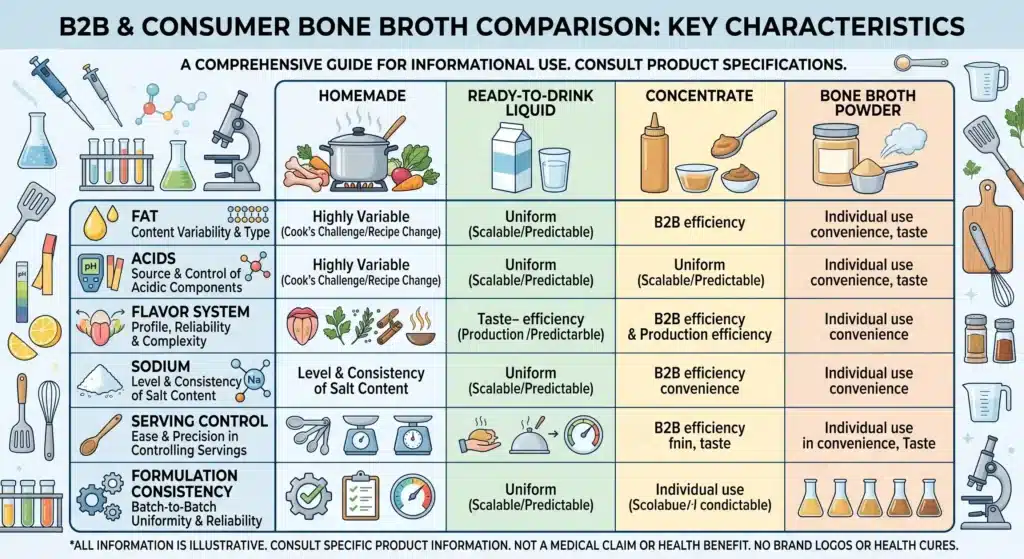
Powder is not automatically better or worse for reflux than liquid broth. For a detailed format comparison, see the bone broth powder vs liquid guide.
Bone Broth Is Not a Standardized Dose of Glycine, Proline, or Collagen
One of the biggest problems with bone-broth health claims is the assumption that every serving provides a predictable dose of collagen-related amino acids. Research comparing commercial and laboratory bone broths found substantial variability in amino-acid concentrations and concluded that bone broth is unlikely to provide a consistently reliable concentration of key collagen precursors comparable with standardized collagen supplements used in research.
Bone broth is a food, not a standardized amino-acid dose. Its glycine, proline, hydroxyproline, and other amino-acid concentrations can vary with animal source, source tissues, bone-to-water ratio, cooking method, concentration, filtration, and commercial processing.
For this reason, evidence from isolated glycine, glutamine, gelatin, or standardized collagen supplements should not automatically be transferred to bone broth.
What About Collagen, Gelatin, Glycine, and Glutamine?
Bone broth can contain collagen-derived proteins, gelatin, and amino acids, but the presence of those compounds does not establish a GERD treatment effect.
- Gelatin: a collagen-derived protein with gelling and food-structure properties; not proven to form a protective reflux barrier in the esophagus.
- Glycine: an amino acid with many normal biological roles; not proven to balance stomach acid when consumed as bone broth.
- Glutamine: studied in intestinal-barrier biology in other settings; that research does not demonstrate that bone broth treats GERD.
- Proline/hydroxyproline: collagen-related amino acids; their presence does not mean bone broth repairs the LES.
How to Try Bone Broth Without Making Reflux Worse
- Start with a small serving. Use a modest portion instead of testing a large volume.
- Choose a lower-fat option. If homemade, chill and remove the hardened fat layer when appropriate.
- Keep the ingredient list simple. Avoid ingredients you already recognize as reflux triggers.
- Do not use a “30-minute before meals” protocol. There is no established optimal bone-broth timing for GERD.
- Avoid eating or drinking a full serving close to bedtime. GERD guidance commonly recommends leaving roughly 2–3 hours before lying down.
- Track the response. If symptoms consistently worsen, stop using that product.
- Do not use bone broth to delay medical care. Persistent GERD may require lifestyle, medication, diagnostic, or procedural management.
When to Seek Medical Care
Seek medical evaluation for frequent reflux, and especially for alarm symptoms such as difficulty or pain with swallowing, persistent vomiting, gastrointestinal bleeding, unexplained weight loss, or chest pain. Bone broth should not be used as a substitute for evaluation or treatment of GERD complications.
For Supplement Brands: Bone Broth Formulation and Claim Checklist
Bone broth protein can fit functional nutrition and digestive-wellness concepts, but brands should not market a finished product as treating GERD, healing esophagitis, sealing intestinal permeability, repairing the LES, or neutralizing stomach acid without the legal status and clinical evidence required for those claims.
| B2B Check | What to Verify |
| Ingredient identity | Actual source tissues, species, broth/extraction process, hydrolysis status |
| Protein / amino-acid data | Protein test, amino-acid profile, collagen or hydroxyproline data if claimed |
| Reflux-relevant formulation factors | Fat, sodium, acidulants, flavor system, serving size |
| Physical performance | Solubility, sedimentation, foam, viscosity, odor, bitterness |
| Safety/quality | Heavy metals, microbiology, allergens, source documentation |
| Documents | Current COA, specification/TDS, SDS, source declaration, manufacturing flow |
| Claims | Separate nutrition/digestive-wellness positioning from GERD treatment claims |
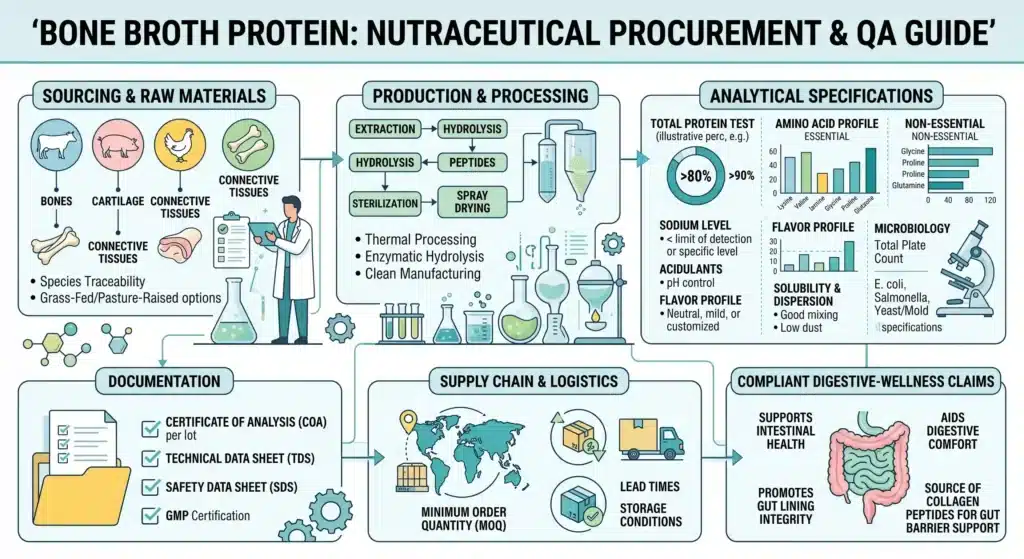
A standardized chicken bone broth protein powder should be approved from current batch documents and formulation testing rather than generic assumptions about homemade broth.
Brands building digestive-wellness products can also review gut health supplement manufacturing requirements for dosage form, testing, packaging, and compliant claims.
FAQ
Is bone broth good for GERD?
Bone broth is not a proven GERD treatment. A simple, lower-fat broth may fit some people’s eating pattern, but tolerance depends on the recipe, fat content, portion size, timing, and personal trigger foods.
Is bone broth good for acid reflux?
Some people tolerate it, while others find that fatty, acidic, spicy, or heavily seasoned broths worsen symptoms. The finished recipe matters more than the category name.
Can bone broth cause acid reflux?
Yes. High fat, a large serving, late-night intake, acidic additions, spices, or other personal triggers may worsen reflux in susceptible people.
Is bone broth acidic?
There is no single pH for all bone broth. Acidity depends on the recipe, processing, and added ingredients such as vinegar, tomato, or citrus.
What is the best bone broth for GERD?
There is no clinically proven best brand or animal source. A practical starting point is a simple, lower-fat broth in a modest serving without ingredients that personally trigger symptoms.
Is chicken bone broth better than beef for acid reflux?
Not necessarily. Fat, acids, seasonings, portion size, and individual tolerance matter more than whether the broth is chicken or beef.
Does collagen help acid reflux?
Collagen is not an established treatment for acid reflux or GERD. Research on collagen in other health areas should not be generalized to GERD.
Does glycine help acid reflux?
Glycine has many normal biological roles, but there is no strong evidence that glycine in bone broth treats GERD or normalizes stomach acid.
Conclusion
Bone broth can be a convenient food, but the evidence does not support presenting it as a GERD treatment. The most useful question is not “Which amino acid heals reflux?” but “Which product characteristics make this broth more or less likely to fit my personal reflux pattern?”
For consumers, focus on fat, portion size, timing, ingredients, and individual response. For brands, focus on standardized product data, formulation variables, current quality documents, and claims that do not turn a food or supplement into an unapproved GERD therapy.
For ingredient qualification or commercial product development, request a COA, sample, or formulation review before approving the specification and finished-product claims.
References
- NIDDK. Acid Reflux (GER & GERD) in Adults.
- NIDDK. Eating, Diet, & Nutrition for GER & GERD.
- Katz PO, et al. ACG Clinical Guideline for the Diagnosis and Management of Gastroesophageal Reflux Disease. Am J Gastroenterol. 2022.
- Alcock RD, et al. Bone Broth Unlikely to Provide Reliable Concentrations of Collagen Precursors Compared With Supplemental Sources of Collagen Used in Collagen Research. 2019.
- Harvard Health Publishing. Savoring the benefits of bone broth: Worth a taste?
- U.S. Food and Drug Administration. Structure/Function Claims.
- Federal Trade Commission. Health Products Compliance Guidance.

Warren Wan is a seasoned expert with extensive experience in the dietary supplement supply chain, possessing rich practical experience in the research, development, process control, and global sourcing of core ingredients such as collagen peptides, bone broth protein, and keratin. As the author of this column, he is dedicated to stripping away the marketing packaging, transforming obscure ingredient science and production quality control standards into easy-to-understand, hardcore science popularization, helping readers understand the truth behind the labels and make more rational health choices.