
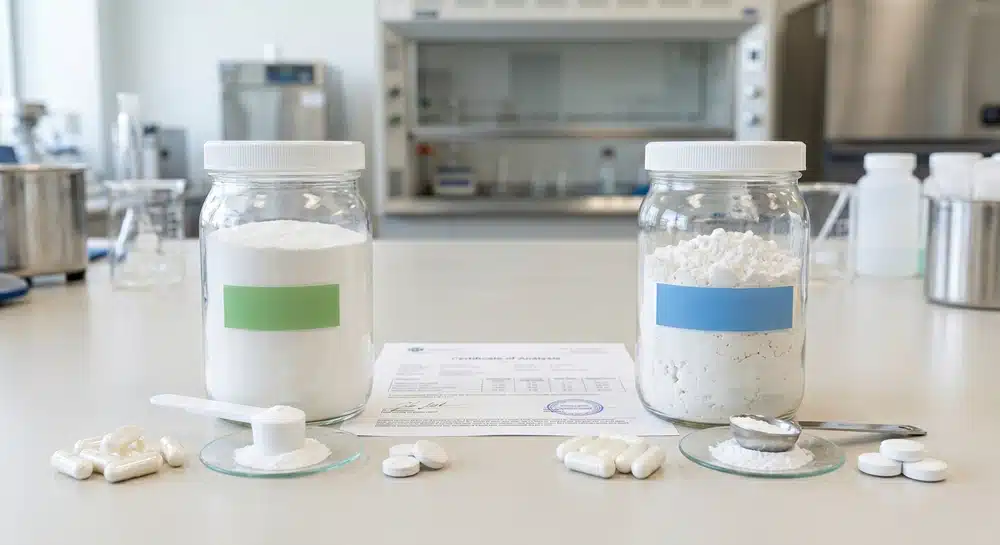
Kurzantwort: Magnesiumchelat mit Aminosäuren vs. Magnesiumglycinat bei Nahrungsergänzungsmittelmarken
Magnesiumglycinat ist eine bestimmte Form von chelatiertem Magnesium in Form einer Aminosäure. Auf den meisten Etiketten von Nahrungsergänzungsmitteln bedeutet dies, dass Magnesium an Glycin gebunden ist; oft wird dies als Magnesiumbisglycinat oder Magnesiumglycinat-Chelat bezeichnet.
Magnesium amino acid chelate is a broader category. It may refer to magnesium bound to glycine, lysine, aspartate, malate-related ligands, or a mixed amino acid chelate depending on the supplier specification.
Für Hersteller von Nahrungsergänzungsmitteln lautet die bessere Frage nicht einfach: “Welches ist besser?”, sondern:
Welche Magnesiumform passt zu Ihrer Produktpositionierung, Ihrem Zielwert für elementares Magnesium, Ihrer Darreichungsform, Ihrem Ziel hinsichtlich der Verträglichkeit, Ihren COA-Anforderungen, Ihrem Kostenziel und Ihrer Strategie für die Angaben auf dem Etikett?
Entscheiden Sie sich für Magnesiumglycinat, wenn Ihre Rezeptur auf eine schonende Verdauung, die Unterstützung des Schlafes, Stressbewältigung, Entspannung oder eine hochwertige Mineralstoffergänzung ausgerichtet ist.
Wählen Sie einen umfassenderen Magnesium-Aminosäurechelat wenn Ihre Rezeptur Flexibilität hinsichtlich Kosten, Mineralstoffgehalt, Kapselanzahl oder der Positionierung im Bereich Sporternährung und allgemeines Wohlbefinden erfordert.
Die wichtigste Erkenntnis für den B2B-Bereich lautet: Kaufen Sie nicht allein aufgrund der Bezeichnung “chelatiertes Magnesium”. Prüfen Sie das Analysezertifikat (COA), den prozentualen Anteil an elementarem Magnesium, die Art der Liganden, die Analysemethode, die Ergebnisse zu Schwermetallen, die Partikelgröße und den Herstellungsprozess.
Wichtigste Erkenntnisse
- Magnesiumglycinat ist eine Art von Aminosäurechelat, aber nicht jedes Magnesium-Aminosäurechelat ist Glycinat.
- “Chelatgebunden” sollte bedeuten, dass der Mineralstoff chemisch an einen Liganden gebunden ist und nicht lediglich mit einer Aminosäure vermischt wurde.
- Eine korrekte Chelatbildung ist entscheidend für die Produktkonsistenz, das Auflösungsverhalten, die Genauigkeit der Angaben auf dem Etikett und das Kundenerlebnis.
- Magnesiumglycinat ist in der Regel die wirksamere Wahl für Schlaf, Entspannung und bei empfindlichem Magen.
- Generisches Magnesium-Aminosäure-Chelat kann für eine breit angelegte Mineralstoffversorgung, Sporternährung, Tabletten, Kapseln und kostengünstige Rezepturen nützlich sein.
- Bei der B2B-Beschaffung ist die Prüfung des COA wichtiger als Marketingformulierungen.
Die Grundlagen verstehen: Was vergleichen wir wirklich?
Was ist Magnesium-Aminosäure-Chelat?
Magnesium-Aminosäure-Chelat ist eine weit gefasste Kategorie von Inhaltsstoffen. Darunter versteht man Magnesium, das an einen oder mehrere Aminosäure-Liganden gebunden wurde, um einen chelatierten Mineralstoffkomplex zu bilden.
Bei der Herstellung von Nahrungsergänzungsmitteln kann diese Kategorie verschiedene Ligandensysteme umfassen. Einige Produkte enthalten Glycin, während andere möglicherweise Aminosäuregemische oder andere organische Liganden verwenden. Aus diesem Grund sollten Hersteller nicht alle Inhaltsstoffe der Kategorie “Magnesium-Aminosäure-Chelat” als identisch betrachten.
Fragen Sie sich bei der Prüfung einer Lieferantenspezifikation Folgendes:
- Welcher Aminosäure-Ligand wird verwendet?
- Wie hoch ist der prozentuale Anteil an elementarem Magnesium?
- Ist es vollständig umgesetzt oder lediglich vermischt?
- Welche Analysemethode wird verwendet?
- Wie groß ist die Partikelgröße und wie hoch ist die Schüttdichte?
- Ist der Inhaltsstoff für Kapseln, Tabletten, Pulver, Gummibärchen oder Flüssigkeiten geeignet?
Was ist Magnesiumglycinat?
Magnesiumglycinat ist eine spezielle Form von chelatiertem Magnesium, bei der Magnesium an Glycin gebunden ist. Je nach der vom Anbieter verwendeten Terminologie wird es häufig auch als Magnesiumbisglycinat oder Magnesiumglycinat-Chelat vermarktet.
Für Hersteller von Nahrungsergänzungsmitteln ist Magnesiumglycinat attraktiv, da es bei den Verbrauchern einen guten Ruf genießt: Es ist magenfreundlich, gilt als hochwertig und eignet sich für Produkte zur Förderung des Schlafes oder der Entspannung. Daher eignet es sich besonders für Produkte, die auf Stressbewältigung, nächtliches Wohlbefinden und die tägliche Mineralstoffzufuhr ausgerichtet sind.
Allerdings sind nicht alle Magnesiumglycinat-Produkte gleich. Ein hochwertiges, chemisch umgewandeltes Magnesiumglycinat-Chelat unterscheidet sich von einer einfachen Mischung aus Magnesiumoxid und Glycin. Die Bezeichnung auf dem Etikett mag zwar ähnlich aussehen, doch der Herstellungsprozess, der Gehalt an elementarem Magnesium, das Auflösungsverhalten und die Verbrauchererfahrung können erheblich voneinander abweichen.
Warum eine echte Chelatbildung bei Magnesiumpräparaten so wichtig ist
Unter echter Chelatbildung versteht man, dass das Magnesiumion unter kontrollierten Herstellungsbedingungen chemisch an einen Liganden wie Glycin oder eine andere Aminosäure gebunden wird. Dies unterscheidet sich von der bloßen Vermischung von Magnesiumoxid mit Glycin, wobei das Ergebnis als “Magnesiumglycinat” bezeichnet wird.”
Für Hersteller von Nahrungsergänzungsmitteln ist diese Unterscheidung von Bedeutung, da sie sich auf folgende Aspekte auswirken kann:
- Genauigkeit der Beschriftung
- Zufuhr von elementarem Magnesium
- Auflösungsverhalten
- Pulverfluss
- Tablettenpressung
- Füllgewicht der Kapsel
- Verdauungstoleranz bei Verbrauchern
- Markenglaubwürdigkeit
Ein ordnungsgemäß reagiertes Chelat sollte durch Unterlagen des Lieferanten und Qualitätsprüfungen belegt sein. Kann ein Lieferant den Liganden, die Analysemethode, den prozentualen Anteil an elementarem Magnesium und den Herstellungsprozess nicht eindeutig erläutern, sollte der Inhaltsstoff vor der Verwendung sorgfältig geprüft werden.
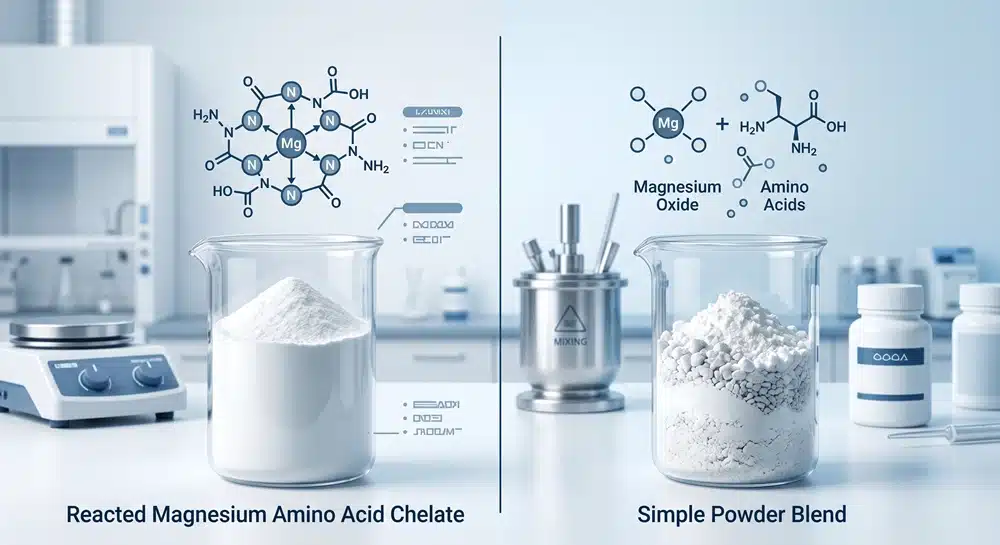
Echtes Chelat vs. einfache Mischung
| Faktor | Echtes, vollständig umgesetztes Magnesiumglycinat / Aminosäurechelat | Einfache Mischung aus Magnesiumoxid und Aminosäuren |
| Herstellungsprozess | Kontrollierte Reaktion unter definierten Bedingungen | Nur physikalisches Mischen |
| Konsistenz der Zutaten | Bei guter Verarbeitung ist die Qualität gleichmäßiger | Kann von Charge zu Charge variieren |
| Glaubwürdigkeit des Labels | Stärker für die Premium-Positionierung | Erhöhtes Risiko einer irreführenden Darstellung |
| COA-Prüfung | Es sollten Analyseergebnisse, der Magnesiumgehalt sowie Qualitätsdaten angegeben werden | Es lässt sich möglicherweise keine tatsächliche Chelatbildung nachweisen |
| Optimaler Anwendungsfall | Hochwertige Mineralstoffformeln, Unterstützung beim Einschlafen, Lagerung bei empfindlichem Magen | Kostenempfindliche Produkte, sofern die Angaben auf dem Etikett korrekt sind |
Magnesiumchelat mit Aminosäuren vs. Glycinat: Vergleich von B2B-Formulierungen
Hier ist die Tabelle in englischer Sprache:
| Faktor | Magnesium Aminosäure Chelat | Magnesium-Glycinat | Formulierungshinweis für Nahrungsergänzungsmittelmarken |
| Zutatenkategorie | Breite Kategorie von an Aminosäuren gebundenem Magnesium | Spezifisches Aminosäurechelat unter Verwendung von Glycin | Glycinat ist eine Form eines Aminosäure-Chelats. |
| Bekanntheit bei den Verbrauchern | Mäßig | Hoch | Magnesiumglycinat lässt sich leichter als Mittel für Schlaf und Entspannung vermarkten. |
| Positionierung der Etiketten | Allgemeine Mineralstoffversorgung, Muskelunterstützung, Sporternährung | Sanftes Magnesium, Unterstützung beim Einschlafen, Unterstützung bei Stress, Entspannung | Passen Sie die Formulierung an das Produktversprechen an. |
| Elementares Magnesium | Hängt von den Spezifikationen des Liganden und des Lieferanten ab | Das hängt in der Regel vom Chelat-Verhältnis und der Qualität des Lieferanten ab. | Berechnen Sie stets das elementare Magnesium und nicht nur das Gewicht der Verbindung. |
| Verdauungstoleranz | Oft besser als Oxid, hängt von der Qualität ab | Wird oft als sanft und gut verträglich beschrieben | Vermeiden Sie pauschale Aussagen; testen Sie Ihre endgültige Formel. |
| Verhalten von Pulver | Hängt vom Liganden, der Partikelgröße und der Qualität ab | Kann je nach Anbieter variieren; kann sperrig sein | Überprüfen Sie die Schüttdichte, bevor Sie die Kapselanzahl planen. |
| Die besten Darreichungsformen | Kapseln, Tabletten, Pulver, Sporternährungsprodukte | Kapseln, Pulver, Schlafmittel, hochwertige Tabletten | Gummibonbons und Flüssigkeiten erfordern eine zusätzliche Stabilitäts- und Geschmacksprüfung. |
| Kosten | Je nach Qualität flexibel einsetzbar | In der Regel höher als die Grundformen | Glycinat kann eine Premium-Preisgestaltung unterstützen. |
| Hauptrisiko bei der Beschaffung | Vage Angaben zu “Aminosäure-Chelaten” | Gepuffertes oder gemischtes Material, das als Glycinat vermarktet wird | Prüfen Sie das COA und die Lieferantenunterlagen. |
Wie Marken für Nahrungsergänzungsmittel ihre Auswahl treffen sollten
Entscheiden Sie sich für Magnesiumglycinat, wenn Ihr Produkt auf folgenden Bestandteilen basiert:
- Schlafunterstützung
- Entspannung
- Hilfe bei Stress
- Schonende Verdauung
- Hochwertige Mineralstoffversorgung
- Kapseln, Pulver oder Nachtformeln
Wählen Sie ein Magnesium-Aminosäure-Chelat mit breiterem Wirkungsspektrum, wenn Ihr Produkt auf folgenden Inhaltsstoffen basiert:
- Allgemeine Mineralstoffversorgung
- Sporternährung
- Unterstützung der Muskelfunktion
- Kostenkontrollierte Formeln
- Tabletten oder Kapseln mit einem bestimmten Zielgehalt an elementarem Magnesium
- Multimineral-Mischungen
Ziehen Sie keine der beiden Optionen in Betracht, bevor Sie die tatsächlichen Formulierungsdaten überprüft haben. Ein Magnesiumwirkstoff, der in Marketingtexten gut klingt, kann Probleme verursachen, wenn die Schüttdichte zu gering ist, die Kapselanzahl zu hoch ist, der Geschmack schwer zu überdecken ist oder im Analysezertifikat wichtige Qualitätsdaten fehlen.
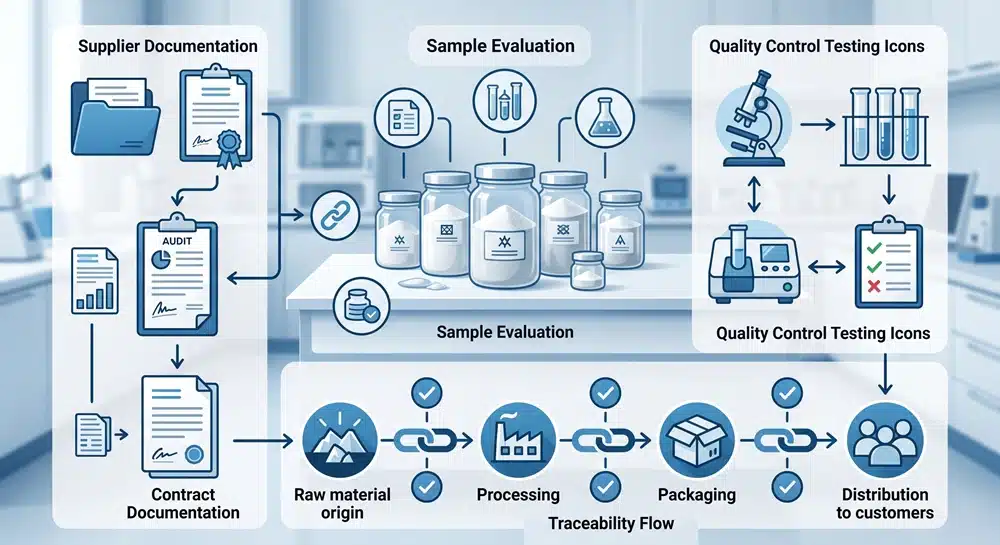
COA-Checkliste vor dem Kauf von Magnesiumglycinat oder Aminosäurechelat
Vor dem Kauf von Magnesiumglycinat oder Magnesium-Aminosäure-Chelat in Großmengen sollten Marken ein vollständiges Analysezertifikat (COA) sowie ein Datenblatt des Lieferanten anfordern. Dabei sollten mindestens die folgenden Punkte überprüft werden:
- Genaue Bezeichnung der Zutat
- Identität des Liganden, z. B. Glycin oder gemischte Aminosäuren
- Prozentualer Anteil an elementarem Magnesium
- Testverfahren
- Schwermetalle, darunter Blei, Arsen, Cadmium und Quecksilber
- Mikrobielle Grenzwerte
- Trocknungsverlust oder Feuchtigkeitsverlust
- Partikelgröße
- Schüttdichte
- Löslichkeit oder Dispergierbarkeit
- pH-Wert, sofern für die Darreichungsform relevant
- Allergenhinweis
- GVO-Status
- Geeignet für Veganer oder Vegetarier
- Herkunftsland
- Fertigungsstandard
- Haltbarkeit und Lagerbedingungen
Bei Tabletten sind außerdem die Komprimierbarkeit und die Fließfähigkeit zu prüfen. Bei Kapseln sind die Schüttdichte und das Füllgewicht zu prüfen. Bei Pulvern sind Geschmack, Mundgefühl und Dispergierbarkeit zu prüfen. Bei Gummibonbons oder Flüssigkeiten sind Stabilität, pH-Verträglichkeit, Geschmacksmaskierung und Wechselwirkungen der Mineralstoffe mit anderen Inhaltsstoffen zu prüfen.

Hinweise zur Herstellung: Kapseln, Tabletten, Pulver, Gummibonbons und Flüssigkeiten
Die Formulierung von Magnesiuminhaltsstoffen kann eine Herausforderung darstellen, da die Dosierung des elementaren Magnesiums unter Umständen ein relativ großes Gesamtgewicht der Verbindung erfordert. Dies wirkt sich auf die Anzahl der Kapseln, die Tablettengröße, die Portionsgröße des Pulvers und den Geschmack aus.
Kapseln
Kapseln eignen sich gut für Magnesiumglycinat und Aminosäurechelate, doch die geringe Schüttdichte einiger Sorten kann zu einer höheren Kapselanzahl führen. Die Hersteller sollten die Kapselgröße und die Anzahl der Portionen berechnen, bevor sie die Angabe endgültig festlegen.
Tabletten
Tabletten können pro Einheit mehr Wirkstoff enthalten als Kapseln, doch bei Magnesiumchelatverbindungen ist unter Umständen eine sorgfältige Auswahl der Hilfsstoffe erforderlich, um eine gute Pressbarkeit, Härte und Zerfallseigenschaft zu erzielen.
Pulver
Pulverformulierungen ermöglichen zwar höhere Dosierungen, allerdings gewinnen Geschmack und Mundgefühl dabei an Bedeutung. Magnesiumglycinat lässt sich in aromatisierten Pulvern nur schwer überdecken, wenn die Rezeptur nicht richtig zusammengestellt ist.
Gummibonbons und Flüssigkeiten
Bei Gummibonbons und Flüssigkeiten muss besonders auf Geschmack, pH-Wert, Stabilität und Wechselwirkungen mit Mineralstoffen geachtet werden. Nicht jede Magnesiumchelat-Sorte eignet sich für diese Darreichungsformen. Vor der Serienproduktion werden Pilotversuche dringend empfohlen.

Abschließende Empfehlung für Ergänzungsmarken
Magnesiumglycinat ist in der Regel die bessere Wahl, wenn Ihre Marke sich als Premiumprodukt, sanftes Mittel, Produkt zur Schlafunterstützung, Entspannungsmittel oder Produkt für empfindliche Mägen positionieren möchte.
Magnesium-Aminosäure-Chelat ist die übergeordnete Kategorie und kann für Marken von Nutzen sein, die Flexibilität hinsichtlich Kosten, Ligandentyp, Darreichungsform, Zielwert für elementares Magnesium oder einer Multimineralformulierung benötigen.
Entscheidend ist, dass man sich nicht allein auf die Bezeichnung der Inhaltsstoffe stützt. Die Auswahl sollte auf der Grundlage der Herstellerunterlagen, nachweisbarer Chelatbildung, des prozentualen Anteils an elementarem Magnesium, der Qualität des Analysezertifikats (COA), der Eignung der Darreichungsform und der Markenpositionierung erfolgen.
Benötigen Sie Hilfe bei der Entwicklung eines Magnesiumpräparats?
Wenn Sie eine Magnesiumkapsel, -tablette, -pulver, -Gummibonbon, -flüssigkeit, eine Schlafformel, ein Sporternährungsprodukt oder ein Mineralstoffpräparat als Eigenmarke entwickeln, teilen Sie uns bitte Ihre angestrebte Dosierung an elementarem Magnesium, die bevorzugte Darreichungsform und die Positionierung mit. Unser Formulierungsteam kann Ihnen dabei helfen, Magnesiumglycinat, Magnesium-Aminosäure-Chelat, Citrat, Malat, Taurat und andere Mineralformen für Ihr Projekt zu bewerten.
Häufig gestellte Fragen zu Magnesiumchelat-Aminosäure im Vergleich zu Glycinat
Ist Magnesiumglycinat dasselbe wie Magnesium-Aminosäure-Chelat?
Magnesiumglycinat ist eine bestimmte Form des Magnesium-Aminosäure-Chelats. Als Aminosäure-Ligand dient dabei Glycin. Magnesium-Aminosäure-Chelat ist eine übergeordnete Kategorie und kann sich je nach Spezifikation des Herstellers auf Magnesium beziehen, das an Glycin, verschiedene Aminosäuren oder andere Liganden gebunden ist.
Ist alles Magnesiumglycinat chelatiert?
Grundsätzlich sollte Magnesiumglycinat eine chelatierte Form von Magnesium sein. Auf dem Markt für Nahrungsergänzungsmittel können einige Produkte jedoch gepuffert oder gemischt sein oder unter unklaren Bezeichnungen vermarktet werden. Marken sollten anhand der Lieferantenunterlagen und der Daten aus dem Analysezertifikat (COA) überprüfen, ob es sich bei dem Inhaltsstoff um ein echtes, durch Reaktion entstandenes Chelat oder um eine Mischung handelt.
Was ist der Unterschied zwischen Magnesiumglycinat und Magnesiumbisglycinat?
Diese Begriffe werden im Marketing für Nahrungsergänzungsmittel häufig in ähnlicher Weise verwendet. Unter Magnesiumbisglycinat versteht man in der Regel Magnesium, das an zwei Glycinmoleküle gebunden ist. Da die Terminologie der Lieferanten variieren kann, sollten Marken die genaue Spezifikation, den prozentualen Anteil an elementarem Magnesium und die Analysemethode überprüfen.
Welche Darreichungsform eignet sich besser für Schlafmittel?
Magnesiumglycinat ist in der Regel die bessere Wahl für Präparate zur Schlafunterstützung und Entspannung, da Glycin bei den Verbrauchern stark mit Ruhe und nächtlichem Wohlbefinden assoziiert wird. Marken sollten jedoch Angaben zur Behandlung von Krankheiten oder Angstzuständen vermeiden und stattdessen eine angemessene Struktur-Funktions-Formulierung verwenden.
Welche Form eignet sich besser für die Sporternährung?
Ein breiter gefasstes Magnesium-Aminosäure-Chelat kann für die Sporternährung nützlich sein, insbesondere wenn das Produkt auf Muskelfunktion, Elektrolytversorgung oder Mineralstoffauffüllung ausgerichtet ist. Auch Magnesiumglycinat kann verwendet werden, doch die beste Wahl hängt von der Dosierung, dem Geschmack, der Kapselanzahl und den Kosten der Rezeptur ab.
Was sollten Marken vor dem Kauf von Magnesiumglycinat beachten?
Marken sollten die genaue Bezeichnung der Inhaltsstoffe, den prozentualen Anteil an elementarem Magnesium, die Analysemethode, die Identität der Liganden, Schwermetalle, Grenzwerte für Keime, Partikelgröße, Schüttdichte, Feuchtigkeitsgehalt, Allergene, die Eignung für Veganer, das Herkunftsland sowie die Frage prüfen, ob das Material einer Reaktion unterzogen oder lediglich gemischt wurde.
Ist Magnesiumglycinat besser als Magnesiumoxid?
Magnesiumglycinat wird oft als hochwertigere und besser verträgliche Form als Magnesiumoxid angepriesen. Magnesiumoxid weist jedoch einen deutlich höheren Anteil an elementarem Magnesium auf und ist kostengünstiger. Welche Wahl die bessere ist, hängt vom Produktziel, der Zielgruppe, dem Preisniveau und der Darreichungsform ab.
Dürfen Marken Angaben wie “hilft bei Angstzuständen” oder “wirkt gegen Schlaflosigkeit” verwenden?
Nein. Nahrungsergänzungsmittel dürfen nicht behaupten, Krankheiten zu diagnostizieren, zu behandeln, zu heilen oder ihnen vorzubeugen. Zu den sichereren Formulierungen im Stil “Struktur/Funktion” gehören “fördert die Entspannung”, “fördert die Schlafqualität”, “unterstützt die normale Muskelfunktion” oder „unterstützt die tägliche Mineralstoffzufuhr“, sofern die Angabe wahrheitsgemäß und belegt ist.
Kann Magnesiumglycinat in Gummibärchen oder Flüssigkeiten verwendet werden?
Das mag zwar möglich sein, doch bei Gummibonbons und Flüssigkeiten sind sorgfältige Tests hinsichtlich Geschmack, pH-Verträglichkeit, Stabilität, Konsistenz und Wechselwirkungen mit Mineralstoffen erforderlich. Marken sollten Pilotchargen herstellen, bevor sie sich zur kommerziellen Produktion entschließen.
Welche Darreichungsform eignet sich am besten für Magnesiumprodukte unter Eigenmarken?
Bei hochwertigen Produkten für Schlaf und Entspannung ist Magnesiumglycinat oft die beste Wahl. Für eine umfassendere Mineralstoffversorgung oder kostensensible Rezepturen kommen Magnesium-Aminosäure-Chelat, Magnesiumcitrat, Magnesiummalat oder andere Formen in Betracht. Die beste Wahl hängt von den Angaben auf dem Etikett, der Darreichungsform, der Portionsgröße, dem Kostenziel und der Zielgruppe ab.
Referenzen
- NIH-Büro für Nahrungsergänzungsmittel. Magnesium – Informationsblatt für medizinisches Fachpersonal. https://ods.od.nih.gov/factsheets/Magnesium-HealthProfessional/
- Case DR et al. Synthese sowie chemische und biologische Bewertung eines Magnesiumtriglycin-Chelats. Molecules. 2021. https://pmc.ncbi.nlm.nih.gov/articles/PMC8122334/
- Blancquaert L. et al. Vorhersage und Überprüfung der Bioverfügbarkeit von Magnesiumpräparaten. Nutrients. 2019. https://pmc.ncbi.nlm.nih.gov/articles/PMC6683096/
- FDA. Struktur/Funktions-Ansprüche. https://www.fda.gov/food/nutrition-food-labeling-and-critical-foods/structurefunction-claims
- FDA. Notifikationen für Struktur/Funktion und damit verbundene Angaben bei der Kennzeichnung von Nahrungsergänzungsmitteln. https://www.fda.gov/food/information-industry-dietary-supplements/notifications-structurefunction-and-related-claims-dietary-supplement-labeling
- eCFR. 21 CFR Teil 111 – Aktuelle gute Herstellungspraxis bei der Herstellung, Verpackung, Kennzeichnung oder Lagerung von Nahrungsergänzungsmitteln. https://www.ecfr.gov/current/title-21/chapter-I/subchapter-B/part-111
- FDA. Leitfaden zur Einhaltung der Vorschriften für kleine Unternehmen: Aktuelle gute Herstellungspraxis bei der Herstellung, Verpackung, Kennzeichnung oder Lagerung von Nahrungsergänzungsmitteln. https://www.fda.gov/regulatory-information/search-fda-guidance-documents/small-entity-compliance-guide-current-good-manufacturing-practice-manufacturing-packaging-labeling
- USP. Programm zur Überprüfung von Nahrungsergänzungsmitteln. https://www.usp.org/verification-services/dietary-supplements-verification-program
- NSF. „Certified for Sport“-Programm. https://www.nsf.org/consumer-resources/articles/certified-for-sport-program
- Current page reviewed: Magnesium Chelate Amino Acid vs Glycinate. https://collagensei.com/magnesium-chelate-amino-acid-vs-glycinate/

Warren Wan ist ein versierter Experte mit umfassender Erfahrung in der Lieferkette für Nahrungsergänzungsmittel und verfügt über fundierte praktische Kenntnisse in den Bereichen Forschung, Entwicklung, Prozesskontrolle und weltweite Beschaffung von Kerninhaltsstoffen wie Kollagenpeptiden, Knochenbrüheprotein und Keratin. Als Autor dieser Kolumne hat er es sich zur Aufgabe gemacht, den Marketing-Hype zu durchschauen und komplexe wissenschaftliche Erkenntnisse über Inhaltsstoffe sowie Standards der Produktionsqualitätskontrolle in leicht verständliche, fundierte Wissenschaftspopularisierung zu verwandeln, um den Lesern zu helfen, die Wahrheit hinter den Etiketten zu erkennen und rationalere Gesundheitsentscheidungen zu treffen.


