

Quick Answer: Magnesium Chelate Amino Acid vs Glycinate for Supplement Brands
Magnesium glycinate is a specific type of amino acid chelated magnesium. In most supplement labels, it means magnesium is bound to glycine, often described as magnesium bisglycinate or magnesium glycinate chelate.
Magnesium amino acid chelate is a broader category. It may refer to magnesium bound to glycine, lysine, aspartate, malate-related ligands, or a mixed amino acid chelate depending on the supplier specification.
For supplement brands, the better question is not simply “Which one is better?” The better question is:
Which magnesium form fits your product positioning, elemental magnesium target, dosage form, digestive tolerance goal, COA requirements, cost target, and label claim strategy?
Choose magnesium glycinate when your formula is positioned around gentle digestion, sleep support, stress support, relaxation, or premium mineral supplementation.
Choose a broader magnesium amino acid chelate when your formula needs flexibility in cost, mineral loading, capsule count, or sports nutrition and general wellness positioning.
The most important B2B takeaway is this: do not buy based only on the name “chelated magnesium.” Review the COA, elemental magnesium percentage, ligand identity, assay method, heavy metal results, particle size, and manufacturing process.
Key Takeaways
- Magnesium glycinate is a type of amino acid chelate, but not every magnesium amino acid chelate is glycinate.
- “Chelated” should mean the mineral is chemically bound to a ligand, not simply mixed with an amino acid.
- True reacted chelation matters for product consistency, dissolution behavior, label accuracy, and customer experience.
- Magnesium glycinate is usually the stronger choice for sleep, relaxation, and sensitive-stomach positioning.
- Generic magnesium amino acid chelate may be useful for broader mineral nutrition, sports nutrition, tablets, capsules, and cost-sensitive formulas.
- For B2B sourcing, COA review is more important than marketing language.
Understanding the Basics: What Are We Really Comparing?
What Is Magnesium Amino Acid Chelate?
Magnesium amino acid chelate is a broad ingredient category. It refers to magnesium that has been bound to one or more amino acid ligands to form a chelated mineral complex.
In supplement manufacturing, this category can include different ligand systems. Some products use glycine, while others may use mixed amino acids or other organic ligands. This is why brands should not treat all “magnesium amino acid chelate” ingredients as identical.
When reviewing a supplier specification, ask:
- Which amino acid ligand is used?
- What is the elemental magnesium percentage?
- Is it fully reacted or simply blended?
- What assay method is used?
- What is the particle size and bulk density?
- Is the ingredient suitable for capsules, tablets, powders, gummies, or liquids?
What Is Magnesium Glycinate?
Magnesium glycinate is a specific form of chelated magnesium in which magnesium is bound to glycine. It is also commonly marketed as magnesium bisglycinate or magnesium glycinate chelate, depending on supplier terminology.
For supplement brands, magnesium glycinate is attractive because it has a strong consumer perception: gentle on the stomach, premium, and suitable for sleep or relaxation formulas. This makes it useful for products positioned around stress support, nighttime wellness, and daily mineral replenishment.
However, not all magnesium glycinate materials are equal. A premium reacted magnesium glycinate chelate is different from a simple blend of magnesium oxide and glycine. The label name may look similar, but the manufacturing process, elemental magnesium level, dissolution behavior, and consumer experience can differ significantly.
Why True Chelation Matters in Magnesium Supplements
True chelation means the magnesium ion is chemically associated with a ligand, such as glycine or another amino acid, under controlled manufacturing conditions. This is different from simply blending magnesium oxide with glycine and calling the result “magnesium glycinate.”
For supplement brands, this distinction matters because it can affect:
- Label accuracy
- Elemental magnesium delivery
- Dissolution behavior
- Powder flow
- Tablet compression
- Capsule fill weight
- Consumer digestive tolerance
- Brand credibility
A properly reacted chelate should be supported by supplier documentation and quality testing. If a supplier cannot clearly explain the ligand, assay method, elemental magnesium percentage, and manufacturing process, the ingredient should be reviewed carefully before use.
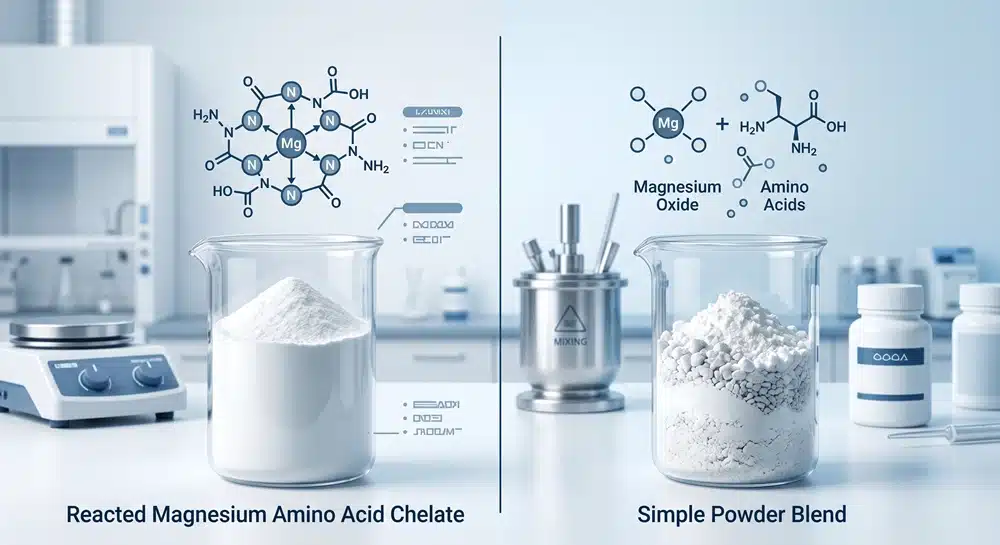
True Chelate vs Simple Blend
| Factor | True Reacted Magnesium Glycinate / Amino Acid Chelate | Simple Blend of Magnesium Oxide + Amino Acid |
| Manufacturing process | Controlled reaction under defined conditions | Physical mixing only |
| Ingredient consistency | More consistent if well manufactured | May vary batch to batch |
| Label credibility | Stronger for premium positioning | Higher risk of misleading positioning |
| COA review | Should show assay, elemental magnesium, and quality data | May not prove actual chelation |
| Best use case | Premium mineral formulas, sleep support, sensitive-stomach positioning | Cost-sensitive products, if label language is accurate |
Magnesium Chelate Amino Acid vs Glycinate: B2B Formulation Comparison
Here is the table formatted in English:
| Factor | Magnesium Amino Acid Chelate | Magnesium Glycinate | Formulation Note for Supplement Brands |
| Ingredient category | Broad category of magnesium bound to amino acids | Specific amino acid chelate using glycine | Glycinate is one type of amino acid chelate. |
| Consumer recognition | Moderate | High | Magnesium glycinate is easier to market for sleep and relaxation. |
| Label positioning | General mineral support, muscle support, sports nutrition | Gentle magnesium, sleep support, stress support, relaxation | Match the form to the product promise. |
| Elemental magnesium | Depends on ligand and supplier specification | Usually depends on chelate ratio and supplier grade | Always calculate elemental magnesium, not just compound weight. |
| Digestive tolerance | Often better than oxide, depends on quality | Often positioned as gentle and well tolerated | Avoid absolute claims; test your final formula. |
| Powder behavior | Varies by ligand, particle size, and grade | Can vary by supplier; may be bulky | Check bulk density before capsule count planning. |
| Best dosage forms | Capsules, tablets, powders, sports nutrition formulas | Capsules, powders, sleep formulas, premium tablets | Gummies and liquids require extra stability and taste review. |
| Cost | Flexible depending on grade | Usually higher than basic forms | Glycinate can support premium pricing. |
| Main sourcing risk | Vague “amino acid chelate” specifications | Buffered or blended material marketed as glycinate | Review COA and supplier documentation. |
How Supplement Brands Should Choose
Choose magnesium glycinate when your product is built around:
- Sleep support
- Relaxation
- Stress support
- Gentle digestion
- Premium mineral nutrition
- Capsules, powders, or nighttime formulas
Choose a broader magnesium amino acid chelate when your product is built around:
- General mineral nutrition
- Sports nutrition
- Muscle function support
- Cost-controlled formulas
- Tablets or capsules with specific elemental magnesium targets
- Multi-mineral blends
Consider neither option until you confirm the real formulation numbers. A magnesium ingredient that looks good in marketing copy may create problems if the bulk density is low, the capsule count is too high, the taste is difficult to mask, or the COA lacks key quality data.
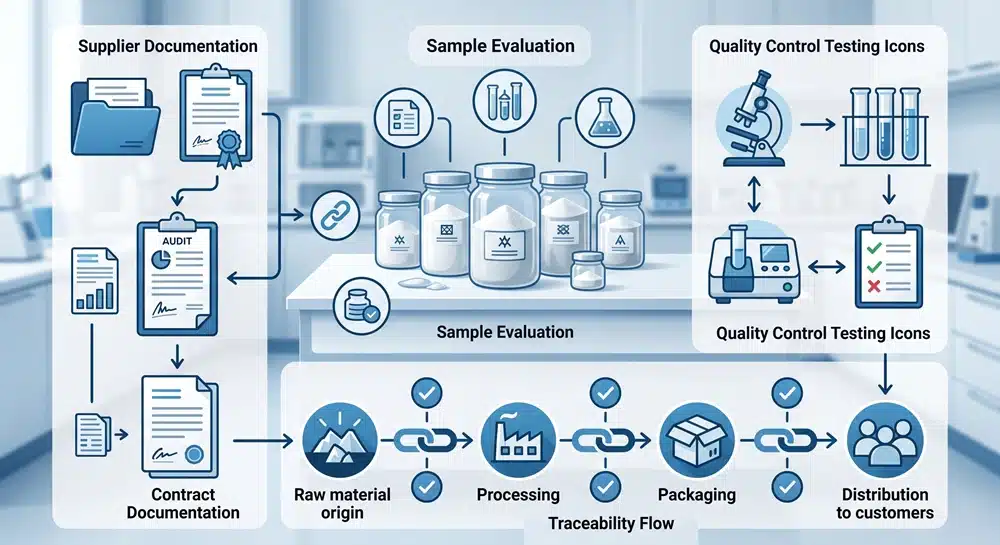
COA Checklist Before Buying Magnesium Glycinate or Amino Acid Chelate
Before purchasing bulk magnesium glycinate or magnesium amino acid chelate, brands should request a complete COA and supplier specification sheet. At minimum, review the following:
- Exact ingredient name
- Ligand identity, such as glycine or mixed amino acids
- Elemental magnesium percentage
- Assay method
- Heavy metals, including lead, arsenic, cadmium, and mercury
- Microbial limits
- Loss on drying or moisture
- Particle size
- Bulk density
- Solubility or dispersibility
- pH, if relevant to the dosage form
- Allergen statement
- GMO status
- Vegan or vegetarian suitability
- Country of origin
- Manufacturing standard
- Shelf life and storage conditions
For tablets, also check compressibility and flow. For capsules, check bulk density and fill weight. For powders, check taste, mouthfeel, and dispersibility. For gummies or liquids, check stability, pH compatibility, taste masking, and mineral interaction with other ingredients.

Manufacturing Notes: Capsules, Tablets, Powders, Gummies and Liquids
Magnesium ingredients can be challenging to formulate because the elemental magnesium dose may require a relatively large compound weight. This affects capsule count, tablet size, powder serving size, and taste.
Capsules
Capsules are practical for magnesium glycinate and amino acid chelates, but the low bulk density of some grades can increase capsule count. Brands should calculate capsule size and serving count before finalizing the claim.
Tablets
Tablets can deliver more material per unit than capsules, but magnesium chelates may require careful excipient selection to achieve good compression, hardness, and disintegration.
Powders
Powder formulas can support higher doses, but taste and mouthfeel become more important. Magnesium glycinate can be difficult to mask in flavored powders if the formula is not designed properly.
Gummies and Liquids
Gummies and liquids require extra attention to taste, pH, stability, and mineral interaction. Not every magnesium chelate grade is suitable for these formats. Pilot testing is strongly recommended before commercial production.

Final Recommendation for Supplement Brands
Magnesium glycinate is usually the stronger choice when your brand wants a premium, gentle, sleep-support, relaxation, or sensitive-stomach positioning.
Magnesium amino acid chelate is the broader category and may be useful for brands that need flexibility in cost, ligand type, dosage form, elemental magnesium target, or multi-mineral formulation.
The key is not to choose by ingredient name alone. Choose by supplier documentation, real chelation evidence, elemental magnesium percentage, COA quality, dosage form feasibility, and brand positioning.
Need Help Developing a Magnesium Supplement?
If you are developing a magnesium capsule, tablet, powder, gummy, liquid, sleep formula, sports nutrition product, or private-label mineral supplement, send us your target elemental magnesium dosage, preferred dosage form, and positioning. Our formulation team can help evaluate magnesium glycinate, magnesium amino acid chelate, citrate, malate, taurate, and other mineral forms for your project.
FAQs About Magnesium Chelate Amino Acid vs Glycinate
Is magnesium glycinate the same as magnesium amino acid chelate?
Magnesium glycinate is a specific type of magnesium amino acid chelate. It uses glycine as the amino acid ligand. Magnesium amino acid chelate is a broader category and may refer to magnesium bound to glycine, mixed amino acids, or other ligands depending on the supplier specification.
Is all magnesium glycinate chelated?
In principle, magnesium glycinate should be a chelated form of magnesium. However, in the supplement market, some materials may be buffered, blended, or marketed with unclear terminology. Brands should verify whether the ingredient is a true reacted chelate or a blend by reviewing supplier documentation and COA data.
What is the difference between magnesium glycinate and magnesium bisglycinate?
The terms are often used similarly in supplement marketing. Magnesium bisglycinate usually refers to magnesium associated with two glycine molecules. Supplier terminology can vary, so brands should confirm the exact specification, elemental magnesium percentage, and assay method.
Which form is better for sleep formulas?
Magnesium glycinate is usually the stronger choice for sleep-support and relaxation formulas because glycine has a strong consumer association with calm and nighttime wellness. However, brands should avoid disease or anxiety-treatment claims and use appropriate structure/function language.
Which form is better for sports nutrition?
A broader magnesium amino acid chelate may be useful for sports nutrition, especially when the product is positioned around muscle function, electrolyte support, or mineral replenishment. Magnesium glycinate can also be used, but the best choice depends on dose, taste, capsule count, and formula cost.
What should brands check before buying magnesium glycinate?
Brands should check exact ingredient name, elemental magnesium percentage, assay method, ligand identity, heavy metals, microbial limits, particle size, bulk density, moisture, allergen status, vegan suitability, country of origin, and whether the material is reacted or simply blended.
Is magnesium glycinate better than magnesium oxide?
Magnesium glycinate is often positioned as a more premium and better-tolerated form than magnesium oxide. However, magnesium oxide has a much higher elemental magnesium percentage and lower cost. The better choice depends on the product goal, target user, price point, and dosage form.
Can brands use “supports anxiety” or “treats insomnia” claims?
No. Dietary supplements should not claim to diagnose, treat, cure, or prevent disease. Safer structure/function-style language includes “supports relaxation,” “supports sleep quality,” “supports normal muscle function,” or “supports daily mineral intake,” as long as the claim is truthful and substantiated.
Can magnesium glycinate be used in gummies or liquids?
It may be possible, but gummies and liquids require careful testing for taste, pH compatibility, stability, texture, and mineral interaction. Brands should run pilot batches before committing to commercial production.
Which form is best for private-label magnesium products?
For premium sleep and relaxation products, magnesium glycinate is often the best starting point. For broader mineral nutrition or cost-sensitive formulas, magnesium amino acid chelate, citrate, malate, or other forms may be considered. The best choice depends on the label claim, dosage form, serving size, cost target, and target consumer.
References
- NIH Office of Dietary Supplements. Magnesium — Health Professional Fact Sheet. https://ods.od.nih.gov/factsheets/Magnesium-HealthProfessional/
- Case DR, et al. Synthesis and Chemical and Biological Evaluation of a Magnesium Triglycine Chelate. Molecules. 2021. https://pmc.ncbi.nlm.nih.gov/articles/PMC8122334/
- Blancquaert L, et al. Predicting and Testing Bioavailability of Magnesium Supplements. Nutrients. 2019. https://pmc.ncbi.nlm.nih.gov/articles/PMC6683096/
- FDA. Structure/Function Claims. https://www.fda.gov/food/nutrition-food-labeling-and-critical-foods/structurefunction-claims
- FDA. Notifications for Structure/Function and Related Claims in Dietary Supplement Labeling. https://www.fda.gov/food/information-industry-dietary-supplements/notifications-structurefunction-and-related-claims-dietary-supplement-labeling
- eCFR. 21 CFR Part 111 — Current Good Manufacturing Practice in Manufacturing, Packaging, Labeling, or Holding Operations for Dietary Supplements. https://www.ecfr.gov/current/title-21/chapter-I/subchapter-B/part-111
- FDA. Small Entity Compliance Guide: Current Good Manufacturing Practice in Manufacturing, Packaging, Labeling, or Holding Operations for Dietary Supplements. https://www.fda.gov/regulatory-information/search-fda-guidance-documents/small-entity-compliance-guide-current-good-manufacturing-practice-manufacturing-packaging-labeling
- USP. Dietary Supplements Verification Program. https://www.usp.org/verification-services/dietary-supplements-verification-program
- NSF. Certified for Sport Program. https://www.nsf.org/consumer-resources/articles/certified-for-sport-program
- Current page reviewed: Magnesium Chelate Amino Acid vs Glycinate. https://collagensei.com/magnesium-chelate-amino-acid-vs-glycinate/

Warren Wan is a seasoned expert with extensive experience in the dietary supplement supply chain, possessing rich practical experience in the research, development, process control, and global sourcing of core ingredients such as collagen peptides, bone broth protein, and keratin. As the author of this column, he is dedicated to stripping away the marketing packaging, transforming obscure ingredient science and production quality control standards into easy-to-understand, hardcore science popularization, helping readers understand the truth behind the labels and make more rational health choices.


