“Yes, collagen peptides count toward your daily protein intake, but they are considered an incomplete protein due to the lack of tryptophan. Research suggests collagen can safely replace up to 36% of total protein in a balanced diet without causing deficiencies. However, for muscle hypertrophy, it should not replace whey or meat but rather complement them to support connective tissue health.”
I. The Biochemical Identity of Collagen: A Misunderstood “Underachiever”
To accurately answer “Do collagen peptides count as protein?”, we must first remove the lens of commercial marketing and examine the molecule through the objective lens of biochemistry. This is not a moral judgment of “good” versus “bad” protein, but strictly a matter of Amino Acid Sequence.
What Actually is Collagen? More Than Just “Skin Glue”
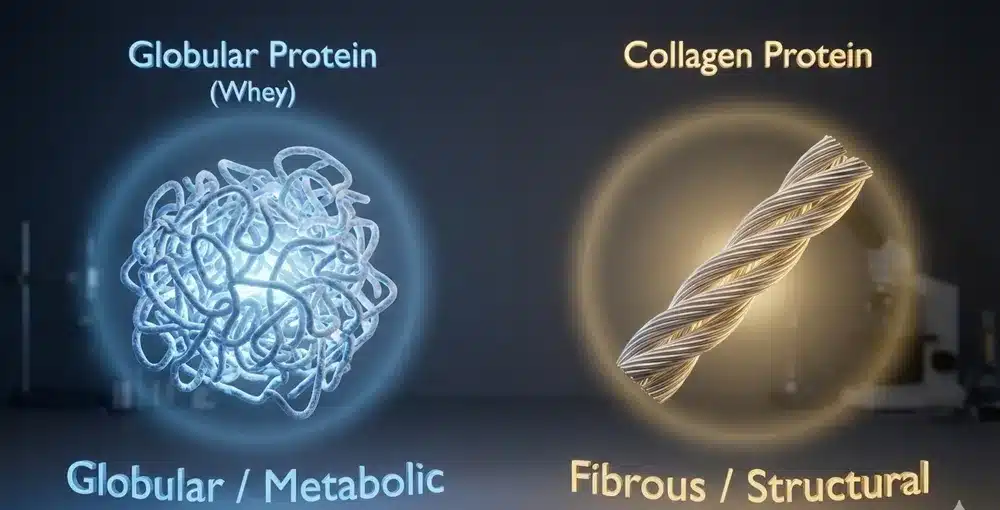
If Whey protein is the “brick” used to build the muscle skyscraper, Collagen is the “steel reinforcement bars” (rebar) that holds the entire structure together. As the most abundant protein in the human body (accounting for ~30% of total protein mass), its uniqueness stems from its rigid Triple Helix Structure.
This structure demands a highly specific, repetitive amino acid sequence known as Gly-X-Y. Every third residue must be Glycine, while the X and Y positions are frequently occupied by Proline and Hydroxyproline. This extreme structural requirement creates an amino acid profile that is radically different from other dietary proteins.
📊 Data Speaks: Collagen vs. Whey vs. Egg
To visualize this difference, let’s compare the amino acid distribution of three common protein sources (g/100g protein):
| Amino Acid | Collagen Peptides | Whey Isolate | Whole Egg | Functional Role |
| Glycine | 20 – 33g 🚀 | 1.5 – 2.0g | 3.0 – 4.0g | Master anti-inflammatory; precursor for DNA, Creatine, & Glutathione. |
| Proline | 12 – 14g 🚀 | 5.0 – 6.0g | 3.0 – 4.0g | Critical for vascular and joint stability (Helix structure). |
| Hydroxyproline | 10 – 12g 🚀 | 0g | 0g | Collagen’s Unique Fingerprint; acts as a signaling molecule for tissue repair. |
| Leucine | 2.5 – 3.0g | 10 – 12g 🔥 | 8.5g | The “Key” that turns on muscle synthesis (mTOR pathway). |
| Tryptophan | 0g ❌ | 1.5 – 2.0g | 1.5g | Essential Amino Acid (EAA); precursor to Serotonin. |
> Data synthesized from USDA FoodData Central and Paul et al. (2019).
Key Insights:
- Specialized, Not Inferior: Collagen is not “lacking” so much as it is “specialized.” Its Glycine content is 10x higher than Whey. If your goal is strictly muscle hypertrophy (driven by Leucine), Collagen is inferior. If your goal is tendon repair (driven by Hydroxyproline), Collagen is irreplaceable.
- The Fatal Flaw: The glaring “0g” of Tryptophan is the primary reason Collagen has been historically dismissed by nutritionists.
The “Incomplete” Label & The PDCAAS Paradox
In many nutrition textbooks and tracking apps (like MyFitnessPal), Collagen is often flagged or discounted because its PDCAAS (Protein Digestibility Corrected Amino Acid Score) is 0. Does a zero score mean zero value?
1. Why is the Score 0? (Liebig’s Law of the Minimum)
The PDCAAS calculation follows the “wooden bucket theory”: the capacity of a bucket is determined by its shortest stave.
- The human body cannot synthesize the 9 Essential Amino Acids (EAAs); they must come from food.
- Collagen completely lacks Tryptophan.
- Mathematically, if any single essential amino acid is 0, the entire PDCAAS score becomes 0.
The Misconception: PDCAAS is designed to evaluate if a single food source can sustain a child’s growth. In the real world, adults rarely survive on collagen alone.
2. The Paradigm Shift: The 36% Rule
A landmark study by Paul et al. (2019) challenged this binary view. The research team used linear programming to analyze the protein quality of the Standard American Diet (SAD).
The Finding:
Because modern diets are typically rich in meat, dairy, and eggs (which provide a surplus of Tryptophan and Methionine), an adult can substitute up to 36% of their daily protein intake with Collagen Peptides without dropping the overall diet’s PDCAAS below a perfect 1.0.11
💡 Expert Interpretation:
This means if you eat 100g of protein daily, 36g can come from Collagen, and the remaining 64g (from meat/dairy/plants) will provide enough “spare” Tryptophan to balance the equation. You are not “diluting” your nutrition; you are optimizing it. By utilizing the surplus amino acids from other foods, you unlock unique benefits—such as using Collagen Peptides for Cellulite reduction and tendon repair—without sacrificing overall protein quality.
II. Collagen for Muscle Growth: Myth vs. Truth
In the fitness community, the most common criticism of collagen is: “It won’t help you build muscle; just drink whey.” This statement is only half true.
Recent advances in exercise physiology have revealed a more complex reality: Muscle is not just contractile fiber; it requires a structural scaffold capable of withstanding immense tension.
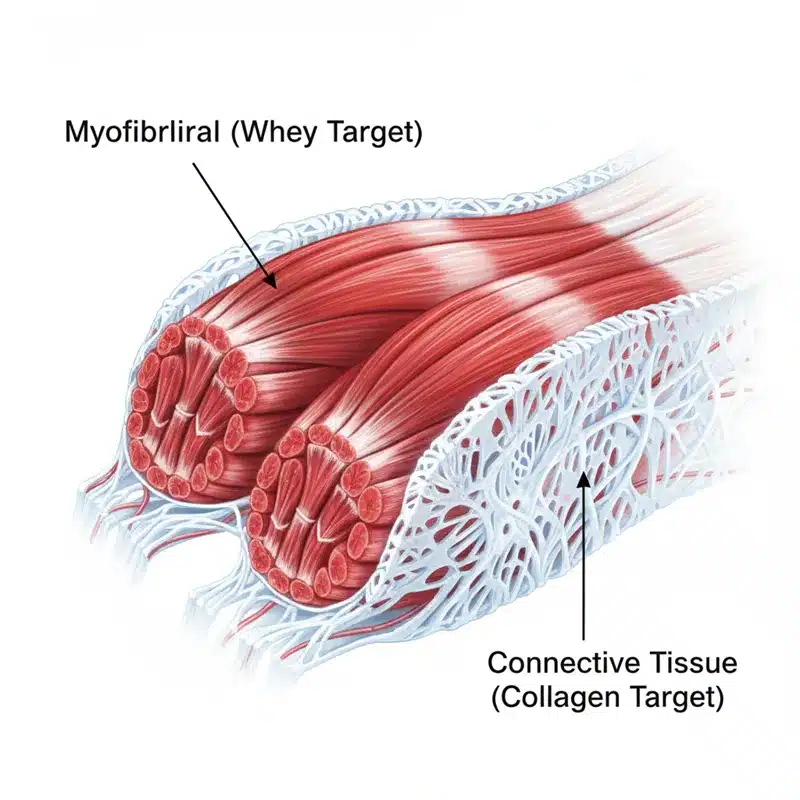
1. The Dual-Pathway Theory: Myofibrillar vs. Connective Tissue
To understand the true role of collagen, we must deconstruct “muscle growth” into two distinct biochemical pathways.
- Pathway A: Myofibrillar Protein Synthesis (MPS)
- Goal: Increase the cross-sectional area of muscle fibers (hypertrophy), making you look bigger.
- Driver: Leucine. This essential amino acid acts as a “switch” to activate the mTORC1 pathway, initiating the muscle-building process.
- The Winner: Whey Protein. Research confirms that whey is significantly superior to collagen for increasing muscle thickness because collagen has a very low leucine content. If your only goal is muscle size, collagen is indeed not the primary tool.
- Pathway B: Muscle Connective Protein Synthesis (MCPS)
- Goal: Strengthen the endomysium, perimysium, and tendons. These act as the “mechanical transmission system” that transfers muscle force to the bone. If the engine (muscle) is strong but the chassis (connective tissue) is weak, force cannot be output efficiently, and injury risk increases.
- Driver: Glycine & Proline.
- The Winner: Collagen. While standard whey intake drives fiber growth, it has been shown to be ineffective at stimulating the synthesis of muscle connective tissue. This is whey’s blind spot, but collagen’s home turf.
2. The 2024-2025 Breakthrough: The Synergy Effect
For years, we believed we had to choose between “muscle building (Whey)” and “joint protection (Collagen).” However, a recent randomized controlled trial published in Medicine & Science in Sports & Exercise has shattered this binary opposition.
Key Study (Holwerda et al., 2024/2025): Researchers compared the effects of single-source protein versus a protein blend on post-exercise recovery.
- Protocol: Subjects ingested a blend of 25g Whey Protein + 5g Collagen following unilateral resistance training.
- Results:
- Amino Acid Surge: The blend provided ample Leucine (from Whey) while significantly elevating plasma concentrations of Glycine and Hydroxyproline (from Collagen).
- Dual Synthesis: This specific blend successfully increased both myofibrillar (MPS) and muscle connective protein synthesis (MCPS) rates simultaneously.
💡 Expert Verdict: You don’t have to abandon whey, but you shouldn’t ignore collagen. The optimal strategy is the “25g + 5g” Rule—adding one scoop (approx. 5-10g) of collagen peptides to your post-workout whey shake. This ensures your muscles become both “bigger” and “tougher.”
3. The “Keith Baar Protocol” for Tendon Health
For athletes suffering from tendinopathy or engaging in high-impact plyometrics, simply “eating” collagen is not enough; timing is everything. The team led by Professor Keith Baar at UC Davis developed a rehabilitation protocol now utilized by NBA and Premier League teams.
The Mechanism: The Sponge Effect Tendons are like sponges with poor blood supply. Nutrients can only enter the tendon matrix when mechanical loading forces fluid out (during stretching) and sucks new fluid in (during relaxation). Collagen peptide concentrations in the blood typically peak 30–60 minutes after ingestion.
The Action Plan:
- Intake: Consume 15g Hydrolyzed Collagen + 50mg Vitamin C exactly 30–60 minutes before training. (Vitamin C is a necessary cofactor for collagen cross-linking).
- Activity: Perform 6–10 minutes of targeted loading (e.g., rope skipping, heavy isometric holds, or slow eccentrics). Beyond 10 minutes, the sensitivity of tendon cells to mechanical signals begins to plateau.
- Rest Window: Allow at least 6 hours of rest after training for the cells to synthesize new collagen.
III. Practical Macro Tracking: How to Calculate & Record
The confusion around tracking collagen stems from a clash between Biochemistry (what molecules are present) and APP Algorithms (how databases score quality).
Most tracking apps (like MyFitnessPal or Cronometer) will either:
- Count collagen toward your protein total fully.
- Display a warning that the protein is “incomplete.”
Neither is fully helpful. Here is the scientifically accurate protocol for tracking collagen based on your specific goal.
1. Context Matters: The 3 Tracking Scenarios
You should treat collagen differently depending on why you are tracking macros.
- Scenario A: General Health / Anti-Aging / Skin Health
- The Strategy: Count it 1:1.
- The Science: If you are eating a standard mixed diet (containing meat, eggs, or dairy), you are likely consuming surplus essential amino acids. According to the 36% Rule, you can safely count collagen toward your daily protein goal without risking deficiency.
- Action: If your goal is 100g protein/day, and you take 20g collagen, you need 80g from other sources. No complex math required.
- Scenario B: Hypertrophy & Bodybuilding (Strict)
- The Strategy: The “Leucine Buffer” Method.
- The Science: For muscle growth, the primary driver is hitting the Leucine Threshold (~2.5–3g per meal) to trigger mTOR.3 Collagen contributes almost zero Leucine.
- Action: Do not count collagen toward your “per meal” protein target for muscle protein synthesis (MPS).
- Example: If you aim for 30g protein post-workout to spike MPS, do not use 20g whey + 10g collagen and call it “30g.” You must hit 30g with Whey/Meat first, then add Collagen on top as “bonus” structural protein.
- Scenario C: Keto / Paleo / Carnivore
- The Strategy: Count for Satiety, Watch Tryptophan.
- The Science: Collagen is highly satiating and blood-sugar neutral, making it excellent for Keto. However, relying on it too heavily (e.g., >40% of intake) can lead to Tryptophan Depletion, potentially affecting serotonin production and mood.
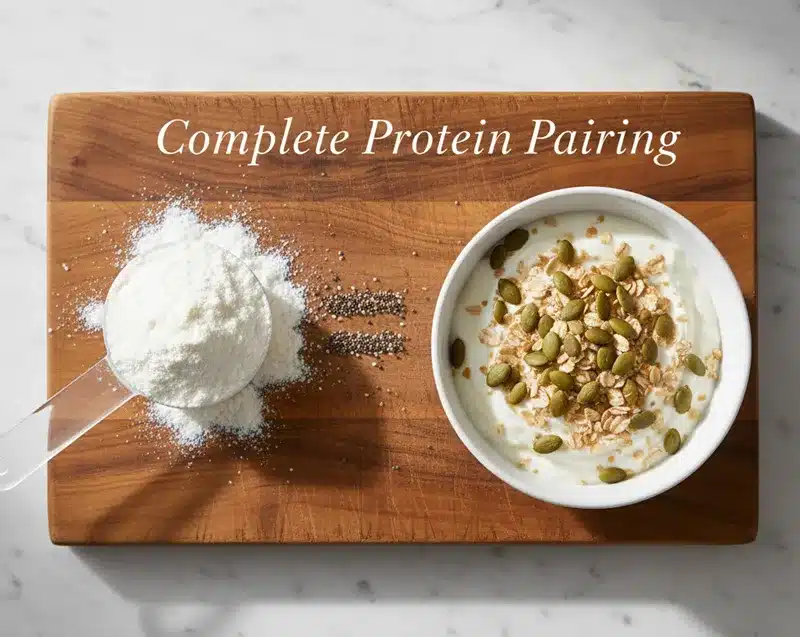
- Action: Ensure you pair every serving of collagen with a tryptophan-rich fat/protein source (e.g., eggs or pumpkin seeds).

2. Hacking the Tryptophan Gap: “Food Math”
Collagen lacks Tryptophan (Trp), an essential amino acid. The average adult requires approximately 6mg of Tryptophan per gram of protein to maintain nitrogen balance.
This means for every 20g serving of Collagen, you need to “find” approximately 120–130mg of Tryptophan from other foods to “complete” the protein profile in your stomach.
⚠️ Warning: Avoid “Fortified” Collagen
You may see “Complete Collagen” products on the market fortified with synthetic Tryptophan. Avoid these.
- Reason: Free-form amino acids are unstable during processing. Research suggests that fortifying hydrolyzed collagen can lead to degradation and the formation of potential toxins or off-flavors due to the Maillard reaction and oxidation.
- Better Solution: Use whole foods. It is safer, cheaper, and more bioavailable.
📊 The “Collagen Completion” Table
Use this table to construct meals that naturally “complete” your collagen.
| Pairing Food (Serving Size) | Tryptophan Content (approx.) | Collagen “Capacity” | The Verdict |
| Whey Isolate (1 scoop / 25g) | ~412 mg | Completes ~60g Collagen | 🏆 The Perfect Partner. Whey has a massive Trp surplus. Mixing them is chemically ideal. |
| Pumpkin Seeds (1 oz / 28g) | ~163 mg | Completes ~25g Collagen | Best for Vegans/Paleo. A handful of seeds makes your collagen smoothie “complete.” |
| Tofu (0.5 cup / 120g) | ~296 mg | Completes ~45g Collagen | Excellent. Soy is one of the highest plant sources of Trp. |
| Oatmeal (1 cup cooked) | ~94 mg | Completes ~15g Collagen | Good Breakfast. Adding collagen to oatmeal almost balances out, but add some seeds to be sure. |
| Eggs (2 large) | ~166 mg | Completes ~25g Collagen | Standard Standard. A collagen coffee + 2 eggs breakfast is fully balanced. |
| Greek Yogurt (1 cup) | ~100-150 mg | Completes ~20g Collagen | Solid Snack. Mix collagen powder directly into yogurt. |
📝 The Formula for Geeks:
Target Tryptophan = (Grams of Collagen) × 6.6
- If your pairing food provides more Tryptophan than this number, your meal effectively has a PDCAAS of 1.0.
IV. Safety & Contraindications: The “Fine Print” of Collagen
While collagen is generally recognized as safe (GRAS), its unique amino acid profile and manufacturing sources introduce specific risks that are often overlooked in marketing materials. For certain populations, these risks are metabolically significant.
1. The Oxalate Risk: Kidney Stone Formation
This is the most critical contraindication for individuals with a history of nephrolithiasis (kidney stones).
- The Mechanism: Collagen is exceptionally rich in Hydroxyproline. Unlike other amino acids, hydroxyproline is not reused for protein synthesis; it must be broken down in the liver. A primary metabolic byproduct of this breakdown is glyoxylate, which is further oxidized into oxalate.
- The Data: An older but pivotal study found that consuming 30g of gelatin (which is chemically similar to collagen peptides) increased urinary oxalate excretion by 43%.
- The Verdict: For healthy individuals, the kidneys easily filter this excess oxalate. However, for those with primary hyperoxaluria or a history of calcium-oxalate stones, high-dose collagen supplementation (over 10g/day) can significantly elevate the risk of stone formation.
- Actionable Advice: If you are prone to stones, limit intake to <10g/day and consume adequate dietary calcium simultaneously to bind oxalates in the gut before they enter the bloodstream.
2. Contamination: Heavy Metals & Toxins
Because collagen is extracted from animal hides, bones, and scales (parts that can accumulate environmental toxins), purity is a major concern.
- The Clean Label Project Study (2020): A widely cited white paper analyzing 30 collagen products found that 64% tested positive for measurable levels of arsenic, 37% for lead, and 34% for mercury. This contamination is often due to the animal feed or industrial processing methods.
- Marine Collagen Risks: While often touted as “cleaner,” marine collagen derived from fish scales can carry higher risks of mercury and other marine pollutants if not sourced from deep-water, wild-caught fish.
- Mitigation Strategy: Strict adherence to Third-Party Testing is non-negotiable. Look for certification seals from NSF Certified for Sport or Informed Choice, which rigorously test for heavy metals and banned substances.
3. Histamine Intolerance & Allergic Reactions
This is an emerging area of concern for the “bio-hacker” community and those with autoimmune sensitivities.
- Histamine Mechanism: Many collagen peptides are fermented or processed in ways that can increase biogenic amines. Furthermore, marine collagen is a known trigger for those with seafood allergies.
- MCAS Warning: For individuals with Mast Cell Activation Syndrome (MCAS) or histamine intolerance, collagen peptides can trigger flares (hives, headaches, GI distress). This is likely due to the high concentration of Glycine, which can influence neurotransmitter balance, or the presence of residual histamines from the source material.
- Digestive Distress (Bloating): Although rare (affecting ~15-20% of users), some users experience bloating or constipation. This is often due to the hydrophilic (water-loving) nature of collagen peptides. If you do not drink adequate water, the peptides can draw fluid into the gut, altering bowel motility.
4. Medication Interactions
- Tryptophan Fortification Risks: Some brands “spike” their collagen with L-Tryptophan to make it a “complete protein.” Users on SSRI antidepressants (like Prozac or Zoloft) should be cautious, as excessive tryptophan intake can theoretically contribute to Serotonin Syndrome, a rare but serious condition caused by excessive serotonin accumulation.
- General Rule: Always consult a physician before adding high-dose amino acid therapy if you are on prescription medication.
Summary Checklist for Safety
| Risk Factor | Risk Level | Mitigation Strategy |
| Kidney Stones | High (for susceptible groups) | Limit to <10g/day; increase calcium intake. |
| Heavy Metals | Moderate | Buy only 3rd-party tested (NSF/Informed Choice). |
| Shellfish Allergy | High (Marine only) | Use Bovine (Cow) collagen instead. |
| Histamine Intolerance | Moderate | Test with small doses (2-3g); monitor symptoms. |
V. Conclusion
Collagen peptides absolutely count toward your daily protein intake, but they must be viewed as a specialized structural nutrient rather than a generic muscle builder. Think of collagen not as a “lesser” protein, but as the “yin” to whey protein’s “yang”: while whey drives the metabolic engine of muscle growth (via Leucine), collagen constructs the mechanical chassis—the tendons, ligaments, and fascia—that supports that horsepower. To maximize longevity and performance without sacrificing nutritional quality, the science dictates a complementary approach: count collagen toward your macros, but ensure it comprises no more than 36% of your total daily protein to maintain a perfect PDCAAS score.