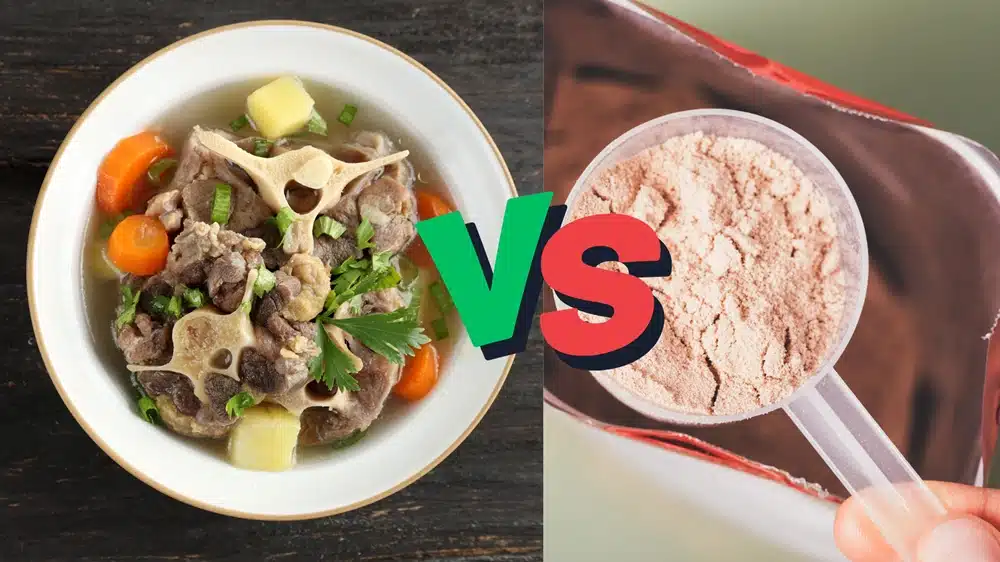
Bone broth powder can still contribute grams of protein and collagen-characteristic amino acids such as glycine, proline and hydroxyproline. The key is to separate “contains protein” from “provides all indispensable amino acids in adequate amounts.”

What Is a Complete Protein?
A nutritionally complete protein supplies all nine indispensable amino acids in proportions that meet the relevant human amino-acid scoring pattern. The nine are histidine, isoleucine, leucine, lysine, methionine, phenylalanine, threonine, tryptophan and valine.
Three questions matter:
- Presence: Is each indispensable amino acid detectable?
- Adequacy: Is each one present in a sufficient amount per gram of protein?
- Digestibilité : How much of the protein and each amino acid is available after digestion?
A product does not become a high-quality complete protein merely because a laboratory detects trace amounts of all nine amino acids. Protein quality methods compare the limiting indispensable amino acid with a reference pattern and account for digestibility.
Is Bone Broth Protein Powder Complete?
Usually not when collagen is the dominant protein. Collagen is rich in glycine, proline and hydroxyproline but lacks tryptophan in its classic amino-acid profile and contains relatively modest levels of several muscle-oriented indispensable amino acids. Under the PDCAAS approach, an absent limiting amino acid can reduce the score to zero.
That conclusion should not be applied blindly to every product carrying the name bone broth protein. Commercial powders can differ by raw material, extraction process, degree of hydrolysis, retained meat protein, carriers, flavors and added amino acids. Request the full amino-acid report for the current ingredient or finished batch.
First Identify What the Powder Actually Is
| Identité du produit | Typical protein character | Can it be assumed complete? | Ce qu'il faut vérifier |
|---|---|---|---|
| Whole bone broth powder | Dried broth solids with variable protein, sodium, ash, flavor compounds and gelatin-derived material | Non | Protein per serving, full amino-acid profile, sodium, ash and ingredient list |
| Collagen-dominant bone broth protein | Hydrolyzed or concentrated connective-tissue protein rich in glycine, proline and hydroxyproline | Generally no | Tryptophan, all EAAs, hydroxyproline, protein quality and source tissue |
| Muscle-meat isolat de protéines de bœuf | May have a more complete EAA profile if genuinely derived from muscle protein | Not from the name alone | Source declaration, amino-acid profile, leucine and tryptophan, digestibility data |
| Fortified or blended formula | Bone broth protein combined with whey, milk, egg, soy, pea-rice protein or amino acids | Possibly | Finished-formula EAA profile and protein quality calculation at the labeled serving |
Consumers comparing formats can also review the bone broth powder vs liquid guide. Powder is more concentrated and convenient, but format alone does not determine protein completeness.

Why Tryptophan and Leucine Matter
Tryptophan is the classic limiting issue
Collagen protein is commonly classified as incomplete because tryptophan is absent. Some complex broth products may contain trace tryptophan from residual non-collagen proteins, but a trace amount does not establish adequacy. The report should show milligrams of each indispensable amino acid per gram of protein or per labeled serving.
Leucine affects muscle-protein positioning
Leucine is one of the essential amino acids involved in the regulation of muscle protein synthesis. Collagen-dominant proteins generally provide less leucine and a less balanced EAA profile than whey, milk, egg, soy or well-designed plant-protein blends. Therefore, bone broth protein should not automatically be positioned as a direct one-for-one replacement for a complete sports protein.
For a focused comparison, see the bone broth protein vs whey comparison. The most useful choice depends on the product goal rather than a universal winner.
Does Bone Broth Still Count as Protein?
Yes. If the label reports protein grams and the testing supports that value, those grams contribute to total dietary protein intake. “Incomplete” does not mean “not protein.” It means the source should not be relied on as the sole high-quality protein source for meeting all indispensable amino-acid needs.
For U.S. food labeling, protein grams and protein Percent Daily Value are not identical calculations. When a protein claim or Percent Daily Value is used, protein quality may need to be considered through the applicable regulatory method. Brands should have regulatory review before using claims such as “high protein,” “excellent source of protein” or a specific protein %DV.
Is Bone Broth Protein Good for Muscle Building?
Bone broth protein can contribute amino acids and total protein, but a collagen-dominant product is not the strongest standalone option for maximizing muscle-protein synthesis. Consumers whose primary goal is muscle gain should prioritize adequate total protein and complete, leucine-containing protein sources across the diet.
Bone broth protein may be used alongside a complete protein when a consumer also values its taste, animal-based positioning or collagen-characteristic amino-acid profile. It should not be marketed as “better than whey,” “directed to joints” or “clinically proven to prevent injury” without finished-product evidence.
How to Make Bone Broth Protein More Complete
Consumer pairing options
Use bone broth protein as one part of a varied protein pattern rather than the only source. Practical complementary sources include:
- whey, milk or yogurt;
- egg protein;
- fish, poultry or meat;
- protéines de soja ;
- a verified pea-and-rice or other complete plant-protein blend.
Adding only BCAAs is not enough because BCAA products do not provide all nine indispensable amino acids. Adding only tryptophan may also be insufficient if another amino acid is limiting at the target serving. The overall diet matters more than a marketing phrase on one ingredient.
Formulation requirements for brands
A supplement brand should formulate from actual analytical data:
- Obtain a full amino-acid profile for every protein ingredient.
- Set the target protein serving and target consumer.
- Compare the finished blend with the relevant indispensable amino-acid scoring pattern.
- Account for protein digestibility using the method required for the target claim and market.
- Verify the finished product after flavor, carrier and processing changes.
- Review Nutrition Facts or Supplement Facts presentation and all protein claims.
Brands developing a finished powder can work with a protein supplement manufacturing partner to evaluate serving size, amino-acid balance, flavor, blend uniformity and finished-product testing.

Bone Broth Protein vs Other Protein Sources
| Source de protéines | Typical complete-protein status | Relative EAA/leucine positioning | Best-fit use |
|---|---|---|---|
| Collagen-dominant bone broth protein | Usually incomplete | Lower EAA balance; rich in glycine, proline and hydroxyproline | Bone-broth concepts, savory powders, collagen-positioned blends |
| Whey or milk protein | Compléter | Leucine-rich and commonly used for sports nutrition | Muscle-oriented protein powders and meal products |
| Protéines d'œuf | Compléter | Balanced indispensable amino-acid profile | Dairy-free complete-protein products where egg is acceptable |
| Protéine de soja | Compléter | Plant-based complete protein; allergen declaration required | Vegan and plant-based products |
| Well-designed plant-protein blend | Can be complete | Depends on ingredient ratio, serving and digestibility | Vegan powders and meal replacements |
| Muscle-meat beef protein isolate | May be complete | Depends on true source and analytical profile | Dairy-free animal-protein products |
Chicken and beef source alone does not establish protein quality. The chicken bone broth vs beef bone broth guide explains why lot-specific amino-acid and quality data matter more than broad species marketing.
Consumer Label Checklist
- Read the exact ingredient name: bone broth powder, chicken bone broth protein, collagen peptides and beef protein isolate are not automatically equivalent.
- Check protein per prepared serving: compare the amount you actually consume, not the dry scoop weight alone.
- Do not infer complete protein from “animal protein”: connective-tissue collagen differs from muscle meat.
- Look for amino-acid transparency: especially tryptophan, leucine and all nine indispensable amino acids.
- Check sodium: broth-style products can vary widely.
- Review flavors and carriers: sweeteners, coconut ingredients, gums and dairy components can change allergen and dietary positioning.
- Verify current certifications: confirm the exact product and certificate scope rather than relying on a logo.
- Use complete protein elsewhere in the diet: especially when the powder is used as a meal or post-workout product.
Supplier and COA Checklist for Brands
| Spécifications | Que demander ? | Pourquoi est-ce important ? |
|---|---|---|
| Identité et source | Animal species, tissue inputs, country of origin, process description | Separates true broth, collagen-derived protein and muscle-meat protein |
| Protein assay | Method, as-is and dry-basis result, nitrogen conversion factor | Supports serving calculation and label review |
| Profil complet en acides aminés | All nine indispensable amino acids plus glycine, proline and hydroxyproline | Determines completeness and confirms collagen character |
| Tryptophan method | Validated method suitable for tryptophan analysis | Tryptophan can require a different hydrolysis approach from other amino acids |
| Protein quality | Applicable amino-acid score and digestibility documentation | Needed before making strong protein-quality claims |
| Propriétés physiques | Moisture, ash, sodium, pH, mesh, bulk density, solubility/dispersibility | Affects serving size, taste, blending and packaging |
| Safety testing | Lead, cadmium, arsenic, mercury, microbiology and relevant pathogens | Supports raw-material release and finished-product safety |
| Animal-origin controls | BSE/TSE documentation, veterinary/source records, allergen statement | Supports market access and label claims |
| Batch consistency | Recent lot COAs and change-control policy | Broth composition can vary by raw material and process |
| Finished-product suitability | Flavor, sodium, mixing, heat exposure and stability data | Raw-material data do not replace finished-product testing |
Procurement teams can use bulk chicken bone broth powder specifications as a starting point, but every published specification should be reconciled with the current batch COA, amino-acid data and the target market’s regulatory requirements.
Safety, Allergens and Claims
- Bone broth protein is animal-derived and is not vegan or vegetarian.
- Species, flavor systems and co-ingredients can create allergen, religious-certification and market-access requirements.
- Consumers with medically prescribed protein restrictions, kidney disease, allergies or pregnancy-related concerns should discuss concentrated protein supplements with a qualified healthcare professional.
- Brands should not claim that bone broth protein treats intestinal permeability, reduces systemic inflammation, rebuilds cartilage, prevents injury or cures joint disease without appropriate regulatory authorization and finished-product evidence.
- Structure/function claims must be truthful, non-misleading and supported by evidence relevant to the actual product, dose and population.
Questions fréquemment posées
Is bone broth protein powder a complete protein?
Most collagen-dominant products are not complete proteins because tryptophan is absent or severely limited and the overall indispensable amino-acid pattern is weak. Check the finished product’s full amino-acid profile because blended or fortified formulas can differ.
Is regular liquid bone broth a complete protein?
Do not assume so. Liquid bone broth varies greatly by recipe, concentration and retained meat protein. It may contribute protein, but a complete-protein classification requires adequate indispensable amino acids and digestibility data.
How can I make bone broth protein more complete?
Pair it with a complete protein such as dairy, egg, soy, fish, meat or a verified complete plant-protein blend. For a commercial formula, calculate and test the finished EAA profile rather than adding BCAAs or a single amino acid by guesswork.
Does bone broth protein count toward daily protein?
Yes, its tested protein grams can contribute to total intake. However, it should not be the only protein source used to meet indispensable amino-acid needs.
Is bone broth protein good for building muscle?
It can contribute protein, but collagen-dominant bone broth is generally lower in leucine and total indispensable amino acids than whey, milk, egg, soy or a balanced plant blend. Use a complete protein as the primary muscle-oriented source.
Is chicken bone broth more complete than beef bone broth?
Not automatically. Species can influence composition, but extraction, retained tissues and processing also matter. Compare full amino-acid reports from the actual lots.
Is Ancient Nutrition bone broth protein a complete protein?
A brand name or category is not enough to answer. Review the current product label, ingredient sources, amino-acid profile and any protein-quality documentation because formulas can change.
Is bone broth protein powder vegan?
No. Bone broth protein is made from animal-derived materials. A plant product marketed with “broth-style” flavor is a different product and should not be called true bone broth protein.
Conclusion
Most collagen-dominant bone broth protein powders are not nutritionally complete standalone proteins. They can still provide protein and collagen-characteristic amino acids, but completeness depends on indispensable amino-acid adequacy and digestibility—not the words “bone broth,” “animal protein” or “hydrolyzed.” Consumers should use them within a varied protein pattern, and brands should verify the finished formula with full amino-acid, protein-quality and safety data before making claims.
Références
- FAO : Évaluation de la qualité des protéines alimentaires dans la nutrition humaine
- Collagen Peptides and Indispensable Amino Acid Balance
- Bone Broth Amino Acid Variability Study
- NCBI Bookshelf: Essential Amino Acids
- FDA: Protein Quality and Nutrition Facts Label Resources
- FDA : Allégations « structure/fonction »
- FDA: Dietary Supplement CGMP Guide
- FTC : Lignes directrices relatives à la conformité des produits de santé
Disclaimer: This article is for educational and formulation-planning purposes and is not medical, legal or regulatory advice. Product claims, labels and specifications should be reviewed for the target market by qualified professionals.

Warren Wan est un expert chevronné qui possède une vaste expérience dans la chaîne d’approvisionnement des compléments alimentaires, ainsi qu’une solide expertise pratique dans la recherche, le développement, le contrôle des processus et l’approvisionnement mondial d’ingrédients clés tels que les peptides de collagène, les protéines de bouillon d’os et la kératine. En tant qu'auteur de cette chronique, il s'attache à aller au-delà des discours marketing pour transformer les notions scientifiques obscures relatives aux ingrédients et les normes de contrôle qualité de la production en une vulgarisation scientifique rigoureuse et accessible, aidant ainsi les lecteurs à comprendre la vérité qui se cache derrière les étiquettes et à faire des choix plus rationnels en matière de santé.