The phrase peptide de collagène de soie is commonly used as a commercial name, but silk fibroin is not Type I, II or III collagen. Brands should identify the actual ingredient rather than combining unrelated protein names. This guide compares the three categories for consumers, formulators and supplement buyers.
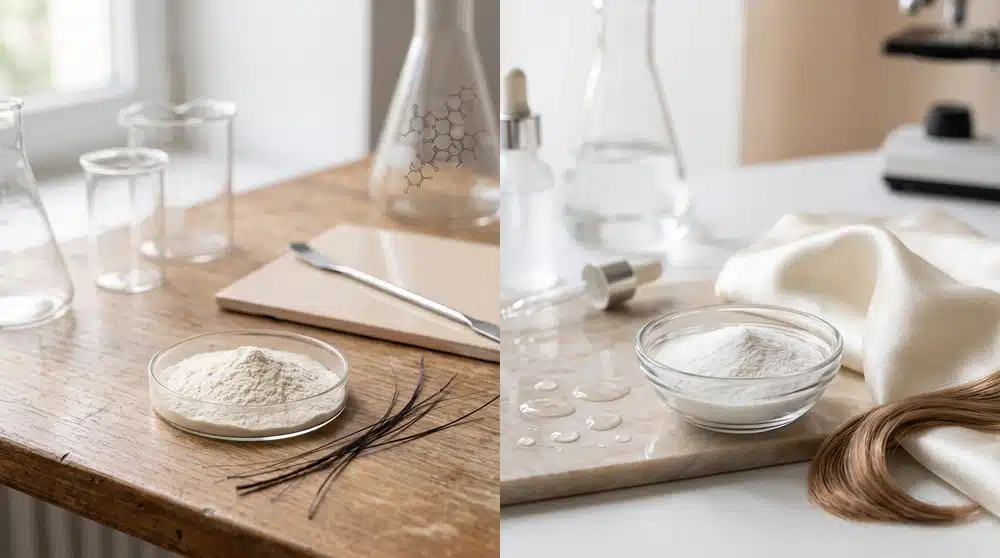
Keratin vs Collagen vs Silk Peptides at a Glance
| Facteur | Kératine hydrolysée | Peptide de soie | Peptides de collagène |
|---|---|---|---|
| Protein origin | Keratin-rich animal material such as wool or feathers | Silkworm cocoon-derived fibroin or silk protein | Collagen-rich bovine, porcine, marine or poultry tissues |
| De quoi s'agit-il ? | Hydrolyzed fragments of a fibrous structural protein | Hydrolyzed silk fibroin or hydrolyzed silk protein | Hydrolyzed collagen or gelatin-derived peptides |
| Is it collagen? | Non | No, despite the commercial name “silk collagen” | Yes, it is produced from collagen |
| Typical amino-acid emphasis | Often richer in sulfur-containing amino acids than collagen | Often characterized by glycine, alanine and serine-rich silk sequences | Typically rich in glycine, proline and hydroxyproline |
| Strongest evidence area | Topical hair-fiber conditioning and mechanical testing for specific grades | Cosmetic hair- and skin-conditioning use; broad oral beauty claims remain product-specific | Oral skin hydration and elasticity outcomes for certain standardized products |
| Hair-growth evidence | Insufficient for a general hair-regrowth claim | Insufficient for a general hair-regrowth claim | Limited and less established than the skin evidence |
| Vegan status | Normally not vegan | Not vegan; insect-derived | Normally not vegan |
| Key buyer specification | Source, molecular-weight distribution, protein, amino-acid profile and solubility | Identity, source, degumming/hydrolysis, peptide distribution, sericin status and solubility | Species, peptide profile, hydroxyproline, protein, solubility and sensory profile |
What Is Hydrolyzed Keratin?
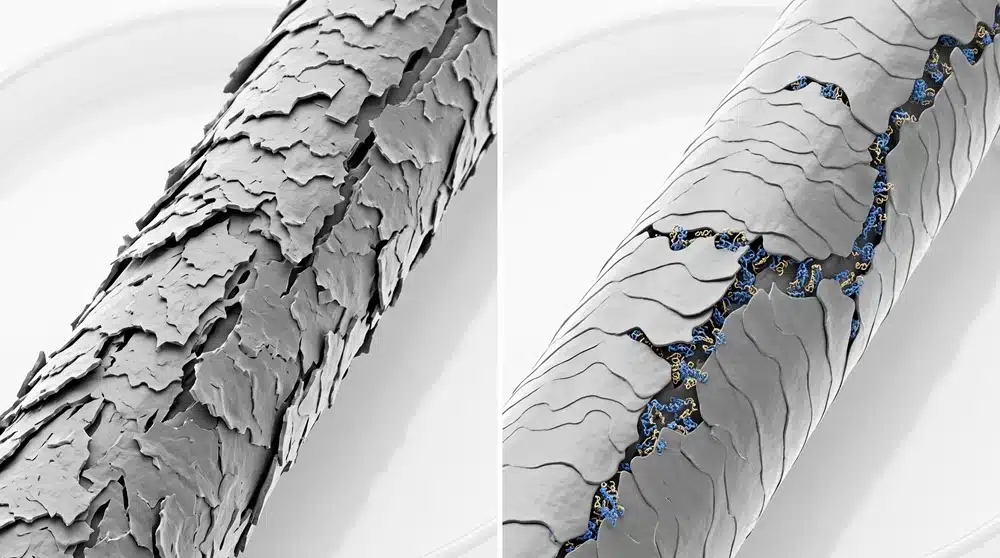
Keratin is a fibrous protein family found in hair, nails, wool, feathers and similar animal tissues. Native keratin is highly cross-linked and difficult to disperse in ordinary formulas. Hydrolysis breaks it into smaller peptide fractions and amino-acid-containing mixtures.
The ingredient name alone does not predict performance. A controlled hair-fiber study found that low- and mid-molecular-weight wool-derived keratin fractions penetrated more deeply into relaxed hair, while a high-molecular-weight fraction mainly adsorbed onto the surface. Mechanical effects also differed by fraction. This supports a molecular-weight-dependent explanation rather than the blanket claim that every keratin hydrolysate “rebuilds broken bonds.”
For a broader identity and source explanation, read what hydrolyzed keratin is.
What Is Silk Peptide or “Silk Collagen”?
Silk peptide is generally hydrolyzed silk fibroin or hydrolyzed silk protein produced from silkworm cocoons. Fibroin and sericin are the principal silk proteins, although commercial ingredients can differ according to degumming, purification and hydrolysis conditions.
Silk peptide is not true collagen. The expression “silk collagen” is a market name and should not be used to imply that the ingredient contains bovine, marine, porcine or poultry collagen. In cosmetic ingredient declarations, the applicable identity may be Hydrolyzed Silk or Hydrolyzed Fibroin, depending on the material and destination market. In supplements, the ingredient description should accurately state the silk-derived source.
Brands evaluating this ingredient should review silk peptide powder specifications, including source, hydrolysis method, amino-acid profile, molecular-weight distribution, sericin status, microbiology and heavy metals.
Que sont les peptides de collagène ?
Collagen peptides are produced by hydrolyzing collagen-rich animal or marine material. They are chemically and nutritionally different from keratin and silk fibroin. Collagen hydrolysates are commonly characterized by a glycine-proline-hydroxyproline-related profile, although species, processing and peptide distribution differ among products.
Randomized human trials have reported improvements in selected skin hydration, elasticity or wrinkle measurements after oral use of specific collagen-peptide products. Those results apply to the tested ingredient, dose, population and duration. They do not prove that every collagen powder improves every skin or hair outcome.
Brands sourcing this category can review the collagen peptides supplier guide for species, solubility, peptide and documentation considerations.
Is Keratin the Same as Collagen?
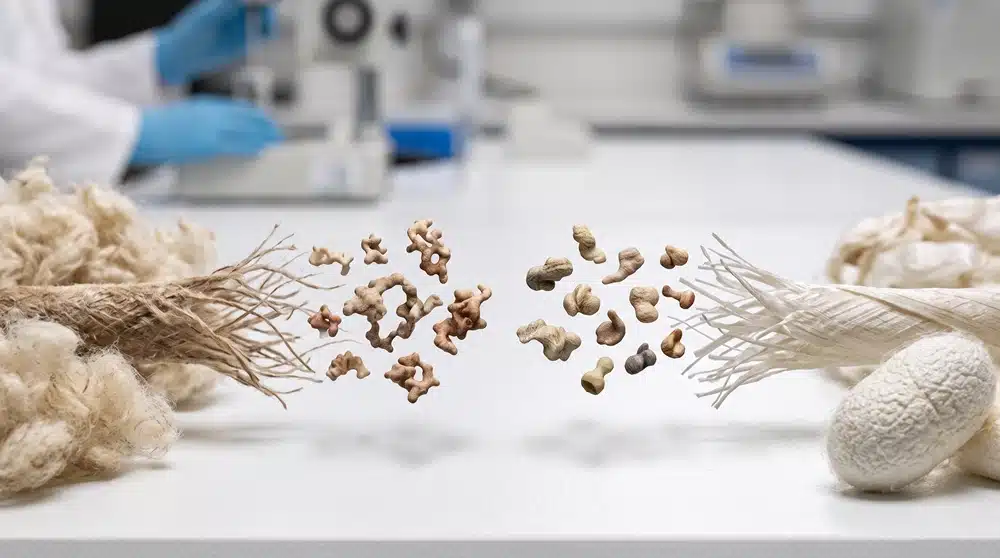
No. Keratin and collagen are both structural protein families, but they have different amino-acid patterns, biological locations and material properties. Hair shafts are primarily keratin-based. Collagen is a major extracellular-matrix protein in skin, connective tissue, bone and cartilage and is present in the tissue environment surrounding hair follicles, but it is not the main structural protein of the visible hair shaft.
This distinction matters for search intent. “Keratin vs collagen for hair” is not a comparison between two interchangeable hair ingredients. Topical kératine hydrolysée is usually evaluated for hair-fiber conditioning, while oral collagen-peptide research is more developed for selected skin outcomes than for direct hair growth.
Which Is Better for Hair?
For a topical conditioner or mask
A well-selected hydrolyzed keratin grade may be the most direct option when the formula targets damaged-hair feel, combability or temporary mechanical reinforcement. Silk peptide may be selected for film formation, slip, smooth feel or a premium sensory story. Collagen hydrolysates can also function as film-forming or conditioning proteins, but the finished formula—not the protein name alone—determines performance.
For a beauty supplement
No ingredient should be described as a proven hair-regrowth solution without product-relevant human evidence. Hydrolyzed keratin provides a keratin-related amino-acid and peptide profile, collagen peptides provide collagen-derived peptides, and silk peptides provide silk-fibroin-derived peptides. After digestion, dietary proteins and peptides are processed through the gastrointestinal system; they do not travel intact to a chosen hair shaft.
When developing a commercial oral formula, compare the ingredient identity, serving size, protein contribution, amino-acid profile, safety, sensory burden and evidence. A product may combine protein peptides, but the brand should not imply that combining them guarantees synergy.
Which Is Better for Skin?
Among the three categories, standardized oral collagen peptides have the strongest human evidence base for selected cosmetic skin outcomes. Several randomized trials have reported improvements in hydration and some elasticity or wrinkle measurements, although results are ingredient- and study-specific.
Silk proteins are recognized as skin- and hair-conditioning ingredients in cosmetics, and the Cosmetic Ingredient Review Expert Panel concluded that several silk protein ingredients, including Hydrolyzed Silk and Hydrolyzed Fibroin, are safe in the reported cosmetic practices of use and concentration. That cosmetic safety conclusion is not proof of an oral anti-aging benefit.
Evidence for oral hydrolyzed keratin and broad skin-barrier claims is more limited. Brands should not copy collagen-peptide clinical outcomes onto keratin or silk peptide simply because all three are proteins.
Which Is Better for Nails?
Keratin is a major structural protein in nails, but structural similarity does not by itself establish that an oral keratin supplement will improve nail growth or hardness. Collagen-peptide and other beauty-supplement studies sometimes measure nail outcomes, but ingredient-specific evidence is needed. Silk peptide should not be positioned as a nail-growth ingredient without appropriate substantiation.
Safer consumer language includes “supports a beauty nutrition formula” or “provides protein-derived peptides,” while stronger claims such as reducing splitting, accelerating growth or correcting brittle nails should be tied to reliable finished-product evidence.
Topical Evidence vs Oral Supplement Evidence
| Evidence or use | What it can support | What it cannot automatically support |
|---|---|---|
| Hair-fiber testing of topical hydrolyzed keratin | Penetration, deposition or mechanical performance under the tested conditions | Oral absorption, follicle growth or treatment of hair loss |
| Cosmetic safety review of Hydrolyzed Silk | Use as a hair- or skin-conditioning cosmetic ingredient within reviewed conditions | Oral efficacy, anti-aging supplementation or universal hypoallergenic claims |
| Oral collagen-peptide randomized trial | The measured skin outcome for the tested collagen product and protocol | Equivalent outcomes from keratin, silk peptide or an untested collagen grade |
| Profil en acides aminés | Ingredient characterization and formula comparison | Proof of clinical efficacy or targeted delivery to hair, skin or nails |
Can the Three Ingredients Be Used Together?
Yes, they can be combined when the formulation, serving size and commercial rationale are coherent. A multi-protein beauty powder might use collagen peptides as the main protein-derived active, with keratin or silk peptide as a smaller specialty component. However, adding more proteins is not automatically better.
Formulators should evaluate total protein load, taste, odor, color, solubility, hygroscopicity, foam, sedimentation and serving size. In capsules or tablets, the low active payload may make a three-protein formula commercially inefficient. In gummies, heat, water activity and flavor can create additional constraints.
Source, Vegan, Halal and Kosher Considerations
- Hydrolyzed keratin: normally animal-derived. Species and tissue source should be declared and documented.
- Silk peptide: silkworm-derived and therefore not vegan. Vegetarian acceptance may depend on the applicable standard and consumer interpretation.
- Peptides de collagène : derived from bovine, porcine, marine or poultry sources and not vegan.
- Halal and Kosher: not automatic. Certification must cover the specific source, facility, processing aids and supply chain.
- Allergen and sensitivity review: evaluate source-specific risks, cross-contact, processing aids and destination-market requirements. Do not use “allergen-free” without documented support.
Comment les marques de compléments alimentaires devraient faire leur choix
| Objectif de la marque | Priority ingredient | Pourquoi | Verification needed |
|---|---|---|---|
| Topical damaged-hair conditioner | Hydrolyzed keratin or a keratin/silk system | Direct hair-fiber and conditioning rationale | INCI, MW distribution, active solids, compatibility and salon testing |
| Oral skin-hydration concept | Clinically studied collagen peptide | More developed human skin evidence | Exact ingredient match, dose, trial relevance and claim review |
| Premium silk-positioned cosmetic | Hydrolyzed silk or fibroin | Silk-derived sensory and conditioning story | Correct identity, sericin status, cosmetic safety and formula testing |
| Hair-skin-nails supplement | Evidence-led formula, often collagen-centered | Allows broader nutritional formulation | Finished-product evidence, total formula, serving size and compliant claims |
| Vegan beauty product | None of these three by default | All are animal- or insect-derived | Use a genuinely plant- or fermentation-derived alternative and verify every component |
Supplier and COA Checklist
Request the following before approving a raw material:
- Exact commercial name and regulatory identity.
- Source species, tissue or silkworm-derived source statement.
- Manufacturing flow, including hydrolysis method and relevant processing aids.
- Protein or peptide assay and test method.
- Molecular-weight distribution and analytical method—not only an average marketing number.
- Amino-acid profile, including appropriate identity markers.
- Moisture, ash, pH, color, odor, solubility and bulk density.
- Métaux lourds, microbiologie et contaminants associés.
- Allergen, BSE/TSE, GMO and country-of-origin statements where applicable.
- Halal or Kosher certificate scope when a claim is planned.
- Stability, retest period, storage and packaging requirements.
- COA-to-specification consistency across multiple commercial batches.
For a keratin-focused project, review peptides de kératine hydrolysés en vrac by actual source, test methods and batch documentation rather than relying only on a “low molecular weight” claim.
Finished-Product Testing Checklist
- Poudres : blend uniformity, protein verification, taste, odor, mixability, sedimentation, moisture and packaging barrier.
- Capsules and tablets: fill weight, disintegration, flow, compression behavior and realistic active payload.
- Gommes : heat exposure, water activity, texture, protein interaction, flavor and microbiology.
- Liquids: pH, precipitation, preservation, oxidation, odor and packaging compatibility.
- Topical hair care: viscosity, deposition, wet/dry combing, breakage, tensile testing, buildup, color and consumer sensory testing.
Brands moving from ingredient selection to a finished oral product can use a fabricant de compléments protéiques to review serving size, flavor, mixability, packaging and finished-product specifications.
Considérations relatives aux allégations et à l'étiquetage
Dietary supplement structure/function claims must be truthful, not misleading and substantiated. They cannot claim to diagnose, treat, cure or prevent disease. Advertising claims also need competent and reliable scientific evidence that is relevant to the marketed ingredient, dose, delivery format and target population.
Avoid or qualify statements such as:
- “rebuilds hair bonds from within”;
- “stops hair loss” or “regrows hair”;
- “clinically proven” when the commercial grade or finished product was not tested;
- “silk collagen” presented as a true collagen type;
- “superior absorption” based only on a lower molecular-weight specification;
- “safe for everyone,” “allergen-free” or “guaranteed results”;
- fixed dosage and result timelines borrowed from unrelated products.
Questions fréquemment posées
Is keratin the same as collagen?
No. They are different structural protein families with different amino-acid profiles and biological functions.
Is silk collagen real collagen?
Usually no. “Silk collagen” is commonly a market name for hydrolyzed silk fibroin or silk protein peptide, not Type I, II or III collagen.
Is keratin or collagen better for hair?
For topical damaged-hair conditioning, hydrolyzed keratin may have the more direct hair-fiber rationale. For oral products, collagen has more human research for skin than for direct hair growth. Neither is a universally proven hair-growth ingredient.
Can collagen and keratin be taken together?
They can be formulated together, but the combination needs a rational serving size, safety review, sensory testing and claim substantiation. Combination alone does not prove synergy.
Are silk peptides good for hair?
Hydrolyzed silk is used as a hair-conditioning ingredient in cosmetics. Performance depends on the specific grade and finished formula. Evidence is not sufficient for a general hair-regrowth claim.
Do hydrolyzed proteins absorb better?
Hydrolysis changes peptide size and can improve solubility or processing. It does not by itself prove superior clinical absorption, efficacy or targeted delivery compared with every other protein product.
Are keratin, silk peptide and collagen vegan?
No. Keratin and collagen are animal-derived, while silk peptide is insect-derived. Vegan positioning requires a different ingredient system.
How quickly do they work?
There is no universal timeline. Topical sensory changes may be noticed after use, while measured oral outcomes depend on the exact product, dose, study duration and individual. Avoid promising a fixed result period without product-specific evidence.
Recommandation finale
Choose by verified identity and intended use—not by whichever protein name sounds closest to hair, skin or nails. Hydrolyzed keratin is most relevant to hair-fiber conditioning; silk peptide is a distinct silk-derived conditioning ingredient; and collagen peptides have the most developed oral evidence for selected skin outcomes. A responsible product brief should specify the delivery format, source, peptide profile, evidence, claim scope and finished-product tests before selecting a supplier.
Références
- Penetration of Different Molecular Weight Hydrolysed Keratins into Hair Fibres
- CIR: Safety Assessment of Silk Protein Ingredients as Used in Cosmetics
- Oral Intake of Low-Molecular-Weight Collagen Peptide: Randomized Controlled Study
- FDA : Allégations « structure/fonction »
- FTC : Lignes directrices relatives à la conformité des produits de santé

Warren Wan est un expert chevronné qui possède une vaste expérience dans la chaîne d’approvisionnement des compléments alimentaires, ainsi qu’une solide expertise pratique dans la recherche, le développement, le contrôle des processus et l’approvisionnement mondial d’ingrédients clés tels que les peptides de collagène, les protéines de bouillon d’os et la kératine. En tant qu'auteur de cette chronique, il s'attache à aller au-delà des discours marketing pour transformer les notions scientifiques obscures relatives aux ingrédients et les normes de contrôle qualité de la production en une vulgarisation scientifique rigoureuse et accessible, aidant ainsi les lecteurs à comprendre la vérité qui se cache derrière les étiquettes et à faire des choix plus rationnels en matière de santé.