I: Introduction
Collagen is the most abundant structural protein in the human body, acting as the biological “glue” that provides integrity, elasticity, and strength to our skin, cartilage, bones, and connective tissues. As we age, our natural production of this vital protein declines, leading to the global surge in collagen-infused creams and dietary supplements. However, for the average consumer, the ingredient deck often presents a confusing linguistic maze, most notably the distinction between soluble collagen vs hydrolyzed collagen.
A common misconception in the wellness industry is the belief that “solubility” is synonymous with “absorvability.” Many consumers assume that because a protein is labeled as “soluble,” it can easily penetrate the skin barrier or be effortlessly utilized by the digestive system. In reality, the term “soluble” often refers to the protein’s native, intact state, which, while beneficial for surface-level hydration, behaves very differently from its “hydrolyzed” counterpart.
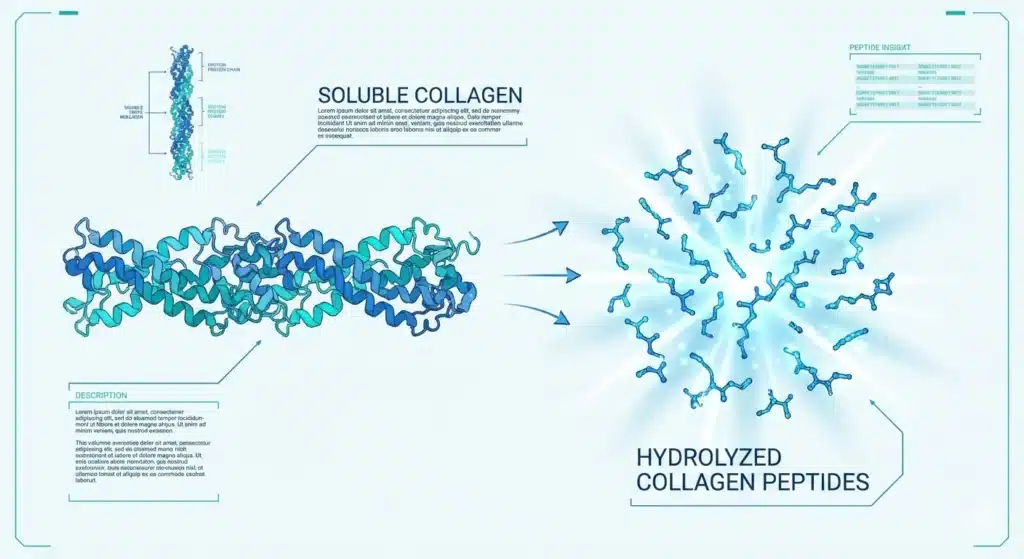
The fundamental difference lies in their molecular architecture. While soluble collagen maintains its complex, large-scale triple-helix structure, hydrolyzed collagen has been enzymatically “broken down” into smaller bioactive fragments. This article aims to demystify these terms by comparing their molecular weights and biological pathways, revealing why the choice between soluble collagen vs hydrolyzed collagen is the defining factor in whether your supplement truly works from within or simply sits on the surface.
II: Core Definitions — Understanding the Molecular Identity
To grasp the functional differences of soluble collagen vs hydrolyzed collagen, one must first understand their biochemical architecture. The primary distinction lies in the degree of processing and the resulting molecular size, which dictates how these proteins interact with the human body.
1. Soluble Collagen: The Intact Giant
- Definition: Often referred to as “native collagen,” soluble collagen is the protein in its most natural, unprocessed state. It retains the signature triple-helix structure—three long polypeptide chains tightly wound together. This is the same form found naturally in young, healthy animal connective tissues.
- Key Characteristics:
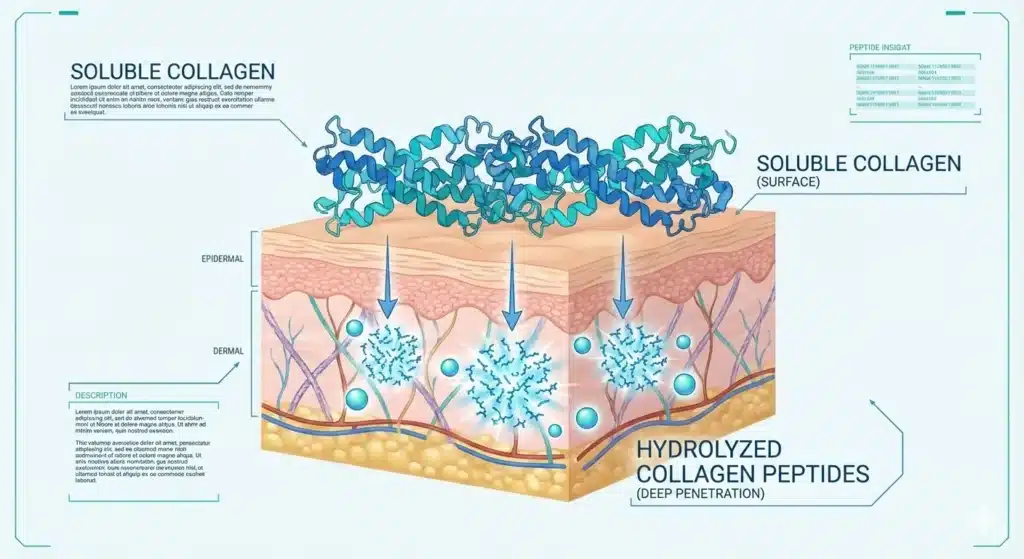
- Massive Molecular Weight: It possesses a high molecular weight of approximately 300,000 Daltons. Because of this enormous size, it is physically impossible for soluble collagen to penetrate the stratum corneum (the outermost layer of the skin).
- Film-Forming & Humectant Properties: While it cannot be absorbed deeply, it is a powerhouse of hydration. It acts as a superior humectant, sitting on the skin’s surface to create a moisture-locking barrier that provides an immediate “plumping” effect.
2. Hydrolyzed Collagen: The Bioactive Fragment
- Definition: Commonly known as collagen peptides, hydrolyzed collagen is the result of a process called enzymatic hydrolysis. In this state, the large triple-helix “ropes” of soluble collagen have been scientifically “clipped” or broken down into much shorter chains of amino acids.
- Key Characteristics:
- Minimal Molecular Weight: The hydrolysis process reduces the molecular weight significantly, typically down to 2,000 – 5,000 Daltons. This is roughly 60 to 150 times smaller than the soluble version.
- High Bioavailability: Due to their small size, these peptides are highly “bioavailable,” meaning they can be efficiently absorbed through the intestinal wall into the bloodstream or penetrate deeper into the skin’s layers in topical applications. They function not just as building blocks, but as signaling molecules that trigger the body’s own collagen production.
Expert Insight: Think of soluble collagen as a high-quality “finished fabric” that protects and covers from the outside, whereas hydrolyzed collagen represents the “raw silk threads” that your body can actually use to repair and weave its own internal structures.
III: Deep Comparison — Four Key Performance Indicators
To truly understand the debate of soluble collagen vs hydrolyzed collagen, we must evaluate them against the rigorous standards of nutritional science and dermatology. Here is how they compare across four critical dimensions:
1. Molecular Weight and Permeability
The most significant barrier to collagen efficacy is size.
- Soluble Collagen: Due to its massive size ($300,000$ Daltons), it acts as a macro-molecule. When applied topically, it is physically incapable of penetrating the dermal layer; it remains strictly on the surface of the epidermis.
- Hydrolyzed Collagen: By reducing the weight to under $5,000$ Daltons, these peptides gain “access passes” to the body. They are small enough to pass through the intestinal mucosal barrier during digestion and can achieve significantly better penetration in advanced skincare formulations.
2. Bioavailability (Absorption Efficiency)
Bioavailability refers to the proportion of a substance that enters the circulation when introduced into the body.
- The Digestibility Gap: In oral consumption, the body struggles to break down the complex triple-helix of soluble collagen efficiently. In contrast, hydrolyzed collagen is essentially “pre-digested.”
- Clinical Advantage: Research indicates that over $90\%$ of hydrolyzed collagen peptides are absorbed and appear in the blood as small peptides within hours, whereas intact soluble collagen is largely wasted or broken down into basic amino acids, losing its specific “collagen-signaling” identity.
3. Solubility and Stability
The physical behavior of the powder or liquid impacts both consumer experience and shelf life.
- Soluble Collagen: Despite its name, it can be difficult to work with. It often requires specific pH levels or temperatures to remain stable and can create a “gel” or thickened texture that isn’t always desirable in drinks.
- Hydrolyzed Collagen: These peptides are highly versatile. They dissolve seamlessly in both cold and hot liquids without changing the viscosity or flavor profile. Furthermore, they are more resistant to heat, making them ideal for use in coffee, soups, or baked goods.
4. Functional Focus: Where They Shine
The choice between soluble collagen vs hydrolyzed collagen ultimately depends on your “beauty goal.”
| Feature | Soluble Collagen (Native) | Hydrolyzed Collagen (Peptides) |
| Primary Use | Topical Skincare (Serums/Creams) | Dietary Supplements (Powders/Drinks) |
| Main Benefit | Instant surface hydration and “plumping” | Long-term structural repair and synthesis |
| Mechanism | Forms a moisture-protective shield | Stimulates fibroblasts to produce new collagen |
Expert Summary: If you want an immediate glow for a photo shoot, soluble collagen in a face mask is your friend. If you want to improve joint health and skin elasticity over 12 weeks, hydrolyzed collagen is the undisputed winner.
IV: Application Guidance — How to Make the Right Choice
Understanding the technical specs is one thing, but knowing which to reach for in a specific scenario is where the expertise of soluble collagen vs hydrolyzed collagen truly matters. Depending on whether you are looking for a cosmetic “quick fix” or a long-term structural overhaul, your choice will shift.
1. The Skincare Domain: The Secret of High-End Creams
You will often find soluble collagen listed on the labels of premium anti-aging creams and luxury serums.
- Why it’s used: Luxury brands prioritize the “sensory experience.” Because soluble collagen is a massive molecule with incredible water-binding capacity, it creates an immediate plumping effect.
- The Benefit: It forms a breathable, microscopic film on the skin’s surface that prevents trans-epidermal water loss (TEWL). This results in a “glass skin” finish and an instant reduction in the appearance of fine lines—making it the gold standard for topical hydration and film-forming protection.
2. The Oral Supplement Domain: The Athlete’s and Biohacker’s Choice
In the world of ingestible wellness, hydrolyzed collagen (collagen peptides) reigns supreme. It is the preferred choice for professional athletes and those focused on longevity.
- Joint & Tissue Repair: Athletes use hydrolyzed collagen to support ligament and tendon health. Because the peptides are small enough to reach the bloodstream, they act as “messenger signals” to fibroblasts, the cells responsible for repairing connective tissue.
- Skin Elasticity from Within: While soluble collagen works on the outside, hydrolyzed collagen works from the inside out. Regular consumption has been clinically shown to increase skin density and elasticity by stimulating the body’s endogenous collagen production, rather than just temporarily hydrating the surface.
3. Medical and Aesthetic Medicine: Healing and Scaffolding
In clinical settings, the distinction between soluble collagen vs hydrolyzed collagen is utilized for regenerative purposes:
- Soluble Collagen for Scaffolding: Due to its intact triple-helix structure, soluble collagen is often used in medical “scaffolds” or sponges to support tissue growth and wound healing. It provides a physical matrix that mimics human tissue.
- Hydrolyzed Collagen for Recovery: Hydrolyzed versions are frequently used in clinical nutrition for patients recovering from burns or surgery, as the pre-digested peptides provide the rapid-fire amino acids necessary for accelerated protein synthesis.
Summary Table for Fast Decision Making
| Goal | Recommended Type | Why? |
| Instant Glow/Pre-Makeup | Soluble Collagen | Superior surface plumping and smoothing. |
| Joint Pain/Injury Recovery | Hydrolyzed Collagen | Fast absorption and direct tissue support. |
| Long-term Anti-Aging | Hydrolyzed Collagen | Stimulates internal collagen “factory.” |
| Dry/Dehydrated Skin | Both | Soluble for protection; Hydrolyzed for repair. |
V: Expert Buying Guide — How to Avoid Marketing Traps
Navigating the supplement aisle can be daunting. To ensure you are getting the most biological “bang for your buck” in the soluble collagen vs hydrolyzed collagen debate, follow these three expert-vetted rules.
1. Master the Label: Look for the “Golden Keywords”
The most common mistake consumers make is buying a product simply because the word “Collagen” is in large font on the front. To ensure you are buying a product capable of internal absorption:
- The Keywords: Explicitly look for “Collagen Peptides” or “Hydrolyzed Collagen”. These terms guarantee that the massive triple-helix has been broken down into the $2,000–5,000$ Dalton range.
- The Trap: If the label only says “Pure Collagen” or “Soluble Collagen” in an oral supplement, you may be paying a premium for a large-molecule protein that your stomach will struggle to process effectively before it passes through your system.
2. Know the Source: Marine vs. Bovine
Not all hydrolyzed collagen is created equal. The source of the raw material dictates the collagen “Type” and the ease of absorption:
- Marine Collagen (Fish): Generally considered the “gold standard” for anti-aging. It consists primarily of Type I collagen and has smaller particle sizes, making it up to 1.5 times more absorbable than bovine sources.
- Bovine Collagen (Cow): Typically a mix of Type I and Type III. While slightly larger in molecular profile, it is exceptionally effective for joint health and gut repair.
- Expert Tip: If your primary goal is skin radiance, go Marine. If it is muscle and joint recovery, Bovine is often more cost-effective and targeted.
3. Check the Synergy: The Vitamin C Factor
Buying collagen without checking for co-factors is a rookie mistake. Collagen synthesis in the human body is a complex biochemical process that requires a specific “spark.”
- The Role of Vitamin C: Vitamin C is the essential co-enzyme for the enzymes prolyl hydroxylase and lysyl hydroxylase. Without adequate Vitamin C, your body cannot cross-link the amino acids from your hydrolyzed collagen into stable, functional fibers.
- The Buying Rule: Always choose a supplement that includes Vitamin C in the formula, or ensure you are consuming a Vitamin C-rich food (like an orange or kiwi) alongside your dose.
Expert Red Flag: Beware of products labeled “Plant-Based Collagen.” Plants do not contain collagen. These products are actually “collagen boosters” (a mix of amino acids and antioxidants). While helpful, they do not provide the specific bioactive peptides found in genuine hydrolyzed collagen.
VI: Conclusion
In the debate of soluble collagen vs hydrolyzed collagen, it is easy to look for a “winner.” However, as we have explored, these are not competing ingredients, but rather specialized tools designed for different biological tasks. The “best” version is entirely dependent on your specific physiological needs and delivery method.
The Power of Complementary Action
The most effective approach to collagen supplementation isn’t choosing one over the other, but understanding their inner vs. outer synergy:
- Topical (Soluble Collagen): Use this as your “External Shield.” It excels at providing immediate aesthetic results, locking in moisture, and creating a smooth, hydrated canvas on the surface of your skin.
- Ingestible (Hydrolyzed Collagen): Use this as your “Internal Architect.” It focuses on the long game—providing the bioactive signals and amino acid building blocks necessary to repair joints, strengthen hair, and rebuild the dermal matrix from within.
Final Takeaway
If you are seeking a quick “plumping” effect for your skin’s surface, soluble collagen is a masterpiece of cosmetic chemistry. But if you are looking to change the actual structural integrity of your body and fight the signs of aging at the cellular level, hydrolyzed collagen (peptides) is the scientifically superior choice.
By aligning your choice with your goals—and ensuring you have the right co-factors like Vitamin C—you can move past the marketing “fog” and make an informed investment in your long-term health and vitality.
At a Glance: Soluble vs. Hydrolyzed
| Feature | Soluble Collagen | Hydrolyzed Collagen |
| Structure | Intact Triple Helix (Large) | Short Chain Peptides (Small) |
| Molecular Weight | ~300,000 Daltons | 2,000 – 5,000 Daltons |
| Best Used For | Topical Skincare / Medical Sponges | Oral Supplements / Smoothies |
| Primary Goal | Surface Hydration & Plumping | Structural Repair & Synthesis |
| Bioavailability | Low (too big to absorb) | High (rapidly enters bloodstream) |