
This guide is written for supplement brands, purchasing teams and formulators evaluating a tablet project. It explains the process controls and documents to review before requesting tablet supplement manufacturing services.
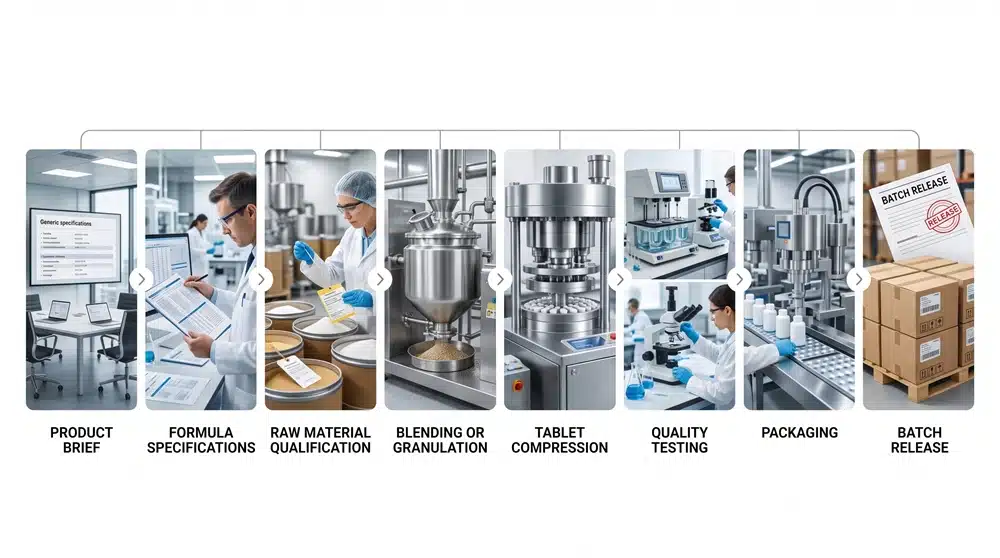
What Is Tablet Supplement Manufacturing?
Sản xuất thực phẩm bổ sung dạng viên nén is the controlled production of a dietary supplement by compressing a qualified powder or granulated blend between punches and dies. A tablet formula usually includes dietary ingredients plus functional excipients selected to support flow, compression, disintegration, coating, appearance and stability.
Manufacturing is not simply “mix and press.” A formula that looks acceptable on paper can fail because the blend segregates, sticks to tooling, caps after compression, becomes too large to swallow, loses potency during processing or does not meet its disintegration or dissolution specification.
Quick Process Map
| Sân khấu | Main Decision | Typical Output |
|---|---|---|
| 1. Product brief | Serving size, claims, market and dosage format | Approved development brief |
| 2. Formula and specifications | Ingredient forms, target amounts and test requirements | Draft formula and component specifications |
| 3. Process-route selection | Direct compression, dry granulation or wet granulation | Development process |
| 4. Pilot development | Flow, compressibility, tablet size and stability | Prototype and pilot data |
| 5. Commercial manufacturing | Dispensing, blending, granulation and compression controls | Batch production record |
| 6. Testing and release | Identity, potency, physical tests and contaminants | Approved lot and COA |
| 7. Packaging and stability | Moisture, oxygen, light and distribution protection | Finished retail product |
Step 1: Define the Product Brief Before Formulation
The manufacturer needs more than a list of ingredients. The development brief should identify the target market, intended consumer, serving size, number of tablets per serving, tablet type, label positioning, packaging format, shelf-life objective and required testing.
- Dosage target: Confirm the amount of each dietary ingredient per serving and per tablet.
- Tablet experience: Set limits for tablet weight, dimensions, shape, coating, score line and swallowability.
- Các tuyên bố: Separate permitted nutrient or structure/function positioning from disease claims.
- Market: Confirm ingredient status, labeling and quality requirements for the destination market.
- Nhu cầu thương mại: Define target MOQ, packaging count, launch date and cost range.
Brands should resolve these items before approving công thức chế phẩm bổ sung tùy chỉnh. Late changes to dosage, claims or packaging can require a new pilot, tooling adjustment or stability assessment.
Step 2: Qualify Raw Materials and Excipients
Each component should have an approved specification that reflects its role in the formula. The same ingredient name can represent different grades, carriers, particle sizes, bulk densities, moisture levels and active concentrations.
| Material Category | What to Confirm | Tại sao điều này lại quan trọng |
|---|---|---|
| Dietary ingredients | Identity, assay, form, carrier, contaminants and stability | Supports label amount and formula compatibility |
| Diluents or fillers | Grade, bulk density and compressibility | Builds tablet mass and affects tablet strength |
| Binders | Type, level and activation method | Supports granule or tablet integrity |
| Disintegrants | Type, level and intragranular/extragranular use | Helps the tablet break apart under the specified test |
| Glidants and lubricants | Level, order of addition and blend time | Affects flow, ejection and potential over-lubrication |
| Coating materials | Composition, allergens, color status and weight gain | Affects appearance, taste masking and protection |
Supplier qualification, incoming quarantine, representative sampling, identity testing and quality-control release should occur before components enter production. A supplier COA is useful, but it does not replace the manufacturer’s responsibility to establish and verify appropriate specifications.
Step 3: Choose the Manufacturing Route
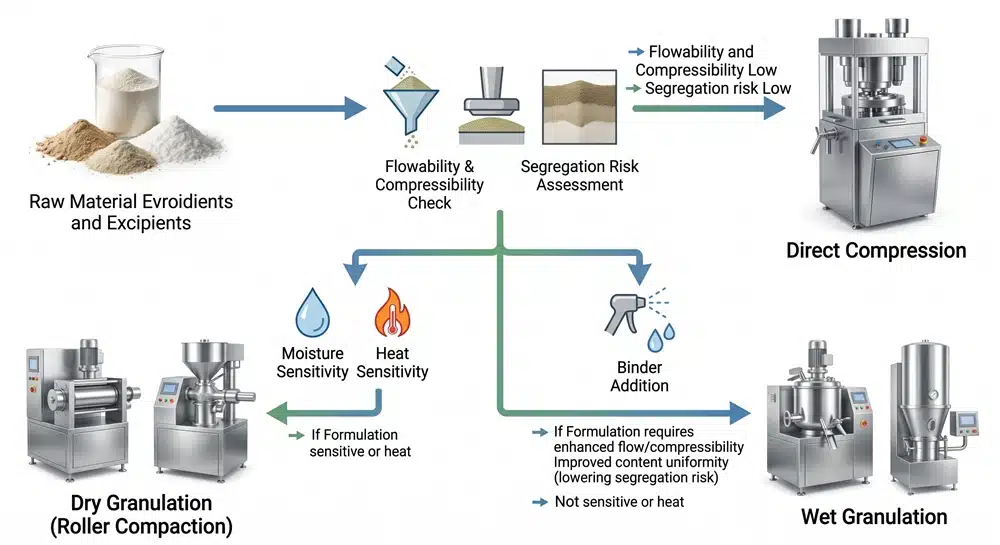
The process route should be selected from development data. Direct compression is efficient when the final blend already has suitable flow and compressibility. Granulation is used when the formulation needs improved flow, reduced segregation or better compaction.
| Route | Phù hợp nhất | Main Advantages | Main Risks to Control |
|---|---|---|---|
| Direct compression | Free-flowing, compressible ingredients or engineered premixes | Fewer steps; avoids added heat and water | Segregation, poor flow, low-dose uniformity and capping |
| Dry granulation | Moisture- or heat-sensitive formulas needing densification | No liquid binder or drying stage | Excess fines, compact hardness and variable ribbon quality |
| Wet granulation | Formulas needing stronger granules or improved uniformity | Can improve flow and compression | Moisture exposure, drying variability and active degradation |
No route is universally superior. A vitamin, mineral and botanical combination may require a different process than a high-dose single-ingredient tablet, even when both products use the same tablet press.
Step 4: Conduct Preformulation and Pilot Trials
Development trials should convert the paper formula into measurable process parameters and product specifications. The team may evaluate particle-size distribution, bulk and tapped density, flow, moisture, blend behavior, compactability, ejection force, tablet dimensions, breaking force, friability and disintegration.
A pilot should also test whether the proposed tablet is commercially practical. A formula can be chemically acceptable but still create a tablet that is too heavy, too wide, difficult to coat or expensive to package. Low-dose ingredients may require a validated premix strategy to support uniform distribution.
Step 5: Create the Master Manufacturing Record
Before commercial production, the approved process should be documented in a master manufacturing record for the specific formula and batch size. It should identify component quantities, theoretical yield, equipment, processing instructions, control points, sampling, packaging and required approvals.
The commercial batch production record then documents what actually occurred, including component lot numbers, weighing, equipment identification, times, yields, in-process results, deviations and quality-control decisions.
Step 6: Dispense, Verify and Stage Components
Approved components are dispensed according to the batch record. Independent verification, status labeling, line clearance and controlled staging reduce the risk of wrong-ingredient use, weighing errors and mix-ups.
Microgram- or milligram-level ingredients need special attention. A geometrically diluted premix or supplier-standardized dilution may be more practical than attempting to distribute a very small quantity directly into a large batch.
Step 7: Blend or Granulate the Formula
Direct-Compression Blending
Ingredients are added in a defined sequence and blended for a justified time. Excessive blending after lubricant addition can reduce tablet bonding in some formulas, while insufficient blending can create weight, potency or appearance variability.
Granulation khô
The blend is compacted, commonly by roller compaction, and then milled to a controlled granule distribution. The process must balance densification with the generation of fines and the compressibility of the final granules.
Granulation ướt
A binder solution or granulating liquid is added under controlled conditions, followed by wet massing, screening or fluid-bed processing, drying and milling. The drying endpoint should be based on the product and method rather than a universal moisture percentage.
Step 8: Final Blend and Lubrication
After granulation or the main blending stage, external disintegrants, glidants, flavors, colors or lubricants may be added. The order and blend time should be controlled because these materials can influence flow, ejection, tablet strength and disintegration.
The final blend should be assessed against its approved in-process requirements before compression begins.
Step 9: Compress the Tablets
A rotary tablet press meters the blend into die cavities and compresses it between upper and lower punches. Operators adjust fill depth and compression settings within the approved process range while monitoring the product and equipment.
| In-Process Check | What It Detects | Possible Response |
|---|---|---|
| Average and individual weight | Fill consistency and powder-flow changes | Adjust fill depth; investigate hopper or feed-frame behavior |
| Thickness and dimensions | Compression or fill changes | Review compression force and tablet weight |
| Breaking force | Mechanical strength | Adjust compression or investigate formula/process changes |
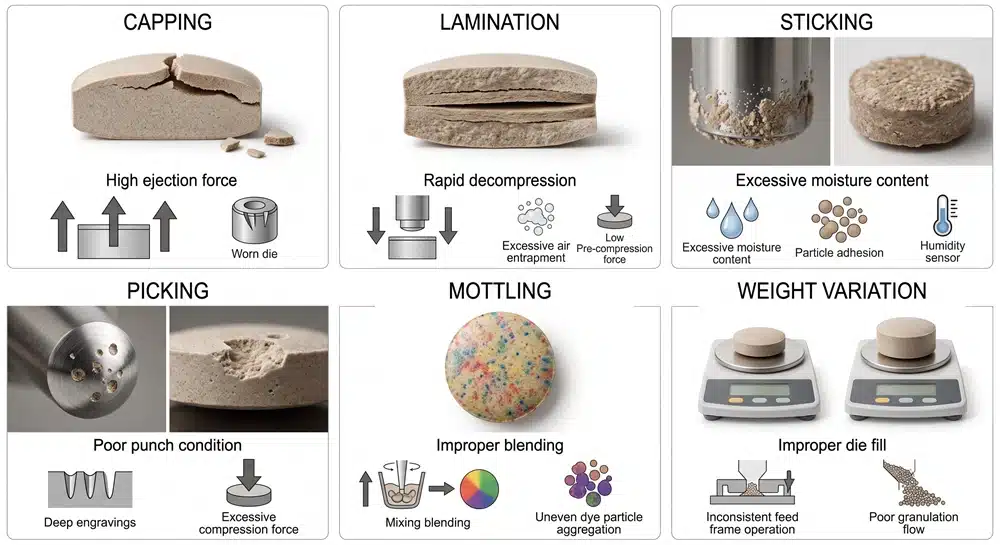
| Hình thức | Capping, lamination, sticking, picking or mottling | Stop and investigate tooling, moisture, flow or lubrication |
| Disintegration, when used in process | Whether the tablet breaks apart as intended | Review compression, lubricant, binder and disintegrant effects |
Step 10: Apply Coating or Printing When Needed
Film coating may improve swallowability, appearance, odor control or taste masking and can provide limited protection from the environment. It should not be assumed to create controlled release unless the formula and coating system were specifically designed and tested for that purpose.
Coating controls may include inlet and product temperature, spray rate, atomization, pan speed, visual appearance and percentage weight gain. Printed or debossed identification should be reviewed for legibility and label consistency.
Step 11: Test the Finished Tablet
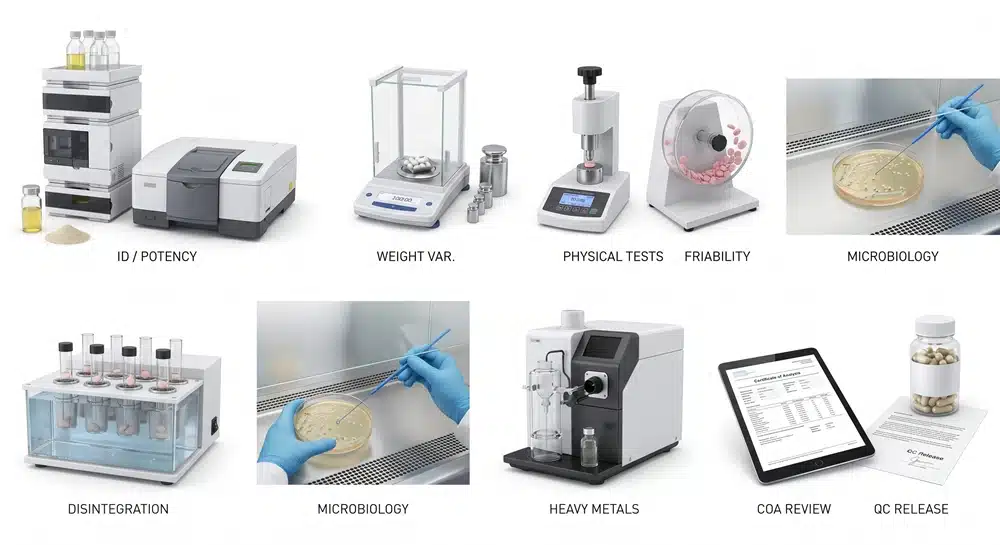
The finished-product specification should be product-specific. Depending on the formula and applicable standards, testing may include:
- Identity and assay of dietary ingredients
- Weight variation or dosage-unit uniformity
- Appearance, dimensions and tablet breaking force
- Friability for applicable compressed tablets
- Disintegration or dissolution where applicable
- Moisture or water activity when relevant
- Microbiological quality and specified contaminants
- Heavy metals, pesticides, residual solvents or other formula-specific tests
A meaningful kiểm soát chất lượng thực phẩm bổ sung program connects approved specifications, validated or scientifically suitable methods, representative sampling, batch records, deviations, reserve samples and quality-unit release. A single generic “pass” statement is not enough.
Step 12: Package, Label and Place the Product on Stability
Packaging should protect the tablet through the proposed shelf life and distribution conditions. The correct container depends on the formula’s sensitivity to moisture, oxygen, light, abrasion and repeated opening.
| Packaging Option | Potential Advantages | Key Questions |
|---|---|---|
| Bottle with closure | Efficient for higher counts and common retail formats | Is a desiccant or induction seal needed? Does opening affect stability? |
| Blister | Individual cavity protection and dose visibility | Does the selected film/foil provide the required barrier? |
| Unit-dose or sachet | Portability and controlled exposure | Is seal integrity verified and is the format commercially practical? |
Label review should confirm the Supplement Facts, ingredient declaration, serving directions, warnings, claims and required disclaimer. Stability work should use the final formula in the proposed commercial packaging.
Common Tablet Manufacturing Defects
| Defect | What It Looks Like | Factors to Investigate |
|---|---|---|
| Capping | Top or bottom separates from the tablet | Air entrapment, fines, speed, moisture, tooling and compression profile |
| Lamination | Tablet separates into layers | Air, over-compression, formulation elasticity and dwell time |
| Sticking or picking | Material adheres to punch faces | Moisture, low-melting ingredients, lubrication, tooling and temperature |
| Mottling | Uneven color or appearance | Color distribution, ingredient color, drying and migration |
| Weight variation | Individual tablets differ in mass | Flow, segregation, feed-frame settings and press speed |
| High friability | Excess chipping or abrasion | Binder level, compression, granule quality and over-lubrication |
| Quá trình phân hủy chậm | Tablet does not break apart within the specification | Compression, coating, binder, lubricant and disintegrant performance |
Vitamin C Tablet Manufacturing: A Better Case Framework
A vitamin C tablet should not be presented with a universal formula or guaranteed one-week development schedule. The development team should first confirm the ascorbic acid form, dose, tablet weight, flavor, coating, moisture sensitivity and label claim.
Because ascorbic acid can be sensitive to moisture, heat and oxidation, direct compression or dry granulation may be considered when the material properties and target tablet allow it. Wet granulation may still be possible, but the liquid system, drying exposure and stability impact require product-specific evaluation.
The finished specification should include a justified potency range and relevant physical and contaminant tests. Barrier packaging, desiccant use and stability in the final pack should be evaluated instead of assuming a standard two-year shelf life. Marketing language such as “supports normal immune function” requires appropriate substantiation and label review; the manufacturing process itself does not prove a health outcome.
Tablet Manufacturing vs. Other Dosage Forms
| Định dạng | Often Chosen When | Key Development Constraint |
|---|---|---|
| Máy tính bảng | Precise solid dose, efficient high-volume production or coated presentation | Flow, compressibility, tablet size and disintegration |
| Viên nang | Formula is better suited to filling than compression | Fill volume, shell compatibility and powder flow |
| Bột | Serving size is too large for practical tablets | Flavor, solubility, scoop accuracy and moisture control |
| Kẹo dẻo | Consumer experience and flavor are primary | Heat exposure, water activity, potency loss and sugar system |
| Dạng lỏng | Flexible serving experience or liquid-compatible ingredients | Microbiology, preservation, dose delivery and stability |
Dosage-form comparisons should not claim that liquids or capsules are automatically absorbed better. The ingredient form, product design, disintegration or dissolution behavior and finished-product evidence all matter.
How Brands Should Evaluate a Tablet Manufacturer
- Confirm experience with the proposed ingredient dose, tablet weight and coating type.
- Ask how the manufacturer selects direct compression, dry granulation or wet granulation.
- Review component specifications, supplier qualification and identity-testing procedures.
- Request the proposed in-process checks and finished-product specification before quoting production.
- Confirm how low-dose ingredients, premixes and blend uniformity are controlled.
- Ask for examples of batch documents, deviation handling and change-control procedures.
- Confirm tooling, tablet dimensions, coating capability, packaging formats and stability support.
- Verify which certifications apply to the exact facility and production line.
RFP Questions for a Tablet Supplement Manufacturer
- Which manufacturing route do you recommend for this formula, and what development data support that choice?
- What is the estimated tablet weight and size at the requested ingredient amounts?
- Which ingredient grades or premixes are required for flow, compression and uniformity?
- How do you qualify suppliers and verify component identity?
- What pilot or scale-up work is included before commercial production?
- Which in-process controls are recorded during blending, granulation, compression and coating?
- Which finished-product tests are included in the quote, and which are optional?
- How are weight variation, friability, breaking force and disintegration specifications established?
- What packaging barrier and stability program do you recommend?
- What are the MOQ, tooling charges, pilot quantity, testing cost and packaging minimums?
- What is the realistic project schedule after formula, label, components and packaging are approved?
- How are deviations, out-of-specification results, reprocessing and change control managed?
Câu hỏi thường gặp
What are the main steps in tablet supplement manufacturing?
The main stages are product definition, formulation, raw-material qualification, process-route selection, pilot development, dispensing, blending or granulation, final lubrication, compression, optional coating, finished-product testing, packaging and quality release.
Is granulation always required before tablet compression?
No. Direct compression may be suitable when the blend has acceptable flow, uniformity and compressibility. Dry or wet granulation is considered when the formula needs improved flow, densification, reduced segregation or stronger compaction.
How long does a custom tablet supplement take to manufacture?
There is no responsible universal timeline. Development depends on formula readiness, ingredient sourcing, pilot results, tooling, testing, label approval, packaging availability and stability requirements. Brands should request a milestone schedule rather than a promise based only on the dosage form.
Which quality tests are used for supplement tablets?
Testing is product-specific and may include ingredient identity and assay, weight variation or dosage-unit uniformity, appearance, dimensions, breaking force, friability, disintegration or dissolution, microbiology, heavy metals and stability.
What causes tablets to cap or stick during compression?
Capping and sticking can result from material properties, moisture, fines, trapped air, tooling, press speed, temperature, lubrication and compression settings. The manufacturer should investigate the formula and process rather than correcting only the press setting.
Can a tablet manufacturer guarantee absorption?
No. Manufacturing controls can verify specifications such as potency, disintegration or dissolution where applicable, but they do not by themselves establish human absorption, bioavailability or clinical effectiveness.
Điểm chính cần ghi nhớ
A reliable tablet project starts with a manufacturable formula and product-specific specifications. The process route, excipients, compression settings, testing and packaging must be developed as one system. Brands should compare manufacturers by technical controls and documentation—not by generic GMP claims or a list of machines.
For a project review, share the formula, target dose, tablet type, destination market, packaging concept, required documents and forecast volume when you liên hệ với GENSEI.
Tài liệu tham khảo
- FDA — Small Entity Compliance Guide: Dietary Supplement Current Good Manufacturing Practice
- Electronic Code of Federal Regulations — 21 CFR Part 111
- FDA — Current Good Manufacturing Practices for Food and Dietary Supplements
- USP–NF General Chapter <2750> Manufacturing Practices for Dietary Supplements
- USP–NF General Chapter <2040> Disintegration and Dissolution of Dietary Supplements
- USP–NF General Chapter <2091> Weight Variation of Dietary Supplements
- USP–NF General Chapter <1216> Tablet Friability
- USP–NF General Chapter <1217> Tablet Breaking Force
- FTC — Hướng dẫn tuân thủ đối với các sản phẩm chăm sóc sức khỏe
- FDA — Các tuyên bố về cấu trúc/chức năng
- Google Search Central — Article Structured Data

Warren Wan là một chuyên gia dày dạn với kinh nghiệm phong phú trong chuỗi cung ứng thực phẩm bổ sung, sở hữu kinh nghiệm thực tiễn sâu rộng trong nghiên cứu, phát triển, kiểm soát quy trình và tìm nguồn cung ứng toàn cầu các thành phần cốt lõi như peptit collagen, protein từ nước hầm xương và keratin. Với tư cách là tác giả của chuyên mục này, ông cam kết loại bỏ những lớp bao bọc tiếp thị, biến những kiến thức khoa học phức tạp về thành phần và các tiêu chuẩn kiểm soát chất lượng sản xuất thành những nội dung phổ biến khoa học dễ hiểu nhưng sâu sắc, giúp độc giả hiểu rõ sự thật đằng sau các nhãn mác và đưa ra những lựa chọn sức khỏe hợp lý hơn.


