
Quick Answer: CoQ10 vs Fish Oil

Coenzyme Q10 and fish oil are not the same ingredient. CoQ10 is a fat-soluble antioxidant involved in mitochondrial energy production, while fish oil provides omega-3 fatty acids such as EPA and DHA that are commonly used for lipid, inflammation, and cardiovascular wellness positioning.
For consumers, the better choice depends on the health goal and medication status. CoQ10 is often discussed in the context of cellular energy, statin use, and antioxidant support. Fish oil is more closely associated with omega-3 intake, triglyceride support, and systemic inflammation.
For supplement brands, the more important question is not simply “which is better?” It is: which ingredient fits the dosage form, claim strategy, oil system, COA requirements, stability target, and market positioning?
In many product development projects, CoQ10 and fish oil are not competitors. They can be complementary ingredients, especially in softgel products designed around heart health, healthy aging, and premium omega-3 positioning.
Early custom CoQ10 omega-3 formulation support can help define the right CoQ10 form, EPA/DHA target, carrier oil, and antioxidant system.Coenzyme Q10 là gì?
Coenzyme Q10, often shortened to CoQ10, is a naturally occurring compound found in human cells. It plays an important role in mitochondrial energy production and also functions as an antioxidant. The highest concentrations are found in high-energy organs such as the heart, liver, kidneys, and pancreas.
In supplement formulation, CoQ10 is usually used in two commercial forms: ubiquinone and ubiquinol. Ubiquinone is the oxidized form and is widely used because it is stable and cost-effective. Ubiquinol is the reduced form and is often positioned as more bioavailable, especially in premium formulas or products targeting older adults.
Because CoQ10 is fat-soluble, its delivery system matters. A CoQ10 ingredient blended into an oil-based softgel may behave very differently from a dry powder tablet or capsule. For supplement brands, this means CoQ10 selection should consider not only dosage, but also solubility, carrier oil, antioxidant system, softgel compatibility, and stability testing.
Lợi ích của Coenzyme Q10
Tại sao bạn nên cân nhắc bổ sung CoQ10 vào chế độ chăm sóc hàng ngày của mình? Hãy cùng tìm hiểu chi tiết:
- Sức khỏe tim mạch: CoQ10 là người bạn tốt nhất của tim, đặc biệt là đối với những người bị suy tim. Các nghiên cứu, như một nghiên cứu trong tạp chí Tạp chí của Hiệp hội Tim mạch Hoa Kỳ, cho thấy việc bổ sung CoQ10 giúp giảm 39% các biến cố tim mạch nghiêm trọng ở bệnh nhân suy tim. Điều này đặc biệt hữu ích đối với những người đang dùng statin, vì loại thuốc này có thể làm giảm nồng độ CoQ10, dẫn đến đau cơ hoặc mệt mỏi.
- Giảm đau do đau nửa đầu: Nếu chứng đau nửa đầu thường xuyên ghé thăm, CoQ10 có thể giúp ích. Một nghiên cứu được công bố trên Đau đầu Kết quả cho thấy việc dùng 150 mg CoQ10 mỗi ngày giúp giảm số ngày bị đau nửa đầu xuống 48% so với nhóm dùng giả dược. Đây thực sự là một bước đột phá đối với những ai đã chán ngán những cơn đau đầu dữ dội.
- Khả năng chống oxy hóa: Bằng cách trung hòa các gốc tự do, CoQ10 giúp bảo vệ tế bào khỏi stress oxy hóa, một yếu tố có liên quan đến các bệnh mãn tính như tiểu đường và các rối loạn thoái hóa thần kinh. Một số nghiên cứu cho thấy nó có thể cải thiện độ nhạy insulin ở người mắc bệnh tiểu đường, tuy nhiên vẫn cần thêm nhiều nghiên cứu nữa.
- Các lợi ích tiềm năng khác: Hiện nay, các nghiên cứu về vai trò của CoQ10 trong việc nâng cao hiệu suất tập luyện và làm chậm sự tiến triển của các bệnh như Parkinson hay Alzheimer vẫn đang được tiến hành, nhưng kết luận cuối cùng về những vấn đề này vẫn chưa được xác định.
CoQ10 giống như một người bạn đồng hành đáng tin cậy, hỗ trợ nhu cầu năng lượng của cơ thể và ngăn ngừa tổn thương tế bào. Nhưng so với dầu cá thì sao?
Dầu cá là gì?
Fish oil is a marine oil ingredient that provides long-chain omega-3 fatty acids, mainly EPA and DHA. These fatty acids are naturally found in oily fish such as sardine, anchovy, mackerel, salmon, and herring. In supplement manufacturing, fish oil is most commonly used in softgels, liquid oils, and omega-3 combination products.
The quality of fish oil is not determined by the words “fish oil” alone. Brands should compare the actual EPA and DHA content, oxidation markers, contaminant testing, source traceability, odor profile, and shelf-life performance.
For fish oil ingredients, oxidation control is a major quality issue. A high-quality oil should be supported by COA data such as peroxide value, p-anisidine value, and TOTOX. Heavy metals, PCBs, dioxins, and microbial limits should also be reviewed before bulk purchasing or production.
Lợi ích của dầu cá
Dầu cá được biết đến nhờ những lợi ích đa dạng, đặc biệt là đối với tim và não. Dưới đây là những gì khoa học đã chỉ ra:
- Sức khỏe tim mạch: Dầu cá là một “siêu sao” trong việc bảo vệ sức khỏe tim mạch. Hiệp hội Tim mạch Hoa Kỳ khuyên dùng thực phẩm bổ sung omega-3 cho những người có nồng độ triglyceride cao, vì chúng có thể giúp giảm nồng độ này từ 20–50% tùy theo liều lượng. GIẢM BỚT nghiên cứu, được công bố trên tạp chí Tạp chí Y học New England, cho thấy rằng việc sử dụng EPA liều cao giúp giảm 25% các biến cố tim mạch ở những bệnh nhân có nồng độ triglyceride cao.
- Sức khỏe não bộ: Các axit béo omega-3, đặc biệt là DHA, đóng vai trò quan trọng đối với chức năng não bộ. Chúng là thành phần chính của màng tế bào não và có thể giúp giảm nguy cơ suy giảm nhận thức và trầm cảm. Một nghiên cứu trong Tạp chí Tâm thần học Lâm sàng Nghiên cứu cho thấy việc bổ sung omega-3 có thể là một phương pháp điều trị bổ trợ hiệu quả cho rối loạn trầm cảm nặng.
- Tác dụng chống viêm: Các axit béo omega-3 giúp giảm viêm, từ đó có thể làm dịu các triệu chứng của các bệnh như viêm khớp dạng thấp. Nghiên cứu trong Health.com cho biết dầu cá có thể giúp giảm đau và cứng khớp ở bệnh nhân viêm khớp.
- Các lợi ích khác: Dầu cá cũng có thể hỗ trợ sức khỏe mắt, cải thiện chức năng gan và thậm chí còn giúp cải thiện sức khỏe làn da bằng cách giảm các tình trạng liên quan đến viêm nhiễm như mụn trứng cá.
Dầu cá giống như một loại thuốc mỡ làm dịu cơ thể, giúp giảm viêm và hỗ trợ các cơ quan quan trọng. Nhưng so với CoQ10 thì sao?
Coenzyme Q10 và dầu cá: Điểm khác biệt là gì?
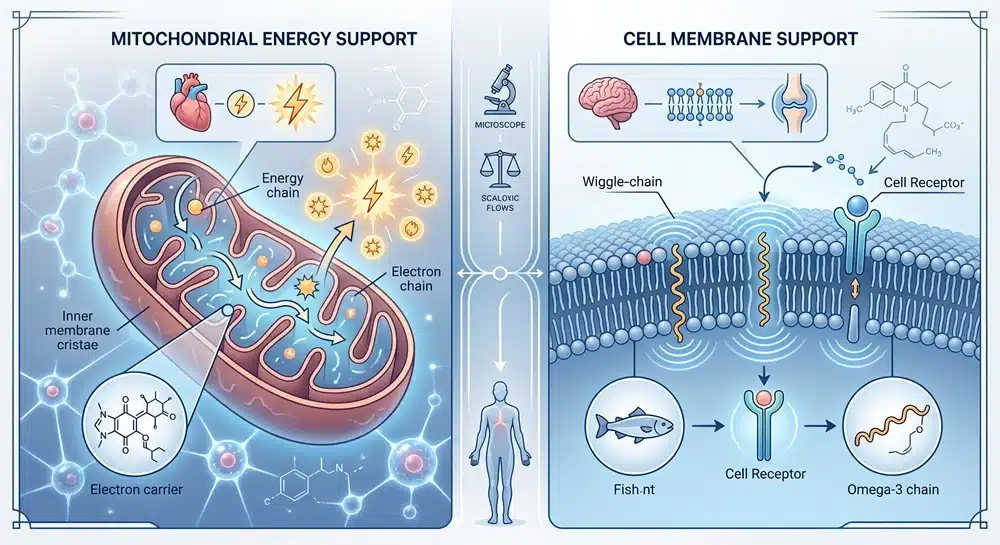
Mặc dù cả CoQ10 và dầu cá đều được ca ngợi vì những lợi ích đối với sức khỏe, nhưng chúng hoạt động theo những cơ chế khác nhau:
- CoQ10 tập trung vào việc sản xuất năng lượng và bảo vệ chống oxy hóa. Chất này tập trung nhiều ở các cơ quan tiêu thụ nhiều năng lượng như tim, gan và thận, đảm bảo cung cấp đủ “nhiên liệu” để các cơ quan này hoạt động tối ưu. Chất này đặc biệt hữu ích trong các tình trạng liên quan đến thiếu hụt năng lượng hoặc stress oxy hóa.
- Fish Oil provides omega-3 fatty acids that reduce inflammation and support the structural integrity of cell membranes, particularly in the heart and brain. It’s ideal for managing systemic inflammation and improving lipid profiles.
Hãy tưởng tượng cơ thể bạn như một nhà máy đang hoạt động nhộn nhịp: CoQ10 giúp các máy phát điện luôn vận hành trơn tru, trong khi dầu cá đảm bảo các thiết bị không bị quá nhiệt. Hai chất này bổ sung cho nhau, nhưng cách sử dụng lại khác nhau tùy theo nhu cầu sức khỏe của bạn.
Bảng so sánh Coenzyme Q10 và dầu cá
Để làm rõ hơn những điểm khác biệt, dưới đây là bảng so sánh song song:
| Yếu tố | CoQ10 | Dầu cá | Formulation Note |
| Primary role | Mitochondrial energy and antioxidant support | EPA/DHA omega-3 delivery | They solve different product positioning problems. |
| Common form | Ubiquinone or ubiquinol | EPA/DHA-rich marine oil | Both are fat-soluble and fit oil-based dosage forms. |
| Best dosage form | Softgel, capsule, tablet, oil-based formula | Softgel or liquid oil | Combination softgels can be commercially attractive. |
| Key quality marker | Assay, purity, residual solvents, form | EPA/DHA potency, PV, p-AV, TOTOX, contaminants | COA review is essential before production. |
| Main manufacturing issue | Poor water solubility, dispersion, color stability | Oxidation, odor, leakage risk | Carrier oil, antioxidant system, and shell compatibility matter. |
| Best positioning | Healthy aging, cellular energy, heart wellness | Omega-3, triglyceride support, inflammation balance | Combined products can target premium heart-health formulas. |
Cái nào tốt hơn cho sức khỏe tim mạch: CoQ10 hay dầu cá?
Khi nói đến sức khỏe tim mạch, cả hai loại thực phẩm chức năng này đều có những ưu điểm riêng, và lựa chọn tốt nhất sẽ phụ thuộc vào nhu cầu cụ thể của bạn:
- CoQ10 đặc biệt hiệu quả đối với bệnh nhân suy tim và những người đang dùng statin. Một nghiên cứu từ Cedars-Sinai chỉ ra rằng CoQ10 có thể giúp tăng cường sản xuất năng lượng trong các tế bào tim và giảm căng thẳng oxy hóa, từ đó có khả năng làm giảm nguy cơ các biến cố liên quan đến tim mạch. Chất này đặc biệt hữu ích trong việc khắc phục tình trạng thiếu hụt CoQ10 do statin gây ra, vốn có thể dẫn đến đau cơ.
- Dầu cá rất hiệu quả trong việc giảm triglyceride và cải thiện chỉ số cholesterol. Sản phẩm này Hiệp hội Tim mạch Hoa Kỳ chỉ ra rằng axit béo omega-3 có thể làm giảm nồng độ triglyceride từ 20–30% ở những người bị tăng triglyceride máu, và việc sử dụng EPA liều cao đã được chứng minh là giúp giảm nguy cơ các biến cố tim mạch. Dầu cá cũng giúp hạ huyết áp và ổn định nhịp tim.
Các kết quả nghiên cứu về tác động tổng thể của chúng đối với việc phòng ngừa bệnh tim mạch còn chưa thống nhất. Ví dụ, một nghiên cứu năm 2018 trên tạp chí Tạp chí Y học New England Nghiên cứu không ghi nhận sự giảm đáng kể tỷ lệ nhồi máu cơ tim ở những người không có yếu tố nguy cơ bệnh tim khi sử dụng thực phẩm bổ sung dầu cá. Trong khi đó, CoQ10 cho thấy tiềm năng trong điều trị một số bệnh lý tim mạch cụ thể nhưng chưa được công nhận rộng rãi trong việc phòng ngừa bệnh tim nói chung. Nếu bạn lựa chọn dựa trên mục tiêu bảo vệ sức khỏe tim mạch, dầu cá có thể có lợi thế nhẹ hơn trong việc kiểm soát lipid máu, trong khi CoQ10 phù hợp hơn cho các trường hợp suy tim hoặc các vấn đề liên quan đến statin. Việc kết hợp cả hai có thể mang lại sự hỗ trợ toàn diện, vì chúng tác động đến các khía cạnh khác nhau của sức khỏe tim mạch.
Khi nào nên dùng Coenzyme Q10 và khi nào nên dùng dầu cá
Việc lựa chọn giữa CoQ10 và dầu cá phụ thuộc vào mục tiêu sức khỏe của bạn. Dưới đây là hướng dẫn giúp bạn đưa ra quyết định:
- Hãy chọn CoQ10 nếu:
- Bạn đang dùng statin, loại thuốc có thể làm giảm nồng độ CoQ10, dẫn đến mệt mỏi hoặc đau cơ.
- Bạn bị suy tim hoặc các bệnh tim mạch khác mà việc sản xuất năng lượng là vô cùng quan trọng.
- Bạn thường xuyên bị đau nửa đầu — các nghiên cứu cho thấy CoQ10 có thể giúp giảm đáng kể số ngày bị đau nửa đầu.
- Bạn muốn tăng cường năng lượng tế bào và bảo vệ cơ thể khỏi stress oxy hóa.
- Hãy chọn dầu cá nếu:
- Nếu bạn có nồng độ triglyceride hoặc cholesterol cao, thì hãy lưu ý rằng các axit béo omega-3 đã được chứng minh là có tác dụng cải thiện chỉ số lipid.
- Bạn đang muốn giảm viêm, điều này có thể giúp cải thiện các tình trạng như viêm khớp.
- Bạn muốn hỗ trợ sức khỏe não bộ, đặc biệt là chức năng nhận thức hoặc sự ổn định tâm trạng.
- Bạn không ăn đủ cá béo (loại Hiệp hội Tim mạch Hoa Kỳ (khuyến nghị ăn ít nhất hai phần mỗi tuần).
Sarah, một phụ nữ 45 tuổi đang dùng thuốc statin, có thể sẽ chọn CoQ10 để chống lại tình trạng mệt mỏi và hỗ trợ sức khỏe tim mạch. Trong khi đó, người bạn của cô là John, người có nồng độ triglyceride cao và hiếm khi ăn cá, có thể sẽ thu được nhiều lợi ích hơn từ dầu cá. Bác sĩ của bạn có thể giúp bạn lựa chọn sản phẩm phù hợp nhất với nhu cầu của bản thân.
Có thể dùng CoQ10 và dầu cá cùng lúc không?
CoQ10 and fish oil are commonly used together because they work through different mechanisms. CoQ10 is involved in mitochondrial energy production and antioxidant protection, while fish oil supplies EPA and DHA omega-3 fatty acids. From a general nutrition perspective, they are not the same ingredient and do not replace each other.
However, consumers taking anticoagulants, blood pressure medication, diabetes medication, or prescription lipid-lowering drugs should speak with a healthcare professional before combining supplements. Fish oil at higher intakes may affect bleeding risk, and CoQ10 may interact with certain medications such as warfarin.
From a supplement manufacturing perspective, CoQ10 and fish oil can make sense in the same softgel because both are compatible with oil-based delivery systems. A combination product may be positioned around heart health, healthy aging, omega-3 intake, and cellular energy support.
The main challenge is not whether the ingredients can sit together on a label. The real challenge is manufacturing execution: CoQ10 dispersion in the oil phase, fill uniformity, oxidation control, shell compatibility, fishy odor control, and stability over shelf life. A well-designed formula should define the carrier oil, antioxidant system, CoQ10 form, EPA/DHA potency, and quality specifications before pilot production.
For brands planning a combined oil-based product, CoQ10 and fish oil softgel manufacturing requires careful control of fill uniformity, oxidation, and shell compatibility.Manufacturing Considerations for CoQ10 + Fish Oil Softgels
A CoQ10 + fish oil softgel can be attractive for supplement brands, but it requires more formulation control than a simple single-ingredient capsule.
First, CoQ10 is a lipophilic ingredient, but it still needs proper dispersion in the oil phase. If dispersion is poor, the finished softgel may have inconsistent active content from capsule to capsule. Brands should confirm whether the formula uses ubiquinone or ubiquinol and how the ingredient is suspended or dissolved in the carrier system.
Second, fish oil is sensitive to oxidation. The formulation should be built with oxidation control in mind, including raw oil quality, antioxidant selection, nitrogen flushing if applicable, packaging protection, and accelerated stability testing.
Third, shell compatibility must be checked. Marine oils, carrier oils, and suspended actives can affect softgel sealing, leakage risk, and appearance. A pilot batch is important before commercial-scale production.
For B2B buyers, the ideal development path is:
1. Define target CoQ10 dosage.
2. Define EPA and DHA target per serving.
3. Review raw material COAs.
4. Confirm carrier oil and antioxidant system.
5. Run pilot softgel filling.
6. Test fill uniformity, oxidation, leakage, and appearance.
7. Confirm packaging and shelf-life strategy.
Quality Checklist Before Buying CoQ10 or Fish Oil Ingredients

For supplement brands, quality control should start before production. Ask suppliers for a complete COA and confirm the test methods used.
For CoQ10 ingredients, review:
– CoQ10 assay and purity
– Ubiquinone vs ubiquinol form
– Residual solvents
– Heavy metals
– Giới hạn vi sinh
– Particle size or dispersion properties
– Nước xuất xứ
– Allergen and GMO statements
– Stability data if available
For fish oil ingredients, review:
– EPA content
– DHA content
– Total omega-3 content
– Peroxide value (PV)
– p-anisidine value (p-AV)
– TOTOX value
– Heavy metals
– PCBs
– Dioxins
– Odor and sensory profile
– Source traceability
– Third-party testing or certification
A low-cost ingredient is not always the lower-cost product in the long run. Poor CoQ10 dispersion, oxidized fish oil, or weak documentation can lead to production delays, failed stability results, customer complaints, or regulatory risk.
A structured kiểm soát chất lượng thực phẩm bổ sung review can help verify CoQ10 assay, EPA/DHA potency, oxidation values, heavy metals, and supplier documentation before production.Need Help Developing a CoQ10 + Fish Oil Product?
If you are developing a CoQ10 softgel, fish oil softgel, or combined CoQ10 + omega-3 formula, Gensei can help review ingredient form, carrier oil selection, EPA/DHA target, antioxidant system, pilot batch feasibility, packaging options, and quality testing requirements.
Send us your target dosage, dosage form, and market positioning, and our formulation team can help evaluate whether a single-ingredient softgel, combination softgel, or multi-SKU product line is the better commercial direction.
If you are building a finished retail product, our private label CoQ10 and fish oil supplements service can support formulation, packaging, quality testing, and launch planning.Kết luận
Trong cuộc so tài giữa Coenzyme Q10 và Dầu cá, không có một lựa chọn nào phù hợp với tất cả mọi người. CoQ10 là sự lựa chọn hàng đầu để tăng cường năng lượng tế bào và bảo vệ cơ thể khỏi stress oxy hóa, khiến nó trở thành giải pháp lý tưởng cho những người bị suy tim, đang sử dụng statin hoặc mắc chứng đau nửa đầu. Dầu cá, với hàm lượng axit béo omega-3, lại là lựa chọn hàng đầu trong việc giảm viêm, hạ triglyceride và hỗ trợ sức khỏe tim mạch và não bộ.
Đối với nhiều người, việc kết hợp cả hai loại thực phẩm chức năng này tạo thành một bộ đôi hiệu quả, giúp cải thiện nhiều khía cạnh của sức khỏe. Dù bạn giống như Sarah, muốn giảm bớt tác dụng phụ của statin, hay như John, muốn kiểm soát mức triglyceride, những thực phẩm chức năng này đều có thể là những lựa chọn hữu ích để bổ sung cho lối sống lành mạnh. Hãy luôn tham khảo ý kiến của bác sĩ để đảm bảo chúng phù hợp với bạn, đồng thời chọn những sản phẩm chất lượng cao để tận dụng tối đa lợi ích.
Câu hỏi thường gặp
Q: Is CoQ10 the same as fish oil?
A: No. CoQ10 is a fat-soluble antioxidant involved in mitochondrial energy production. Fish oil is a marine oil that provides EPA and DHA omega-3 fatty acids. They are different ingredients and serve different supplement positioning needs.
Q: Can you take CoQ10 and fish oil together?
A: Many consumers use CoQ10 and fish oil together, and the two ingredients are often considered complementary. However, people taking blood thinners, blood pressure medication, diabetes medication, or prescription heart medication should consult a healthcare professional before combining supplements.
Q: Which is better for heart health, CoQ10 or fish oil?
A: They support different aspects of heart wellness. Fish oil is commonly used for omega-3 intake and triglyceride support, while CoQ10 is often discussed for cellular energy and statin-related contexts. Neither should be positioned as a treatment without medical supervision.
Q: Is CoQ10 the same as omega-3?
A: No. Omega-3 refers to fatty acids such as EPA and DHA. CoQ10 is not an omega-3 fatty acid. They can appear in the same formula, but they are chemically and functionally different.
Q: What is better, CoQ10 or krill oil?
A: Krill oil is another omega-3 source, while CoQ10 is an antioxidant ingredient. The better choice depends on whether the product goal is omega-3 delivery, antioxidant positioning, or a combination heart-health formula.
Q: Can CoQ10 and fish oil be made in one softgel?
A: Yes, this is possible from a dosage-form perspective because both are compatible with oil-based systems. However, the formula must be tested for CoQ10 dispersion, fish oil oxidation, shell compatibility, fill uniformity, and leakage risk.
Q: What should brands check before sourcing fish oil?
A: Brands should review EPA, DHA, total omega-3 content, PV, p-AV, TOTOX, heavy metals, PCBs, dioxins, odor profile, source traceability, and third-party testing.
Q: What should brands check before sourcing CoQ10?
A: Brands should review CoQ10 assay, form, purity, residual solvents, heavy metals, microbial limits, particle size, country of origin, allergen status, and stability information.
Tài liệu tham khảo
- NCCIH. Coenzyme Q10. https://www.nccih.nih.gov/health/coenzyme-q10
- NIH Office of Dietary Supplements. Omega-3 Fatty Acids – Health Professional Fact Sheet. https://ods.od.nih.gov/factsheets/Omega3FattyAcids-HealthProfessional/
- Mortensen SA et al. Q-SYMBIO randomized trial, PubMed. https://pubmed.ncbi.nlm.nih.gov/25282031/
- Sandor PS et al. Efficacy of coenzyme Q10 in migraine prophylaxis, PubMed. https://pubmed.ncbi.nlm.nih.gov/15728298/
- Bhatt DL et al. REDUCE-IT trial, New England Journal of Medicine. https://www.nejm.org/doi/full/10.1056/NEJMoa1812792
- AHA Science Advisory: Omega-3 fatty acids for management of hypertriglyceridemia. https://www.ahajournals.org/doi/10.1161/CIR.0000000000000709
- GOED Voluntary Monograph for EPA and DHA Omega-3 Oils. https://goedomega3.com/storage/app/media/Monograph/GOED%20Monograph%20-%202022%2001%2006%20-%20FINAL.pdf
- FDA. Các tuyên bố về cấu trúc/chức năng. https://www.fda.gov/food/nutrition-food-labeling-and-critical-foods/structurefunction-claims
- Oxidation levels of North American OTC n-3 supplements. https://pmc.ncbi.nlm.nih.gov/articles/PMC4678768/

W. Wenyang là một chuyên gia dày dạn với kinh nghiệm phong phú trong chuỗi cung ứng thực phẩm bổ sung, sở hữu kiến thức thực tiễn sâu rộng về nghiên cứu, phát triển, kiểm soát quy trình và tìm nguồn cung ứng toàn cầu các thành phần cốt lõi như peptide collagen, protein nước hầm xương và keratin. Với tư cách là tác giả của chuyên mục này, ông cam kết loại bỏ những lớp bao bọc tiếp thị, biến những kiến thức khoa học phức tạp về thành phần và các tiêu chuẩn kiểm soát chất lượng sản xuất thành những nội dung phổ biến khoa học dễ hiểu, giúp độc giả hiểu rõ sự thật đằng sau các nhãn mác và đưa ra những lựa chọn sức khỏe hợp lý hơn.
