For most healthy adults, there is no widely recognized reason that MSM and glycine must be separated. However, combination-specific safety data are limited. Serving size, medical history, medications, pregnancy or breastfeeding, and the quality of the finished product still matter. Consumers should follow the product label and consult a qualified healthcare professional when appropriate.
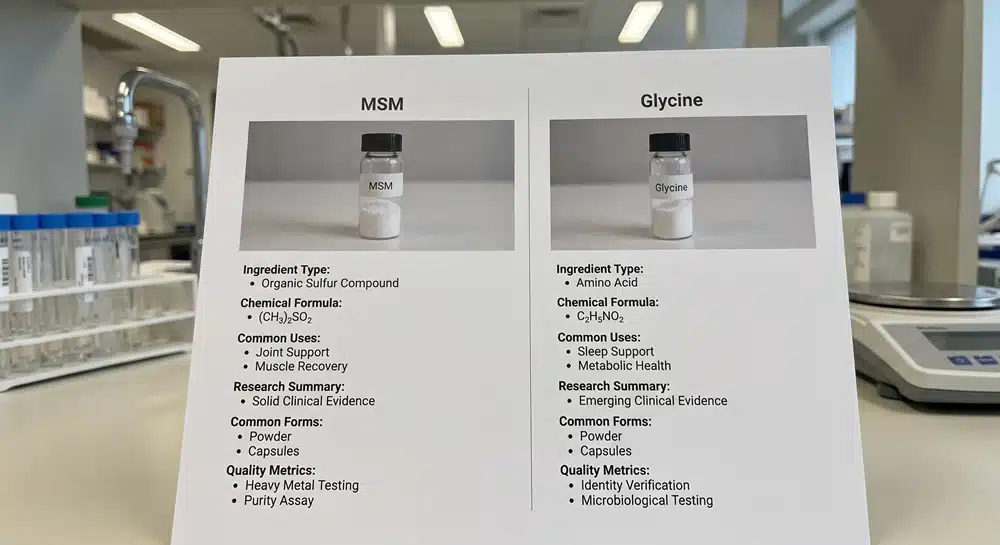
MSM vs Glycine at a Glance
| Hệ số so sánh | MSM | Glycine |
|---|---|---|
| Full name | Methylsulfonylmethane, also called dimethyl sulfone | Glycine, also called aminoacetic acid |
| Loại nguyên liệu | Defined organosulfur compound | Protein-forming amino acid |
| Chemical formula | C2H6O2S | C2H5NO2 |
| Main physiological context | Exogenous MSM is absorbed and contributes sulfur, but its supplement mechanisms are not fully established | Used in proteins and metabolic pathways, including collagen, glutathione, creatine, purines, and heme synthesis |
| Most common supplement positioning | Joint comfort, mobility, active lifestyle, exercise recovery, and beauty-from-within formulas | Amino acid nutrition, collagen-support concepts, sleep-positioned formulas, sports nutrition, and flavor balancing |
| Human evidence | Some trials report improvements in selected joint, exercise, or skin outcomes; evidence is promising but not definitive | Strong evidence for biological roles; supplement outcome evidence varies, and sleep studies are small and at risk of bias |
| Typical format | Powder, capsules, tablets, gummies, drink mixes | Powder, capsules, tablets, gummies, amino acid blends, drink mixes |
| Taste and formulation | Can have a bitter or sulfur-like sensory note depending on purity and formula | Mildly sweet and often useful for flavor balance |
| Key sourcing check | Identity, purity, residual solvents, particle size, odor, heavy metals, and microbiology | Grade, assay, identity, impurities, taste, particle size, heavy metals, and microbiology |
MSM là gì?
Methylsulfonylmethane, commonly shortened to MSM, is a small organosulfur compound with two methyl groups and two oxygen atoms bonded to sulfur. It is also known as dimethyl sulfone or DMSO2. Small amounts have been detected in foods and beverages, and MSM can also arise from sulfur metabolism. Commercial supplement-grade MSM is generally manufactured and purified to a defined specification.
MSM should not be described simply as “sulfur for collagen production.” Sulfur is relevant to many biological molecules, but the clinical effects of an Thực phẩm bổ sung MSM cannot be inferred from sulfur content alone. Human studies must be evaluated by the exact ingredient, dose, duration, population, and measured outcome.
What Is MSM Commonly Used For?
MSM is most commonly included in joint-support and active-lifestyle products. Small randomized trials have evaluated MSM for knee discomfort, stiffness, mobility, exercise-associated soreness, and selected skin outcomes. Results are not uniform, and systematic reviews have described the joint evidence as positive but not definitive because of limited trial numbers, small sample sizes, and differences in study design.
Appropriate consumer language may include “supports joint comfort,” “supports mobility,” or “supports recovery after exercise” when the finished formula and serving are adequately substantiated. Claims that MSM treats osteoarthritis, repairs cartilage, cures inflammation, detoxifies the liver, prevents chronic disease, or treats eczema and acne should not be used for a dietary supplement article.
Glycine là gì?
Glycine is the smallest protein-forming amino acid. In water and under physiological conditions, it is predominantly present as a zwitterion, carrying both a positive and a negative charge. Glycine is therefore not accurately described as a non-polar molecule in the way that term is normally used for amino acid side-chain classification.
The body can synthesize glycine, and it is also obtained from dietary protein. Glycine is especially prominent in collagen, where its small size helps the collagen triple helix pack tightly. It also contributes to the synthesis of glutathione, creatine, heme, purines, and other biologically important compounds.
What Is Glycine Commonly Used For?
Glycine supplements are marketed for general amino acid nutrition, collagen-support concepts, sleep, metabolic wellness, sports nutrition, and healthy-aging formulas. Some small studies used glycine before bedtime and reported improvements in subjective sleep measures. More recent reviews emphasize that the available sleep trials are small and have methodological limitations, so glycine should not be presented as a proven treatment for insomnia.
Glycine’s established biochemical role does not automatically prove that supplemental glycine improves every process in which it participates. Statements about cognition, mood, glucose control, liver detoxification, wound healing, muscle regeneration, or disease treatment require outcome-specific clinical evidence and careful regulatory review.
Can You Take MSM and Glycine Together?
MSM and glycine are chemically distinct and can be formulated together. A review of the available search results and biomedical literature did not identify a well-designed human trial that directly tested an MSM-plus-glycine combination against each ingredient alone. Therefore, it is more accurate to say that they have complementary formulation roles than to claim clinically proven synergy.
- MSM may contribute: a defined organosulfur ingredient commonly used in joint-comfort and active-lifestyle formulas.
- Glycine may contribute: an amino acid, a mildly sweet sensory profile, and a role in collagen and other metabolic pathways.
- The combination does not prove: faster collagen synthesis, cartilage regeneration, superior pain relief, better sleep, or enhanced detoxification.
A combined product should be judged by the amounts of each ingredient, the target consumer, other actives in the formula, testing, warnings, and claim substantiation. Consumers using medications or managing medical conditions should ask a healthcare professional before starting a multi-ingredient supplement.
Potential Benefits and Evidence Strength
| Topic | MSM evidence | Glycine evidence | Kết luận có trách nhiệm |
|---|---|---|---|
| Sức khỏe khớp | Several small human trials and an older systematic review suggest possible benefit, but the evidence is not definitive | Glycine is a collagen amino acid, but direct evidence that glycine alone improves joint symptoms is limited | MSM has the more direct joint-outcome evidence; glycine should not be positioned as an equivalent joint active |
| Collagen and connective tissue | Mechanistic and formulation rationale exists, but MSM is not collagen and does not supply collagen peptides | Glycine is a major collagen building block | Biochemical relevance is not the same as proof that the combination rebuilds cartilage, tendons, or skin |
| Exercise recovery | Some small studies evaluate soreness, oxidative-stress markers, or exercise-related outcomes | Reviews discuss possible roles in performance and recovery, but human supplementation evidence remains developing | Use qualified active-lifestyle language rather than guaranteed performance or recovery claims |
| Skin appearance | A small oral MSM study reported changes in selected signs of skin aging | Glycine is a component of collagen, but glycine-only skin outcome trials are limited | A beauty-from-within concept is plausible, but formula-specific evidence is required |
| Ngủ | Not a well-established sleep ingredient | Small studies suggest possible subjective sleep benefits; reviews note small samples and bias risk | Do not imply that MSM strengthens a glycine sleep effect without combination data |
| Antioxidant pathways | Research evaluates oxidative-stress and inflammatory markers | Glycine is one of three amino acids used to synthesize glutathione | Do not translate pathway involvement into broad “detox” or disease-prevention claims |
MSM and Glycine for Collagen: Are They the Same as Collagen Peptides?
No. MSM, glycine, and collagen peptides are three different ingredient categories:
- MSM is a small sulfur-containing molecule.
- Glycine is one amino acid used in collagen and many other molecules.
- Peptide collagen are mixtures of peptides produced by hydrolyzing animal collagen proteins.
A formula may contain one, two, or all three. Glycine supplies a single amino acid, while collagen peptides supply glycine together with proline, hydroxyproline, and other amino acids and peptides. MSM does not replace dietary protein or collagen peptides. For brands developing collagen or joint-support products, ingredient selection should match the serving size, format, target claims, and evidence strategy rather than relying on a “more ingredients must be better” approach.
Natural Sources of MSM and Glycine
Which Foods Contain MSM?
MSM has been reported in small amounts in foods and beverages such as milk, coffee, tea, fruits, vegetables, grains, and some fermented beverages. Concentrations are low, variable, and affected by analytical method and processing. Search results often publish lists of “MSM-rich foods,” but there is no widely used food-composition database that supports a reliable ranked list of high-MSM foods for practical dosing.
For accuracy, use the phrase foods that may contain small amounts of MSM rather than claiming that tomatoes, broccoli, garlic, milk, or coffee are clinically meaningful sources of a supplement-level MSM dose.
Which Foods Contain Glycine?
Glycine occurs in protein-containing foods. Collagen-rich animal foods, gelatin, skin, connective-tissue cuts, meat, poultry, fish, and bone broth can contribute glycine. Dairy products, legumes, nuts, seeds, and grains also supply varying amounts as part of their protein content. The body additionally synthesizes glycine from other metabolic precursors.

Dosage Context: What Studies Used
There is no universally appropriate MSM-and-glycine dosage. Human studies use different ingredients, populations, and endpoints, and a study dose is not automatically a recommended daily dose for every consumer.
- MSM: Human studies have used amounts ranging from roughly 1 to 6 grams per day, depending on the study. A 2017 safety review reported that MSM was generally well tolerated in the reviewed literature, but long-term evidence and evidence for many marketed outcomes remain limited.
- Glycine: Small sleep studies often used approximately 3 grams before bedtime. Other research and product formulations use different amounts for different purposes.
- Combination formulas: The serving should be based on the role of each ingredient, total active load, dosage form, tolerability, and substantiated label positioning.
Consumers should follow the finished-product label rather than copying a dose from a single study. Brands should conduct claim review, safety review, and finished-product testing before setting a serving.
Safety, Side Effects, and Who Should Be Cautious
MSM and glycine are generally reported as well tolerated in many short-term studies, but “generally tolerated” does not mean risk-free or appropriate for everyone.
- Possible digestive effects: Either ingredient may cause stomach discomfort, nausea, loose stools, or other gastrointestinal symptoms in some users, especially at larger servings.
- Headache or sleep changes: Individual responses vary. Stop use and seek advice if symptoms appear after starting a product.
- Pregnancy and breastfeeding: Combination-specific safety evidence is limited. Professional guidance is appropriate.
- Children: Adult supplement data should not be automatically applied to children.
- Medical conditions and medications: People using prescription drugs or managing a health condition should consult a qualified healthcare professional.
- Allergens and excipients: MSM and glycine themselves are defined small molecules, but finished products may contain flavors, sweeteners, carriers, or other active ingredients that affect suitability.
Dietary supplements are not approved by the U.S. Food and Drug Administration before marketing in the same way as drugs. Structure/function claims must be truthful, not misleading, and substantiated, and they must not imply that the product diagnoses, treats, cures, or prevents disease.
How Supplement Brands Should Formulate MSM and Glycine
| Ý tưởng sản phẩm | Possible role of MSM | Possible role of glycine | Key formulation issue |
|---|---|---|---|
| Joint-support powder | Primary joint-comfort active | Amino acid and flavor-balancing component | Serving size, taste, evidence, and whether other actives create claim or interaction complexity |
| Viên nang hoặc viên nén | Can require substantial capsule volume at gram-level servings | Also has a high dose burden when used at gram-level servings | Capsule count, tablet size, flowability, compression, and consumer adherence |
| Beauty-from-within drink | Supporting active when substantiated | Collagen-related amino acid and mildly sweet ingredient | Do not imply that MSM plus glycine equals collagen peptides |
| Active-lifestyle formula | Exercise recovery or joint-comfort positioning | Amino acid nutrition positioning | Avoid guaranteed recovery, performance, or injury claims |
| Sleep powder | No clear sleep-specific role | May fit a sleep-positioned formula based on limited human evidence | Do not add MSM merely to imply unproven synergy; assess taste and total formula rationale |
Gensei supports bulk MSM ingredient sourcing, glycine powder supply, công thức chế phẩm bổ sung tùy chỉnh, và Sản xuất thực phẩm bổ sung dạng bột. Ingredient and finished-product claims should be reviewed for the destination market.
Các tiêu chuẩn chất lượng cần kiểm tra
MSM Supplier Checklist
- Identity: methylsulfonylmethane / dimethyl sulfone, CAS 67-71-0
- Assay and test method
- Crystal or powder form and mesh size
- Moisture or loss on drying
- Residual solvents and process-related impurities
- Heavy metals and microbiological limits
- Odor, taste, solubility, and color
- Country of origin, manufacturing flow chart, change control, packaging, and shelf life
Glycine Supplier Checklist
- Identity: glycine / aminoacetic acid, CAS 56-40-6
- Required grade: food, FCC, USP, or another applicable specification
- Assay, identification, pH, loss on drying, residue on ignition, and related impurities
- Chloride, sulfate, heavy metals, and microbiological limits as applicable
- Particle size, bulk density, flowability, solubility, and sensory profile
- Allergen, non-GMO, origin, packaging, storage, and shelf-life documents
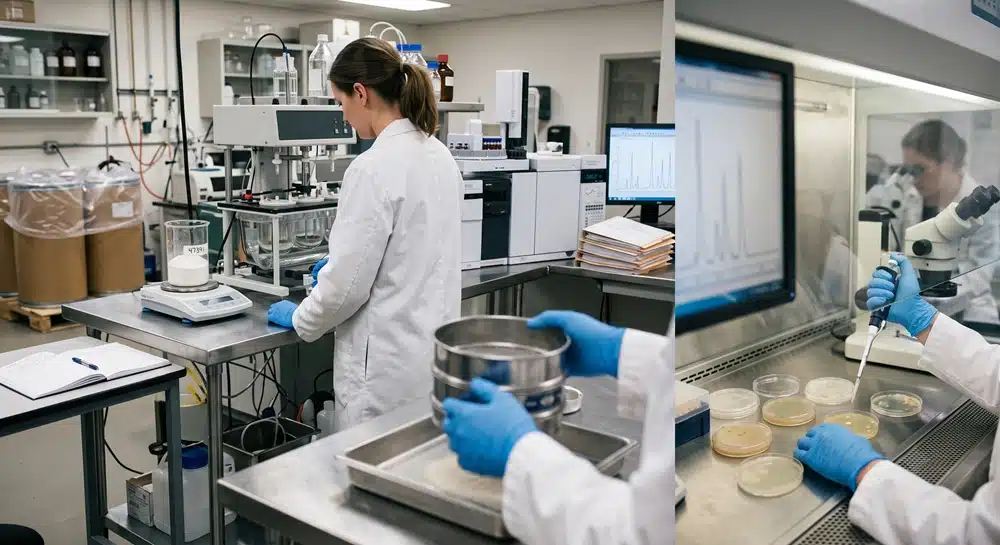
Always compare the current batch certificate of analysis with the approved specification. A marketing statement such as “pharmaceutical grade,” “natural,” “bioavailable sulfur,” or “detox amino acid” is not a substitute for a defined grade, validated test method, and batch result.
RFP Questions for MSM and Glycine Suppliers
- What is the exact chemical identity, CAS number, grade, and assay method?
- Which specifications are tested on every batch and shown on the COA?
- How is MSM manufactured and purified, and which residual solvents or process impurities are controlled?
- Does the glycine meet the requested FCC, USP, food-grade, or customer specification?
- Can you provide a typical COA, specification, SDS, TDS, allergen statement, non-GMO statement, and manufacturing flow chart?
- What particle-size and bulk-density options are available for capsules, tablets, gummies, and powders?
- What are the MOQ, sample quantity, packaging, stock status, lead time, and change-notification terms?
- Can you support prototype work for taste, solubility, blend uniformity, and stability?
- Which proposed claims are supported by the exact ingredient and serving amount?
Câu hỏi thường gặp
Is MSM the same as glycine?
No. MSM is an organosulfur compound, while glycine is an amino acid. They have different chemical structures, biological roles, serving sizes, and evidence bases.
Can MSM and glycine be taken at the same time?
They can appear in the same supplement formula, and no widely recognized direct incompatibility was identified. However, direct combination trials are limited, so consumers should follow the product label and seek professional advice when they use medications, have a medical condition, or are pregnant or breastfeeding.
Do MSM and glycine increase collagen?
Glycine is an important amino acid in collagen, and MSM is often used in connective-tissue formulas. That biological rationale does not prove that taking the two together increases collagen in humans or produces the same effects as collagen peptides.
What foods contain MSM?
Small amounts of MSM have been reported in milk, coffee, tea, fruits, vegetables, grains, and some beverages. Amounts are variable and generally much lower than supplement servings, so “MSM-rich food” rankings should be treated cautiously.
What foods are high in glycine?
Collagen-rich foods, gelatin, connective-tissue cuts, meat, poultry, fish, and bone broth can contribute glycine. Other protein foods, including dairy products, legumes, nuts, seeds, and grains, also provide glycine in varying amounts.
Is MSM better than collagen?
They are not direct substitutes. MSM is a sulfur-containing compound, whereas collagen peptides are protein-derived peptides. The better ingredient depends on the product goal, serving size, evidence, dietary preferences, and format.
What should brands request before buying MSM or glycine in bulk?
Request a batch COA, approved specification, identity and assay methods, contaminant results, grade documents, particle-size information, origin, manufacturing process information, packaging, shelf life, MOQ, lead time, and claim-support documents.
Tóm lại
MSM and glycine can be used together, but the combination should not be marketed as clinically proven synergy. MSM has limited but direct human research in selected joint, exercise, and skin contexts. Glycine has established biochemical roles and limited outcome-specific supplement evidence, including small sleep studies. A high-quality article or product should distinguish biological function from proven consumer benefit, use conservative structure/function language, and match every claim to the exact ingredient, serving, and evidence.
For B2B ingredient qualification, request the actual batch documents and confirm format requirements before ordering. Brands can review Gensei’s joint health ingredient portfolio, bulk amino acid ingredients, hoặc contact the technical sales team for specification and formulation discussions.
Tài liệu tham khảo
- Methylsulfonylmethane: Applications and Safety of a Novel Dietary Supplement
- Efficacy of methylsulfonylmethane in osteoarthritis pain of the knee: a pilot clinical trial
- Randomized trial of MSM consumption in adults with mild knee pain
- Systematic review of DMSO and MSM for osteoarthritis
- Oral MSM and selected signs of skin ageing
- An Update of the Promise of Glycine Supplementation
- Systematic review of glycine administration and sleep
- Multifarious Beneficial Effect of the Nonessential Amino Acid Glycine: A Review
- FDA: Các tuyên bố về cấu trúc/chức năng
- FTC: Health Claims and Substantiation Guidance

Warren Wan là một chuyên gia dày dạn với kinh nghiệm phong phú trong chuỗi cung ứng thực phẩm bổ sung, sở hữu kinh nghiệm thực tiễn sâu rộng trong nghiên cứu, phát triển, kiểm soát quy trình và tìm nguồn cung ứng toàn cầu các thành phần cốt lõi như peptit collagen, protein từ nước hầm xương và keratin. Với tư cách là tác giả của chuyên mục này, ông cam kết loại bỏ những lớp bao bọc tiếp thị, biến những kiến thức khoa học phức tạp về thành phần và các tiêu chuẩn kiểm soát chất lượng sản xuất thành những nội dung phổ biến khoa học dễ hiểu nhưng sâu sắc, giúp độc giả hiểu rõ sự thật đằng sau các nhãn mác và đưa ra những lựa chọn sức khỏe hợp lý hơn.