Pour les marques de compléments alimentaires, le choix optimal dépend de la forme galénique, du positionnement sur l'étiquette, des exigences en matière de solubilité, de l'objectif de coût, de la stabilité, de la documentation et des allégations que vous souhaitez étayer. Si vous comparez des ingrédients de vitamine B2 en vrac, Gensei peut vous aider à évaluer la riboflavine, le R5P et d'autres options de matières premières pour les vitamines pour les gélules, les comprimés, les bonbons gélifiés, les boissons en poudre et les prémélanges sur mesure.
Qu'est-ce que la riboflavine ?
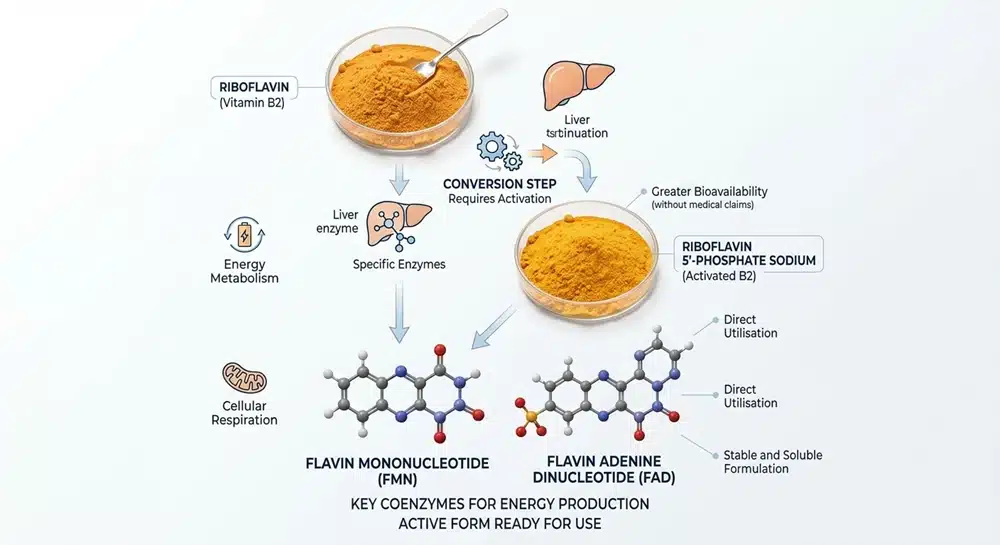
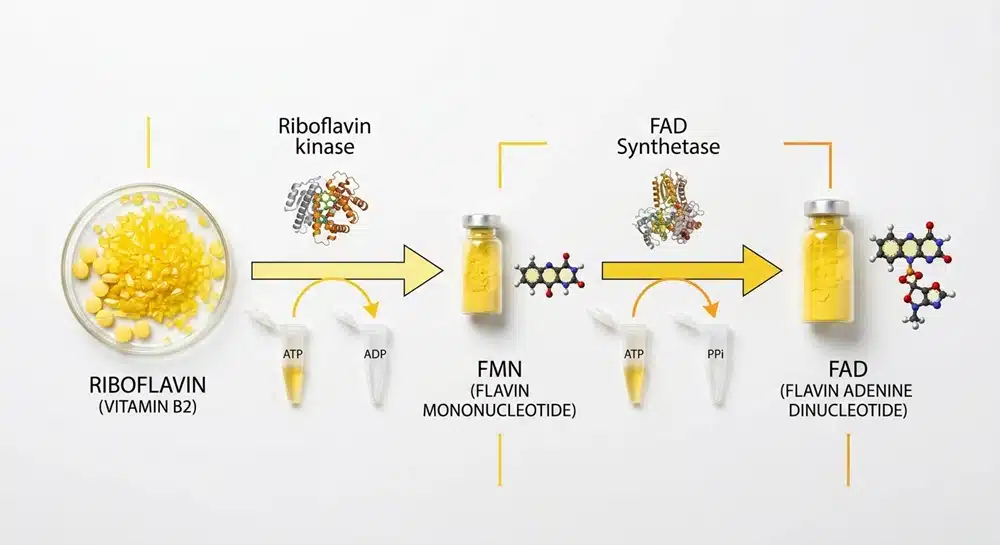
La riboflavine, également appelée vitamine B2, est une vitamine B hydrosoluble qui intervient dans le métabolisme énergétique normal et le fonctionnement cellulaire. Dans l'organisme, la riboflavine est transformée en coenzymes : le mononucléotide de flavine (FMN, également appelé riboflavine-5-phosphate) et le dinucléotide d'adénine-flavine (FAD). Ces coenzymes interviennent dans de nombreuses réactions d'oxydoréduction impliquées dans le métabolisme normal.
Dans le domaine des compléments alimentaires, la riboflavine est couramment utilisée dans les multivitamines, les gélules de complexe B, les comprimés, les poudres et les préparations nutritionnelles enrichies. Elle est généralement choisie lorsque les marques recherchent un ingrédient à base de vitamine B2 connu, économique et bénéficiant d'une large notoriété auprès des consommateurs.
Qu'est-ce que la riboflavine-5-phosphate sodique ?
La riboflavine-5-phosphate sodique est un sel de sodium de la riboflavine-5-phosphate. Elle est également communément appelée R5P, phosphate de riboflavine sodique, FMN sodique ou vitamine B2 active. Dans le cadre de l'approvisionnement en compléments alimentaires B2B, les acheteurs évaluent généralement le R5P en fonction de sa teneur, de sa forme de sel, de la taille de ses particules, de sa solubilité, de sa teneur en eau, de ses conditions de stockage, de la documentation fournie et de la forme galénique prévue.
Gensei fournit riboflavine-5-phosphate de sodium en poudre pour les formules à base de vitamines du complexe B, les multivitamines, les gélules, les comprimés, les bonbons gélifiés, les boissons en poudre, les poudres nutritionnelles et les projets de prémélanges sur mesure.
Riboflavine et riboflavine-5-phosphate de sodium : principales différences
| Facteur | Riboflavine | Riboflavine 5-Phosphate de sodium |
|---|---|---|
| Nom commun | Vitamine B2, riboflavine | R5P, FMN sodique, phosphate de riboflavine sodique |
| Formulaire | Forme classique de la vitamine B2 | Forme de sel de sodium phosphorylé de la vitamine B2 |
| Transformation de la carrosserie | Transformés en FMN et en FAD dans l'organisme | Elle apporte une forme B2 phosphorylée, mais son absorption finale et son utilisation dépendent toujours d'une digestion et d'un métabolisme normaux |
| Positionnement de la formule | Standard B2, multivitamines quotidiennes, complexe de vitamines B | B2 active, B2 sous forme de coenzyme, positionnement spécifique au complexe B |
| Solubilité/formulation | Généralement privilégié pour les préparations en poudre classiques | Souvent pris en compte lorsque la compatibilité avec l'eau ou le positionnement de la forme active est important |
| Stratégie en matière de coûts | Généralement plus rentable | Généralement plus haut de gamme et plus exigeants en matière de caractéristiques techniques |
| Formes galéniques les mieux adaptées | Gélules, comprimés, prémélanges, aliments enrichis | Gélules, comprimés, bonbons gélifiés, boissons en poudre, poudres fonctionnelles et formules à base de complexe B actif |
La riboflavine-5-phosphate est-elle plus biodisponible ?
De nombreux distributeurs de compléments alimentaires décrivent le riboflavine-5-phosphate de sodium comme une forme “ active ” ou “ coenzyme ” de la vitamine B2, car il est apparenté au FMN, l’une des formes fonctionnelles de la riboflavine agissant en tant que coenzyme. Toutefois, les marques doivent faire preuve de prudence lorsqu’elles avancent des allégations fortes telles que “ plus biodisponible ” ou “ mieux absorbé ”, à moins de disposer de preuves appropriées concernant l’ingrédient précis, la dose, la population cible et le produit fini.
Une façon plus claire d’expliquer la différence est la suivante : la riboflavine doit être transformée en FMN et en FAD dans l’organisme, tandis que le riboflavine-5-phosphate sodique est une forme phosphorylée de la vitamine B2 qui peut être choisie pour des raisons de positionnement en tant que forme active et de formulation. Pour la plupart des consommateurs, l’une ou l’autre de ces formes peut apporter de la vitamine B2 lorsqu’elle est utilisée de manière appropriée. Pour les marques de compléments alimentaires, les raisons principales de choisir le R5P tiennent souvent au positionnement, à la compatibilité de la formulation et aux préférences des acheteurs, plutôt qu’à un avantage de performance universel garanti.
Riboflavine et riboflavine-5-phosphate de sodium : principales différences
| Facteur | Riboflavine | Riboflavine 5-Phosphate de sodium |
|---|---|---|
| Nom commun | Vitamine B2, riboflavine | R5P, FMN sodique, phosphate de riboflavine sodique |
| Formulaire | Forme classique de la vitamine B2 | Forme de sel de sodium phosphorylé de la vitamine B2 |
| Transformation de la carrosserie | Transformés en FMN et en FAD dans l'organisme | Elle apporte une forme B2 phosphorylée, mais son absorption finale et son utilisation dépendent toujours d'une digestion et d'un métabolisme normaux |
| Positionnement de la formule | Standard B2, multivitamines quotidiennes, complexe de vitamines B | B2 active, B2 sous forme de coenzyme, positionnement spécifique au complexe B |
| Solubilité/formulation | Généralement privilégié pour les préparations en poudre classiques | Souvent pris en compte lorsque la compatibilité avec l'eau ou le positionnement de la forme active est important |
| Stratégie en matière de coûts | Généralement plus rentable | Généralement plus haut de gamme et plus exigeants en matière de caractéristiques techniques |
| Formes galéniques les mieux adaptées | Gélules, comprimés, prémélanges, aliments enrichis | Gélules, comprimés, bonbons gélifiés, boissons en poudre, poudres fonctionnelles et formules à base de complexe B actif |
Éléments à prendre en compte lors de la formulation des compléments alimentaires
Capsules
La riboflavine et le 5-phosphate de riboflavine sodique peuvent tous deux être utilisés sous forme de gélules. Pour les formulations en gélules, il convient de vérifier la teneur, la taille des particules, la fluidité, la densité apparente, l'impact sur la couleur et la compatibilité avec d'autres vitamines du groupe B. Gensei peut accompagner les projets de fabrication de gélules de vitamines grâce à fabrication de compléments en gélules et l'approvisionnement en ingrédients vitaminiques sur mesure.
Tablettes
La fabrication de comprimés nécessite de prêter attention au comportement à la compression, à la compatibilité des excipients, à l'uniformité de la couleur et à la stabilité. La riboflavine convient souvent aux comprimés classiques, tandis que le R5P peut être utilisé dans les comprimés haut de gamme à base de complexe B si la formulation permet de répondre aux exigences en matière de coût et de spécifications. Pour obtenir de l'aide concernant le produit fini, consultez fabrication de vitamines en sous-traitance.
Gommes
Pour les bonbons gélifiés, les formulateurs doivent tester la couleur, le goût, la résistance à la chaleur, l'activité de l'eau, le pH et la stabilité de la durée de conservation. Les ingrédients à base de riboflavine présentent une couleur allant du jaune à l'orange et peuvent influencer l'aspect du bonbon gélifié fini. L'utilisation du R5P peut être envisagée, mais le choix final doit être confirmé par des essais pilotes et des tests par lots.
Poudres et préparations pour boissons
Les poudres destinées aux boissons et les poudres fonctionnelles nécessitent une attention particulière en matière de dispersibilité, de couleur, d’interaction des arômes, de solubilité et de protection de l’emballage contre la lumière et l’humidité. Le R5P est souvent évalué pour les concepts B2 compatibles avec l’eau, tandis que la riboflavine reste couramment utilisée dans les prémélanges secs.
Critères de qualité à vérifier avant l'achat
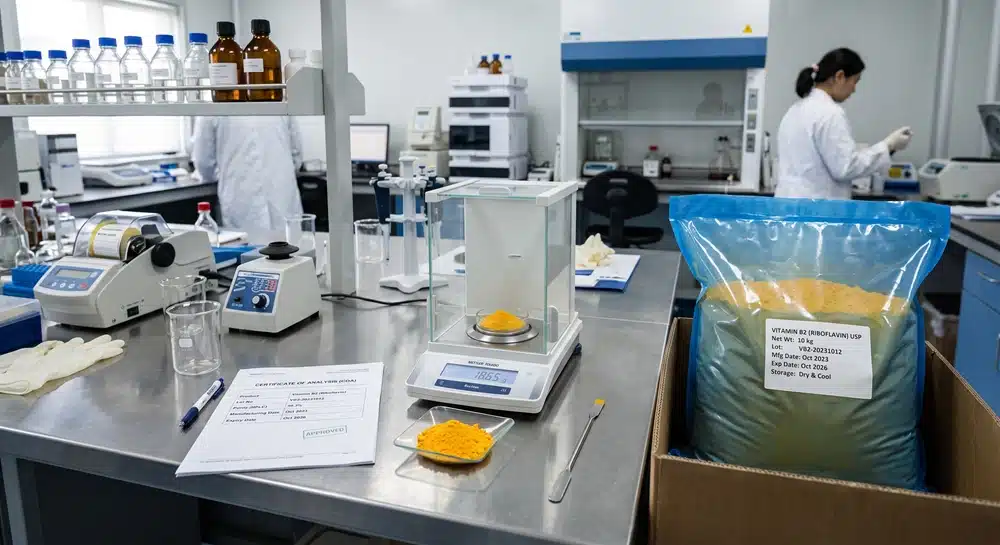
Que vous optiez pour la riboflavine ou le 5-phosphate de riboflavine sodique, ne procédez pas à un achat en gros en vous basant uniquement sur le nom de l'ingrédient. Demandez aux fournisseurs le certificat d'analyse (COA), la fiche technique et les documents techniques relatifs au lot faisant l'objet de l'offre.
- Méthode d'analyse et d'identification
- Forme saline, état d'hydratation et référence CAS
- Granulométrie et densité apparente
- Aspect et gamme de couleurs
- Teneur en eau ou perte au séchage
- Limites relatives aux métaux lourds et aux micro-organismes
- Substances apparentées ou impuretés, le cas échéant
- Conditions de conservation, durée de conservation et type d'emballage
- Pays d'origine et documents d'exportation
- Mention relative aux allergènes, aux produits sans OGM, aux produits végétaliens ou toute autre mention spécifique au marché, le cas échéant
Pour le contrôle qualité B2B, Gensei peut fournir une assistance en matière de documentation des lots grâce à son contrôle de la qualité des compléments alimentaires processus.
Remarques concernant les allégations figurant sur l'étiquette et la conformité
La teneur en vitamine B2 ne peut être mise en avant en lien avec le métabolisme énergétique normal, le fonctionnement cellulaire et le bien-être général que si l'allégation est véridique, non trompeuse et dûment étayée. Évitez de présenter la riboflavine ou le R5P comme des éléments permettant de traiter une maladie. Par exemple, évitez les allégations telles que “ traite les migraines ”, “ guérit la fatigue ” ou “ prévient les maladies oculaires ”, à moins d’avoir obtenu un avis juridique et de disposer de preuves solides et pertinentes pour étayer cette allégation.
Les compléments alimentaires ne font pas l'objet d'une autorisation préalable de la FDA avant leur mise sur le marché. Les marques de compléments alimentaires restent responsables de la sécurité des ingrédients, de l'exactitude de l'étiquetage, de la justification des allégations et de la conformité aux réglementations en vigueur sur leurs marchés cibles. Lorsque vous formulez des allégations relatives à la structure ou à la fonction aux États-Unis, veillez à employer une formulation prudente et à respecter les exigences d'étiquetage applicables.
Questions à poser aux fournisseurs avant de demander un devis
- Proposez-vous de la riboflavine, du 5-phosphate de riboflavine sodique, ou les deux ?
- Quelles sont la forme commerciale exacte, la référence CAS et le statut d'hydratation ?
- Pouvez-vous nous fournir le certificat d'analyse (COA), la fiche technique, la fiche de données de sécurité (FDS) et la fiche technique du produit (TDS) ?
- Quelle méthode d'analyse est utilisée pour déterminer la teneur en vitamine B2 ?
- Quelles sont la granulométrie et la densité apparente typiques ?
- Cet ingrédient convient-il à la fabrication de gélules, de comprimés, de bonbons gélifiés, de boissons en poudre ou de prémélanges ?
- Quel type d'emballage protège cet ingrédient de la lumière, de la chaleur et de l'humidité ?
- Quelle est la quantité minimale de commande (MOQ) pour les échantillons, les commandes pilotes et les achats en gros ?
- Pouvez-vous assurer la fabrication de prémélanges sur mesure ou de produits finis ?
- Quels documents de qualité sont disponibles pour le marché cible ?
FAQ
La riboflavine, c'est la même chose que la vitamine B2 ?
Oui. La riboflavine est la vitamine B2. Il s'agit d'une vitamine B hydrosoluble présente dans les aliments, les compléments alimentaires, les multivitamines et les formules à base de complexe B.
La riboflavine-5-phosphate de sodium est-elle identique à la riboflavine ?
Non. Il s'agit de formes apparentées de la vitamine B2, mais ce ne sont pas des ingrédients identiques. La riboflavine est la forme classique de la vitamine B2. Le 5-phosphate de riboflavine sodique est une forme de sel de sodium phosphorylé associée au FMN, l'une des formes actives de la riboflavine en tant que coenzyme.
Le R5P est-il toujours plus efficace que la riboflavine ?
Non. Le R5P n'est pas systématiquement plus adapté à tous les produits. Il peut être préférable pour un positionnement actif de la vitamine B2 ou pour répondre à certains besoins de formulation, tandis que la riboflavine est souvent plus indiquée pour les multivitamines standard et économiques ainsi que pour les formules à base de complexe B.
La riboflavine ou le R5P peuvent-ils donner à l'urine une couleur jaune vif ?
Oui. La riboflavine peut donner à l'urine une couleur jaune vif, car les vitamines B hydrosolubles en excès sont éliminées par l'urine. Ce phénomène est courant et ne constitue généralement pas un sujet d'inquiétude, mais il est recommandé aux consommateurs de respecter les consignes figurant sur l'étiquette et de consulter un professionnel de santé en cas de doute.
Quelle forme une marque de compléments alimentaires devrait-elle choisir pour ses bonbons gélifiés ?
Pour les bonbons gélifiés, le choix doit se fonder sur des essais préliminaires. Vérifiez les données relatives à la couleur, au goût, à la solubilité, à la stabilité thermique, au pH, au conditionnement et à la durée de conservation avant de choisir entre la riboflavine et le 5-phosphate de riboflavine sodique.
Conclusion
La riboflavine et le 5-phosphate de riboflavine sodique sont tous deux des ingrédients utiles à base de vitamine B2, mais ils s'inscrivent dans des stratégies de formulation différentes. La riboflavine est souvent le choix le plus pratique pour une supplémentation standard en B2 et pour des multivitamines au bon rapport qualité-prix. Le 5-phosphate de riboflavine sodique est souvent choisi pour un positionnement actif de la B2, des formules spécialisées à base de complexe B et des projets où la solubilité ou la différenciation haut de gamme sont importantes.
Si votre équipe développe un complément alimentaire de type B2, une formule active à base de complexe B, des bonbons gélifiés, une boisson en poudre ou un prémélange vitaminé, comparez les ingrédients en fonction de leurs caractéristiques techniques, de leur certificat d'analyse (COA), de leur forme galénique, de leur stabilité, de leur marché cible et de la stratégie d'allégations figurant sur l'étiquette. Pour discuter de l'approvisionnement en R5P en vrac ou du développement de formules vitaminées, contacter Gensei pour l'examen des spécifications, la mise à disposition d'échantillons et l'établissement d'un devis.
Références
- Bureau des compléments alimentaires des NIH – Fiche d'information sur la riboflavine destinée aux professionnels de santé
- Bureau des compléments alimentaires des NIH – Fiche d'information destinée aux consommateurs sur la riboflavine
- PubChem – Phosphate de riboflavine sodique
- Institut Linus Pauling – Riboflavine
- FDA – Questions et réponses sur les compléments alimentaires
- FTC – Lignes directrices relatives à la conformité des produits de santé

Warren Wan est un expert chevronné qui possède une vaste expérience dans la chaîne d’approvisionnement des compléments alimentaires, ainsi qu’une solide expertise pratique dans la recherche, le développement, le contrôle des processus et l’approvisionnement mondial d’ingrédients clés tels que les peptides de collagène, les protéines de bouillon d’os et la kératine. En tant qu'auteur de cette chronique, il s'attache à aller au-delà des discours marketing pour transformer les notions scientifiques obscures relatives aux ingrédients et les normes de contrôle qualité de la production en une vulgarisation scientifique rigoureuse et accessible, aidant ainsi les lecteurs à comprendre la vérité qui se cache derrière les étiquettes et à faire des choix plus rationnels en matière de santé.