
If you have ever stood in the supplement aisle debating between a bottle of fruit-flavored gummies and a standard jar of capsules, you aren’t alone. It is tempting to choose the option that tastes like candy, but is that convenience costing you your health results? Here is the core truth we will uncover in this guide: while gummies offer unmatched convenience for those with “pill fatigue,” capsules remain the scientifically superior choice for potency, purity, and nutrient stability.
For years, the supplement industry has pushed gummies as the fun alternative to “clinical” pills. However, recent 2025 data reveals a hidden trade-off. While gummies solve the problem of swallowing hard tablets, they often come with lower nutrient bioavailability, shelf-life instability, and a surprisingly high sugar load.
In this post, we are moving past the marketing hype. We will break down the Gummies vs. Capsules debate by analyzing absorption rates, ingredient lists, and cost-per-serving to help you decide if the trade-off is actually worth it for your specific health goals.
Bioavailability & Absorption: Do Gummies Actually Work?
Before we declare a winner, we need to define the most crucial term in supplement science: Bioavailability.
Simply put, it does not matter how much Vitamin C is listed on the bottle; it matters how much of that nutrient actually enters your bloodstream and gets utilized by your cells. If your body cannot absorb it, you are essentially buying expensive urine.
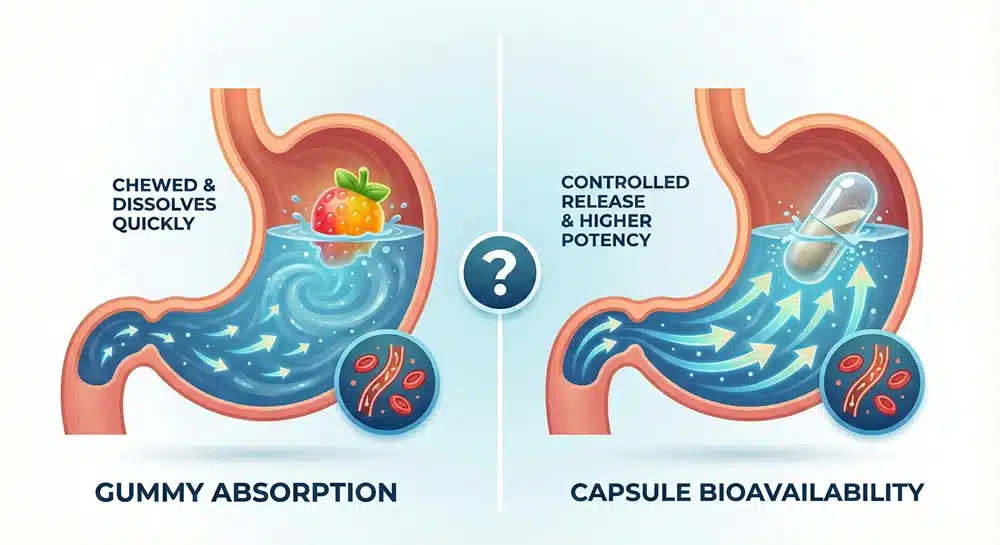
When it comes to absorption, marketing teams have created a lot of confusion. Let’s separate the myths from the 2025 scientific reality.
The “Mouth Absorption” Myth
A common marketing claim is that because you chew gummies, absorption starts immediately in the mouth through saliva, giving you a “faster boost” than a pill that has to be swallowed.
The Truth:
The Stomach Acid Equalizer
Once the supplement hits your stomach, the playing field levels out somewhat. Your stomach acid is incredibly powerful and designed to break things down.
Surprisingly, for some specific nutrients, gummies actually hold their own. Studies have indicated that fat-soluble vitamins (like Vitamin D3) can have comparable absorption rates in gummy form versus capsule form, assuming the gummy fully dissolves. If the nutrient is in there, your digestive tract can usually find it.
However, “if it’s in there” leads us to the biggest problem with gummies—one that most consumers are completely unaware of.
The Real “2025 Truth”: Stability is the Dealbreaker
If absorption rates are roughly similar when fresh, why do health experts still lean toward traditional Capsule Supplements? The answer is shelf-stability.
A capsule is a sealed, dry environment designed to protect sensitive ingredients from oxygen, moisture, and light. A gummy, by contrast, is a moist, porous piece of candy exposed to the elements every time you open the jar.
Recent analyses have shown that active ingredients degrade significantly faster in gummy form. Vitamin C, for example, breaks down rapidly when exposed to moisture.
⭐The “Overage” Secret: To ensure their product still meets label claims by its expiration date, a gummy supplement manufacturer often has to add “overages”—putting 20% to 50% more of the vitamin in the factory batch, hoping enough survives shelf-rot to meet the label requirement later.
This means with gummies, you rarely get the precise dose on the label. You are getting significantly more when the bottle is fresh, and potentially less than advertised as it ages. With capsules, the dosage remains stable and precise over time.
The Ingredient Breakdown
If absorption is the engine of a car, ingredients are the fuel. And this is where the difference between gummies and capsules becomes glaring.
When you look past the colorful packaging and fruit flavor names, you realize that gummy manufacturing has a fundamental flaw: to make a vitamin taste like candy, you have to treat it like candy.
Here is the breakdown of what you are actually consuming.
The Sugar Trap: A Spoonful to Help the Medicine Go Down
The most significant drawback of gummy vitamins is the sweetener required to mask the bitter taste of raw minerals like zinc or iron.
The average serving size of adult gummy vitamins typically contains 2 to 8 grams of added sugar. While that might not seem like much in a single day, let’s do the math: taking a 5g sugar serving daily amounts to eating nearly four pounds of extra sugar every year—just from your “health” supplement.
The “Sugar-Free” Dilemma
Many 2025 consumers are opting for “sugar-free” gummies to avoid the calories. However, these are often sweetened with sugar alcohols like maltitol, sorbitol, or xylitol. While lower in calories, sugar alcohols are notorious for causing digestive distress, bloating, and a laxative effect in many people when taken daily.
The “Structural Matrix” vs. Clean Labels
How does a gummy hold its shape? It needs a structural matrix. How does a capsule hold its shape? It doesn’t need to—the shell does the work.
The Gummy Reality
To create that chewy texture, manufacturers must use significant amounts of gelatin (derived from animal collagen, usually pork or beef) or pectin (a plant-based fiber). To make them appealing, they often add artificial food dyes like Red 40 or Yellow 5, along with flavor enhancers and citric acid for tartness.
The Capsule Advantage
A high-quality capsule contains the active ingredient (the vitamin powder) and perhaps a tiny amount of a clean flow agent like rice flour. The capsule shell itself is usually just plain gelatin or vegetable cellulose.
When you take a gummy, the majority of what you are eating is filler designed for texture and taste. When you take a capsule, the majority of what you are swallowing is the active nutrient.
Nutrient Density: The “Space” Problem
This is the practical downside that frustrates many users once they realize it. There is only so much physical space inside a gummy bear.
Because so much room is taken up by sugar, gelatin, and flavorings, there is less room for the actual vitamins. This is especially true for bulky minerals like Magnesium or Calcium.
To get a therapeutic dose of a multivitamin, you might need to take just one comprehensive capsule. To get that exact same dose in gummy form, you might have to chew four to six gummies daily. This not only increases your sugar intake but also makes a bottle of gummies significantly more expensive per effective dose than a bottle of capsules.
Pros and Cons at a Glance
Based on the 2025 data regarding absorption, stability, and ingredients, the choice between gummies and capsules is no longer just about flavor. It is a fundamental trade-off between convenience and clinical efficacy.
Here is a snap-shot summary of the benefits and downsides of each form to help you decide which trade-offs you are willing to make.
📄The Quick Comparison Radar
| Feature | Gummy Vitamins | Capsule Supplements | Winner |
| Taste & Experience | Candy-like, enjoyable | Flavorless, clinical | Gummies |
| Ease of Swallowing | Very easy (chewable) | Can be difficult for some | Gummies |
| Dosing Accuracy | Low (due to degradation) | High (stable & precise) | Capsules |
| Ingredient Purity | Low (sugar, dyes, gelatin) | High (clean ingredients) | Capsules |
| Nutrient Density | Low (requires multiple) | High (often just one) | Capsules |
| Cost Per Serving | Typically higher | Typically lower | Capsules |
🍬Deep Dive: The Gummy Trade-Off
Gummies are essentially a “gateway” supplement. They solve behavioral problems but introduce nutritional ones.
✅The Pros
- Adherence & Compliance: This is the biggest selling point. The best supplement is the one you actually remember to take. Because gummies taste good, people look forward to taking them, leading to better consistency.
- Solution for Dysphagia: For the estimated 40% of adults who struggle to swallow pills (dysphagia), or for children, gummies are sometimes the only viable option to ensure nutrient intake.
- No Water Needed: They offer ultimate convenience for on-the-go lifestyles.
❌The Cons
- The “Sugar Tax” on Your Health: As established, consuming 2–8g of added sugar daily just to get your vitamins is counterproductive to overall health goals.
- Dental Damage: Gummies are sticky. They cling to teeth longer than regular food, providing a steady fuel source for cavity-causing bacteria. Dentists generally dislike them.
- Unreliable Dosing (The 2025 Reality): Due to stability issues mentioned in Section 1, you may be getting far more or far less than the label claims depending on how old the bottle is.
- The “Candy Effect” Risk: Because they taste delicious, there is a real risk—especially with children—of consuming far more than the recommended dose, which can lead to vitamin toxicity (particularly with Iron or Vitamin A).
💊Deep Dive: The Capsule Standard
Capsules remain the gold standard for clinical nutritionists, doctors, and biohackers for a reason.
✅The Pros
- Clinical Potency: You can fit a massive amount of nutrition into a small space. A single capsule can often replace 3-4 gummies.
- Clean Ingredients: No sugar, no calories, no artificial dyes, and usually vegan-friendly (if using cellulose caps). It is just the nutrient you paid for.
- Superior Stability: The airtight environment of a capsule protects sensitive vitamins (like Probiotics or Vitamin C), ensuring that what is on the label is exactly what you get, even months later.
❌The Cons
- The Swallowing Barrier: Large “horse pills” are unpleasant and can cause anxiety for many users.
- Pill Fatigue: Taking multiple capsules daily can feel like a chore or a medical regimen, leading people to skip doses and eventually stop taking them altogether.
The “Pill Fatigue” Factor: When Are Gummies Okay?

If we lived in a laboratory, everyone would happily swallow flavorless capsules every morning because the data tells them to. But human behavior is messy, and the psychology of taking supplements is just as important as the biology.
After reading the previous sections exposing the flaws of gummies, you might think we are suggesting you throw them all away. Not necessarily.
While capsules win on science, gummies win on compliance—the medical term for actually sticking to your routine.
The Golden Rule of Behavioral Health
There is one undeniable truth in the supplement world: The most effective vitamin is the one you actually take.
A perfectly formulated, high-potency capsule that sits unopened in your cupboard because you dread swallowing it is 0% effective. An imperfect, sugary gummy supplement that you look forward to eating every morning is infinitely better than taking nothing at all.
This is where “pill fatigue” comes in—the psychological weariness of taking a handful of clinical-looking tablets every day. It feels like a chore, or worse, a medical treatment. Gummies reframe that chore into a small treat.
The Verdict: When to Choose Which Form
Based on the 2025 landscape of supplement options, here is a practical guide on when to compromise with gummies and when to hold firm with capsules.
🟢 The “Gummy Green Light”: Choose Gummies If…
- You Have Dysphagia (Difficulty Swallowing): For the estimated 40% of adults who physically struggle to swallow pills, or have a strong gag reflex, capsules are a non-starter. Gummies are a vital alternative here.
- Your Routine is Inconsistent: If you find yourself forgetting your vitamins three days a week, the “reward” factor of a tasty gummy can help cement the daily habit.
- You Are Just Covering Basics: If you are a generally healthy person just looking for a basic “insurance policy” multivitamin and aren’t treating a specific deficiency, a gummy is an acceptable baseline.
🔴The “Capsule Non-Negotiable”: Stick to Capsules If…
- You Need Therapeutic Doses: If your doctor told you to take 400mg of Magnesium Glycinate for sleep or a high dose of Omega-3s for heart health, do not use gummies. You would likely need to eat 6–8 gummies to match the dose of 2 capsules, tripling the cost and sugar intake.
- You Are Taking Sensitive Nutrients: Probiotics and certain antioxidants degrade very quickly in the moist environment of a gummy. A reputable capsule supplement manufacturer knows how to create a stable, dry environment to protect these delicate ingredients. For gut health, always choose a stable capsule.
- You Are Watching Sugar or Carbs: If you are diabetic, pre-diabetic, on a Keto diet, or generally avoiding added sugars, the 3–5g of sugar in a gummy serving is an unnecessary spike you should avoid.
Cost Comparison: The Price of Potency
When you are standing in the aisle looking at price tags, a bottle of gummies often seems cheaper than a high-quality bottle of capsules. But this is one of the biggest illusions in the supplement industry.
You should never calculate cost per bottle; you must calculate cost per effective dose.
Because gummies are mostly filler and have limited space for nutrients, the serving size required to get a therapeutic amount is much higher.
Real-World Example: Cost Analysis
- A typical high-quality brand provides 200mg of elemental magnesium in just 2 capsules.
- A 120-capsule bottle might cost $25.
- The bottle lasts for 60 days.
- A popular gummy brand provides only 50mg per gummy.
- To get the same 200mg dose, you need to eat 4 gummies every single night.
- A 60-gummy bottle might cost $18, but it only lasts for 15 days.
In this very common scenario, choosing the “fun” gummy option costs the consumer nearly three times as much per month to get the exact same health benefit.
A Note for Brand Owners: Managing Manufacturing Costs
This cost disparity isn’t just a consumer issue; it impacts brand margins, too.
For supplement companies, manufacturing high-quality gummies that actually meet label claims over time requires specialized expertise, complex stabilizing matrices, and expensive ingredient “overages.” Capsules remain the most cost-effective route for delivering high-potency formulas with healthy margins.
Whether you are launching a high-margin therapeutic capsule line or aiming to create a premium, compliant gummy that actually works, choosing the right partner is crucial to managing these costs.
At Gensei, a leading Dietary Supplement Contract Manufacturer, we specialize in helping brands navigate this exact trade-off. We ensure your product balances premium quality with smart economics, regardless of the delivery form.Don’t let manufacturing inefficiencies eat into your margins. Contact Gensei today to obtain a quote for your next capsule or gummy project.
Conclusion: The Final Verdict on Gummies vs. Capsules
So, after analyzing the 2025 data on absorption, ingredient integrity, and cost, which is actually better?
The answer depends entirely on what problem you are trying to solve.
Capsules are the clear winner for effectiveness. If your primary goal is to improve your health parameters with clinical precision, avoid unnecessary additives, and get the best value for your money, capsules are undisputedly superior. They offer stable, potent, and clean dosing that gummies simply cannot match due to their physical limitations.
Gummies are a valid tool for behavioral compliance. If your primary obstacle is that you hate swallowing pills and will not stick to a routine that feels like a chore, then gummies are a valuable alternative. As we stated, an imperfect supplement taken consistently is better than a perfect one sitting on the shelf.
fAQs
Reference source
- Vitamin C, for example, breaks down rapidly when exposed to moisture.(source link: Vitamins stored in bathrooms, kitchens may become less effective | ScienceDaily)
- The average serving size of adult gummy vitamins typically contains 2 to 8 grams of added sugar.(source link: https://www.uclahealth.org/news/article/should-you-take-gummy-vitamins)
- For the estimated 40% of adults who struggle to swallow pills (dysphagia)(source link: https://pmc.ncbi.nlm.nih.gov/articles/PMC9805106/)
- The “Candy Effect” Risk.(Risk of vitamin A toxicity from candy-like chewable vitamin supplements for children.source link: https://pubmed.ncbi.nlm.nih.gov/16882846/